
Boot Key Harbor in Marathon has three major shoal areas with poor marking, a first-come first-served mooring field that fills by Thanksgiving, and strict dinghy rules including required lights after dark. After 10 years based here, I watched the same mistakes happen to new arrivals week after week. Here is what you need to know before you pull in.
The harbor offers excellent protection from winter winds, mooring costs far below what Keys marinas charge, and a walkable town with groceries, a chandlery, restaurants, and one of the strongest cruising communities in Florida. It fills up for good reason.
The Shoals: Know These Before You Enter
Boot Key Harbor has three major shoal areas and the marking is poor. Every week, boats go aground on the sea grass beds. Beyond the damage to your boat, authorities can fine you $1,000 for each square foot of sea grass you disturb.
If you do go aground, check the tide first. At low tide, the best move is usually to wait. The tide will float you off without causing further damage to your boat or the grass bed.
The map below marks all three areas.
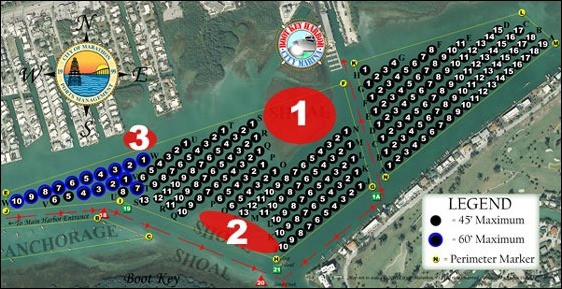
Shoal 1 — The Flats This is the large sea grass bed locals call “the flats.” Do not try to cross it in any motorized boat. At low tide, even rowing dinghies may hit their oars and sailing dinghies will hit their centerboards. See the Dinghy Channel section below for the safe route across.
Shoal 2 — Green 19 to Green 21 When running the channel between Green 19 and Green 21, there are three spar buoys just east of mooring ball Q10 and then nothing between there and Green 21. The shoal extends all the way from Q10 to Green 21 and across to where boats are moored. Draw an imaginary line from Green 19 to Green 21 and stay on the channel side of it. There is a small mangrove island near Green 21 — go SOUTH of it.
Shoal 3 — Small but Tricky This one is smaller and the markers are easier to spot because of that. At low tide, you cannot dinghy over it.
Getting a Mooring Ball
The marina assigns mooring balls first come, first served, with some consideration for boat length and draft. There are no reservations.
You cannot request a mooring ball until you are actually in the mooring field area — east of the bridge to nowhere (shown on most charts as a bascule bridge to Boot Key at the west end of the harbor). The lift section has been removed, so the bridge is permanently open. The city has also removed the power line, so there is no air draft restriction.
If entering from Sister’s Creek, you need to be clear of the creek and into the mooring field channel before calling.
Call “Marathon City Marina” on VHF channel 16, or by phone at 305-289-8877.
When the mooring field is full, boats go on a waiting list. You must be in one of the nearby anchorages to be placed on the list. The field tends to fill up around Thanksgiving and generally stays full until at least mid-February.
Mooring Field Map
Finding your mooring ball can be tricky. The marina staff will give you a general idea of where it is, but print the map above and have it at the helm when you arrive. Row letters are marked in black at each end of each row — small, but they are there.
Yellow Buoys Around the Mooring Field
You will see yellow buoys marked with letters around the edges of the mooring field. These mark the legal boundaries of the field and have nothing to do with the mooring ball letters. They will not help you find your assigned ball.
How to Tie Up to a Mooring Ball
The marina staff at Boot Key Harbor are emphatic about the correct tying method, and with good reason. The wrong method causes chafe that can part your line overnight in a blow. For the correct technique, the best line to use, and how to set up extra security when a squall is approaching, see How To Tie a Boat To a Mooring Ball.
The marina requests no more than four feet from your bow to the pennant eye, so all boats swing in roughly the same arc.
Anchor Lights
If you are at anchor, you must have an anchor light on at night.
In the mooring field, the current interpretation is that only boats on balls bordering the channels are strictly required to display anchor lights. That said, I keep one on regardless of where I am in the field. A light with a photocell turns on automatically at sunset — nothing to think about.
I use and love the Davis Mega Light (Amazon). Unlike a standard anchor light at the top of the mast, the Davis Mega Light hangs in the rigging, positioning the light lower and closer to the water where passing dinghies are more likely to see it.
Dinghies left in the water overnight need their own anchor light in addition to the one on the mother ship. Dinghies on davits or on deck do not. These rules get revisited periodically, so check with the marina office on arrival.
Dinghying in Boot Key Harbor
All of Boot Key Harbor is either an Idle Speed/No Wake or Slow Speed/No Wake zone. Until you have picked up a cruisers’ guide from the office and know which is which, treat everything as an idle zone. The dinghy channel, the areas around the dinghy docks, and the channel beside the office are all IDLE/NO WAKE.
Dinghy light requirements at night:
- Motorized dinghies capable of more than 7 knots: red/green bow lights plus a white stern light
- Motorized dinghies under 7 knots: white all-around light only
- Rowing dinghies: check current Florida law, but carry a light regardless — being hit in the dark is a real risk
All standard safety gear requirements apply: PFDs, fire extinguisher, sound device. Both FWC (Florida Fish and Wildlife Conservation Commission) and the Coast Guard patrol the harbor regularly and conduct safety checks.
For a complete rundown of what to carry every time you leave in the dinghy, see Necessary Dinghy Safety Gear.
The Dinghy Channel
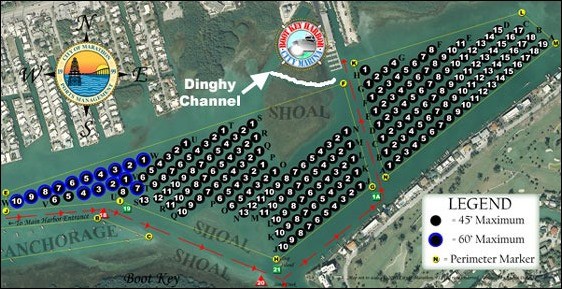
There is a marked dinghy channel along the north edge of the flats. Look for sets of PVC stakes with solar lights — pass between the two stakes in each set. The markers have been improved and are easier to follow than they used to be. Boats larger than dinghies cannot use this channel.
Dinghy Docks
There are no free dinghy docks in the harbor. Beaching your dinghy at Sombrero Beach at the south end of Sister’s Creek is free — and it is one of the few dog-friendly beaches in the Keys — but there are no stores or services there.
Paid dinghy docks:
- City Marina: daily, weekly, and monthly rates. Includes dumpster, showers, laundry, pump out, water, and the community room (laundry and water have additional fees). Weekly and monthly rates include a vehicle parking space and a mailing address for packages.
- Burdine’s (outside the harbor, west end): per-day fee, free tie-up while eating or drinking there
- Dockside (far east end): per-day fee, free tie-up while eating or drinking there
Older cruising guides say West Marine has a dinghy dock. That information is outdated. None of the grocery stores have a nearby dinghy dock either.
Anchoring Out
If the mooring field is full, there are two anchoring options nearby.
Sister’s Creek (south entrance): Anchor in the wide spot with your stern tied to the mangroves. Boats drawing over 5 feet should check charts carefully or get local knowledge first — there are shallow spots. The four large radio towers in the area are reported to put out strong electrical interference that can cause instrument anomalies. Some cruisers say it has damaged their electronics.
Near the bridge to nowhere (west entrance, nearest the 7 Mile Bridge): Holding here can be poor. Back down hard and test your set thoroughly — finding out right away that you are not holding is far better than finding out at 2 AM in a squall. For solid anchoring technique, see How to Anchor a Cruising Boat.
If a squall rolls through while you are at anchor or on a mooring, see Dealing with Squalls at Anchor or on a Mooring.
When the waiting list is long, both areas will be crowded.
Laundry
The Marathon Laundromat is the only public laundromat in Marathon. It has extra-large washers and dryers, air conditioning, and fast free WiFi, and tends to be less crowded than the marina laundry. The marina laundry is the more convenient option if you do not have a vehicle.
A Note on Keys Prices
Nearly everything costs more in the Florida Keys — groceries, fuel, eating out, boat supplies, water. Marathon has just about every service you could need, but budget for higher prices across the board.
IMPORTANT: The information in this article is given to the best of my knowledge. Things change, and I may not always have the most current details. For anything time-sensitive, call the Marathon City Marina office at 305-289-8877.
Get the Florida Keys Cruising Guide
You’re obviously starting to plan your Florida Keys cruising. Want to make it all even easier? Larry Webber and I put all the info you need into a new type of cruising guide. Instead of pages of text, it’s all in tables: anchorages with depth, tide, protection direction, and holding; bridges with clearance, VHF channel, and schedule; free docks; services; haulouts; storm holes. Find your topic, scan to your location, get your answer in seconds.


Carolyn Shearlock has lived aboard full-time for 17 years, splitting her time between a Tayana 37 monohull and a Gemini 105 catamaran. She’s cruised over 14,000 miles, from Pacific Mexico and Central America to Florida and the Bahamas, gaining firsthand experience with the joys and challenges of life on the water.
Through The Boat Galley, Carolyn has helped thousands of people explore, prepare for, and enjoy life afloat. She shares her expertise as an instructor at Cruisers University, in leading boating publications, and through her bestselling book, The Boat Galley Cookbook. She is passionate about helping others embark on their liveaboard journey—making life on the water simpler, safer, and more enjoyable.
Carolyn Shearlock says
Currently $300 a month, plus tax. Includes one pumpout a week. Water costs 5 cents a gallon; honor system. Trash/recycling included, as is one vehicle parking space. No time limits.
Full price list and more info here: https://www.ci.marathon.fl.us/marinaandports/page/pricing
The Boat Galley says
Boats with that draft HAVE come in, but you really have to play the tide (and then watch the 65′ power wire). If you are thinking of coming in, contact SeaTow or TowBoatUS to get exact info.
Dan Kral says
Great overview Carolyn, thank you! There is one area of inconsistency, however, and that is regarding the 65 foot powerline over the bridge. Above you mention that it has been removed but you also mention above to be cautious of it. I’m assuming it has been removed?
Thanks again!
Dan and Rachel
SV Nepenthe
Carolyn Shearlock says
It HAS been removed. I’ll edit the article to make that clear.
Carolyn Shearlock says
I live there, I don’t find it horrible. The dinghy dock is expensive for one day, but land is VERY expensive in the Keys. The monthly rate is the lowest you’ll find anywhere in the Keys. And the Coast Guard can board you anytime, anywhere to check your safety gear (flares).
Finally, many of my readers are European and I have to comply with a European law (GDPR) that requires informed consent where you are asked to give your email. So yes, there really is a law.
T says
Question: I cannot seem to find an answer…
I have to replace my engine on my sailboat. Can I be towed to a mooring ball in Boot Key Harbor while my engine is being replaced? Paying appropriate fees of course.
Carolyn Shearlock says
Call the marina office to confirm current regulations, but we rebuilt our engine while on a mooring ball here in 2015.
Carolyn Shearlock says
Go straight towards mooring U2 — you’ll see some small markers for the shoal marked as #3 and just avoid that area. Once you get close to U2, turn west and head towards “the bridge to nowhere” — a bridge with the center section removed. From there, follow the channel markers out. Once out of that channel, you’ll need to watch your charts as there are shoals between there and 7 Mile Bridge.
Carolyn Shearlock says
Here’s the post on how to tie up to a mooring ball, which specifically shows the BKH preferred way: https://theboatgalley.com/connecting-to-a-mooring-ball/