Dave and I had a rule: anchor as if you know it’s going to blow 50 knots. Every single time.
Because sometimes it does. In 17 years of cruising, we’d have roughly one 50-knot squall blast every year, and several other blows over 40 knots sustained. Normal places, not known for extreme weather. And that is before you count the hurricanes.
If you anchor well every time, you are ready when it happens. If nothing comes through, no harm done. Either way, you sleep soundly.
I get asked all the time: can’t my weather forecast just tell me when there’s a bigger chance of squalls? Well, yes and no. Most apps will show a chance of rain or thunderstorms, but that is not the same as knowing whether today carries real squall potential with strong winds. My book Weather Basics for Boaters: The Details That Matter walks through exactly how to read squall risk in the apps you are already using, and what the signs look like when a day has teeth. So yes, it’s possible to know when the risk is high or low.
But here is the thing: a low-risk day is not a no-risk day. That is exactly why we anchored as if we knew it would blow 50 every single time, not just the days that looked threatening.
Here is the whole system we used, from anchor to alarm.
Your Gear
Anchoring is not one piece of equipment. It is a system. One weak spot anywhere in that system can cause the whole thing to fail. I first read that in a book about hurricane prep, and it has shaped every anchoring decision we have made since.
The Anchor
Start with a good modern anchor. For us, that is a Mantus.
Full disclosure: I earn a small amount on Mantus sales through that link. But we chose Mantus for our own boat before we had any relationship with them. My life depends on my anchor choice, and no amount of money would convince me to use one I did not trust.
Mantus has a sharp, weighted tip and a roll bar that keeps it right-side up so it can dig in immediately. We have never had it fail to set on the first try, even in light grass.
Many older anchors do not set reliably in difficult conditions. More importantly, a lot of them do not reset when the wind or current changes direction. We once rode out a hurricane on a Bruce anchor, and while it held, after that we moved to new-generation anchors and never looked back. Spade and Rocna are also excellent choices.
One note on Fortress and Danforth anchors: they hold very well in soft mud and sand, but they do poorly at resetting when the direction of pull changes. That makes them a risky primary anchor if a squall brings a big wind shift.
The Rode
After the anchor comes the rode, the chain and line that connect the anchor to the boat.
We used 125 feet of chain followed by 150 feet of Brait rope on Barefoot Gal. We inherited a woefully short setup from the previous owner and invested heavily in more chain. Honestly, we often wished we had gone all chain but that would have put quite a bit more weight in the bow of the boat.
The Bridle or Snubber
A bridle (for catamarans) or a snubber (for monohulls) is a length of stretchy nylon line that attaches to the anchor chain and leads back to strong cleats on the boat. Once you rig it and let out a little more chain, the chain goes slack between the attachment point and the boat, and all the load transfers to the line; it is no longer on the windlass.
This matters for two reasons, and both of them are important.
The nylon stretches and absorbs shock loads that would otherwise go straight to the anchor and the cleats. Those shock loads are big enough to pull your anchor loose or pull cleats right out of the deck.
A windlass is also not designed to hold the boat against the forces of anchoring. It is a machine for raising and lowering chain. In gusty conditions, the load can strip the gears, and if that happens, the windlass lets all your chain run out. The bridle or snubber takes that load off the windlass entirely and puts it on the cleats and the boat’s structure, where it belongs.
A bridle or snubber is especially critical on an all-chain rode, or whenever the portion of rode that is loaded is all chain. Chain has no stretch at all, so without a snubber or bridle, there is nothing absorbing those shock loads. Every gust goes straight to the anchor and the windlass.
Sizing matters too. The line has to be the right diameter for your boat to stretch properly. This is one of the rare places on a boat where bigger is not better. Too thick a line will not stretch the way it needs to, and you lose the shock absorption entirely.
We used a Mantus chain hook to attach our bridle to the chain, and it made a real difference. Most chain hooks fall off in light winds. The Mantus hook locks positively into a chain link and stays put. For a full look at how our bridle is rigged, see Anchoring Bridle with a Mantus Chain Hook.
One practical note: the Mantus chain hook bridle only works when you have all chain out. If you have a chain-plus-rope rode and you have let out enough scope to be into the rope, the chain hook has nothing to grab. In that situation, we rigged two dock lines tied directly to the chain with rolling hitches as improvised snubbers. They did the job, but they are slow to remove in an emergency. If you might ever need more scope than your chain allows, think through your backup plan before you need it.
Chafe Protection
With the bridle rigged, the rode is no longer bearing on the bow roller. But the bridle lines themselves pass through hawse holes or over chocks on their way to the cleats, and those contact points need protection.
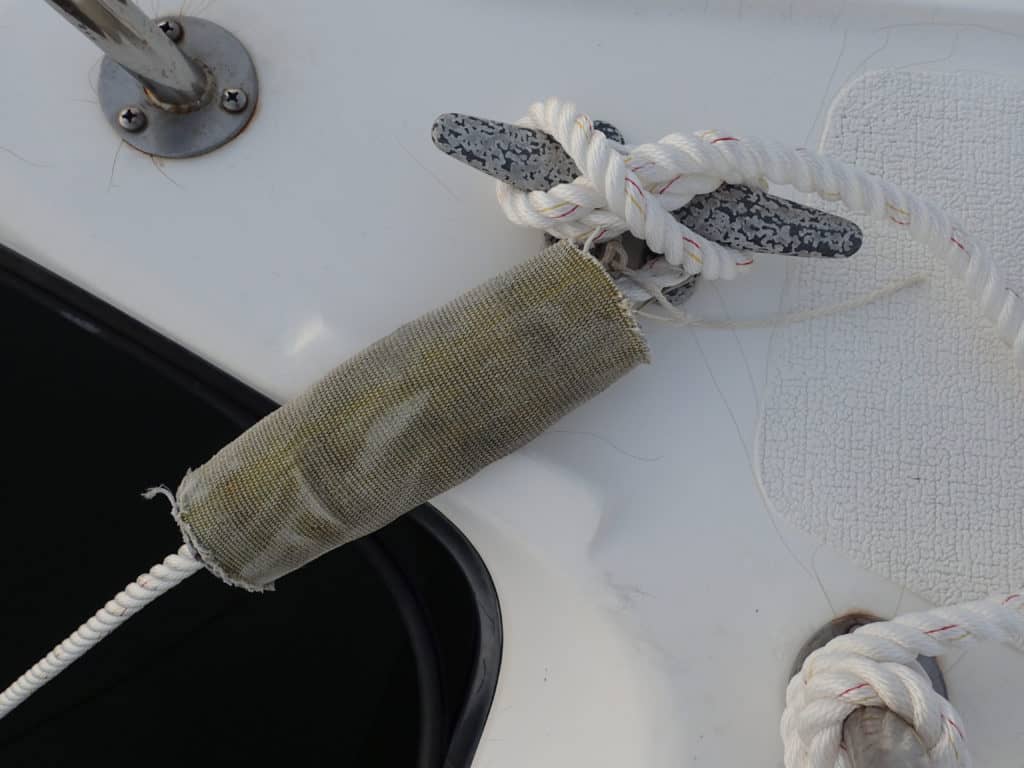
The best chafe protection we have found is old fire hose. Many fire departments give it away for free. Slip a length over the bridle wherever it contacts a hard surface.
The critical detail: tie the chafe gear to the boat, not to the line. If you tie it to the line, it will creep forward as the line stretches under load and leave the vulnerable spot exposed. Tied to the boat, it stays exactly where you put it.
Boat Attachment Points
The bridle has to connect to something solid on the boat. That means beefy cleats with proper backing plates underneath them.
This was the weak spot on Barefoot Gal. Our cleats were a decent size, but the backing plates were not as substantial as they should have been. Here is why that matters: if the backing plates don’t adequately distribute the load, the cleat gets ripped right out of the deck. You lose your bridle in the middle of a storm, the windlass suddenly has to bear the entire load it was never designed to hold, and you now have an open hole in the deck for waves and rain to pour through. That is a genuinely serious situation at 2 AM with a squall on top of you.
If you have any doubts about your cleat installation, fix it before you need it.
The Electric Windlass
We consider an electric windlass vital safety gear, not a luxury.
Here is what it changed for us. With an electric windlass, we would re-anchor as many times as it took to get a set we were both happy with. If either of us had any nagging doubt about the spot or the set, we raised the hook and did it again. No argument about hauling chain by hand in the heat. We just did it.
A windlass also allowed us to anchor in slightly deeper water, giving us a bigger safety margin from shore if we ever dragged. And it meant we could leave in a hurry when conditions changed.
For more on why this matters so much, see Electric Windlass as a Safety Feature.
Communication
When we anchored, Dave was on the bow and I was at the helm. On our first boat we used hand signals and the occasional shouted conversation. Fine in calm conditions. Useless in any real wind.
We switched to 2Talk Bluetooth headsets, and the difference was immediate. Being able to talk normally between bow and helm made every anchoring situation easier and more precise. In the Bahamas, where we were often trying to drop the hook in a 5-foot sandy patch surrounded by grass, clear verbal directions were the difference between nailing it and missing completely. Hand signals simply cannot give you that kind of precision.
The Technique
Great anchoring gear is fine and dandy, but you have to use it correctly.
Choosing Your Spot
When we arrived at an anchorage, we never just pulled in and dropped the hook. We motored slowly around and talked through our options first.
The anchor symbol on the chart just means boats anchor somewhere in that general area. It does not mean it is the best spot, and it almost always marks where the crowd will be. We preferred to be a little apart, in a spot with full 360-degree swinging room if possible.
We thought about the forecast wind direction, any expected overnight shift, the swell direction, and the paths other boats might take through the anchorage. Fishing boats from a local village will leave before dawn regardless of where you are anchored. Think through all of it before you commit.
Dropping the Hook
When we had settled on a spot, I put the engine in neutral and coasted up to it. Dave dropped the anchor and played out rode as we drifted back naturally. No load on the anchor at this point.
We put out at least 5:1 scope, calculated on high-tide depth plus freeboard, and usually aimed for 7:1. Dave next rigged the bridle, giving the anchor a few minutes to settle before we started backing down.
Once the bridle was on, I reversed at idle speed to stretch out the chain and take the slack out of the bridle. We watched the GPS until it read 0.0 knots. Then I slowly increased RPMs, still in reverse, up to our normal cruising RPMs and held there until the GPS read 0.0 knots again.
During that process we usually saw a little movement, maybe 0.4 or 0.6 knots, as the anchor buried deeper, the catenary came out of the chain, and the snubbers stretched. Then it dropped back to zero. That is the moment.
If the GPS did not reach zero, we raised the anchor and tried again in a slightly different spot. Every time, no exceptions.
I have heard people say they avoid backing down hard because they worry about breaking the anchor out. That reasoning has always puzzled me. Backing down hard is exactly how you find out right now whether the anchor will hold. I would far rather discover a poor set during the afternoon than at 2 AM with a squall already on top of us.
Once we were both genuinely satisfied with the set and the position, there was just one more thing to do.
The Anchor Alarm
The anchor alarm goes on before the engine goes off. That is the rule.
Smartphone apps work well, and most chartplotters and navigation apps have a built-in alarm too. We set the alarm radius slightly smaller than the amount of rode we had out. That meant the alarm would trigger on a major wind shift, not just if we were actively dragging. A big wind shift almost always arrives just ahead of a squall, and we wanted that early warning.
Choose a sound that will genuinely wake you from a deep sleep and test it before you turn in. If you are in a noisy anchorage, or are hard of hearing, connect the phone to a Bluetooth speaker set right beside the bunk.
For more on anchor alarms and building real confidence in your set, see How to Get Good Sleep While at Anchor.
When a Squall Rolls Through
If you have anchored this way, you will feel the difference when a big blow hits. As the boat falls back on the rode, the snubbers take the load and begin to stretch. That stretch is the system working, absorbing the shock gradually rather than slamming it through to the anchor and the cleats. The chain runs taut from the anchor up to the point where the bridle attaches, then slack from there back to the boat. The alarm may go off on the wind shift, which is exactly what it is supposed to do, and is your signal to go on deck and take a look around to make sure you’re not dragging and neither is anyone near you.
For a full guide to what to do when a squall is bearing down, see Dealing with Squalls at Anchor or on a Mooring.

Carolyn Shearlock has lived aboard full-time for 17 years, splitting her time between a Tayana 37 monohull and a Gemini 105 catamaran. She’s cruised over 14,000 miles, from Pacific Mexico and Central America to Florida and the Bahamas, gaining firsthand experience with the joys and challenges of life on the water.
Through The Boat Galley, Carolyn has helped thousands of people explore, prepare for, and enjoy life afloat. She shares her expertise as an instructor at Cruisers University, in leading boating publications, and through her bestselling book, The Boat Galley Cookbook. She is passionate about helping others embark on their liveaboard journey—making life on the water simpler, safer, and more enjoyable.
Carolyn Shearlock says
If it happens frequently in the area where you are, you might want to invest in a laser range finder so you can tell them exactly how close they are to you.
ChrisW says
…and we don’t give them the stink eye, we get on the loud hailer.
Capt. Ed says
I wouldn’t be so quick to identify my selves as boaters who mark their anchor, becoming a menace for any other boat passing within 100 feet of you and risking getting your float line tangled in their prop. Also in tight conditions, you are taking 2 anchorage spots. If you are not able to figure out where your anchor is, you should be out practicing rather than taking more anchorage space than needed. look around, how may boats do you see in any anchorage with an anchor float creating a prop hazard?
Ellie says
Having seen friends loose their $1200+of chain and anchor because they didn’t have the anchor marked when the bitter end wasn’t tired off and ran away on them, I was extremely happy when my husband started to use a float to show us where the anchor is and also make it easier to retrieve it if there is an issue. We splurged for my 50th birthday ladmst year and purchased a new Mantus anchor and I’d cry if I lost that anchor I love it that much. It’s given me such peace of mind. Between that our 150 feet if BBB, our bridle and our 300 feet of rode we actally sleep wonderfully at anchor.
Carolyn Shearlock says
20 or 50 feet is just way too close when you figure that most boats are 35 to 45 feet long. We think the absolute minimum is 3 times the length of the larger boat, and really prefer more space especially if there is a chance the weather could turn bad.
Timothy Noble says
Thank you I will use that as great advice.
Last thing I need being new to this is the evil eye.
I just don’t know what I don’t know yet so I appreciate the perspective of someone knowledgeable
Thanks you.
Richard says
We typically keep our distance, but we were in a busier anchorage recently with fewer options. I wanted to anchor downwind of other boats as we often run our generator, and I would not want to disturb others. There was a trawler to our starboard, and as we prepared to drop anchor they hailed us. The captain noted they had 120′ of rode out. It was a subtle warning. I was going to run the same about of rode (6:1). We discussed my location and after dropping anchor about as far as I could get from all other boats, I hailed the same boat. I asked if he was comfortable with our position. He seemed uncomfortable, but said there was no need for us to move. I said I would be happy to move if he were concerned, but he again declined.
There was no issue over the days we were there. We never got closer than about 160′ (which does not seem like much). In the end, it bothered me and we should have moved.
As for the distance, we use our radar to get exact locations of boats around us. I know not all boats have a radar, but if you do have one consider using it when you anchor. It is nice to know all other boats are 330′ (1/16nm) away or whatever distance is needed.
Richard says
We are “close” at about 165′. Figure 6:1 scope in ten feet of water. For us that means 100′ of chain (10′ depth plus 7′ freeboard). Then there is the 57′ length of our boat. Assuming all boats move the same way, all will be well at 165′. But if we are near cats we have to be careful as they are not as effected by current as we are; with wind and current in opposing direction, we could be on top of one another very easily. More room is better!
Estimating distance on the water is difficult too. We use our radar to accurately assess how far away other boats are. Someone else suggested a laser range finder which is another excellent idea. Remember, you are not just anchoring at a safe distance for the other boats, but also a safe distance from them. Be aware of who may drag into you.
Lastly, vessels will often anchor more closely in more crowed anchorages. This can make many feel uncomfortable (myself included). That said, properly anchored vessels of similar draft can often be safely anchored very close, but I do not recommend it unless you know the anchoring skills of the others well.