


Boot Key Harbor in Marathon has three major shoal areas with poor marking, a first-come, first-served mooring field with no reservations that often fills by Thanksgiving, and strict dinghy rules, including lights after dark. During the 10 years Dave and I were based here, I watched new arrivals make the same mistakes week after week. Here is what you need to know before you pull in.
The harbor offers excellent protection from winter winds, mooring costs far below what Keys marinas charge, and a walkable town with groceries, a chandlery, restaurants, and one of the strongest cruising communities in Florida. It fills up for good reason.
The Shoals: Know These Before You Enter
Boot Key Harbor has three major shoal areas and the marking is poor. Every week, boats go aground on the sea grass beds. Beyond the damage to your boat, the harbor is inside the Florida Keys National Marine Sanctuary, and boaters who scar seagrass can face steep federal fines and the cost of restoring it.
If you do go aground, check the tide first. At low tide, the best move is usually to wait. The tide will float you off without causing further damage to your boat or the grass bed.
The map below marks all three areas.
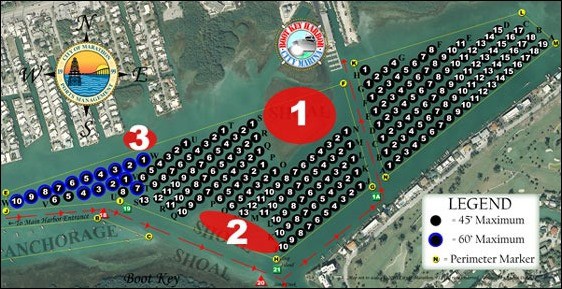
Shoal 1: The Flats This is the large sea grass bed locals call “the flats.” Do not try to cross it in any motorized boat. At low tide, even rowing dinghies may hit their oars and sailing dinghies will hit their centerboards. See the Dinghy Channel section below for the safe route across.
Shoal 2: Green 19 to Green 21 When running the channel between Green 19 and Green 21, there are three spar buoys just east of mooring ball Q10 and then nothing between there and Green 21. The shoal extends all the way from Q10 to Green 21 and across to where boats are moored. Draw an imaginary line from Green 19 to Green 21 and stay on the channel side of it. There is a small mangrove island near Green 21. Go SOUTH of it.
Shoal 3: Small but Tricky This one is smaller and the markers are easier to spot because of that. At low tide, you cannot dinghy over it.
Getting a Mooring Ball
The marina assigns mooring balls first come, first served, with some consideration for boat length and draft. There are no reservations.
You cannot request a mooring ball until you are actually in the mooring field area, east of the bridge to nowhere (shown on most charts as a bascule bridge to Boot Key at the west end of the harbor). The lift section has been removed, so the bridge is permanently open. The city has also removed the power line, so there is no air draft restriction.
If entering from Sister’s Creek, you need to be clear of the creek and into the mooring field channel before calling.
Call “Marathon City Marina” on VHF channel 16, or by phone at 305-289-8877.
Moorings are assigned only during office hours. If you arrive after hours, anchor for the night and call in the morning. The mooring field is for boats with people living aboard: the city doesn’t allow wet storage, so you can’t leave the boat on a ball and fly home.
When the mooring field is full, boats go on a waiting list. You must be in one of the nearby anchorages to be placed on the list. The field tends to fill up around Thanksgiving and generally stays full until at least mid-February.
What a Mooring Costs
As of November 2026, the City of Marathon charges $25 a day or $384 a month for a mooring, plus tax. Both rates include dinghy dockage, showers, and pump-outs (one pump-out with the daily rate, one a week with the monthly rate), and the monthly rate adds a parking space. Rates change, so check the city’s mooring and dockage rates before you arrive.
Mooring Field Map
Finding your mooring ball can be tricky. The marina staff will give you a general idea of where it is, but print the mooring field map in the shoals section above and have it at the helm when you arrive. Row letters are marked in black at each end of each row. They’re small, but they are there.
Yellow Buoys Around the Mooring Field
You will see yellow buoys marked with letters around the edges of the mooring field. These mark the legal boundaries of the field and have nothing to do with the mooring ball letters. They will not help you find your assigned ball.
How to Tie Up to a Mooring Ball
The marina staff at Boot Key Harbor are emphatic about the correct tying method, and with good reason. The wrong method causes chafe that can part your line overnight in a blow. For the correct technique, the best line to use, and how to set up extra security when a squall is approaching, see How To Tie a Boat To a Mooring Ball.
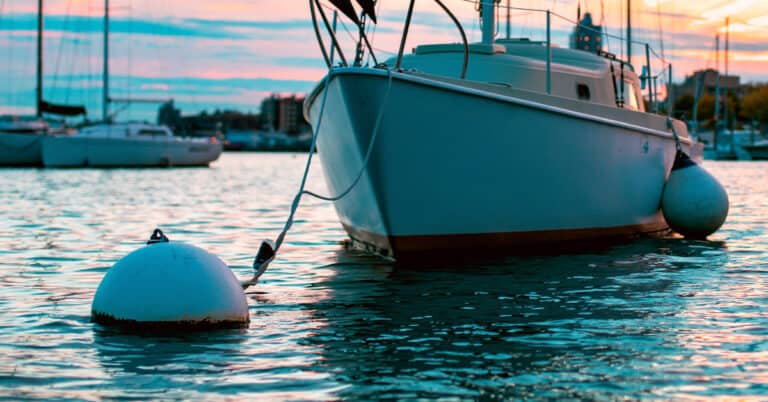
The marina requests no more than four feet from your bow to the pennant eye, so all boats swing in roughly the same arc.
Anchor Lights
If you are at anchor, you must have an anchor light on at night.
In the mooring field, the current interpretation is that only boats on balls bordering the channels are strictly required to display anchor lights. That said, we kept ours on no matter where our ball was. A light with a photocell turns on automatically at sunset, so there’s nothing to remember.
Ours hung low in the rigging instead of at the top of the mast. At a talk for cruisers in Boot Key Harbor, FWC officers encouraged lower anchor lights like this, since passing dinghies and small boats see them far more easily than a light at the masthead. The one we recommend is the Marine Beam Utility LED Anchor Light: it hangs from the boom or mast and switches itself on at dusk. Choose Cool White for the greatest visibility distance.
Dinghies left in the water overnight need their own anchor light in addition to the one on the mother ship. Dinghies on davits or on deck do not. These rules get revisited periodically, so check with the marina office on arrival.
Dinghying in Boot Key Harbor
All of Boot Key Harbor is either an Idle Speed/No Wake or Slow Speed/No Wake zone. Until you have picked up a cruisers’ guide from the office and know which is which, treat everything as an idle zone. The dinghy channel, the areas around the dinghy docks, and the channel beside the office are all IDLE/NO WAKE.
Dinghy light requirements at night:
- Motorized dinghies capable of more than 7 knots: red/green sidelights plus a white all-around light
- Motorized dinghies that can’t go faster than 7 knots: a white all-around light (sidelights too, if you can)
- Rowing dinghies: at minimum, a white flashlight ready to show in time to avoid a collision. Getting hit in the dark is a real risk, so I’d carry an all-around light anyway.
All standard safety gear requirements apply: PFDs, fire extinguisher, sound device. Both FWC (Florida Fish and Wildlife Conservation Commission) and the Coast Guard patrol the harbor regularly and conduct safety checks.
For a complete rundown of what to carry every time you leave in the dinghy, see Necessary Dinghy Safety Gear.
The Dinghy Channel
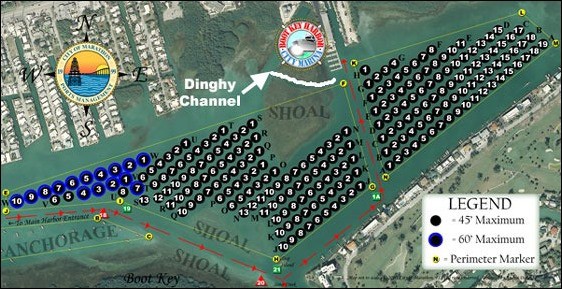
There is a marked dinghy channel along the north edge of the flats. Look for sets of PVC stakes with solar lights. Pass between the two stakes in each set. The markers have been improved and are easier to follow than they used to be. Boats larger than dinghies cannot use this channel.
Dinghy Docks
There are no free dinghy docks in the harbor. Beaching your dinghy at Sombrero Beach at the south end of Sister’s Creek is free, and it’s one of the few dog-friendly beaches in the Keys, but there are no stores or services there.
Paid dinghy docks:
- City Marina: $25 a day, $100 a week, or $250 a month (plus tax, as of November 2026). Includes dumpster, showers, laundry, pump out, water, and the community room (laundry and water have additional fees). Weekly and monthly rates include a vehicle parking space and a mailing address for packages.
- Burdine’s (outside the harbor, west end): per-day fee, free tie-up while eating or drinking there
- Dockside (far east end): per-day fee, free tie-up while eating or drinking there
Older cruising guides say West Marine has a dinghy dock. That information is outdated. None of the grocery stores have a nearby dinghy dock either. If you don’t have a car, here’s how cruisers manage it: Provisioning Without a Car.
Anchoring Out
If the mooring field is full, there are two anchoring options nearby.
Sister’s Creek (south entrance): Anchor in the wide spot with your stern tied to the mangroves. Boats drawing over 5 feet should check charts carefully or get local knowledge first, as there are shallow spots. The four large radio towers in the area are reported to put out strong electrical interference that can cause instrument anomalies. Some cruisers say it has damaged their electronics.
Near the bridge to nowhere (west entrance, nearest the 7 Mile Bridge): Holding here can be poor. Back down hard and test your set thoroughly. Finding out right away that you are not holding is far better than finding out at 2 AM in a squall. For solid anchoring technique, see How to Anchor a Cruising Boat.
When the waiting list is long, both areas will be crowded.
If a squall rolls through while you are at anchor or on a mooring, see Dealing with Squalls at Anchor or on a Mooring.
Two Florida rules apply if you stay a while. If you anchor within a nautical mile of the same spot for 14 days or more in any 30-day period, you need a free long-term anchoring permit from FWC, which you apply for online. And in Monroe County, boats anchored within 10 nautical miles of a public mooring field must move at least half a mile at least once every 90 days.
Laundry
The Marathon Laundromat is the only public laundromat in Marathon. It has extra-large washers and dryers, air conditioning, and fast free WiFi, and tends to be less crowded than the marina laundry. The marina laundry is the more convenient option if you do not have a vehicle.
A Note on Keys Prices
Nearly everything costs more in the Florida Keys: groceries, fuel, eating out, boat supplies, water. Marathon has just about every service you could need, but budget for higher prices across the board.
IMPORTANT: The information in this article is given to the best of my knowledge. We’re no longer based in Marathon, and things change. For anything time-sensitive, call the Marathon City Marina office at 305-289-8877.
Get the Florida Keys Cruising Guide
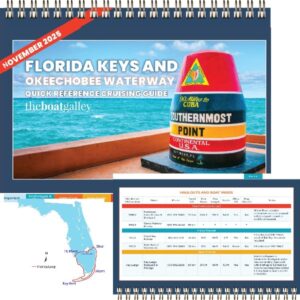
Larry Webber and I put Boot Key Harbor and every other Keys anchorage, mooring field, bridge, and dinghy dock into tables in our guide, the Florida Keys and Okeechobee Waterway Quick Reference Cruising Guide, so you can find what you need at the helm in seconds.
From The Boat Galley Store
Florida Keys and Okeechobee Waterway Quick Reference Cruising Guide
Stuart to Miami to the Dry Tortugas to Ft. Myers, and back across the Okeechobee Waterway. Table format to easily find:
- All bridges and locks with height, type, schedule, and how to contact
- Anchorages by protection direction, including depth and tide range
- Moorings, free docks, and storm holes
- Fuel, propane fills, showers, and pumpouts
- Grocery stores, laundromats, and marine supplies
Spiral bound or instant PDF. Also on Amazon: spiral bound or Kindle

Keep reading


Carolyn Shearlock has lived aboard full-time for 17 years, splitting her time between a Tayana 37 monohull and a Gemini 105 catamaran. She’s cruised over 14,000 miles, from Pacific Mexico and Central America to Florida and the Bahamas, gaining firsthand experience with the joys and challenges of life on the water.
Through The Boat Galley, Carolyn has helped thousands of people explore, prepare for, and enjoy life afloat. She shares her expertise as an instructor at Cruisers University, in leading boating publications, and through her bestselling book, The Boat Galley Cookbook. She is passionate about helping others embark on their liveaboard journey, making life on the water simpler, safer, and more enjoyable.
Some links in this article (including all Amazon links) are affiliate links, meaning that we earn from qualifying purchases.