

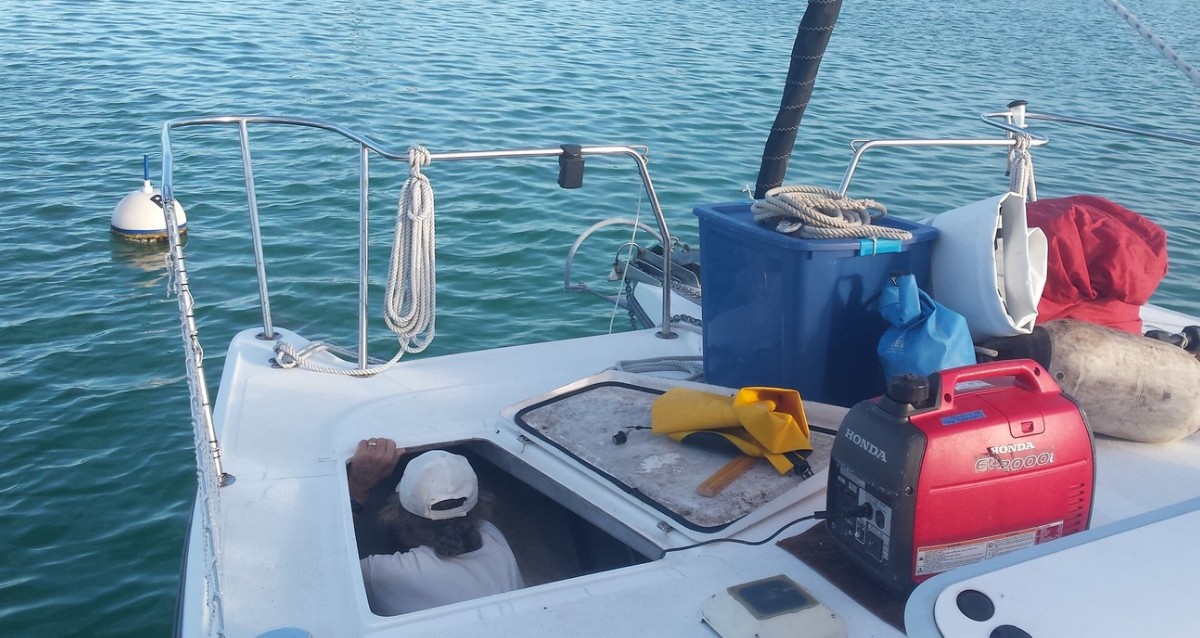
The best way to handle gear breaking on your boat is to plan for it before it happens. Something will break sometime, whether you’re out for an afternoon or heading around the world, and you won’t know what, how, or when. But it doesn’t have to be a crisis if you:
- plan ahead
- have backup systems
- carry spare parts and know how to make quick fixes
- leave enough spare time in your schedule to deal with problems (the one everyone forgets)
Plan Ahead
Over our years of cruising, we discovered that there are basically two types of cruisers: those who have thought ahead about what might break, and those who haven’t. And contrary to what you might think, those who have planned for stuff to break are the happiest. Over and over, it’s the people who haven’t planned ahead who are the most stressed, and end up hating cruising.
What do I mean by planning ahead?
Know What’s Most Crucial to You
When you think about it, it’s most important for the boat to remain afloat (read about dealing with water intrusion) and for the crew to remain healthy. Anything else is secondary.
Engine fails? If you can sail or get a tow, you’re not stranded. And as long as you have food and water and the boat doesn’t sink, you’ll survive. That said, survival isn’t why we took up cruising. So get personal. What would feel like a real loss if something broke and you couldn’t have it? For me, and many fellow cruisers, it was access to coffee. If that’s you, you’ll definitely want to have a coffee backup plan (and really, you probably need the caffeine to aid in problem-solving). Coffee singles (Amazon), which steep like tea bags, take up little room and works well in a pinch.
Add Creating Redundancy to Your Project List
When your pressure water system fails, it’s too late to wish you had a manual pump. Sure, it’s not a sexy project. But it’s a practical one. Installing a manual pump saves water and electricity, and serves as a redundant system if your pressurized water system fails.
And that leads to our next point.
Have Backup Systems
Like I noted above, keeping the crew healthy is vital. Here are a few tips for keeping crew fed and hydrated.
Keeping and Preparing Food
What will you do if your refrigerator fails unexpectedly? Will you lose most of your food? Not if you have a backup system in place. And it can be as simple as a good cooler and ice (if it’s available). Transfer items into a cooler to keep them for a few days. After that, you have a few other options
- cook and eat most perishable meats immediately
- give food to nearby boats (maybe they’ll keep it for you; maybe it’s just a gift, but better than it going to waste)
- have a party for everyone in the anchorage and use all your perishable foods
- have sufficient non-refrigerated (canned or otherwise) food to last the remainder of the trip.
If your fridge is out for longer, or for good, my book, Storing Food Without Refrigeration, shows how to buy and keep hundreds of foods without one.
Sometimes, you already have backup systems built in, but you may not realize it until something goes wrong. For example, if your stove goes down, use your grill. You can cook in a pan on the grill. You can even bake bread on a grill.
In a remote setting, you can cook over wood on the beach. And a solar oven works great almost everywhere.
Water Supplies
Water, of course, is even more important than food. What will you do if your water pump fails?
Here’s where you’ll be glad you installed a manual pump since you can use that in place of a failed pressure water pump. Or, if you didn’t get to install a manual pump before your pressure water pump failed, check the inspection port. Can you dip water out of it with a ladle?
Of course, water tanks can leak, you can run out of water, or your water can go bad. Hopefully, you have water stored in more than one place. You’ll also want to have a manual water purifier on board (Amazon) if in freshwater. You can also strain and boil water.
A filter won’t make salt water drinkable; only a watermaker can do that (here’s how to decide whether you need one).
Of course, you can rely on other beverages (not alcohol, which dehydrates you) and use liquid from canned food when cooking.
Electricity
Over the years, cruisers have come to run more items on electricity. Cheaper solar panels and more efficient batteries make it easier to rely on electric power even in remote areas. Think of all the ways we use electricity on our boats.
It may power your refrigerator and water pump. It provides light. Some boats have an electric stove, coffeemaker, and/or microwave. And on most boats, electricity is needed for the propane solenoid. Losing electricity means all of those need workarounds: a manual freshwater pump, flashlights or a lantern, a plan for the propane solenoid, or cooking on the grill if it has its own fuel.
Know what you’ll do if your propane solenoid fails or you lose power. The solenoid is a safety device: it shuts off the gas whenever the power goes off, and most propane alarms close it if they smell gas. The best backup is a spare solenoid, since they’re a common failure.
Barefoot Gal, our Gemini catamaran, came from the builder with a bypass: you just flipped a valve to send the gas around the solenoid. If your boat doesn’t have one, you can disconnect the hoses on both sides of a dead solenoid and join them with a straight connector. Either way, while the solenoid is bypassed, the tank valve is your only shutoff: open it only while you cook, close it at the tank every time you finish, and get the solenoid working again as soon as you can.
Have Quick-Fixes and Spare Parts
Even with the best preventive maintenance, you can’t avoid breakdowns. So you’ll want to know how to make repairs, even temporary ones. The key is to have supplies for quick fixes as well as spare parts for permanent repairs.
Read my suggestions for important spares to keep on board.
But there’s no shame in making a quick and dirty repair just to get you to the next boatyard or anchorage. Rescue Tape (Amazon) is a silicone product that fuses to itself and will repair leaky hoses in a pinch. It even works under pressure. Read my tips for using Rescue Tape.
A reader, Tami, shared her experience when a rough crossing of the Gulf of Mexico stirred up debris in the bottom of her diesel tank. While trying to dock, their engines began to surge. Fortunately, they had a spare fuel hose on board and installed a temporary fuel line to a jerry can, which allowed them to wait until they got home to inspect and clean their fuel tanks and install inspection ports. See? Good spares and a quick fix can make all the difference.
Not every break makes the difference between returning home or not. Even good old duct tape can repair a broken hinge or cracked cooler box.
And spares don’t just mean hoses and belts. Don’t underestimate the likelihood of losing important items overboard. Cruisers who wash pans in salt water run the risk of dropping one in the drink. You may need to have more than one, or resort to cooking food in aluminum foil. And all that canned food you stocked as a backup doesn’t help if you lose your can opener. That’s one item worth carrying more than one spare of.
The same with knives. You have a sharpener on board, right? But don’t rely on one favorite knife. Pack spares.
Finally, there’s one way to prepare for breakdowns that most cruising guides and repair books never mention.
Free Time to Cope With Problems
When you build in plenty of spare time to your travel plans, something breaking is a nuisance and not a catastrophe. There are many things you can’t control while cruising. But padding your schedule with extra time makes addressing problems that arise less stressful.
It’s the one lesson that all successful cruisers learn. It’s even better if you can learn from someone else’s example instead of finding out the hard way.
Are you ready for things to go wrong on your cruising boat? Planning ahead, creating backups, having the ability to make quick repairs underway, and not being so crushed for time that a breakdown upsets all your plans will make cruising more fun and less stressful.
For Your Next Time Out
Whether you cruise full-time or a few weeks a year, our newsletter brings practical tips every Wednesday on passages, anchoring, provisioning, boat systems, and more.
Free from The Boat Galley
The Boat Galley Newsletter
Free, every Wednesday. Unsubscribe anytime.
Keep reading


Carolyn Shearlock has lived aboard full-time for 17 years, splitting her time between a Tayana 37 monohull and a Gemini 105 catamaran. She’s cruised over 14,000 miles, from Pacific Mexico and Central America to Florida and the Bahamas, gaining firsthand experience with the joys and challenges of life on the water.
Through The Boat Galley, Carolyn has helped thousands of people explore, prepare for, and enjoy life afloat. She shares her expertise as an instructor at Cruisers University, in leading boating publications, and through her bestselling book, The Boat Galley Cookbook. She is passionate about helping others embark on their liveaboard journey, making life on the water simpler, safer, and more enjoyable.
Some links in this article (including all Amazon links) are affiliate links, meaning that we earn from qualifying purchases.