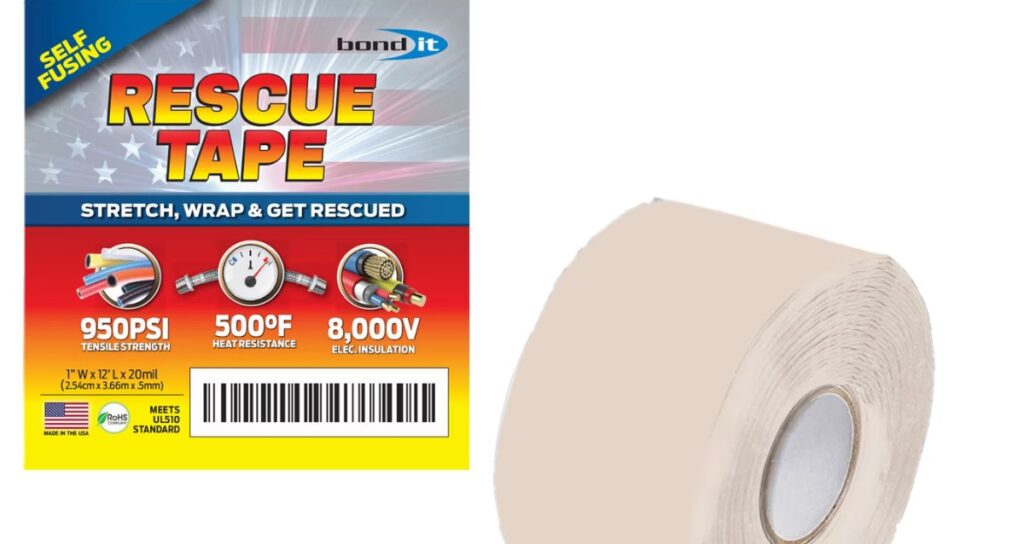
Once you discover Rescue Tape, you will wonder how you got by without it. In fact, when you meet other cruisers who have it aboard, you’ll find a wide range of uses for it.
What is Rescue Tape
Rescue Tape is made from silicone and sticks to itself. Actually, it fuses to itself when wrapped around an object. The tighter you pull it, the better the seal. No, you can’t just put it on a flat surface to mend something, but it’s great on hoses and plumbing. Unlike electrical tape, it won’t get gummy. And it won’t dry out like duct tape can, even in the sun.
Dave and I had used similar “plumbing repair tapes” in the years we owned our first cruising boat, Que Tal. But at the 2012 Annapolis Sailboat Show, we found a highly improved version of “plumber’s tape” sold under the brand name Rescue Tape.
Rescue Tape vs. Other Plumber’s Tape
The plumber’s tape we used previously handled about 100 PSI and 212° F. We used “Magic Wrap tape” most often (I think), but other brands have similar performance characteristics. These are good for household plumbing and a few other low-stress applications, but they are less useful on a boat.
Rescue Tape costs slightly more, but
- will remain flexible at -85°F,
- it’s good to 950 PSI,
- will insulate up to 8000 volts of electricity,
- is heat resistant to 500° F and
- will remain flexible at -85°F.
Rescue Tape costs slightly more BUT
- it’s good to 950 PSI,
- will insulate up to 8000 volts of electricity,
- is heat resistant to 500° F. and
- will remain flexible to -85° F.
It resists fuel (gas and diesel), oils, acids, salt water, and UV. That means you can use it on the high-pressure side of a watermaker, and on diesel engine hoses and fuel lines in areas that must withstand the heat of an overheating engine. You can also use it to seal a punctured refrigeration line.
Unlike most other tapes or repair materials, the surface doesn’t have to be completely clean or dry.
As I began writing this article, I discovered a few other brands of “repair tape” with similar specs. Most don’t have the same specs, though — so be sure to check carefully if you buy a different brand.
How to Use Rescue Tape
Most people who don’t think Rescue Tape (or any other brand of silicone tape) works well are not applying it correctly. Two things: you have to pull hard on it and really stretch it (make it very tight, particularly with high-pressure applications), and you can’t be chintzy.
You wrap it around an item, and overlap it by 50%, pulling tight — stretching it to at least double the length — and going 3 to 5 inches on both sides of the leak. That means for a 1″ split in a hose, the total repair is going to be 7 to 11 inches long! The tighter it’s wrapped, the faster and stronger it will fuse. For high-pressure leaks, you may need to put a second layer on. But the result will be water-, fuel-, and air-tight. Consider it permanent, too. If you need to remove it, you’ll have to cut it off.
This method is not necessary for things like rigging, chain marking, line whipping, and so on where there’s no leak.
Bonus tip: Hold your hand on the taped area for a few seconds after making the repair. The body heat appears to help the tape fuse.
The only problem we encountered using Rescue Tape was that it can be difficult to apply properly in a small space. You’ll have to get creative to make it work.
Where to Buy Rescue Tape
You can buy Rescue Tape in all sorts of colors (and clear) directly from the company on Amazon:
It’s also available at various brick-and-mortar stores, including most Pilot travel centers and some other truck stops. This is one of those things to get before you need it. While I hope you’ll never be desperate for it, just remember Captain Ron’s words of wisdom: “If it’s going to happen, it’s going to happen out there.”
Rescue Tape Uses
When we first found Rescue Tape, Dave and I thought of all the times we would have used it to make an essentially permanent repair. Times when we spent a lot of time making a repair . . . or waiting for a part because we couldn’t repair it. And it would be better for certain other projects than what we had used. In just a few minutes as we stopped for a cold drink, we came up with this list of things we could have used Rescue Tape for:
- a couple of watermaker leaks that took forever — and a few new connectors — to cure;
- a split in our oil cooler that took 2 days to repair using JB Weld, some patch material and hose clamps;
- a split diesel copper fuel line that could have been repaired in 15 minutes instead of a full day;
- a cracked dinghy gas line (we did use the plumber’s tape that we had on this);
- a crack in the diesel heat exchanger (the outside shell, not an interior tube);
- virtually any other hose — water, sewage, drain, fuel, exhaust, etc.;
- a split snorkel (don’t leave one in the cockpit where someone else can step on it!);
- a punctured refrigeration tube (would still need to evacuate the system and recharge it, but wouldn’t have to buy and install a new tube);
- rigging tape;
- line whipping (be sure to pull it very tight);
- anchor chain/rode marking (the sales rep from Rescue Tape swears that it will go through a windlass without being chewed off);
- marking halyards for reef points;
- bundling wires;
- shrink-wrapping wire connections (it’d be wonderful not to have to use the butane torch and still make the connection watertight); and
- make galley utensils and other tool handles heat resistant and electrically insulated . . . as well as non-slip!
In the years since we first discovered Rescue Tape, we used it for most of these, and a host of other applications.
Other Cruiser’s Uses
When I first started recommending Rescue Tape, I heard many stories from other cruisers about how it saved their day.
- Sue W. used it to seal her mast.
- Chris L. testified that when he repaired a leaking fuel hose far from an anchorage, it held for days of motoring.
- Leslie L’s coolant hose repair lasted for twenty-four hours of motoring until they arrived at a fuel dock to replace it.
- Need to seal a coaxial cable? Rusty B. found it a quick solution that he found easy to remove later.
- A leaky squeeze ball on an outboard fuel line held for thirty miles, until Shawna S. was able to source a replacement.
- Diana W.’s temporary repair to a seacock hose lasted long enough to get to their planned haulout a month later.
- Susan S. made it all the way back to the United States from the Bahamas after using it to repair a water intake hose leak.
Regular Tips That Make Cruising Easier
If you spend enough time chatting with fellow cruisers, you’ll find so many great ideas. But you don’t have to spend years learning. I share helpful tips every week in The Boat Galley newsletter. Subscribe to make your learning curve less steep.

Carolyn Shearlock has lived aboard full-time for 17 years, splitting her time between a Tayana 37 monohull and a Gemini 105 catamaran. She’s cruised over 14,000 miles, from Pacific Mexico and Central America to Florida and the Bahamas, gaining firsthand experience with the joys and challenges of life on the water.
Through The Boat Galley, Carolyn has helped thousands of people explore, prepare for, and enjoy life afloat. She shares her expertise as an instructor at Cruisers University, in leading boating publications, and through her bestselling book, The Boat Galley Cookbook. She is passionate about helping others embark on their liveaboard journey—making life on the water simpler, safer, and more enjoyable.
Leave a Reply