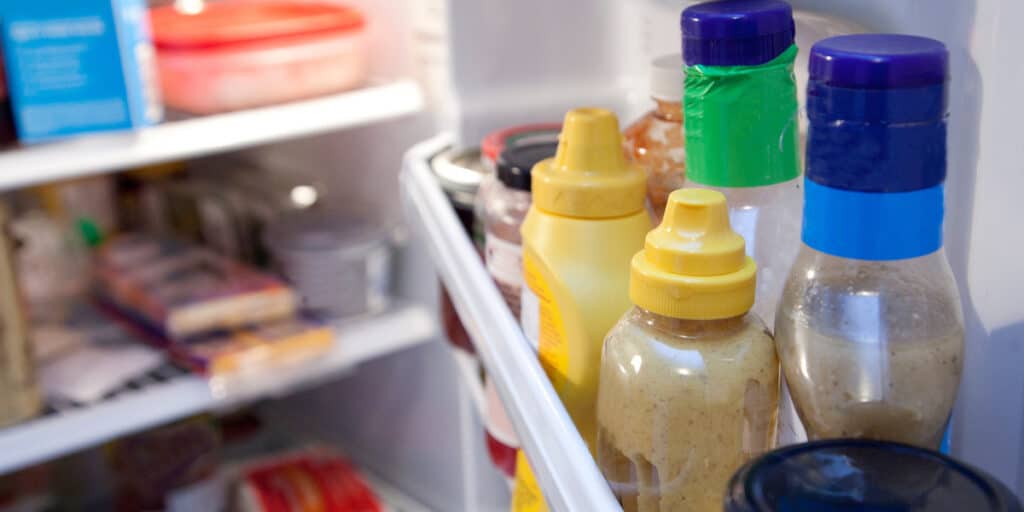
How do you reduce what’s in the refrigerator — outside of just not having as much food?
Most boat refrigerators are far smaller than those in houses or apartments. Ice boxes are usually even smaller. And when you combine that with less frequent grocery shopping, something has to give!
For me, the answer was a combination of two ways to reduce what’s in the refrigerator:
- not refrigerate items that didn’t have to be, and
- use non-refrigerated substitutes for some items
While I enjoy visiting towns and villages as we cruise, I really prefer to do a big stock-up every two to four weeks, staying in secluded anchorages in between. This means that I have to make the most of the refrigerator space I had.
Don’t Refrigerate Most Condiments
Most condiments don’t need to be refrigerated. Ashore, most Americans refrigerate open containers of catsup, mustard, jellies, and jams. Some even keep steak sauce, hot sauce, soy sauce and Worcestershire sauce in the refrigerator.
I keep all of them just in a cupboard and have never had a problem with any getting moldy in the 3 to 6 months it took us to use a container. For things that we don’t use a lot of, I buy smaller containers so that we’d use them up before they got rock hard.
Use “Boxed Milk”
Boxed milk is a cruising staple. The milk is ultra-pasteurized and vacuum-sealed in boxes similar to juice boxes, typically holding 1 quart or liter. You can get whole milk, 2%, skim milk and even almond and soy milk. Some people think boxed milk tastes slightly different from fresh milk or the same variety; we didn’t.
Boxed milk was sold everywhere in much of the world. We found it easily in Mexico, Central America, South America and Africa. In many villages, you could only buy boxed milk and powdered milk — there wasn’t any fresh milk.
In the US, boxed milk can be a little harder to find. I’ve always been able to get it in Super Wal-marts — in the baking aisle! In coastal Florida, almost every grocery carries at least one or two brands; Publix has a wide variety. Read more about boxed milk.
I’ve kept boxed milk for up to 6 months — I think the official recommendation is more like 3 months. Shake it up before using it — the milk solids can settle a bit. Many of the boxes have a resealable pour spout, but whenever we were on the move or in a rolly anchorage, I’d transfer the milk into a bottle with a screw top.
You can also buy light cream (“media crema” in Spanish-speaking countries) in cans or boxes — in the US, it’s usually in the Mexican foods aisle. Evaporated milk, which comes in cans, is not as thick as media crema, but is also a good substitute for refrigerated half-and-half in recipes.
With media crema, you can easily make your own sour cream when you want it — without having to keep it in the refrigerator!
Use Canned Fruits and Veggies Along With Fresh
We love fresh produce. And a great deal can be stored without refrigeration. While some veggies last a surprisingly long time without refrigeration, others don’t. So I took those in cans.
I used a combination of fresh and canned so that we could go longer without re-provisioning. Often, I’d make salads that were a combination — such as canned green beans with fresh tomatoes and onions and a vinaigrette dressing. We’d still feel that we were eating fresh veggies!
Next Steps
Want more ways to save space in the fridge — or have great meals even without one? Check out:
- Storing Food With Refrigeration (paperback or PDF book)
- Eating Well With A Tiny Fridge (online course which includes PDF of the above book)


Carolyn Shearlock has lived aboard full-time for 17 years, splitting her time between a Tayana 37 monohull and a Gemini 105 catamaran. She’s cruised over 14,000 miles, from Pacific Mexico and Central America to Florida and the Bahamas, gaining firsthand experience with the joys and challenges of life on the water.
Through The Boat Galley, Carolyn has helped thousands of people explore, prepare for, and enjoy life afloat. She shares her expertise as an instructor at Cruisers University, in leading boating publications, and through her bestselling book, The Boat Galley Cookbook. She is passionate about helping others embark on their liveaboard journey—making life on the water simpler, safer, and more enjoyable.
Downeast32 says
Use raw seeds instead of oil. Also more nutritious. A good cooking oil is sunflower oil.. except there’s no need to keep the oil around. Cook with raw sunflower seeds instead. Cashews also work great. As for “how to saute without oil?” just use water or any liquid, there’s nothing much magic about oil. Seeds are easier to store/keep than oil. Definitely less mess.
Cheers
Marilyn says
Can you tell me how much water/seeds and do you sauté before adding other ingredients?
Debi says
Pressed cheese stored in olive oil with herbs does not need to be refrigerated either.
What Ihave been trying to figure out without success is: Not having a large pressure cooker are there other strategies for preserving fresh vegetables without the need to freeze or refrigerate them?
Charles says
On the subject of eggs, there are several makers of bottled egg whites with extended, non-refrigerated, shelf lives (one brand advertises 1yr+!). If you can live without the yolk, bottled egg whites are the way to go. Avoid the stuff in the refer section of the American grocery store and look in stores catering to bodybuilders or similar.
Carolyn Shearlock says
That sounds really interesting — I’ll have to see if I can find them and try them out! It would be great here in the US, where it’s almost impossible to find eggs that haven’t been refrigerated.
Thanks for sharing!
-C
Darlene says
I found a farm that will keep a dozen out, unwashed and unrefrigerated for me when I call ahead. Ask a local farmer to do that for you.
Adrienne says
Thank you for the info! We have chickens at home, as do many of our neighbors in northern NE, it’s a surprise to hear anyone say they have a hard time finding previously unrefrigerated eggs, I hardly ever get them all put away the same day they are laid.
Carolyn Shearlock says
Wish I lived near you! In the US, the only place I’ve ever found unrefrigerated eggs for sale was in Alaska — I’ve even checked with some farmers near us, but they won’t sell them unrefrigerated.
Ken Arnold says
When anyone is in Rhode Island, “Stamps Farm” about 1/2 mi. down on the Right side on Rt. 5 south off Rt 44 West (Apple Valley Mall area.) has Fresh unrefrigerated Eggs., all the normal sizes and Multi Yolkers. They also have an “Honor System” for Payment if nobody is in the tiny Store.
http://maps.google.com/maps?oe=utf-8&rls=org.mozilla:en-US:official&client=firefox-a&um=1&ie=UTF-8&q=Stamps+Farm+R.I.&fb=1&gl=us&hq=Stamps+Farm+R.I.&sa=X&ei=bhUgUZrNKNHwigKUnIHgBQ&ved=0CKcBEMgT
Ken Arnold says
p.s. Stamps is a 30 minute ride from Providence.
Sherri Goodman says
In the US – all eggs are washed before they are sold, which washes away the natural coating from the chicken’s body that seals the eggshell and keeps out bacteria. Once you wash away this “bloom” the egg no longer has the protection to keep bacteria out, and so, they need to be refrigerated.
Any farmer who offers fresh eggs from their chickens (as I used to do) never bothers to refrigerate the eggs as the bloom is intact and protecting the egg. Because they’re not washed, don’t expect the eggs to be totally clean on the outside – sometimes you get a little poop hanging on. It doesn’t hurt anything, just wash the egg just prior to using it to get that stuff off.
Also, store the eggs upside down – so the fat side of the egg is at the top. This helps to preserve the eggs better too.
🙂
Elly says
I have not tried this myself but I have heard of cruisers keeping fresh meat well covered in oil in a Tupperware un-refrigerated for weeks.
Carolyn Shearlock says
Anything that I’ve read about this, the meat was already preserved by smoking or salting, and the oil simply added another layer to not allow air to the food . . . but I’ve also read that it’s pretty risky for botulism growing. Not something I’d try . . .
-Carolyn
Mary Jane says
I don´t know about weeks without refrigeration, but if you add lots of spices to the oil, and really cover your meat in it, it easily keeps the meat for a week and it tastes great after marinading for so long! another tip, especially for fish: use a 1:1 mix of oil and fresh lemon juice. the juice kinda pickles the scaled filet whereas the oil keeps the air away. I´ve left fish for up to two whole days like this.
However, please note that none of this works for poultry.
Bonnie Walters says
Ghee, which is very similar to clarified butter, does not need refrigeration. It keeps for up to two months once opened and is good for sauteeing as well good on popcorn.
Also, I’d like to know more about DownEast32’s method for using raw nuts and seeds for sauteeing. Do you toss a few seeds in the skillet first? Grind some nuts to toss in? Coat the item in them…or what exactly? It does sound good. Just need more advice on how to do it, and I agree that no oil, just water, is needed for most things and is healthier.
Debi Shaimas on Facebook says
Do relishes and chutneys need to be refrigerated after opening?
The Boat Galley on Facebook says
Hi Debi Shaimas! I don’t refrigerate pickle relish and haven’t had a problem with it. Ditto on some corn relish, but we eat it up pretty quickly when I make it! Chutneys are probably okay, but I’d enforce the “clean spoon” rule (or use squeeze bottles) with them or any other relishes so that you don’t contaminate the contents.
Sara Peterson says
We have a Farmers Market every Thursday afternoon between 4:00 PM and 8:00 PM. One of the Farmers brings me 2 or 3 dozen eggs (depending on what I asked him to bring me) that he keeps out of the refrigeration as I have asked them to that for me.
Carolyn Shearlock says
Fantastic! I’ve been trying to find a farmer around here who will do that . . . no luck so far (not too many have eggs, period) but I keep hoping!
Krissy says
How long do you suppose pickled eggs can be stored without refrigeration? Its something we have done in our house since we were kids at Easter, but now as a live aboard, I wonder if this might be useful in a whole new way?
Nicki says
Canning fresh meat. Before we cruise I can my own fresh store bought meat using my pressure cooker. It is a bit time consuming, but easy enough to do. For a six month cruise 2 to 3 cases of canned meat is enough for us two to supplement our fresh food we buy along the way. I can leave my small freezer space for cheeses, butter, bacon, lunch meats, and the fish we catch. I have found that ground meats, pork roast/tenderloins, and beef roast all can well and are the most versatile for various meals. Other cruisers are always impressed to get a pulled pork BBQ sandwich aboard Hello Texas!
My canned meat meals are ready in minutes which is ever so nice after a hard travel day!
Liz says
I have one of those European butter dishes that allows you to keep your butter out of the fridge. The butter dish stores the butter upside down under water so no air gets to it. When you open the butter dish, the butter comes out of the water, is dry, and is immediately spreadable since it’s at room temp.
Imagine a juice glass full of butter resting upside down inside a bowl with a couple of inches of water in the bottom of the bowl. The water acts as a seal preventing air from getting to the butter so it won’t go rancid. The whole getup is designed to fit together elegantly and seals so the water doesn’t splash out.
The only caveat is that this only works well at ambient temps up to the low-mid 80s. Any hotter than that and the butter is soft enough that it won’t stay inside the dish upside down…it slips out of the dish and plops into the water and you have to fish the glob of it out of the water with a big spoon. Ick.
So, this works well for 3 seasons, but not at the height of summer, and not in really hot places.
I store my bulk blocks of stock butter in the itty bitty freezer or fridge, (or sometimes get that canned butter) and my ready-supply for the next few weeks in the European butter dish outside of the fridge.
Susanna says
In Alaska there is the added advantage of a cool bilge. We have a couple if easy-access bilge spots that serve as our “fridge.” In as high as 56-degree water, we’ve kept dozens of eggs (previously refrigerated) for more than a month. Same with cheese, butter, cured meats (like kielbasa and summer sausage and pepperoni, even when we bought them refrigerated). A can of evaporated milk is fine for 3-4 days of coffees (whenever we can, we buy a pint of half and half, which also lasts until finished). Leftovers keep a couple of days. Curious to know if anyone in the Pacific Northwest does the same, as we are headed that way!
I want to use a squeeze bottle of mayo but am still a bit nervous about that. Anyone with more experience about that? Are there easy ways to tell if mayo has gone bad?
Karen Cook says
I have used full jars of unrefrigerated Helman’s mayonnaise in Florida with no problem. I very strictly never put a used utensil into the jar. If making multiple sandwiches I would take a large dollop out and work from that for all the slices of bread. I could never tell if it was going bad but when we left the boat for about a month I wasn’t comfortable using that open jar again so tossed it. Our refrigerator on the boat often freezes items and mayonnaise does NOT freeze well. It becomes liquid and you have to toss it. I was very hesitant to not refrigerate the mayo like you but have been using a lot of Carolyn’s ideas from her Boat Galley books and articles and it has been very helpful!!
Rachael says
Mayo + “clean spoon rule” works for sure even with hot Virginia summers – I always used Duke’s mayo which does not have high sugar content like other mayo’s might – more vinegary than sweet.
So glad to see how Caroyln’s site is growing over the years! Yay!
Rose says
I have also rarely put mayo in the fridge… living in west coast of Canada it doesn’t get very hot often, but since cruising and having learned from The Boat Galley cookbook just how little condiments need to be refrigerated… I definitely use the clean spoon tule and where possible also they unwashed and unrefrigerated eggs… and do not keep them in the fridge. It’s great to learn these details! Thanks all!
Richard Darling says
Re: Boxed Milk.
As mentioned in your other article, boxed milk does need to be refrigerated once opened.
To add one more point…in my humble opinion, it tastes much better when cold. So plan on putting the box in the refrigerator at least the night before if you want cold milk for your granola!
Charlene says
Hi, I enjoyed reading all the ideas and would like to take time to comment on the section: Use Oil instead of Butter. Please consider correcting the statements about the side benefits. . . Truth is, BUTTER is BEST for you (containing good fats-your body needs) Olive oil is ok (but not for high temp cooking). MARGARINE IS BAD (contains bad fats-your body can’t process AND (which is worse) CANOLA -(genetically modified organism GMO called rapeseed from Canada = Can ola. Visit https://www.google.com/url?client=internal-element-cse&cx=partner-pub-4771166113579725:9487389092&q=https://www.healthline.com/nutrition/is-canola-oil-healthy&sa=U&ved=2ahUKEwj_pLq-v5LmAhWQTt8KHW8aD5YQFjAAegQIBRAC&usg=AOvVaw0IYaxuP0-iN5Lzp5wRsrvA Bottom Line: Canola oil is made with a highly unnatural processing method that involves high heat, deodorization and the toxic solvent hexane. Significant amounts of trans fats are formed during this process. Margarine & Canola are the absolute WORST for you! Informing the public to help make healthy choices reflects your concern for your readers and yourself, and for that, I thank you in advance.
Carolyn Shearlock says
There is a great deal of controversy over what are good & bad fats. Everyone has to decide for themselves.
Amber says
Just wanted to thank you for your tips on food storage. I just found your website while searching for how to keep produce without refrigeration. I don’t live on a boat, but I am a long haul truck driver and my refrigerator/freezer is very small. Now I just have to figure out where I can put the things I take out of the fridge! Space is at a premium, fridge or otherwise. I have read several of your articles so far and found them very helpful.
Wayne says
You should not store mayonnaise unrefrigerated after opening.
Wayne
TexasGrizzley.net
Carolyn Shearlock says
Yep, that’s what the FDA says too. But many cruisers do it, using the clean spoon rule (me too: Unrefrigerated Mayo?). It’s up to everyone to make their own decision.
Debbie Bowen Crawford says
Lord this is a daily struggle
Jennifer says
If you go to Hatchet Bay in Eleuthera, BJ’s Sports Bar has fresh eggs. It’s really close to the awesome dinghy dock (Emitt’s dock, not the sorry government dock). You’ll have to ask, and they might walk you right out and get them on demand. We became addicted to egg sandwiches while we were there for 5 weeks.
Fran McLaughlin says
Have lived aboard our boat AKA outside the states for 34 years. When I can get real mayonnaise I have never refrigerated it. I use the clean utensil rule. But someday would like to try making my own.Fran
Barbara Campbell says
Powdered milk powder can be added to cooking with some extra water. Also, add a few drops (to taste) of vanilla flavoring to powdered milk to make it taste and smell creamy. (The enjoyment of eating includes the smell of items. And the vanilla makes the milk smell good..)