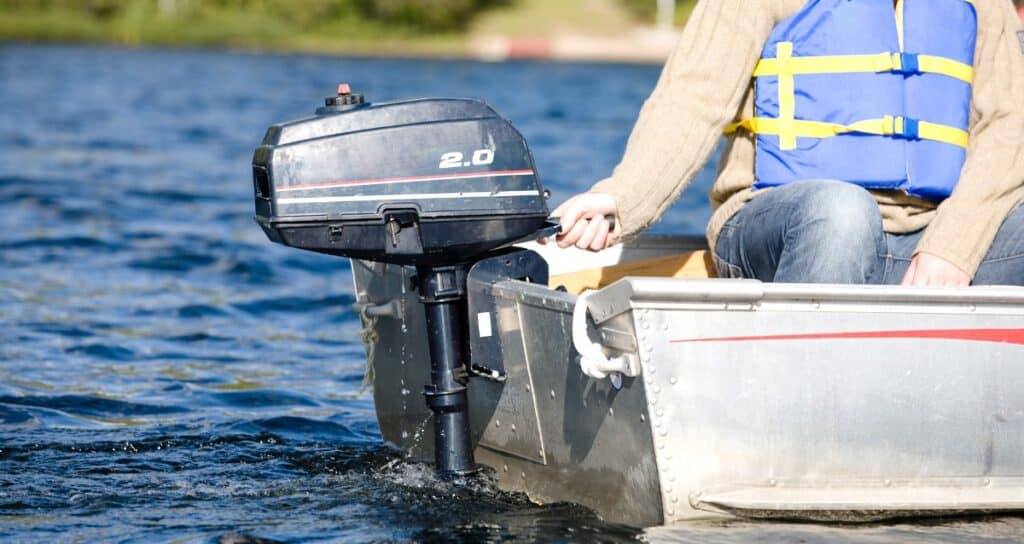
When your outboard won’t start, there’s a good chance you can fix it in a few minutes with no tools at all. I’ve been running outboards for over 50 years, including two decades of full-time life aboard. About 95% of starting problems come from the same short list of causes. Most take less than a minute to check.
It doesn’t matter what brand you have, or whether it’s a 2-stroke or 4-stroke. The checklist is the same.
Only one check below requires a tool, a small flat-blade screwdriver. A roll of Rescue Tape (Amazon) is also worth keeping aboard. It can patch a cracked fuel line well enough to get you home.
First: Don’t Drift Into Trouble
Before you start troubleshooting, make sure you’re safe. If you’re not tied to a dock, anchored, or tied to another boat, deal with that first. Row or paddle to safety, tie on, or drop anchor.
And if you smell gas, put out any cigarettes or open flames right now, before you touch anything else.
Always carry basic safety gear on the water. Here’s what I keep aboard.
Five Clues That Tell You What’s Wrong
Take 10 seconds before you touch anything. Notice what’s happening, then jump to the right section.
- It doesn’t sound like it’s even trying to start
- It almost starts, but won’t catch
- You smell gas
- You’re using an external fuel tank with a hose
- It starts, but dies when you put it into gear
It Doesn’t Sound Like It’s Trying to Start
No sign of life at all? Check these in order. These are the most common “nothing happens” causes.
1. Kill Switch (Deadman Cord)
Make sure the kill cord is attached properly to the motor. Don’t just glance at it. If it’s even slightly out of place, the motor won’t start. Unclip it and clip it back on firmly.
In my experience, this is the single most common reason an outboard won’t start. It’s also easy to knock loose when boarding or shifting around. Once you’ve ruled it out as the culprit, learn how to wear the lanyard to keep it clipped in underway without accidentally killing the motor every time you reach for something.
2. Out of Gas?
Yes, really. Check the fuel level. Easy to miss on outboards with a small built-in tank, common on motors around 6 HP and under.
If you have an external tank, there may be a little fuel left, but not enough for the pickup tube to reach. Try tilting the tank so the fuel pools at the end where the hose connects. Anything works — prop it on a life jacket, a bag, even your toes. Sometimes that’s all it takes to get home.
3. Tank Selector Switch
Some motors can run off either an internal or external tank, with a selector switch on the front of the motor. Make sure it’s set to the tank you’re actually using. It’s easy to bump the switch when you’re lifting, tilting, or moving the motor.
4. In Neutral?
Many outboards won’t start in gear. Make sure you’re in neutral. It’s easy to accidentally nudge the shifter into forward or reverse without noticing.
5. Battery (Electric Start Motors)
If you have an electric-start motor, the battery may be dead. Many smaller outboards also have a pull start. If yours does, try it manually. Even if you can’t pull-start it yourself, a nearby boater might be able to help. Know where the cord is before you need it.
It Almost Starts, But Won’t Catch
Trying but not quite firing? Start here, but also check the I Smell Gas section if there’s any fuel odor.
1. Choke
Try starting it both with and without the choke, even if you think you know the right setting. Sometimes that’s the entire difference between “almost” and “running.”
2. Throttle
Adjust the throttle position slightly. Not wide open, just a little more or a little less than your usual spot. Sometimes that small change is all it takes.
I Smell Gas
A fuel smell means one of two things: the engine is flooded, or there’s a leak in the fuel system. Work through these in order.
1. Flooded Engine
Flooded means too much fuel got into the engine. It does not mean you dropped it in the water — that’s a different problem entirely. Flooding is the most common cause of a fuel smell, especially after several failed start attempts.
Don’t squeeze the bulb. Then try one of these:
Option 1: Wait 10 minutes.
The excess fuel will evaporate on its own. This often works without any further steps, and it’s always the safe choice.
Option 2: Clear-flood start.
This only works if your motor lets you be in neutral with the throttle wide open at the same time. Many tiller models and some other outboards have a single control that combines throttle and gear shift with no way to separate them. Some have a trick to get to neutral independently first — on ours, you pulled the shifter out. If you’re not sure whether your motor can do this safely, use Option 1 instead. Attempting a clear-flood start when the throttle and gear are linked will cause the boat to lurch forward unexpectedly.
If you’re confident that you can be in neutral with the throttle open:
- No choke
- Throttle all the way open
- Pull-start 2 to 3 times (sometimes a few more)
The motor doesn’t start after about 6 pulls? Stop and wait 10 minutes. If it fires and then dies, restart using your normal cold-start procedure.
2. Fuel Leak (External Tank Only)
If you have an external fuel tank and the smell was there before you started attempting to start the motor, or if you can see or feel fuel on the hose or fittings, you likely have a leak rather than a flooded engine.
Run your hand along the full length of the fuel hose. Look for a cracked, cut, or nicked section, or a loose clamp at either fitting.
If it’s a loose clamp and you have a screwdriver, tighten it. If it’s a crack or nick in the hose, wrap it tightly with Rescue Tape (Amazon) as a temporary get-home fix. Keep your speed down so the engine isn’t demanding much fuel, then replace the hose as soon as you can. One crack usually means the rest of the hose isn’t far behind.
You’re Using an External Fuel Tank
Most starting problems on motors with an external tank happen somewhere between the tank and the engine. Do a quick visual check from tank to motor, then run your hand along the full length of the hose. A lot of problems become obvious just from doing that.
1. Tank Vent Open?
Make sure the vent on the fuel tank cap is open. If it’s closed, air can’t replace the fuel being drawn out, and flow stops. If the vent is open but the tank looks collapsed or sucked in, the vent may be clogged. Crack the gas cap to let air in. That will usually get you home, unless it’s rough enough that water could splash into the tank.
2. Fuel Line Connected — Really Connected?
Lines can look connected when they’re not fully snapped in. Disconnect and reconnect at both ends (tank and motor), then tug gently on each to confirm they’re clipped in.
3. Fuel Line Kinked or Pinched?
Look for a kink similar to what you’d find in a garden hose. Common causes:
- Hose pinned under the tank
- Hose squeezed between the tank and the hull
- Someone stepping on it
- Gear sitting on top of it
Also, check right where the hose enters the motor. We once had a hose bent so sharply at that point that it was essentially crimped shut.
4. Squeeze Bulb Firm?
Squeeze the bulb until it feels firm, but don’t keep squeezing beyond that. Too much and you’ll flood the engine.
If the bulb never firms up, you may have a closed tank vent, a kink or blockage, or a cracked hose pulling in air.
If you squeeze the bulb and smell gas, stop squeezing and go to the Fuel Leak section above.
5. Blocked Fuel Hose (Delamination)?
Some hoses have an inner liner that can break loose and wad up inside, blocking fuel flow with no visible sign on the outside. To test:
- disconnect the hose at the motor,
- press the ball valve in the hose fitting with a small flat-blade screwdriver, and
- pump the bulb to see if fuel flows out strongly.
If it’s blocked, the real fix is a new hose. As a temporary workaround, keep your speed down and pump the bulb frequently to push fuel past the blockage and keep the engine running. The slower the engine runs, the less fuel it needs. Pump just enough to keep it going — over-pumping risks flooding the engine.
It Starts But Dies When You Put It Into Gear
This is the classic sign that something is wrapped around the prop. Turn the motor off, tilt it up, and check carefully. It’s usually a line, but I’ve pulled all kinds of things out of there over the years. Remove everything you find before you try again.
Bottom Line
When your outboard won’t start, don’t just keep pulling until you’re exhausted or run the battery dead. Take 10 seconds, look for the clues, and work through the likely causes in order. Most starting problems are simple fixes. And if it turns out you do need a mechanic, you’ll be glad you checked the basics first. A fellow cruiser once paid a mechanic his full one-hour minimum only to find out the tank selector switch was in the wrong position. Don’t be that story.
The Next Time This Happens, You’ll Want This in Your Hand
Got your motor running now? Super! But the next time it quits, you may not have your phone or be able to find this page. That’s exactly why I put together Outboard Troubleshooting for Beginners: a simple step-by-step checklist printed on waterproof, fuel-proof paper that lives in the boat and works when things are wet and messy. Also available on Amazon. And getting home is usually easier than it feels in the moment.


Carolyn Shearlock has lived aboard full-time for 17 years, splitting her time between a Tayana 37 monohull and a Gemini 105 catamaran. She’s cruised over 14,000 miles, from Pacific Mexico and Central America to Florida and the Bahamas, gaining firsthand experience with the joys and challenges of life on the water.
Through The Boat Galley, Carolyn has helped thousands of people explore, prepare for, and enjoy life afloat. She shares her expertise as an instructor at Cruisers University, in leading boating publications, and through her bestselling book, The Boat Galley Cookbook. She is passionate about helping others embark on their liveaboard journey—making life on the water simpler, safer, and more enjoyable.
Leave a Reply