When things are going well, it’s hard to remember that boat systems must be usable by everyone. There’s nothing like having a crew member ill or injured to remind us how important it is that crew can use all equipment regardless of strength, height, or age. To make sure your boat is accessible to everyone aboard, you must
- identify problem areas
- create a plan for addressing them
- invest in corrections.
This is how we updated two different cruising boats so I could do everything that my husband Dave could.
Of course, many crew don’t think about this until something happens to someone aboard. And then, it’s too late.
How Most Boat Crews Get Things Done
Most cruising couples and families end up with each person usually doing the same jobs on the boat.
I don’t want to call them pink and blue jobs because (a) I hate stereotyping jobs and (b) it often has nothing to do with gender, just who prefers to do what. Dave made the bed 95% of the time. I did 95% of the electrical work. Not stereotypical, but still a division of labor.
The Reality of Assigning Boat Chores
Some jobs, however, do tend to be “assigned” by strength or other physical characteristics. Dave is stronger than I am and, perhaps more importantly, taller. Those traits give him better leverage or the necessary reach for certain tasks.
Boat Systems Every Crew Member Can Use
When we began cruising over fifteen years ago, we made a conscious decision that every system on the boat must be usable by either of us. I say that we made the decision, but it was Dave’s background in heavy industry that caused him to suggest it. In his words:
Systems have to be designed to be used by anyone.
What it comes down to is can any crew member manage the boat if something goes wrong?
If You’re Alone, Can You Do Everything Needed?
When we started cruising, we envisioned that someday one of us could be injured or ill and the other one would need to essentially single-hand the boat. We all think about the horrific possibilities: heart attack, stroke, MOB. The reality is that even a minor injury, for example, a broken finger, can make certain tasks impossible.
When Dave needed medical care, our prep paid off. Dave had surgery to treat the chronic prostate infection he had been fighting for over a year. It was an outpatient procedure, but until he healed, he was forbidden to do much of anything other than sit or lie down. That means he couldn’t start the outboard. Or start the generator. He definitely couldn’t hoist the dinghy. No filling the water tanks. No climbing out of the cockpit, even to hang up a towel. But all those things still need to be done. We were, at the time, on a mooring ball in Marathon, Florida.
And while I may not have done “his” jobs as quickly and easily as Dave did, the fact is that I could do them. It bugged Dave that he couldn’t do what he normally did; he hates feeling useless. But I explain to him that he’s not useless — he’s the one who made sure I could do these things!
How To Do It On Your Boat
Are you ready to make every system on your boat usable for every crew member?
Identify Problem Areas
Swap all your routine jobs and note which ones are impossible or difficult for another crew member. This is best done during a low-stress time. You don’t want a less-experienced crew member anchoring with a gale expected. It’s also a team experience. Everyone has to feel comfortable giving feedback to help you create the best systems.
Create a Plan for Addressing the Systems That Don’t Work for Everyone
Do you have a list of upcoming upgrades or improvements? How will you implement them so that they work for every crew member? Do you have to order supplies (like a mast step)?
Create your plan, remembering to put safety items and daily chores at the top of the list.
Invest in Making Boat Systems More Usable
You’ll need to invest both time and money to make your boat systems work for everyone onboard. Increase your budget to ensure you can afford necessary improvements. Add small jobs to your schedule in the coming days and weeks. Not every task has to be a major project. Sometimes, just labeling equipment or creating a list of instructions can make a huge difference.
I find it useful to read about real-life application of general ideas. If you do too, keep reading for a description of how we adapted our boat systems on two different cruising boats.
Creating Usable Boat Systems on Our First Boat
No, it didn’t happen immediately, but every time we made an upgrade or improvement, we followed this basic principle.
- When we added an outboard crane, we put extra purchase in the block and tackle so that I could hoist the motor if I ever had to.
- We added a low mast step so that I could hook the halyard to the main sail. Before that, I could not reach it from the deck.
- Previous owners had installed oversize sheet winches, which made it possible for me to sheet in the sails (and furl the genoa) even when it was windy.
- Before we bought a 15 HP outboard for the dinghy, we made sure I could start it.
Doing It Again on Our Second Boat
On our current boat, we’ve done the same:
- We substantially modified our dinghy davits. Not only did we make them sturdier, but we also made it possible for me to hoist the dinghy with the motor on. We modified the lifting lines to include an additional purchase point and to automatically cleat when hoisting.
- Again, added an outboard crane, and once again used more purchase than what Dave alone would have needed.
- Our boat came with an electric windlass, but we would have added one had it not. While Dave could hoist our 35-pound Mantus without it, I would have had a very difficult time. An electric windlass is important for more than ease. It is a crucial safety feature.
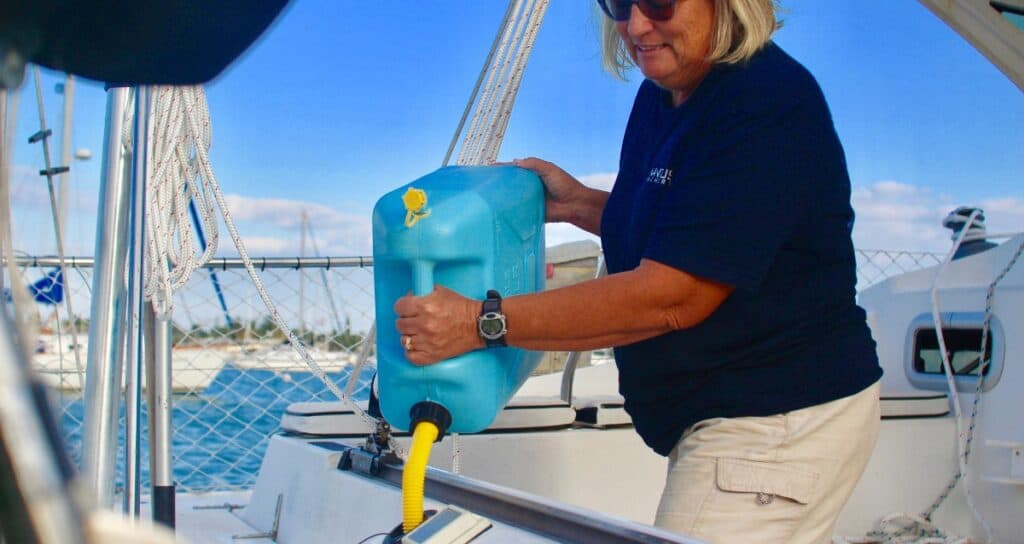
- We had a watermaker and used it daily. We both appreciated not having to lug jerry jugs of water. But while Dave could transfer 4 or 5-gallon jerries from the dinghy to Barefoot Gal, I had to do it one or two gallons at a time.
- We had a siphon hose for filling both diesel and gas tanks, and we had 2 and 2-1/2 gallon gas cans. I’d have had a hard time getting more diesel aboard if I filled the 5-gallon jerries full, but I could transfer their contents to the tank without a problem. Since the gas cans were smaller, I had no problem refilling them and getting them back aboard. If I really needed more diesel and Dave couldn’t help, I could always have filled the larger cans less full.
Along with physically ensuring we could both do everything on the boat, we also add little notes or cheat sheets: “fill to here” or “do this first.” On the dinghy davits and outboard crane, the lines are marked for the “all the way up” and “release to here to hook up” positions.
Accessible Boat Systems Make Life Aboard Better for Everyone
Dave’s forethought prepared us well for him being unable to do his usual tasks. It also helped us function better as a couple and a crew. If you’re concerned about being a good crew, you can get more tips from The Uncertain Cruiser course. With two tracks, one for the enthusiastic cruiser and the other for the reluctant one, all members of the crew will come out as stronger team members.
I hate to think how much more stressful Dave’s recovery would have been if our systems weren’t set up for everyone to use. I hope I’ve given you a few ideas that will get you thinking about the possibilities for your cruising boat.

Carolyn Shearlock has lived aboard full-time for 17 years, splitting her time between a Tayana 37 monohull and a Gemini 105 catamaran. She’s cruised over 14,000 miles, from Pacific Mexico and Central America to Florida and the Bahamas, gaining firsthand experience with the joys and challenges of life on the water.
Through The Boat Galley, Carolyn has helped thousands of people explore, prepare for, and enjoy life afloat. She shares her expertise as an instructor at Cruisers University, in leading boating publications, and through her bestselling book, The Boat Galley Cookbook. She is passionate about helping others embark on their liveaboard journey—making life on the water simpler, safer, and more enjoyable.
Julia Pilon says
This site has lots of great tips for me!
Carolyn Shearlock says
You’ll be younger than Dave was when we started cruising. It’s possible at any age . . . see my post on Cruising at 75+.
The Boat Galley says
Hope he’s doing well now. And yes, incredibly important to be able to manage single-handedly.
Carolyn Shearlock says
You can do it — I know plenty of women who single hand!
Sharon Ellens says
Your last statement is the key — patience with each other is something my husband and I both have to work on! We plan to do more task-sharing this coming summer; I like your idea of laminated cheat sheets.
Carolyn Shearlock says
Yes, we run it here and know of several others (including one former Spectra rep) who use theirs. We test it the same as we do anywhere — with a PPM Total Dissolved Solids tester. The biggest thing that will happen using it in a harbor is that prefilters will clog a little faster. Katadyn — who makes our watermaker — sees nothing wrong in using watermakers in harbors as long as there hasn’t been any sort of a petroleum spill (petroleum will ruin a watermaker membrane). A 0.5 micron carbon block (not carbon wrapped or carbon granules) filter will remove both giardia and cryptosporidium: see Choosing the Right Water Filter
The Boat Galley says
I agree. You don’t have to be super-boater, but you have to know the basics.