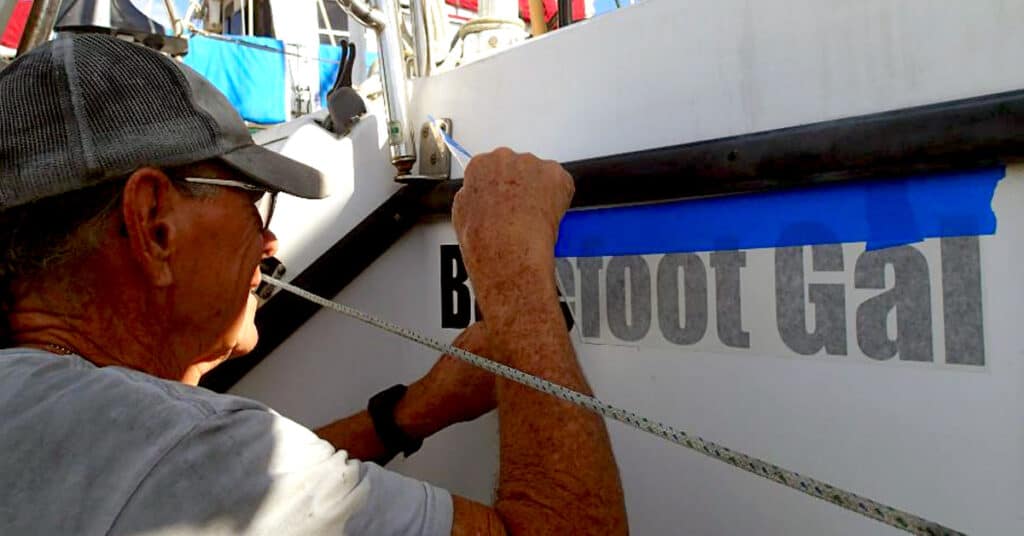
So why do we DIY on the boat?
More than one reader has commented that we do a lot of our own work on our boat. And – in more polite terms, of course – we get asked a couple of questions quite frequently:
- Are you just cheap?
- Do you just like to work on your boat? As opposed to, say, going somewhere on it?
While there may be some element of cost-consciousness in doing our own work, that’s really not it.
Self-Sufficiency
We do get a certain satisfaction in being self-sufficient, but we’d much rather spend our time exploring new places, sailing and socializing. But when something breaks, or we decide it needs to be changed/upgraded, the work has to be done somewhere by someone. Professionals might be faster; often they’re not due to full schedules. By doing it ourselves, we can, to some extent, determine the timing and location.
I’ll start by saying that Dave and I are both reasonably mechanical, but we were never big on home improvement ashore. Neither of us came to cruising with any special set of skills or background that would be particularly helpful in boat work. So it’s not like any of this is stuff we’ve been doing all our lives.
When we bought our first cruising boat, we hired out most of what we needed done. And we had mixed results. Some work was very good and some not so good. Sometimes something wouldn’t really be fixed, and sometimes it was made worse.
When We Work on the Boat, We Care
When we pay a professional to do a job, we think that it’s going to be done right. Better than we could do it. Faster. And sometimes, yes, that’s true. But many times it’s not. Even though a particular job may have been something we knew nothing about when we started, we were virtually always successful.
I think a large part of that was because we cared. We weren’t just picking up a paycheck for our work; we were going to have to live with how the job was done. So we’d research. Watch YouTube. Do something and re-do it if the results weren’t satisfactory. We were far more tenacious.
Our Turning Point
A case in point, which was actually a turning point in our DIY or not mindset: in 2005, our refrigerator just wasn’t cooling sufficiently. Two repairmen couldn’t find the problem; we finally figured out that it was low voltage from dying batteries on our own.
It was an A-HA moment. We didn’t have to be experts. We had owner’s manuals, books from Nigel Calder and Don Casey, the internet, and other cruisers. With their help, we could figure stuff out. Little by little, we began doing more and more of our own work.
Future Benefits of DIY
The more of our own work that we did, the fewer problems overall that we had. We had a better understanding of the routine maintenance needed and spotted potential problems before they became something big. When problems did arise, we knew what we’d done before and where the likely trouble spots were.
If we discovered a problem while doing one job, we’d go ahead and fix the other thing as well. Most professionals aren’t going to do that: they do the job they were hired for, and that’s it. Yeah, it’s that old project creep and one of the reasons it takes longer to do something yourself. You know, things like when you run a wire for your new fan and find another wire that’s not crimped but just twisted and taped, so you take the time to take it apart and crimp it properly.
We Choose the Parts
Removing old parts and having to decide exactly what new parts to buy has paid off for us, too, versus letting someone else spec out a job. So many times, it’s when we get in there to remove the old whatever that we discover why it failed or wasn’t satisfactory – or another problem with it. And then when we choose the new, we can read product descriptions and reviews to try to find something that will work better – or an improved installation method. (Admittedly, sometimes we still choose a dud.) Ordering parts ourselves, too, we get to choose the quality. And we aren’t limited to an in-house supplier.
Discovering Problems When You DIY
We removed our lifelines with plans to send them out to be redone. Many rigging shops offer a service where you can send them your old ones, and they’ll duplicate them. A friend convinced us to do them ourselves, saying we could borrow his swaging tool.
Although Dave and I had looked at what we had when we removed the lifelines, it wasn’t until I started measuring what we had to figure out what I needed to order that I discovered that we had four close but different-sized fittings: 6mm, 1/4”, 8mm and 5/16”. And only three different sizes on the threaded studs. So some had been jammed and cross-threaded together. Other connections didn’t have any locking mechanism, and I discovered one lifeline with no adjusting turnbuckle. Had I not been buying parts, we wouldn’t have known — and the shop probably wouldn’t have noticed the difference since we would only have sent in the ends with the threaded studs.
I had to buy additional parts, but the problems will be corrected: we’ll have one size of connector, none will be jammed on, the cross-threaded ones are headed for recycling, all that are threaded will lock, and we’ll be able to adjust the length of all. We also decided to use different hardware in one area to avoid a chafe problem. And I chose to use 316 stainless instead of the “standard” 304 that the rigging shop used.
We Don’t Do Everything
Admittedly, we don’t do everything ourselves. AC power is one that we do very little with – a mistake could kill us instantly. Other times, we go a semi-DIY route: we’ll hire a “consultant” or someone to work with us. That was the case with our solar panel installation. Alex helped us figure out what we needed, and we did 90% of the work on our own. We learned about our system, it cost less, and we got it done sooner than if we’d needed to wait for a larger slot in Alex’s schedule (he was at our boat a couple times for an hour each time and had a little shop time vs. the two days he’d have needed if he did everything).
We Can Do More On the Boat Than We Thought
The longer we cruise, the more we do ourselves. We’ve come to realize that most of what needs to be done isn’t really that difficult when you break it down. We’re not trying to come up with new ways of doing things. The how-to and troubleshooting guides are all out there. Google is the cruiser’s best friend.
The more we try (and succeed at), the more we’re willing to try. Dave and I find that often it’s the idea of doing something that’s scary when you’ve never done it before. Who? Me? Fill in a thru-hull? But actually doing the work isn’t nearly as mind-boggling as we anticipated. Yes, it may be tiring, and yes, we may spend some time at various points staring at parts and re-reading the book and then watching YouTube for the seventh time, but suddenly things will click, and we’ll get it done. We’ve learned to allow plenty of time for new things and take it step by step. Hey, that thru-hull is patched!
NOTE: I don’t want to imply that we’re against hiring professionals. Good ones are wonderful to work with, and we seek them out whenever we can. But we also try to learn how to do things on our own. We’ve found that the truly top-notch pros aren’t afraid to teach as they go.
Other Cruiser’s Thoughts
We’re not the only cruisers taking the DIY route. Cruiser Jonathan suggests several excellent reasons to work on your boat yourself:
1. Many times a failed item is a simple fix. Learning basic troubleshooting, by trial and error if necessary, will save you time and money in the long run.
2. Learning DIY skills will enlarge your cruising grounds. It’s much easier to travel farther when you don’t need to rely on professional help for every repair. After all, when you’re forty miles offshore, you can’t just call for a repair person.
3. Developing DIY skills allows you to “pay it forward” when another boater is in a jam. Sometimes two DIY brains tossing the problem back and forth makes the light bulb go off.
As you know, the cruising community is very important to me. This may be my favorite of Jonathan’s reasons.
Victor also makes the excellent point that when you do it yourself, you can take the time to plan the project out to its best completion. Taking your time in preplanning can result in a neater job.
I hope some of our reasons help you find the confidence to do more on your boat. DIY is a great way to go, for so many reasons.

Carolyn Shearlock has lived aboard full-time for 17 years, splitting her time between a Tayana 37 monohull and a Gemini 105 catamaran. She’s cruised over 14,000 miles, from Pacific Mexico and Central America to Florida and the Bahamas, gaining firsthand experience with the joys and challenges of life on the water.
Through The Boat Galley, Carolyn has helped thousands of people explore, prepare for, and enjoy life afloat. She shares her expertise as an instructor at Cruisers University, in leading boating publications, and through her bestselling book, The Boat Galley Cookbook. She is passionate about helping others embark on their liveaboard journey—making life on the water simpler, safer, and more enjoyable.
Cheryl Bular says
Very well said. Been there and learned that lesson. Just DO IT YOURSELF
The Boat Galley says
Prepare for the worst, hope for the best. The system is over 1,000 miles wide so it’s really hard to say what will happen and when.
John Hodgson says
The Boat Galley which system is being discussed L99?
The Boat Galley says
John Hodgson Invest 99L — currently in the SE Bahamas