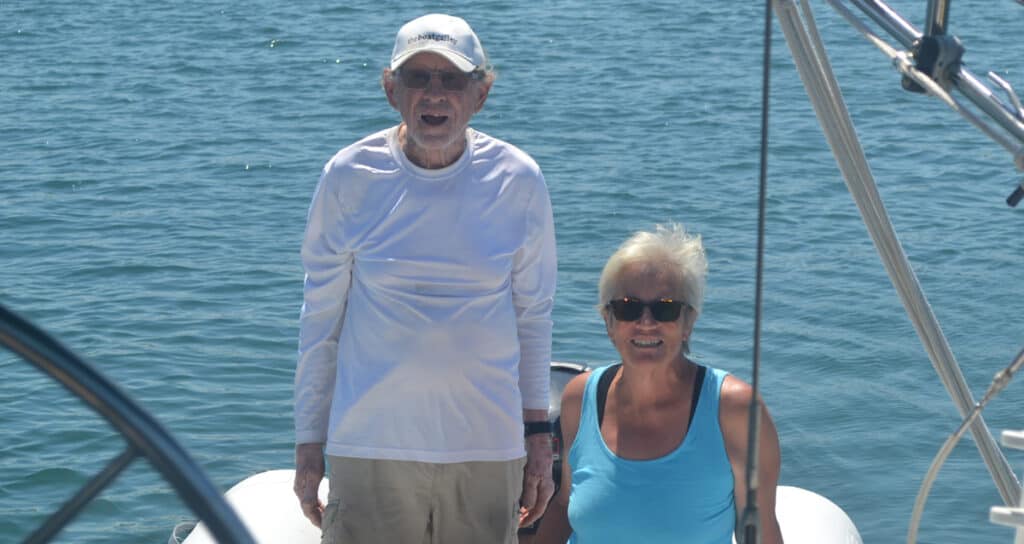
Yes, you can go cruising in your 70s, and yes, you can keep going well into your 80s. People do it all the time. The honest gates aren’t age itself. They’re physical fitness, balance, mental sharpness, and how much you want it.
My husband Dave and I began cruising full-time when he was 64 and I was 42. We cruised together for 21 years, across the Sea of Cortez, Pacific Mexico, Central America, the Florida Keys, and the Bahamas. Dave actively cruised until he was 83. We lived aboard until he was 85, when his heart and kidney issues finally made it impractical and we moved ashore in October 2023. That’s more than two decades of watching how cruising changes as you get older, and what it really takes to keep doing it.
So when someone asks me if they’re too old to start, or too old to keep going, my honest answer is: probably not. But it’s worth understanding what actually changes.
Starting With Some Boating Background vs. Starting From Zero
Readers of this article fall into two rough groups, and the on-ramp looks different for each.
If you have some boating background already, you’re further along than you think. Maybe you sailed as a kid, or owned a powerboat, or chartered a few times. The core skills are still there. What you’ll need is time to build up cruising-specific competence: anchoring, weather, provisioning, boat systems, handling the boat in close quarters. Chartering for a week or two at a time is a great way to stretch those skills before committing to a boat of your own.
If you’re starting from zero, welcome to the club. Plenty of people do. Many Loopers, the folks who cruise America’s Great Loop, begin with no boating background at all, often in their 60s. The Loop runs mostly through protected water, with a strong community of fellow first-timers and plenty of professional help available along the way. It’s one of the most age-friendly on-ramps into cruising that exists.
If you’re brand new to sailing specifically, our podcast episode with Nica Waters on how to learn to sail walks through the real options: community sailing clubs, formal schools like ASA and US Sailing, chartering with an instructor aboard, and crewing on other people’s boats. There’s no single right path, but there are a lot of good ones.
And if you’re still in the dreaming phase, trying to figure out whether cruising is actually realistic for your situation, may I suggest our course From Dreamer to Cruiser. Pamela Douglas built it for exactly this reader: someone who’s interested in cruising but isn’t yet sure how to get there, or whether they can.
Acknowledge the Limits, Then Work Within Them
The single biggest lesson I took from watching Dave cruise into his 80s is this: honesty about your limits is what lets you keep going.
It’s easy to gloss over limits when you live ashore, or even when you’re tied to a dock. Out cruising, you can’t. You just can’t do what you did even five years ago, and pretending otherwise leads to injuries or worse. Once you acknowledge the limits, though, you can figure out how to work within them. That’s where all the rest of this comes from.
Every Person Aboard Has to Be Able to Run the Boat, or Accept What Happens If They Can’t
This one matters more the older you get, and it’s the part most people underestimate. The requirement is simple: every person aboard has to be able to run the boat, or understand and willingly accept the consequences if they can’t. That second option is a real option. It’s just one you have to choose with your eyes open.
Cruising as a Couple
The ideal is that both people aboard can run the boat. Not at advanced levels, but at working levels: starting and stopping the engine, raising and dropping the anchor, running the radio, reading a chart, handling the boat in and out of a slip. If your partner has resisted learning the boat, that’s a conversation worth having before you go cruising later in life, not after.
Here’s the honest version if that conversation doesn’t go the way you hoped: if one person can’t run the boat, you are effectively single-handing with extra crew aboard. That’s a real option, and plenty of couples cruise that way. But the risks are the single-hander’s risks, not the couple’s risks. And those risks go up with age, because the odds of a stroke, heart attack, fall, or sudden illness climb as you get older. At 45, it’s unlikely the non-skipper will ever have to take over. At 75, it’s no longer unlikely. That’s the tradeoff you’re accepting.
It also means the boat itself has to be set up so whoever’s aboard can operate every system. We wrote years ago about designing boat systems that everyone can use, and the principle matters more every year. Extra mechanical advantage on the dinghy davits. Winches that the smaller person can actually crank. A windlass that doesn’t require brute strength. Smaller jerry cans so nobody has to lift 40 pounds over the lifelines alone.
Single-Handing
For a solo sailor, this same requirement is sharper. If you have a heart attack at anchor three miles from shore, it might be survivable. It might be a mild one. But it’s going to be on you to get yourself the help you need. Nobody else is going to do it for you.
Plenty of older solo cruisers cruise with that reality in full view, and it’s not the same thing as being reckless. It does mean being clear-eyed about it, and it means building every safety net you reasonably can: AIS, reliable communications, a check-in schedule with someone ashore, medications and equipment where you can reach them in a bad moment, and a brutally honest assessment of what you can still do alone on a bad day.
The Bigger Version of This Conversation
What we’re really talking about here is risk, and the risk goes up with age. The older you are, the more likely you are to have a medical event while you’re out cruising. That’s not alarmism, it’s just statistics. Dave and I talked about this, too, long before the heart and kidney issues showed up.
The truth is either of us could have died out there because of how far we were from medical care. Something that would be survivable in a city, a heart attack, a stroke, a serious injury, can be fatal when you’re a day’s sail from the nearest hospital. At 50, the odds of that mattering on any given passage are small. At 80, they’re not.
And honestly, the odds were higher for Dave than for me. That meant we weren’t making the same calculation. Dave had to accept the possibility of his own death out there. I had to accept the possibility of losing him out there, and being left alone on passage or at anchor, possibly in a foreign country, and then alone in life afterward. Those aren’t the same decision. Mine was harder in some ways. I had to embrace Jimmy Buffett’s “I’d rather die while I’m living” on Dave’s behalf, too, because he’d rather have had those years cruising than spent them sitting on the sofa watching TV. And so would I, for him.
That’s not the right calculus for everyone. It’s a calculus you get to make, consciously, rather than having “too old” made up for you by someone else.
Staying Injury-Free Is the Whole Game
Broken bones, pulled muscles, bruised ribs, wrenched backs, all of these take longer to heal as you age, and it’s harder to regain full function afterward. Nearly every practical decision we made as Dave got older traced back to lowering the chance of injury.
That starts with fitness. Dave was firmly in the “use it or lose it” camp and worked to maintain his strength, balance, and agility. Living on a boat helped. It’s a bit of a circular proposition: you have to be physically fit to cruise, and cruising keeps you physically fit. Climbing in and out of the dinghy, moving around the deck, hoisting sails, it all adds up to a pretty solid daily workout.
The mental side matters just as much. Cruising keeps your brain working: figuring routes, solving problems, dealing with whatever the day throws at you. That has to be better for long-term mental sharpness than sitting on the sofa watching reruns.
Choose a Boat That Works With You, Not Against You
When we bought our second boat in 2014, we made her easier to handle on purpose. Our first boat, Que Tal, was a heavy bluewater-capable Tayana 37 with a 66-pound anchor, big sails, and a full keel that, in the words of another Tayana owner, “backs like a drunken elephant.” She was a great boat for what we bought her for, but she wasn’t going to be the right boat for Dave in his late 70s.
Barefoot Gal, our Gemini 105M catamaran, was a deliberate choice in the other direction. Smaller sails, easier to raise and trim. Thirty-five-pound anchor instead of 66. Much more maneuverable in close quarters, which makes anchoring, docking, locking through bridges, and picking up mooring balls far less stressful. Faster under both sail and power, so days were shorter and we arrived less tired. Side entry to the queen berth instead of crawling into a V-berth. No long companionway steps to navigate with an armload of groceries. You can read more about why we picked her if you want the full comparison.
A catamaran isn’t the only right answer. Plenty of older cruisers do beautifully on smaller, simpler monohulls. The principle is what matters: choose a boat that’s easier to handle than you technically need, not harder. It is tempting, as your finances allow, to buy bigger and more complex as the years go by. Dave and I were not at all convinced that bigger is better. For older cruisers, it’s usually the opposite.
Mechanical Advantage Is Your Friend
Anywhere you can replace muscle with leverage, do it. This becomes more important every year. Same principle as before, too: every system has to be set up so whoever’s aboard can operate it alone.
- Dinghy davits with extra purchase. We beefed up the davits and added more mechanical advantage to the lifting lines. We also added a block with an integrated cam cleat so the line cleats automatically as you pull. Pull a foot or two, reach for the next handful, the line holds itself. No one-handed struggle.
- An outboard crane so the motor goes from the dinghy to the stern rail without being hand-lifted. This also meant we could run a larger outboard than we otherwise would have.
- An electric windlass. We consider this a major safety feature on any cruising boat, and essential as you get older. With it, you’ll re-anchor as many times as you need to, move to a better spot when conditions change, and get off a lee shore when you need to go now. When our windlass motor died in the Bahamas once, we could still manage the 35-pound anchor and quarter-inch chain manually, but only just. A bigger boat with a bigger anchor would have been a different story.
- A watermaker. Lugging 40-pound jerry cans of water from shore gets old fast, and docking for water has its own injury risks. A watermaker eliminates both.
- Bigger winches, longer winch handles, rigging the jib furler so it runs to a winch. Every bit of mechanical advantage buys you capability you’d otherwise lose.
- Good blocks. Dave was insistent on this. Bigger, better-quality blocks (we liked Harken) make a real difference anywhere a line is under load.
How the Daily Pace Changes
Our style of cruising got slower and less ambitious as we aged, and we were happier for it.
We got more conservative about weather windows. We weren’t waiting for perfect conditions, but we were willing to sit a few extra days for better weather rather than push through something iffy. What good is getting somewhere two days sooner if you spend those two days recovering from a rough passage? We were also quicker to move to a more protected anchorage when conditions looked like they were deteriorating.
We shortened our daily runs. When Dave was in his 70s, we aimed for no more than 50 miles a day. By his 80s, we aimed for 30. We tried to arrive in a new anchorage by late afternoon, not at sunset, so we had light and energy to get settled. Long days and overnight passages still happened sometimes, but we planned around the fact that he didn’t have the stamina he used to.
We made checklists for everything. Most of us don’t have the memory at 80 that we did at 60, and cruising has a lot of small steps that can’t be skipped. Checklists, reminder labels on equipment, and calendar reminders really help.
We also spent more money. Annual haul-outs got more help hired. We took taxis instead of carrying loads back from the grocery store. We ducked into marinas when bad weather threatened rather than toughing it out at anchor. It all added up to higher annual expenses, and it was worth it.
It’s Possible If You Want It Enough
Dave called it “geezer cruising,” cheerfully, right up until the end. He was still out there actively cruising at 83 and living aboard at 85. Starting later, like many Loopers do in their 60s, is very much a real option. Continuing into your 70s and 80s is very much a real option.
The style of cruising may change. The boat may change. The destinations may look different than the original dream. The important thing is figuring out a style that works with whatever you’ve got, and doing everything you reasonably can to avoid the injuries that shut cruising down for good.
If it’s what you want to do, you can almost certainly find a way to make it happen.
Still Figuring Out If This Life Is for You?
Questions like “am I too old?” rarely come up in isolation. If you’re working through what cruising would actually look like for your situation, join the 22,000 readers who get our weekly newsletter. Every Wednesday morning, one article for cruisers at every stage, plus the week’s recent posts across boat systems, provisioning, safety, and life aboard.
Carolyn Shearlock has lived aboard full-time for 17 years, splitting her time between a Tayana 37 monohull and a Gemini 105 catamaran. She’s cruised over 14,000 miles, from Pacific Mexico and Central America to Florida and the Bahamas, gaining firsthand experience with the joys and challenges of life on the water.
Through The Boat Galley, Carolyn has helped thousands of people explore, prepare for, and enjoy life afloat. She shares her expertise as an instructor at Cruisers University, in leading boating publications, and through her bestselling book, The Boat Galley Cookbook. She is passionate about helping others embark on their liveaboard journey—making life on the water simpler, safer, and more enjoyable.


John Feemster says
Good then I won’t feel so bad at 55
Cheryl Bular says
Everything you said is very accurate. We’re in our early 70’s and have found life aboard is much less stressful if you maintain a positive attitude, keep one hand for the boat, and wait for weather, always.
Jan Bogart says
We are the same age, and my husband will be 73 this year!
Florian says
I still remember an elderly English couple that I got to know in Cannes decades ago. They were both approaching their 70ies, but were very lean and fit. When they showed me their boat it was obvious why: they sailed a 26 metre steel cruiser-racer, a sleek and apparently very fast boat. They had converted everything demanding & mechanical to electrical and had re-rigged the boat, so that one person could operate it from the cockpit. When asked by me why they went through all this hazzle the elderly lady – who could have jumped out of a Rosamunde Pilcher movie – looked at me, smiled and said: “My dear, we may not be the youngest anymore, but we love racing and speed…”. The next morning I helped them getting out of the marina, and once they had cleared the breakwater they hoisted every piece of canvas that they had and went off like a rocket. That was the day when I decided to die whith oak under my feet and the wheel in my hands. They were amazing !
Florian says
And a bit more about ourselves: we are in our ‘Screaming 50ies’ and sail a girl much older that we are, a 65 ft. 1923 timber gaff ketch with internal keel that allows us to sail very close to beaches and reefs due to her low draft (1.6 metres). Like all others we believe that age has the benefit of getting smarter (sometimes at least 🙂 and having more experience; being mindful about what can, and cannot be done, is paramount to stay healthy in your later life. If the weather looks iffy, we have a cuppa instead, if an anchorage doesn’t look ok we look for the next one, etc. ‘Smart / cautious / mindful’ doesn’t mean ‘boring’ – it just allows us to experience more in a safer way.
Did I mention that I am legally blind (I still can see a tiny bit, but honestly not a lot) ? Probably not, but I can assure you it does not matter at all – I sail mainly by the seat of my pants, the feel in my feet, sense of smell (coastlines !) and hearing; feeling the movements of the boat, hearing how wind & waves play around us, using a few smart alterations on board and playing it safe always allows for a good run. Everything on our ship is manual, even hoisting the Gaff Mainsail, so it gives us a good workout & at the same time forces you to slow down and think first. However, while keeping the ship as authentic as possible we have a lot of modern safety features – admittedly in disguise – on board; most importantly an active AIS to avoid collisions and passive radar reflectors, but chart plotter, radar, electronic & manual charts (the latter more for my wife than me :-), etc. make our life easy.
And we love the stream of ideas that frequently comes in from ‘The Boat Galley’ ! While most of the stuff is suitable for more modern cruisers a lot of ideas have been adapted, modified and integrated in our ship. Great job, Carolyn, keep the goodies coming !
Rebecca says
Boat Galley thank you! This post encourages me and gives me comfort we are not to old! Husband and I are planning our retirement and boat purchase and crusing are in focus for next year.
Carolyn Shearlock says
Nah, you’re not too old!
Sandy says
My father-in-law is still cruising at 83! We just did the reverse of your current trip this winter and loved it 🙂
Randy Hicks says
Excellent advice. Thanks.
Kathy says
We are both in our 70’s and are still living aboard and cruising. Our home is a motor yacht and we basically did many of the same things with our mechanical systems over the years. Either of us can run the vessel and we work hard to maintain our capability to do so. Thanks for encouraging others to continue to enjoy our water based life-style.
Deb says
We have Guy in our club that single hands at 95. He is amazing. He does short cruises and takes a nap when he gets there.
Carolyn Shearlock says
Love it!
Claire Ford says
Great article! My husband is also 78, and I’m 65. My philosophy is, “Never sit down!” You stay young by moving, and cruising helps with that along with thinking skills. We’ve just moved up from a 28′ to a 44′ and can hardly wait to get out on the water again. Think young, be young. Also, we love TBG articles and suggestions.
Donna Chiappini says
Thank you for this article. I’m 59 and my husband is 61. We have been coastal sailors for over 10 years now. We recently purchased our second and hopefully last boat, a brand new 45′ monohull that will take us into retirement. But, we have a few years to go before we can officially retire. I worry all the time that by the time we actually can retire, we won’t be able to sail for one reason or another. As sailing for long trips is our retirement dream, keeping our health now is paramount. We look forward to posting and blogging about our amazing adventures like you do. You two are an inspiration.
Tom Alvord says
It is always enjoyable to read the boat gallery articles. I look forward to them arriving in my email.
Donna Blagg says
We too are cruising in our later years. We will both be 70 this summer. When we were 35 we took an early “retirement” for 5 years ans cruised the Bahamas, Turks and Caicos, Jamaica, Honduras, Guatemala, Belize, and the eastern coast of Mexico. Since then we went back to work, cruising only locally (Florida gulf coast and the Keys) as time and vacation permitted.
Now we are back into cruising full-time nearing our 70’s. And have added some features
to make our boat safer in our later years. One huge improvement that you did not mention (nor may it apply to many boats) is that we have added Treadmaster decking. I now feel totally safe walking anywhere, no fear of slipping on the cabin house or any deck surface.
This application is now 4 years old. We did this project ourselves and could not be more pleased with its durability and safety security.
Hope this may help those with slipping on deck concerns.
Henry Kivett says
I read with great interest your article and I too am at that age (76) and up till now was about to give it all up. Thanks to you I may give it another shot at trying. My boat is a 1986 CS 30 and over the course of 5 yrs have rigged it for single handed operations. The only thing i don’t have is the water maker and davits and for the cost of it have not considered it. I do have a brand new dinghy (still in the box) and hoist system attached to the radar mast. Is there a cheaper water maker out there if so let me know where the cheapest one i have found is $4000.00. I can live without the davits but water and fuel is a different thing altogether.
Carolyn Shearlock says
Unfortunately, I don’t know of any that are much less than that new. If you are lucky, you might find a used one that someone wants to sell at a good price. Good luck and don’t give up!
Barb Fonner says
My husband and I just turned 73 in June. Last December we bought a 36 year old 55 ft. Ocean Alexander Flush deck from a seller on Vancouver Island in British Columbia (we live in Florida).. We have never cruised before or owned a boat. This was totally uncharted territory for us. After months of repair on the hard replacing black water systems, practically all the wiring, and other repairs too numerous to mention….we are now cruising the Pacific Northwest and the Gulf Islands. We read everything we could, got lots of training, asked thousands of questions at the repair marina, had a few false starts, some days of buyers remorse, a few “marital spats”, and spent way more money than initially planned for the first year!!! HOWEVER, we are in better physical shape now than four months ago. My hubby lost of ten pounds, and we can bend, stoop, hang, hoist and climb and contort these old bodies like twenty years ago. We are actually quite amazed and out kids say we look better and younger than the “before” picture. Now we just need to find a Florida winter activity that will keep us tuned up for next year in Canada. I don’t think golf is going to do it. We did it!!!! So can you! P. S. Everything we bought at the suggestion of The Boat Galley has turned out to be great!!! This website was kind of my bible! Thanks Carolyn
Carolyn Shearlock says
That is SO great to hear, Barb!
Michael. Meyers says
I did it at 65. At 70 i sold my beautiful sail boat and bought a 42″ power boat. I’m not sure l did the right thing.
Sellers remorse. My new boat has everything but character.
Good luck with your choices and decisions.
Mike Meyers
Stefan says
Wonderful to hear.
Warm regards,
Stefan (only 57)
Jim Creighton says
May I suggest to your readers that they consider a junk rig for their elder years’ sailing. It is particularly practical for elder sailors. It can extend the years you can sail comfortably. Without going into the subject here, I suggest going to The Junk Rig Association website and find their publications on the subject. See also the website called Teleport Expeditions and read their account of transiting the North West Passage in a junk rigged boat I built for myself back in the 80’s.
Erika says
Thank you for sharing all of this! I’m 53 and my husband is 71. We plan to buy our boat in the coming year and move aboard shortly afterward. Most people think he is too old and that we are insane; but it is a shared dream and we hope to be able to at least get in a few years if not more before health issues send us back to land. Your post gives me great encouragement and some useful tips! Much appreciated!
Carolyn Shearlock says
You’re not insane! Enjoy it.
Allan Young says
I am 66 and have parkinsons however i hope to get back into sailing again later this year
I would love to hear from any other parkinson sufferers out there as to how they cope
Anonymous says
Brian Kasch
Anonymous says
I’m in my 70’s and Deb’s in her 60’s and we think we have some cruising years left in us. Good article.
Anonymous says
As George Burns used to say, “You’re only as young as the girl you feel”.
Chris says
What a great article. Thanks so much for the encouragement. My husband and I are nearly 70 and are looking to explore this lifestyle for the first time.
Also great thanks to Barb Fonner for sharing. What an inspiration. A great source of encouragement as well as a great idea to buy something old and spend time fixing it up. What better way to learn about your boat and support self-sufficiency.
Love this website. Many thanks, Carolyn!
Randy Mabry says
I thought I was the odd one – turning 74 & “girlfriend” 70 & just completing the last 2 month cruise in the Bahamas with hurricane Dorian skirting us by 70 miles. We were in the Berrys. Still easily dive to chk the anchor(s). Close to selling all & cruising full.time to include Dominican Republic & south. Struggling with giving up my 3 Harleys & 2 Corvettes, tho.
Carolyn Shearlock says
No, you’re not odd at all! Glad that you missed the worst of Dorian. Maybe the bikes and cars can go in storage for trips back to the US? Selling everything doesn’t have to be literally selling everything.
Kathy says
Met this amazing couple this past summer. They’ve got a reputation all over the globe and a huge fan club. If you’re still able to cruise at age 104, no fussing about being in your 50’s!
Jeff Lilley says
I am 59 and my wife is 62. We sail actively in Hawai’i on our Wauquiez Ketch. In many ways, sailing here has been a great exercise in getting ready to cruise extensively. 20+ knots of wind and 4ft. seas are normal fare for us. We have been slowly refitting Orca with gear that will allow us to sail for many years to come. I have often wondered if we will be up to it in 7 years or so when I retire. You are an inspiration! We will retire to Puget Sound and plan to cruise there till we die. Thanks for the inspiration.
Jerry Gotts says
I guess I am the odd one!! I will be 68 in December and have done very little sailing. Some day sailing but mostly armchair ! I would love to live out a dream I’ve had for years. (living full time on a sailboat) I can retire this year and my plan would be sailing mostly the coast of Florida staying in a marina from time to time but mostly anchoring out. Am I too old ???? I understand that you can sail until you are older but I have not had much experience. I am a quick learner and could take classes.
Jerry
Carolyn Shearlock says
You’re not too old. Get some classes now — don’t wait any longer!
Bud Roberts says
I’m 72. I have a 23 foot Venture of Newport 23 cutter with retractable swing keel that is outfitted for solo Chesapeake Bay cruising with features good for oldsters. More handholds and footholds and non-skid on deck. Raised gunwales. Being a cutter she has 2 foresails (“jibs”) each of which is smaller than a sloop’s 1 big jib; being smaller, each sail is lighter and easier to handle. Otoh it’s 2 sails to set and tack and adjust, not one. Downhauls on foresails eliminate having to go onto foredeck to drop sails under way. Bigger fasteners everywhere are easier to manipulate.
Speed chocks on all sheets. All 14 lines led to cockpit. That’s a lot of lines so they’re color coded and chocks(?) labeled. Dyneema with blocks has replaced wire on backstay, making it easy to rig & de-rig & tension stays. Lots of fenders to aid solo docking!
I give credit to previous owner for lots of this; these features were a big part of my decision to buy this boat. It’s a hundred details that make it easier to operate a boat.
Cheers and happy sailing.
Boatman Bob says
I will be 77 this summer, have a 40′ Riviera flybridge convertible with diesels. We cruise every summer (wife is 75) mostly alone to weekend destinations, and, 1-2 week cruises out to Rhode Island, Connecticut, and South to Virginia Beach, Ocean City Md, the Chesapeake and NJ. Thus far, I handle the boat myself with my wife assisting tossing a line to the dock where some of the time there is help, or I simply climb down from the bridge and do it myself. I have no issues physically, and no plan to stop anytime soon. As long as I can get to the flybridge and run my boat, I will continue to cruise well into my 80’s! I bike ride 3-4 times weekly (weather permitting) and lift iron once in awhile, more so when its warm out. (garage is cold). Had always dreamed of running boat to Florida for the Winter, but the cost of fuel and dockage over the past few years has made that prohibitive (but still want to do it).
Carolyn Shearlock says
Great to hear!!
Drew Murphy says
Hi Carolyn I have read your articles over many years and have always found them very informative thank you.i am 78 years old and my wife is 65 and a few years ago went over to the dark side and bought a jeanneau prestige 32 power boat.we now cruise mostly the south and West Coast of Ireland,for a few weeks at a time.i have a few medical issues but that doesn’t interfere with our boating at all.bad weather dose.the reason I am sending you this is to thank you for all the encouragement that you give to old salts like us and the reason to keep going,sailing has been in my blood since I was knee high to a grasshopper thanks again from a fellow mariner.