Wireless Bluetooth headsets let two crew members communicate hands-free while docking, anchoring, going through locks, or working the mast — without shouting over wind and engine noise. We cruised for 7 years without them, and then 10 years with them. I know what both sides look like, and the difference is dramatic.
There’s a reason cruisers call them “marriage savers.”
Why Headsets Matter on a Cruising Boat
Docking, anchoring, locking through, and mast work all share one problem: the two people who need to communicate most are often too far apart to talk normally, and too busy with their hands to hold a radio.
Without headsets, your options are shouting — which the wind swallows — or hand signals, which leave too much room for error. One misread signal at a tight marina entrance can mean a scraped hull, a missed mooring, or worse. It can also mean a genuinely unpleasant exchange between two people who love each other and are just trying to get the boat sorted.
With headsets, you talk. You discuss where you’re going to anchor, what the depth is, whether the swing room looks clear. When something unexpected happens — and it always does — you can communicate in real time instead of reacting to guesswork.
The moments where headsets make the biggest difference:
- Docking — especially in crosswinds or tight marinas, where the person on the bow needs to tell the helm exactly what they’re seeing
- Anchoring — calling depth, watching the chain, telling the helm when the anchor is set
- Locks — coordinating lines with crew at different points on the boat
- Mast work — the person going up needs a direct line to the person on deck, every time
What Makes a Good Boat Headset
Not all headsets work on a boat. Consumer headphones and basic wireless earbuds fail quickly in a marine environment. Here’s what actually matters:
Behind-the-neck design. When you’re leaning over the bow to grab a dock line or looking down to watch chain come up, a headset that sits on top of your head will fall off. A behind-the-neck band stays put no matter how much you move around.
Hands-free and voice-activated. If you have to push a button to transmit, you’ll be doing it with wet, busy, or gloved hands. A good boat headset is always on — you just talk.
Full-duplex communication. Both people need to be able to talk and hear at the same time, like a phone call. Push-to-talk systems where only one person can speak at a time create exactly the kind of confusion you’re trying to avoid.
Noise control. Wind noise and engine noise can make a headset useless if it doesn’t filter them out. Advanced noise control keeps voices clear even in conditions that would make shouting pointless.
Water resistance. Spray, rain, and the occasional wave are facts of life. Your headsets need to handle all of it without dying.
Works with hats and glasses. This sounds minor until you’re anchoring in the Bahamas in a visor and sunglasses and realize the headset won’t fit. A good behind-the-neck design accommodates both without discomfort.
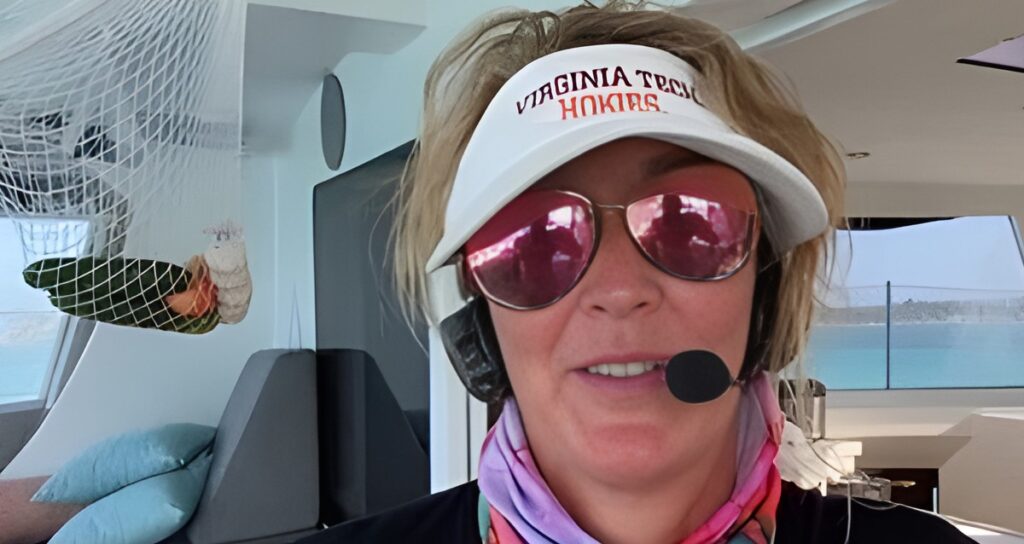
The 2Talk Headsets: What We Use and Recommend
After years of testing, the headsets we carry in our store and use ourselves are the 2Talk Bluetooth headsets. They were developed specifically for cruisers — not repurposed consumer gear — and the difference shows.
They’re fully hands-free and voice-activated, so there are no buttons to push during a maneuver. They auto-pair when you power them on, so there’s no fiddling with Bluetooth settings on a busy approach. The behind-the-neck design stays put when you’re looking down at lines or chain, and it’s comfortable with hats, visors, and glasses.
The water resistance is serious — these handle rain, spray, and splashes without hesitation. And the noise control is good enough that we can have a calm conversation at anchor while the wind is up.
A few specifics worth knowing:
- Range: up to 900 meters line of sight — enough to reach from foredeck to helm and then some, though range is reduced through the hull
- Battery: 10 hours of talk time, 7 days standby, charges in about 1.5 hours via USB
- Expandable: works with up to 4 headsets — additional headsets require a one-time pairing setup, after which all headsets auto-pair together on startup
- Full-duplex: both people talk and hear simultaneously, no push-to-talk delays
- Includes: storage case, foam ear and mic covers with a spare set
These are store-only — you won’t find them on Amazon.
Ready to Stop Yelling Across the Boat?
Getting a good pair of headsets was one of the best decisions we made for our boat. If you’re ready to make docking and anchoring a lot calmer, you can get the 2Talk headsets from our store.
Carolyn Shearlock has lived aboard full-time for 17 years, splitting her time between a Tayana 37 monohull and a Gemini 105 catamaran. She’s cruised over 14,000 miles, from Pacific Mexico and Central America to Florida and the Bahamas, gaining firsthand experience with the joys and challenges of life on the water.
Through The Boat Galley, Carolyn has helped thousands of people explore, prepare for, and enjoy life afloat. She shares her expertise as an instructor at Cruisers University, in leading boating publications, and through her bestselling book, The Boat Galley Cookbook. She is passionate about helping others embark on their liveaboard journey—making life on the water simpler, safer, and more enjoyable.


Frances Liz Fernandez says
We’ve almost perfected our yelling skills and hand signals! Might be a definite consideration if/when we get a bigger boat.
Annette Cleckner Baker says
Thanks for the info. We used the Eartec Simultalk on our 44′ sailboat. They were fine, but we found that they wore or were a bit lightweight at the connections and we would get static or drop out after about 2 years. Nice and reasonably priced. We got reasonable use (full time cruising) for price. Then we bit the bullet and bought Senas and really like those. So far so good one year in. The headsets in addition to hand signals as needed have just about eliminated yelling!
Lynn Kaak says
Hand signals don’t need batteries. Or replacement.
Ted Broom says
We have used headsets since we found a Radio Shack set on board our first boat. We currently have a pair of Motorola vox walkie talkies (FRS/GMRS) with headsets that work great at a lot less cost. In any case, they save a lot of stress on board. No yelling back and forth, no misread hand signals and when hidden under a hat, make you look real good at what you are doing…Ted..
Catherine Whisenhunt Yox says
Best item we have bought for boat!!! No more screaming.
Danielle Gagne says
We use the simultalk 24G listed above . I agree with Annette the first poster . The connections wear out after awhile resulting in too much static. ( by then warranty is up & units are useless.) Also, the wire from unit to headset gets caught on things and the main unit falls out of pocket. Overall, not happy with the system and am in the process of looking for a new system. This article could not have come at a better time! Thanks!
Tere Vidal says
Thank you so much for researching this and giving us an expert’s view. We have, like others, perfected the hand signal method, however, as crew you are not always in an eye to eye line with the Captain! I have worried many times when I walk back to the bridge, because of the blind spot. Not to mention when we are docking and I am in the swim platform, getting ready to jump. Those few seconds we are not in view of each other, or able to communicate. I looked into walkie-talkies, but they are awkward when you have to tend the lines and push buttons. We will be investing in one of these models, based on the article and the comments!
Bejay Grackin says
We have used the Eartec 24G for about 6 years and love them.
Liz says
We have a pair of the Sena/My Team Talks. My husband was familiar with that brand from their motorcycle headsets. I really like them, and my husband refuses to go up the mast unless we’re wearing them now. Even when it’s windy, it’s easy to hear each other and they’ve never felt like they would fall off. Sadly, the part of the frame that loops over the ear on his pair broke, but we’ve managed to continue using them by splinting the broken part with a sawed-off chopstick held in place by rescue tape.
I suspect this may be a weakness in many brands of headsets because they want to make them light enough to avoid being cumbersome.
Liz says
Update: Sena replaced our headset with the broken earpiece for free.
Misty Smith says
Used our Eartec units for the first time this weekend. Love them! We have a 44′ steel Power Scow. Communicating from the wheelhouse to the deck was pretty much impossible with hand signals, lip reading & shouting. Now we’re able to have a calm conversation from the wheelhouse to the deck. Thank you!!
Katrina Schiro says
We have talked about getting wireless headsets. Like the idea of hands free!
The Boat Galley says
We love the Sena “My Team Talks” bluetooth ones. No interference, no falling off. And Amazon has them a little cheaper right now (thanks to another reader who let me know): http://amzn.to/2tsE2gf
Michael Guelker-Cone says
We just purchased a pair of Sena SPH10 headsets after trying Wilkie talkies with and without headsets and trying hand signals. The delay in the wallow talkies caused so much frustration and miscommunication. Out they went. Hand signals are okay in line of sight situations. But in many cases I can’t see my wife at critical moments. Friends with the same Sena model introduced us to theirs and we were instantly smitten. We ordered them from Amazon for $318 for the pair with free delivery. We tried them out for the first time the other day for both anchoring and docking and they changed our lives instantly. We speak calmly and share important info instantly. The Sena headsets work great! Check them out: http://amzn.to/2tsE2gf
Carolyn Shearlock says
Those are the same ones that are discussed as “My Team Talks” — we have them and they are great.
Wayne says
No matter what unit you get you will have a battery pack. The advantage to a unit that is self contained is that you do not have a wire running from your head to your waist or wherever you put the remote unit. The unit I referenced has a short wire and the unit could be installed right on the head muffs. No wire to catch on anything so less of a chance to catching it on something or getting in your way.
As far as the muffs falling off, I am not following your logic. These muffs do not fit loosely on your head, they are nice and snug.so I am missing why this wouldn’t work
Carolyn Shearlock says
My experience — from ones we previously had — is that heavier ones with a larger battery pack incorporated into the headset and which do not go around the back of the neck tend to fall off if you really bend over to look at something with the anchor. That problem is why we “stopped” using our old set — one headset went to the bottom of the anchorage and salt water isn’t kind to electronics. The Sena ones with the tiny battery back and design of going around the neck mean that we haven’t lost one even when untangling an oops.
Julie Strickland says
We bought the Eartec wireless headsets for this season – game changer when docking and tying lines!
Winston says
We use our cellphones with earbuds. Works well as long as we have service.
Wayne says
I found a much much cheaper alternative. Using motorcycle intercom systems mounted in cheap homedepot ear protection muffs.
Carolyn Shearlock says
Yes, definitely cheaper, but the still have the battery pack that has to be worn and the cord, which the Sena (aka My Team Talks) system doesn’t. I’d also be a little more worried about those ear muffs falling off . . . and into the water as I was looking down at the anchor.
Sara Burns says
Since every boat we’ve chartered, and our relatively short stature compared to boat designers’ ideal sailor height, means that my SO can’t see or hear each other during mooring/anchoring maneuvers, we just ordered a pair of My Team Talks based on your recommendation. He was especially impressed with the intelligent behind-the-head-so-it-doesn’t-fall-in-the-water design. Thanks for your research and links.
Karen Bowen says
Has anyone come across a brand compatible which is compatible with two hearing aids? Either adaptable to work directly with his hearing aids or comfortable to wear without feedback with his hearing aids. My husband wears two hearing aids which are blue tooth enabled. He can use his cell phone to play music, answer cell phone calls, and adjust the volumes through a clip which holds a mic. The clip is too easy to knock off and is not waterproof. Thanks.
Carolyn Shearlock says
Two companies that I work with a lot sell several types of good headphones and provide EXCELLENT customer service. I’d recommend that you call either one (or both) and see what the owners have to say.
Sea Dog Boating Solutions — Steve: (802) 734-3389
Cruising Solutions –Maeve and Bradd: 800-460-7451
Karen Bowen says
Thank you for pointing me in their direction.
Richard Hermann says
Another VERY helpful use case is between the helm and the engine room.
Jackie formerly SV Lively Lady (now a dirt-dweller) says
When we were on the boat (last time was 7 years ago- cruising for 6 years) we had a set: can’t say what brand, but I’m sure the ones available now are better from what I’ve read in the comments. They definitely lived up to the nickname “marriage savers”!
Two “modifications” that we made out of necessity back then were:
1) To handle the “falling in the drink” possibility we simply tied a string to the unit and made a loop at the other end to go around one’s neck. Simple!
And 2) when the “fuzziness” on the mike wore way from my husband’s beard, I just took a bit of leftover fleece (from making fender covers) and made a little drawstring “bag” to fit over the mike head. Worked just fine.
Also. When not using the units, take the batteries out. The batteries can’t accidently run down (!) and leave you with worthless equipment, at the time you need them most. And no chance of ruining the units if the batteries corrode in place. We’ve had that happen.