Part 1:
Part 2:
In the excitement of buying a new boat, don’t forget to systematically learn and map the systems. It will benefit you as long as you own it. How do you do it? You trace the system from end to end, document what you find, and keep good records. Read on, for how we learned all about our new cruising boat, twice!
When a Boat is New to You
If you have recently bought a boat, it’s easy to feel clueless about how everything works! Ditto if you’ve begun a new relationship and your significant other has a boat that you’re suddenly trying to learn.
My husband, Dave, has a background in heavy industry (blast furnace supervisor in a steel mill). He was the hands-on manager, who knew exactly how everything operated. For that reason, he was the first person anyone called in an emergency.
When we bought our first cruising boat, Que Tal, I began to understand how he operated. The boat was in Puerto Vallarta, Mexico and we were in central Illinois. On the “purchase trip,” the former owner was present. He went over many of the systems with us. I assumed that on our next trip to the boat, we’d head out of the marina for a few days at a nearby anchorage.
Dave had a different idea. And frankly, his was much better.
How to Learn the Systems on a New Boat
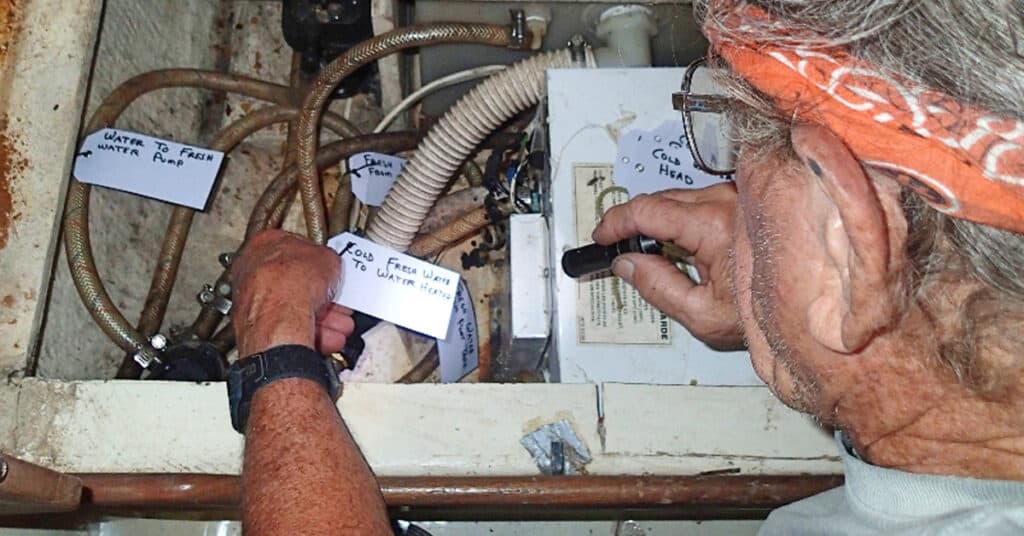
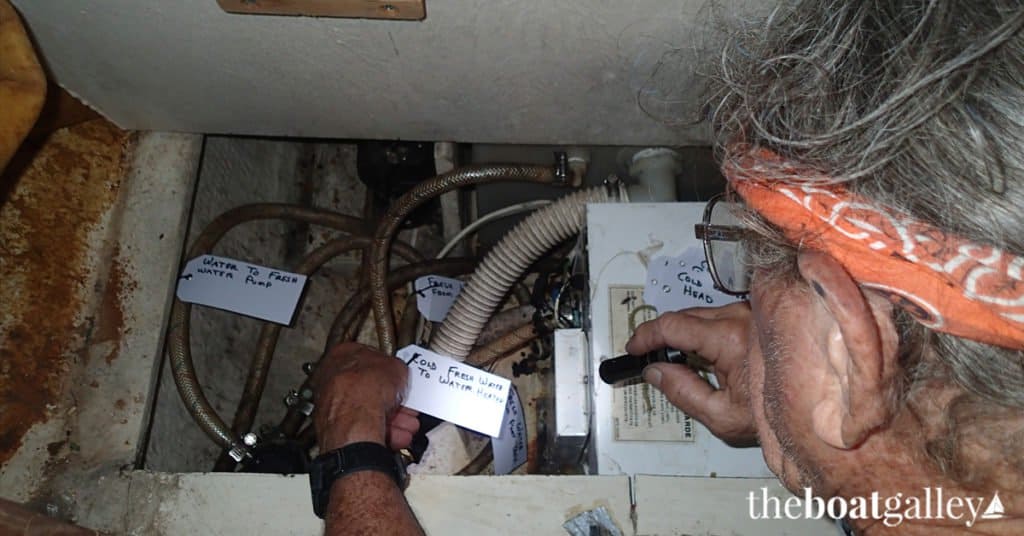
Our next trip — actually, the next two trips of about a week each — we spent learning the boat right at the dock. Together, we traced and sketched out every system on the boat and labeled it all. That way, when we left the dock and were out on our own, we felt that we really knew our boat and how everything worked.
Example: Freshwater System
To use a galley-specific example, we began with the freshwater system. We started at the deck
Important Points in Learning Systems
Several things were important about this:
- We did it together. We were both learning the boat and often one of us would have a question or spot something that was good for both us to know. Some systems one of us understood better than the other initially but when we were done we both felt that we knew our boat . . . and that we had the same understanding of it (this last part is important).
- We sketched it all out (these drawings were left on the boat when we sold her but they weren’t anything professional). Having to draw it made us know exactly where things went, not just assume!
- We found a few problems (which we took care of) and things that we
adde to our routine maintenance lists. - We took our time and didn’t try to do too many systems in a day. We needed time to absorb it and we needed time to have fun, too.
- When we did finally leave the marina and head to an anchorage, we felt confident that we knew the basic systems. Sure, there was still a huge learning curve about sailing, motoring and anchoring her, but at least we weren’t learning everything at once, which is what we would have done if we’d just immediately left the dock.
- Since we’d been living aboard Que Tal while learning her, we’d had experience with actually using many of the systems and, particularly, the galley.
Getting to Know Our Second Boat
When we bought Barefoot Gal, we went through exactly the same procedure. Admittedly, it went a lot faster as there were a lot of similarities to systems on Que Tal. And we did a lot of it while we were still working on the boat in the boatyard. Again, time very well spent as things went pretty smoothly when we launched for the first time.
Two Tips to Help You Learn
Okay, for us it was easy as we’d just bought the boat and neither one of us knew her. But it often happens that there’s a new relationship, one person has a boat (and knows it) and the new squeeze starts going out on it, etc, etc. Okay, you’re not going to go over all the boat systems on the first date! But as time goes on and the relationship becomes a little more serious and you’re spending more time on the boat, I’d really recommend trying to go over the systems together. I think that sketching them out for yourself — not just looking at drawings that already exist or taking photos — is the best way to really understand how things work.
I also know from our cruising days that there will be some who say “but I’m not mechanical!! I’m not going to understand it!” Don’t worry — you don’t have to be super-mechanically inclined to understand the basics of how the boat works. And by tracing the systems instead of just trying to understand how something works in the abstract, I’ll bet that you find it makes sense. O
Boat Systems You Should Know
Here’s a quick list of the main systems that I can think of to check out (different boats will have different items, leave a note in the comments of any you think I’ve missed):
- Fresh water system
- Watermaker
- Propane
- Toilets (water intake, holding tank, pump out, discharge, or whatever your system may have)
- All thru-hulls (it’s good to have a drawing with all these displayed prominently)
- Engine fuel (important if you ever have to track down a fuel problem en route)
- Engine/transmission/generator cooling water
- Shore/wind/solar/generator/alternator power to batteries, including the charge regulators
- Battery switches
- Breaker panel and any other breakers (we had additional breakers for the windlass, washdown pump, and solar charging — you might be surprised at what you find!)
While it might have been a good idea, we didn’t trace out all of the wiring initially but did as we worked on various items.
Take It Slowly and Go Back Over Systems
Okay, I know it seems like a lot. Don’t try to do it all at once. Take it slowly and enjoy learning about your boat. Remember, you didn’t learn all about living ashore in a day. You just picked it up over a period of years. Don’t expect to know everything at once about the boat.
While everyone’s learning style is different, Dave and I found that after each of our times on the boat, we’d go back home and read more about the various systems both in books and on the internet. Things that had seemed incomprehensible to us before suddenly made sense. Our confidence at being able to master this new lifestyle just soared!
Advice From Other Boat Owners
Mary R. adds that on naval ships, all lines are labeled (water, fuel, etc.) along with the flow direction. In case of a mishap, there’s no confusing about the systems you’re dealing with.
Other boaters have suggestion for documentation. Chris took hundreds of “before” pictures when he bought his book. Every time he opened a compartment, h’ed compare present conditions with his photographs. He admitted that they saved a lot of money by catching problems early. Ellen says that she doesn’t have good drawing skills. However, she used photos to create diagrams in PowerPoint as references.
Randy also printed out relevant sections from the owner’s manual and put them in plastic sleeves before taping them in relevant spots. For example, information about disconnecting shore power belongs inside the main breaker panel. Labels around coaxial and power cables can indicate what equipment it belongs to. If you wrap the label with clear packing tape, the labels will stay attached. He also includes the proper replacement fuse type near fused power curds.
Finally, he also wrapped different colored duct tape around each end of different coaxial cables.to “color code” them. Two smaller zip ties kept the duct tape from unraveling. In combination with the labels described previously, all cables could be be easily identified and matched with the appropriates piece of equipment..
You’ll get the best information from others who have been there. It’s the idea behind The Boat Galley and our courses, like The Basics of Living on a Boat where we help new cruisers decrease the steepness of the first year learning curve.
One Final Note
A final note. Most boaters and cruisers that I talk to all say the same thing: the first year is by far the hardest. There is such a learning curve. Other boaters are one of your greatest resources. While it was hard for Dave and me to ask for help, many times we found that there was an easy solution for what we thought was an almost insurmountable problem. And in time, we became the ones that were offering help instead of always asking for it!

Carolyn Shearlock has lived aboard full-time for 17 years, splitting her time between a Tayana 37 monohull and a Gemini 105 catamaran. She’s cruised over 14,000 miles, from Pacific Mexico and Central America to Florida and the Bahamas, gaining firsthand experience with the joys and challenges of life on the water.
Through The Boat Galley, Carolyn has helped thousands of people explore, prepare for, and enjoy life afloat. She shares her expertise as an instructor at Cruisers University, in leading boating publications, and through her bestselling book, The Boat Galley Cookbook. She is passionate about helping others embark on their liveaboard journey—making life on the water simpler, safer, and more enjoyable.
Carolyn Shearlock says
Congratulations! You’ll love it!
Carolyn Shearlock says
Good idea — it’s the same thing of making you really figure it out to have a diagram.
Carolyn Shearlock says
Glad it’s helpful and congrats on the new boat! Eat the elephant one bite at a time 🙂
Carolyn Shearlock says
You’re going to do great when you get it😎
Carolyn Shearlock says
All great ideas!