
It’s been widely publicized that ingredients in conventional sunscreens kill coral. Studies started appearing a few years ago; even a few drops of sunscreen can kill a relatively large area. A couple of studies have shown that oxybenzone, a chemical that’s in most sunscreens and harmful to reefs, also feminizes some fish.
YIKES! As boaters, we’ve been taught for years to wear sunscreen to avoid skin cancer. But as an avid snorkeler and diver, I don’t want to do anything that even might damage the reefs or fish population. Admittedly, other factors contribute to coral damage, but this is something I can easily avoid. (NOTE: if you use any makeup or moisturizer “with sunscreen,” make sure it doesn’t have any of the bad chemicals listed below!)
Our solution had two parts: cover up when snorkeling and use reef-friendly sunscreen for the parts we can’t cover. Actually, we used reef-friendly sunscreen all the time, not just when snorkeling, since, like most boats, ours drained grey water (the sink and shower drains where we wash up) straight into the ocean.
Cover Up
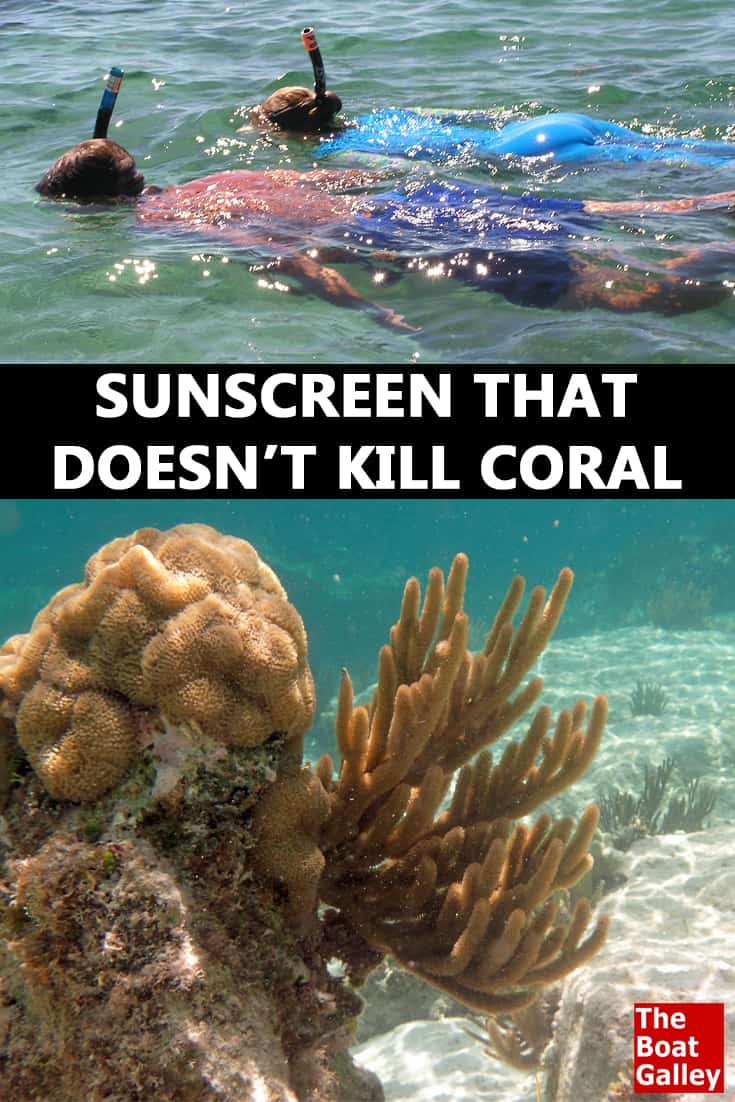
Dave and I didn’t like putting a lot of “goop” on our skin and also don’t want to put any more chemicals into the water than we have to – even ones that are currently believed to be “reef-friendly.” So our first line of defense against the sun was a snorkel suit (aka dive Lycra). We began wearing them other cruisers recommended them to us back in 2003, our first year of cruising.
A Lycra suit doesn’t only provide sun protection – it also protects you against jellyfish, which seem to congregate in many of the best snorkeling spots. I’m not going to claim that a Lycra suit will protect you from a really nasty sting, such as a Portuguese Man-of-War. But it’s great against many of the smaller ones, such as the “aguamales” that were prevalent in the Sea of Cortez.
A Lycra suit is not figure-flattering at all, I’ll admit. The good news is that you don’t have to buy one that’s skintight. In fact, it’ll last a lot longer if it’s slightly loose and not pulling tight.
Finding the Best Lycra Dive Suit
A few other notes about what we looked for:
- Dave and I preferred a one-piece suit to a rash guard, even if we combined it with pants. Two-piece suits can separate at the waist as you swim, leading to sunburn or jellyfish stings on the uncovered area. Just a rash guard left the back of our thighs exposed to sunburn . . . and jellyfish.
- Avoid a super-tight neck. We felt like we were strangling. Also stay away from a low V or scoop neck. They allow jellyfish to end up inside your suit.
- Buy one in a bright color so it’s easier to keep track of each other while snorkeling. You know, that buddy system thing.
- Make sure the suit has a long enough zipper to make it easy to put on and take off. Just be careful. If a zipper is so long it gets into the crotch area, you’ll be very uncomfortable. Don’t ask me how I know.
- Foot stirrups are nice to keep the legs pulled down while you swim. If a suit doesn’t have them, you can sew a piece of elastic to the leg bottoms in a “U” to make a stirrup.
- Lighter weight fabrics stretch more and dry faster, but let more sun through. We opted for a mid-weight–basically anything not advertised as very thin or heavyweight.
- Some people prefer lighter colors as being cooler out of the water. Since we took ours off immediately after exiting the water – or at least pulled the sleeves off and tied them around our waist – this wasn’t a big deal to us.
The Right Fit
Sizing on dive Lycras isn’t the same as on other clothing. You’ll probably take at least one, sometimes two, sizes larger than in regular clothing. When in doubt, go for the larger size. Your suit should be a little loose rather than super tight. If ordering online, check the size charts and take your own measurements; don’t guess. If your measurements, weight, and height put you in more than one size range or you’re right on a borderline, opt for the larger size. A suit that’s a little looser won’t hurt you, but one that’s too tight will be uncomfortable and have a tendency to rip.
We both liked the fit and features of the Neosport dive skins with the bright yellow trim. We bought ours from LeisurePro (now Scuba.com). Before you buy, check the current return policy.
- Neosport Dive Lycra (the smaller sizes will fit many upper elementary kids, too)
Neosport dive suits are also available from Amazon.
For smaller-sized kids, there are several good options on Amazon (friends with kids/grandkids have told me they look for the same things in kids’ Lycras and particularly like the sun protection offered by one-piece suits, although they’re a little tougher to remove for bathroom breaks):
- Cokar One-Piece Neoprene Suits
JDS Snorkel Suit(No longer available on Amazon. The Realon Kids Wetsuit is highly rated.)
Of course, you’ll still need to protect any skin not covered. Sunscreen is also required.
Reef-Friendly Sunscreen
When I first heard about the sunscreen problem (prior to a trip we made to Hawaii in 2013), I started researching alternatives. Several companies offer “reef-friendly” sunscreen but, like everything else, they’re not all created equal.
Ingredients to Avoid
First point: the term “reef-safe” is unregulated. Check the list of ingredients yourself to make sure it doesn’t contain oxybenzone, butylparaben, octinoxate, or 4-methylbenzylidene camphor.
Other Things to Consider
Five other differences between brands:
- Some stay on in water or during sweating, much better than others. Waterproof isn’t just better for your sun protection. It also means that whatever it’s made of isn’t going into the water right over the reefs. And sweatproof is critical for keeping sunscreen out of your eyes!
- Some brands provide much better sun protection than others.
- Some are much easier to apply than others.
- Some are almost impossible to wash off at the end of the day.
- Some feel greasy and/or rub off easily if you rub up against something.
The one place where they are pretty much “equal” is in price. Reef-friendly sunscreens are much more expensive than what you’ve probably been using – especially if you’re like me and always bought the huge bottles of No-Ad. I’m willing to pay the difference, but yes, it’s an additional reason that I wear a dive skin: I don’t have to use nearly as much sunscreen when I snorkel. It saves some money (my sale-priced dive skin cost only a little more than one tube of reef-friendly sunscreen).
Reef-Safe Sunscreen Options
Dave and I began using Rubber Ducky sunscreen as it did a great job on all the counts above. I checked ingredients on many other brands and read reviews. I tried a few free samples that I got at the boat show, but this is the only one that I bought a whole tube of. We were really happy with it, although it’d be nice if it were less expensive.
We used the SPF 30 version. It’s white but rubs in well so that it’s not noticeable even on well-tanned skin. I don’t know if it would show on darker-skinned people. Rubber Ducky also has an SPF 50 version with a tint, as the higher SPF just doesn’t rub in as well. It would look white on your skin were it not tinted (we have not tried this, friends like it but say the tint can rub off a bit on clothing).
Rubber Ducky stays on in the water even better than conventional sunscreens, yet washes off fairly easily at the end of the day with just soap and water on a washcloth. A washcloth is necessary to provide a bit of texture to “scrub” (I love the Scrubr washcloths by Lunatec available on Amazon). It’s easy to apply, being very slightly greasy, but better than any of the other reef-friendly sunscreens I tried. It is also less likely to rub off as long as I rubbed it in well.
Best of all, it doesn’t have any weird chemicals. Zinc oxide is the active ingredient. Both the SPF 30 and 50 varieties are listed as hypoallergenic and safe for kids.
Using and Finding Reef-Safe Sunscreen
For snorkeling, I used sunscreen on the back of my neck and ears only. I preferred not to use it on my face as my mask seals best against bare skin. I did use it on my face, arms, and legs when we were outside on sunny days however.
How long a tube will last you depends totally on how often you use it and how much of your body you use sunscreen on versus covering up. Dave and I tended to wear shirts and hats as our primary sun protection.
- Rubber Ducky appears to only offer 50 SPF squeeze tubes on Amazon now.
- Rubber Ducky SPF 50 untinted reef-friendly sunscreen in a pump bottle
We eventually began using Thinksport sunscreen. It was a little cheaper, had no nasty chemicals, and protected us just as well.
Buy whichever one you can find. They both work well.
Other Options Recommended by Fellow Cruisers
Because of the greater intensity of the sun there, Australian products are highly recommended by southern ocean cruisers. Janine stocks up on Moo Goo and We Are Feel Good when she visits family down under. Evan recommends sun-protective clothing from the Australian company, Coolibar. Coolibar clothing is available on Amazon.
Tami went the DIY route by making her own zinc oxide mix. She made a paste of zinc oxide power (Amazon) and coconut oil (Amazon) and slathered it on. She does admit that it’s difficult to get off, but it does last through sweating and swimming.
Whatever option you choose, it’s important to keep yourself and the coral safe. I hope I’ve given you a few good options to try.
Related Posts

Carolyn Shearlock has lived aboard full-time for 17 years, splitting her time between a Tayana 37 monohull and a Gemini 105 catamaran. She’s cruised over 14,000 miles, from Pacific Mexico and Central America to Florida and the Bahamas, gaining firsthand experience with the joys and challenges of life on the water.
Through The Boat Galley, Carolyn has helped thousands of people explore, prepare for, and enjoy life afloat. She shares her expertise as an instructor at Cruisers University, in leading boating publications, and through her bestselling book, The Boat Galley Cookbook. She is passionate about helping others embark on their liveaboard journey—making life on the water simpler, safer, and more enjoyable.
Leave a Reply