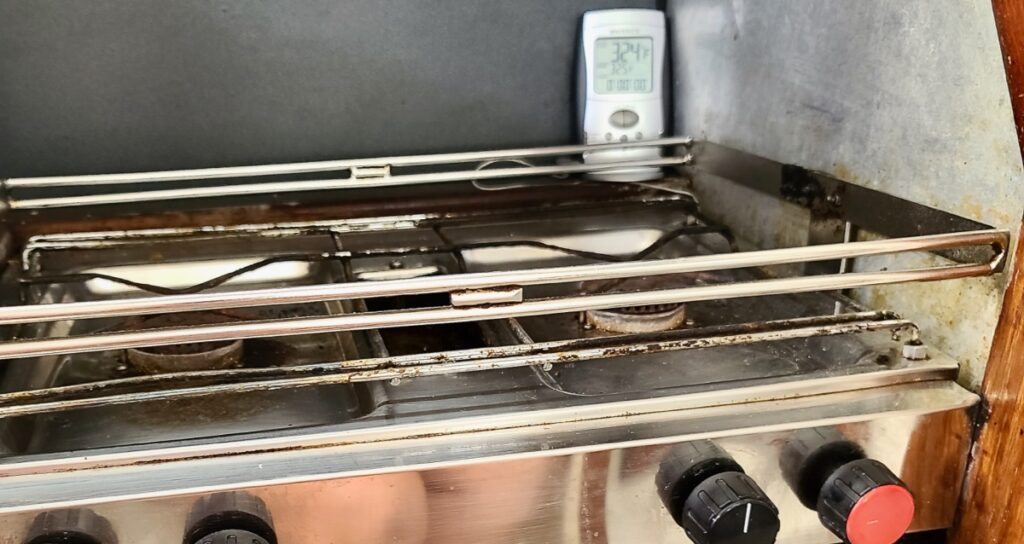
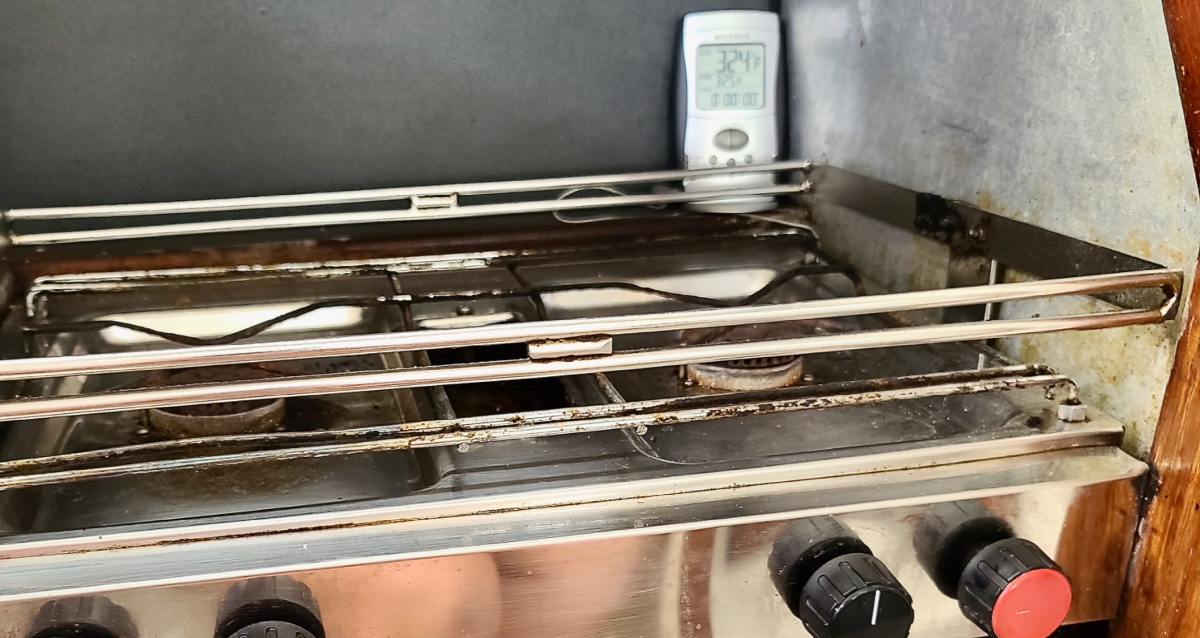
How hot is the oven?? And do you really need to know? I believe so. Using a boat oven thermometer prevents food waste (due to burning) or fuel inefficiency (from constantly opening the oven door to check your baked goods).
The Problem with Boat Ovens
Boat ovens are notorious. Often, their built-in thermometers or thermostats are somewhat out of calibration. On older boats, many ovens don’t even have a built-in thermometer. Newer ovens are much better than older ones, but that’s not really a valid excuse to buy a whole new oven.
If you think your built-in oven thermometer might not be accurate (or doesn’t exist), I have three ideas for you:
- an old-fashioned, non-tech method of guesstimating the heat
- a simple gizmo that costs around $15 or less, or
- a more advanced external digital oven thermometer.
I’ll start with the lowest cost option ($0) and go from there. And, of course, I’ll share tips from fellow cruisers. Hopefully you’ll find an option that fits your needs.
Oven Temp Testing Without a Thermometer
My grandmother used an old wood stove until she was in her 50s. Even after getting a new-fangled gas oven, she never quite trusted the thermostat. She always double-checked the temperature with her hand.
My Grandma Phila and her sister-in-law, my great-aunt Martha, were born before the turn of the last century. Both were great cooks (Aunt Martha was the first Dean of the School of Home Economics at SUNY Oneonta) and neither of them ever believed that little light that signalled that the oven was up to temperature. Cooking with them as a child, I learned to test the oven with my hand.
Now, you have to realize that with this method, you won’t be able to distinguish fine differences in temperature — say between 350° F. and 375° F. Old-time cooks only had three designations for an oven: slow, moderate and hot.
Slow (also called low) was for temperatures up to about 300° F., and was used for long slow cooking. A moderate oven was typically 350° F. A hot oven was over 400° F.
To test, open the oven door and hold your hand in the center of the oven. Begin counting slowly (as if counting seconds) until your hand is just too hot and you have to take it out. If you have to remove your hand after 5 seconds or fewer, the temperature is around 450° F or more. If you can hold your hand in the oven for about 10 seconds, the temperature is around 400° F. Twenty seconds? About 350° F. And if you can hold your hand in the oven for 30 or more seconds, the temperature is probably less than 300° F., probably closer to 250° F.
Yes, your heat tolerance and speed of counting will affect your results. But it will get you in the right ballpark. And remember, lots of great food was baked long before there were oven thermometers — just keep a little closer eye on the oven!
A Basic Boat Oven Thermometer
An oven thermometer is really simple to add into your boat oven. “Installing” it is just a matter of hanging it or setting it on a rack. You can usually get one in the housewares department at any “big box” store as well as lots of places online.
If you start reading reviews, you’ll quickly come to the conclusion that none of the thermometers are very accurate, and begin to wonder why you’re even thinking of buying one. I think that some (most?) of the reported inaccuracies arise from where the thermometer is placed in the oven.
An oven thermometer is most accurate if you can set it on the shelf right where the food is to be cooked.
If you use a baking stone (highly recommended in a boat oven to even out hot spots), setting it on the stone is perfect.
Getting an Accurate Temperature Reading
If you want an accurate temperature, here are some things to avoid. Don’t
- hang it from a rack right over the burner in the bottom of the oven
- place it on the bottom of the oven,
- stick it on a wall (despite many thermometers coming with mounting magnets just for this purpose — the walls are usually hotter than the air that the food is cooking in), or
- put it right at the top of the oven. Heat rises, so it will be hotter there than on the rack where the food is cooking.
Features of a Basic Boat Oven Thermometer
When you are looking for a basic boat oven thermometer, don’t just rely on whatever you find at the grocery store. These are the features you should look for:
- Made of stainless steel (steel quickly rusts)
- Able to be set upright or hung from a rack
- I like 350 being straight up as a reference
- If you’re cruising outside the US, it’s nice if it’s marked in both Fahrenheit and Celsius, so you don’t have to reach for a conversion chart when using local products.
Finally, most oven thermometers are what is called “slow-reacting.” That is, the temperature readout doesn’t instantly drop when you open the oven door to look at it. This is an important feature. I’d also like one with big numbers, but the only one I’ve found with big numbers gets horrible reviews for accuracy, so I’m not sure that it’s just a case of bad placement.
My choice for a basic oven thermometer is available at Amazon:
- CDN Multi-Mount Oven Thermometer — stainless, can stand up, 350 F is straight up, Fahrenheit and Celsius, and slow-reacting.
I’m aware that it doesn’t get the best reviews of all the oven thermometers on Amazon. It worked well for me until I replaced it with an external digital thermometer. It was also chosen by Cooks Illustrated in a comparison test.
As I noted above, I eventually bought an external digital oven thermometer.
External Digital Oven Thermometer
One of the excellent things about an external digital oven thermometer is that you don’t have to open the oven door (losing all that heat) just to check the temperature. A large display is also helpful to aging eyes.
The ovens on both our boats frustrated me. Neither had the temperature regulated by a thermostat and, even worse, had no external thermometer to help with adjusting the heat.
The first digital thermometer I bought is no longer available. But my experience using it gave me good ideas for buying a new one. What you’re looking for is more than a digital thermometer you stick into a roast. It should have an air probe with a clip mount to put inside the oven. You then run the heat-protected cable to the display unit. It’s designed to be caught in the oven door and won’t be hurt by it.
Features
After using mine, these are the features I appreciated:
- A display large enough to read easily.
- Includes a timer.
- An alarm to know when your desired temperature is reached, and if the oven goes more than 20° above or below that.
- Mountable display unit with a magnet, Velcro, or Command strips. Or you can hang it on a screw or just set it on your counter.
- Updates the temperature every 10 seconds.
- Uses one AAA battery. You can turn it off when not in use, so batteries last quite a while.
- Both Fahrenheit and Celsius scales.
- Will not be damaged in ovens up to 572 degrees F. (300 C.)
I am serious when I say that having a digital thermometer made a huge difference baking on the boat. Every five minutes or so, I’d check the temperature and tweak the oven setting if I needed to.
You can also use this external digital oven thermometer with the Omnia Stove Top Oven by inserting the air probe through one of the vent holes in the lid and then using the mounting clip to hold it there.
Buying a Digital External Oven Thermometer
Technology is changing. You can find many digital meat thermometers that give instant reads. And some come with two probes, but they’re both intended to be used for meat. The Maverick that I used has been discontinued. But reader Karen M found a comparable one through Thermoworks. She bought the Simple Dot and a separate air probe. This option was cheaper, but you can also get the Square Dog, which comes with two probes, one for food and the other for the ambient temperature.
As I noted above, this model means running a cable out the oven door. However, the wave of the future probably belongs to Wi-Fi models that send a signal to the display outside your oven instead of relying on a cable (Amazon). Some models rely on apps you download on your phone, while others simply rely on the external display. I don’t have direct experience with them. If you do, share your thoughts in the comments.
Finally, reader Mike suggests another solution: an infrared thermometer (Amazon). The benefit of this tool is that you can also use it to measure engine temperatures, the refrigerator, and anything else around the boat.
Whether you prefer a quick and dirty way to guess the temperature or a state-of-the-art display with an app, you’ll find that being smart about your oven temperature makes cooking and baking onboard much more fun.
Related Posts

Carolyn Shearlock has lived aboard full-time for 17 years, splitting her time between a Tayana 37 monohull and a Gemini 105 catamaran. She’s cruised over 14,000 miles, from Pacific Mexico and Central America to Florida and the Bahamas, gaining firsthand experience with the joys and challenges of life on the water.
Through The Boat Galley, Carolyn has helped thousands of people explore, prepare for, and enjoy life afloat. She shares her expertise as an instructor at Cruisers University, in leading boating publications, and through her bestselling book, The Boat Galley Cookbook. She is passionate about helping others embark on their liveaboard journey—making life on the water simpler, safer, and more enjoyable.
Leave a Reply