You can go three weeks between grocery runs on a boat with a tiny fridge — if you know what actually needs to be cold, what doesn’t, and how to use the space you have effectively. Most people’s first instinct is to cram it full and hope for the best. Food goes bad, space runs out, and the next marina starts looking a lot more appealing than it should.
It doesn’t have to work that way.
I spent 17 years working out this system on two boats — first on Que Tal, a Tayana 37, then on Barefoot Gal, a Gemini 105 catamaran. Both had refrigerators smaller than most dorm fridges. I cruised through the Sea of Cortez, Pacific Mexico, the Florida Keys, and the Bahamas, and I never felt deprived. Here’s what I learned.
What Needs Refrigeration on a Boat
The first step is getting clear on what genuinely has to be cold — and it’s a shorter list than most people expect.
Meat and seafood belong in the freezer, not the main compartment. The freezer holds a steadier temperature, and consistency matters most for food safety. That said, a boat freezer is small — you can’t live out of it for three weeks. We kept frozen meat on hand and filled the gaps with canned meat, which needs no refrigeration at all. Alternating between the two got us through weeks at a stretch without restocking.
Butter, cheese, and any temperature-sensitive medications need to stay cold. These are the real fridge priorities — the things that genuinely earn their space.
One that surprises almost everyone: sealants. In warm climates, opened tubes of sealant last dramatically longer when kept cold — we got six months to a year out of tubes that would otherwise dry out in weeks. In a remote anchorage, having the right sealant when something needs fixing is worth far more than the shelf space it takes.
Then there are the things most of us naturally want cold — milk, yogurt, drinks, white wine. These do need to be kept cold, but there are techniques for managing all of them without giving up nearly as much fridge space as you’d expect. More on that below.
What Doesn’t Need to Be in the Fridge
This is where most people find the space they didn’t know they had — and it’s more than you’d think.
Produce is the biggest opportunity. Most fruits and vegetables do surprisingly well at room temperature, often for a week to several weeks. They’ll last longest if they were never refrigerated to begin with, but even produce from a refrigerated grocery store can move to room temperature — just plan to use it a bit sooner. I kept very little produce in the refrigerator. Moving it out frees up more space than almost anything else you can do. For specifics on what lasts and how to handle it, the guides to storing vegetables without refrigeration and storing fruit without refrigeration are worth bookmarking.
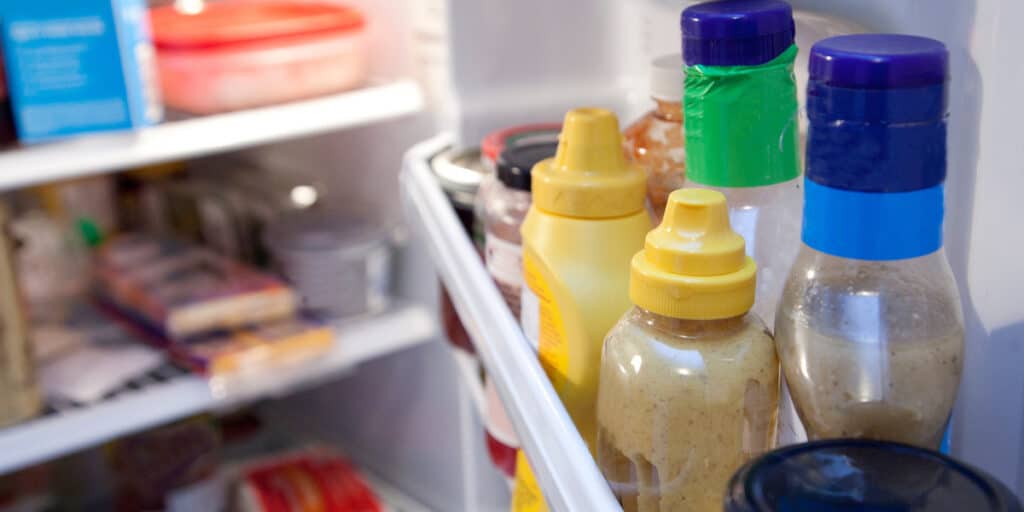
Condiments are the other big one. Americans refrigerate a lot of things that no one else does, and most of them are perfectly fine at room temperature. Even at over 100°F in the Bahamas in summer, I kept all of these unrefrigerated for months without a problem:
- Ketchup
- Mustard
- BBQ sauce
- Jam and jelly
- Syrup
- A1 and Worcestershire sauce
Eggs and Mayonnaise
These two surprise people the most — and both can come out of the fridge.
Eggs keep for weeks at room temperature. The only trick is flipping the carton every day or two to keep the membrane moist and the yolk centered. That’s it.
Mayo doesn’t need refrigeration either, as long as you follow one rule without exception: nothing ever touches the contents after contacting other food. The simplest method is a factory-sealed squeeze bottle — nothing touches the nozzle, so nothing can introduce bacteria. If you prefer a jar and want the full technique for keeping it safe, it’s worth reading before you try it.
How to Use Your Fridge Space More Effectively
Once you’ve moved out everything that doesn’t need refrigeration, the space that’s left can work much harder than you might expect. There are more strategies than we can cover here — these are some of the most effective ones to get you started.
Keep only what you need right now, not what you need for the whole trip. Boxed milk doesn’t need refrigeration until it’s opened, so keep just one quart in the fridge at a time and open a fresh box when it’s gone. Make yogurt in small batches every few days rather than storing a large container. And instead of carrying bottled salad dressing — which needs refrigeration once opened — mix a quick vinaigrette from oil, vinegar, and whatever spices you have on hand. Fresh in two minutes, nothing in the fridge.
Think about quantities, not just what’s in there. The fridge doesn’t need to hold an unlimited supply of cold drinks — just enough for the day. A net bag dropped off the back of the boat, a few feet off the bottom, chills cans and bottles without using any electricity at all. It works at anchor and frees up cold storage for things that actually need it.
Small packaging saves more space than you’d think. Buy lunch meat in half-pound vacuum-sealed packages and pull the inner pouch out of the outer container before putting it in the fridge. One container, the open package goes back into it. Simple, but it adds up.
The One Thing Nobody Tells You About a Tiny Fridge
You will never lose something in the back.
In 17 years across two boats, nothing ever went bad because it got pushed behind something else and forgotten. Everything is visible. Everything is within reach. You always know exactly what you have.
That sounds small until you’ve lived it. A tiny fridge run with a real system doesn’t feel like deprivation. It feels like control. And that changes everything about how you think about provisioning, about passages, about how far you can go without worrying about what’s in the galley.
That’s what the right system does. And it’s more achievable than most people think.
Want to Go Further?
This article gives you the framework. But if you want all the details and specifics — exactly which foods can safely come out of the fridge, precisely how to store them, and over 50 ways to use your refrigerator space more efficiently — may I suggest my course Eating Well With a Tiny Fridge? It includes a copy of Storing Food Without Refrigeration, which covers hundreds of foods in detail.

Carolyn Shearlock has lived aboard full-time for 17 years, splitting her time between a Tayana 37 monohull and a Gemini 105 catamaran. She’s cruised over 14,000 miles, from Pacific Mexico and Central America to Florida and the Bahamas, gaining firsthand experience with the joys and challenges of life on the water.
Through The Boat Galley, Carolyn has helped thousands of people explore, prepare for, and enjoy life afloat. She shares her expertise as an instructor at Cruisers University, in leading boating publications, and through her bestselling book, The Boat Galley Cookbook. She is passionate about helping others embark on their liveaboard journey—making life on the water simpler, safer, and more enjoyable.
The Boat Galley says
You know I can’t “like” a comment like that 🙂
Carolyn Shearlock says
Thanks!
Carolyn Shearlock says
I’d much prefer my old top-loader, actually. Don’t lose all the cool every time I open it!
Carolyn Shearlock says
Really? I thought I had the smallest! Frustrating as the outside cabinet looks decent-sized, then you realize that part is a bookcase on the side . . .
Carolyn Shearlock says
Ours runs on propane when away from shore power, but Dometic’s DC model of the same one uses a little over 3 amps on average, so somewhere in the 75 – 80 amp-hours per day range on a 12-volt system.
Grace says
What make is your fridge Caroline? Did it come with your new boat or where did you buy it? Our boat doesnt have space for anything bigger.
Carolyn Shearlock says
It came with our boat. Dometic 2332 . . . no longer available but Dometic sells the 2354 as the replacement. They have ones that are even smaller, as does Engel.
Carolyn Shearlock says
We definitely eat less meat than we used to, and portion sizes are much smaller. For example, one chicken breast is cut in two and serves us both.
Carolyn Shearlock says
You really shouldn’t have a problem. Even with our small refrig/freezer, we can have meat for 3 weeks (no meals out). We freeze it all. Most fruit and veg don’t need to be refrigerated, even in the tropics, so you don’t have to worry about having the space for them. Eggs don’t have to be refrigerated. Seriously, don’t sweat it.
More on storing fruit without refrigeration
More on storing vegetables without refrigeration
The Boat Galley says
Yep! But I bet you make it work.
Lewis Sipfher says
We’ll see; brand new. Gotta say am impressed with the low draw and good cooling
The Boat Galley says
Yeah, I’d rather have it be small and work well than any size and not work well.
Carolyn Shearlock says
Everyone has different needs; I know vegans, vegetarians and meat-eaters who live both with and without refrigeration.
Paul Thompson says
You are missing the point, which is that for vegans, there is very little need for refrigeration. It becomes a very optional thing. Sure it can be very handy to have (I like my cold beer as much as anyone) but it is also very easy to get by without one.
John Meerman says
When using small office size refr we used cut off alum drink cans to make ice cubes. They froze fast and we didn’t have to use space for drinks. We would share a drink and if there was ice left we put back in fridge. This worked for us while we were living on board 1.5 yrs
Carolyn Shearlock says
Yes, we had to add ventilation to the compressor area on our previous boat.