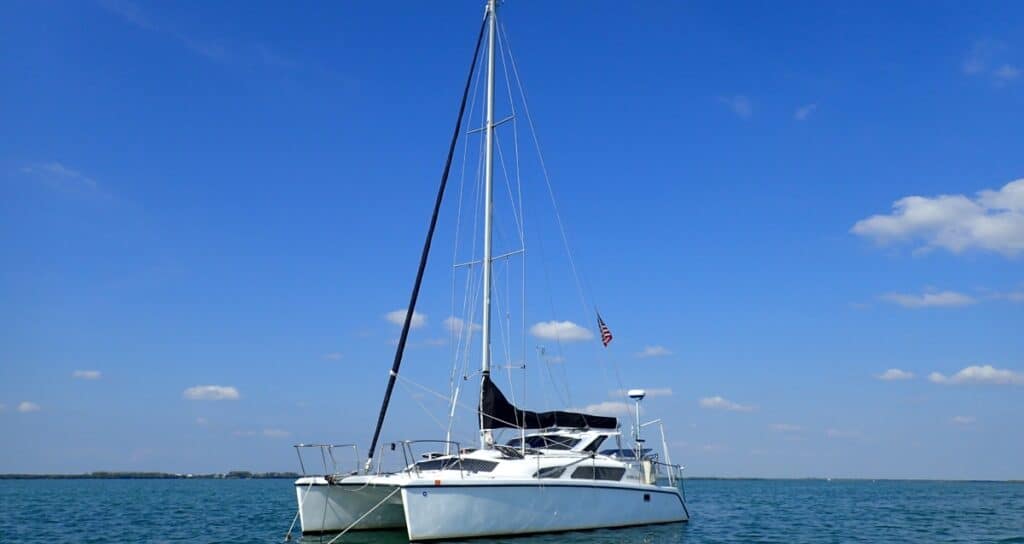
A boat survives a hurricane mostly through preparation, with a good measure of luck on top. There’s rarely one magic step. It’s the sum of many small choices, each one shaving off a little risk, with getting the sails off being the single most important.
When Hurricane Irma raked Boot Key Harbor in 2017, our Gemini catamaran, Barefoot Gal, came through with almost no damage. Most of the boats around her did not.
About three-quarters of the boats on mooring balls came loose and were swept into the mangroves and canals or sunk. Of 226 moorings in the harbor, only 54 still had a boat on them when the storm passed. That’s a sobering number.
So how did Barefoot Gal happen to be one of the survivors? And with virtually no damage?
After seeing which boats made it and talking to four people who rode out the storm aboard, I came to think two things were at play. First, we prepped her as well as we could to give her a fighting chance. Second, there was luck.
I’m normally not a big believer in luck. I think you mostly make your own. But in this case, there was a real random element in which mooring ball she sat on relative to the winds the harbor actually got.
Together, luck and prep brought our boat through Irma.
The Luck Factor
Irma’s eye passed just west of Boot Key Harbor. The eastern edge of her eyewall raked the harbor itself. The winds came first from the east, then the strongest winds out of the south as the eyewall hit, then from the west as she moved off. The harbor never got north winds.
We happened to be in the southernmost row of moorings, with a row of condos on shore to the south. That probably gave Barefoot Gal a little shelter from the worst of it.
More importantly, as other boats broke free, they were swept north, northwest, and northeast. No boats ended up on the southern shore. We simply didn’t have the volume of loose boats slamming into us that other parts of the harbor saw. Had the storm tracked a bit farther east and brought north winds, Barefoot Gal would have been a sitting duck.
The people who stayed aboard (not something I recommend) described a few boats breaking loose early and becoming pinballs through the mooring field. One large boat took out the big dinghy dock. As boats and broken dock sections tore through the harbor, more boats were holed, sunk, or knocked free.
Here’s the telling part. Only 2 of those 226 moorings themselves failed. The moorings held. What gave way was the connection between boat and mooring: lines chafing through, or cleats pulling out of the deck. As boats piled into each other, any chafe already starting just accelerated under the extra load.
Barefoot Gal’s Prep
I don’t think there was one all-important item, other than removing the sails. Each thing we did maybe added 5% to her odds. It was the sum total that mattered.
Sails Off and Deck Stripped
We removed all the sails and stripped the deck bare to cut Barefoot Gal’s windage. The grill, the stern anchor, cockpit cushions, cockpit lights, winch handles, hatch and window covers, even the clotheslines all came off. Everything that could come off did.
Getting the sails off is the big one. A furled headsail left up will tug a little pocket loose in hurricane winds, and that pocket grows until the boat is sailing on its mooring. That’s how boats break free and start the chain reaction. You can read more about stripping the boat and getting the sails off.
Bilge Pumps and Battery Power
We left our solar panel in place. We’d considered taking it down, but since we were leaving the boat five days before the storm was due, we needed it to keep the batteries charged and the bilge pumps running.
And that’s another thing. Geminis were built without automatic bilge pumps, at least when ours was built. Just a few months before Irma, we’d figured out how to run the wiring and discharge hoses and installed bilge pumps with float switches. Barefoot Gal did take on some water from two hatches that leaked, but the pumps kept up.
To stretch the battery power, and because we didn’t know how long we’d be gone, I emptied the refrigerator and turned it off.
Lines, Cleats, and Chafe Gear
We tied Barefoot Gal to the mooring with brand-new lines one size larger than our everyday lines. Sizing storm lines is a balance. They need to be big enough not to snap, but small enough to still stretch and absorb the shock loading from gusts. We used high-quality three-strand nylon for its stretch (braid doesn’t stretch nearly as well). Our regular lines were 1/2 inch; our storm lines were 5/8 inch.
New line matters. Line that’s seen squalls or a lot of UV has likely lost strength, and UV makes nylon less stretchy and more prone to snapping. Our fresh lines cost over $100 and got retired right after. You can read more about choosing and rigging hurricane lines.
We used City Marina’s recommended storm tie-up: two lines with spliced eyes plus one backup line, all tied to the mooring pennant, each line going to its own separate cleat.
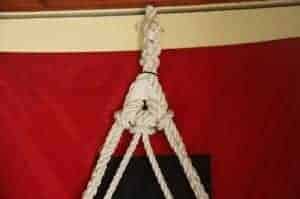
Independent lines on separate cleats matter. If one line chafes through or pulls a cleat, the others still hold the boat. The center line had a little slack so it only took load if one of the others failed.
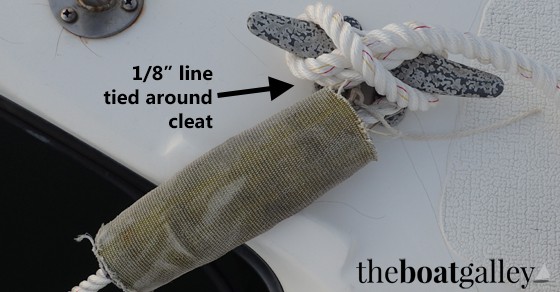
Then there was chafe protection on the boat end. We used old fire hose (fire departments give it away free, and many marinas get it in bulk and pass it along). We punched a hole in the hose and tied the chafe gear to the boat with light 1/8-inch line, not to the dock line itself. That way, as the line stretches and slides, the chafe gear stays exactly where it’s needed.
The Small Things That Added Up
A few months after buying Barefoot Gal, we’d replaced the weatherstripping and latches on all the exterior lockers so they were less likely to fill with water. It paid off. We had minimal water in the two lazarettes and sail lockers, and none at all in the propane locker, line locker, or engine compartment.
The bottom of the boat was clean, too. Probably a small factor, but in wind waves and surge, less underwater drag meant a little less force on the mooring and lines. Every bit helps.
Our one real loss was the dinghy outboard. We’d stored the dinghy and motor ashore in the marina workshop, but the outboard sat on the floor, and the building took 16 inches of storm surge. The motor went under.
That outboard was nearly the whole story of our damage. Our total came to less than $1,000, almost all of it that one badly stored motor. The boat herself? Under $100.
What It Really Comes Down To
No single thing saved Barefoot Gal. It was the sum of dozens of small decisions, each shaving off a little risk, plus luck on where she sat in the harbor. You can’t control the luck. You can control the preparation, and the preparation is what adds up.
If you want the full system behind that preparation, not just what to do but how to judge it for your own boat in your own spot, may I suggest my course, Comprehensive Hurricane Prep for Boaters. The story above shows a well-prepped boat can come through a major hurricane. The course is how you build that preparation, step by step.

About the Author: Carolyn ShearlockCarolyn Shearlock has lived aboard for 17 years and cruised more than 14,000 miles, from Pacific Mexico and Central America to Florida and the Bahamas. In that time, her boats came through two direct hurricane hits — Marty in 2003 and Category 4 Irma in 2017 — plus nine close passes, with less than $1,000 in total damage.
She has spent more than 20 years studying why some boats survive storms while others nearby are lost, and refines her approach after every season. She has taught hurricane prep at Cruisers University and through the American Sailing Association, shared boat-securing tips on The Weather Channel, and her hurricane prep articles have been featured on the cover of Blue Water Sailing and in Cruising World.
Carolyn also created Comprehensive Hurricane Prep for Boaters, a full, self-paced online course with lifetime access including annual updates.
Mark Sierakowski says
There is always a good dose of luck. However, without the prep, you need a lot more luck. Well done.
Kevin Kirkendoll says
Well stated.
Allan Cobb says
Sadly, I lost my sailboat in Hurricane Harvey when the cleat ripped out of the floating dock.
The Boat Galley says
I am so sorry about that. Yes, some things you just can’t control.
Christine Dumaine Springfield says
I did see a lot of hurricane prep articles that talked about getting attached to the dock itself and not depending on those cleats. Not applicable in my case as we were on a mooring ball, but just something I saw. I am beyond sorry about your boat.
Beth Nencetti says
Thank you! Although I’m a firm believer that luck is not a barrier, sometimes it helps. Your tips and recommendations are fantastic. You have provided slight improvements on tried and true methods. So glad BG made it through! Good luck with the rest of this season! Hopefully I will see you at the Annapolis Boat Show.
Rick D Dillard says
Thanks for the update, I was thinking of ya’ll during the storms. Notice the use of ya’ll–that’s just the we talk.
John Liniger says
What’s the saying…It’s Better to Be Lucky than to be good? You were BOTH! I’m off to find some used fire hose
Mike says
On the forums I saw numerous comments that people posted saying they had their boat all ready but yet the foresail and main are still on, strapped down, but still on. Stripping the deck is what a person has to do for even a small hurricane not to mention a category 4 or 5 hurricane.
We are in La Paz and just went through hurricane Lidia. We towed a boat in that was damaged by another boat being improperly anchored. That boat drug anchor and ended up fouling our friends anchor. his anchor held both boats but the bowsprit of the other boat went down the port side taking out all the railing, across the back chopping the dingy in half and sending the davits to the bottom dingy, solar panels and motor included. Then it went back up the starboard side taking out all the railings on that side. The chain wrapped around the prop shaft and bent it disabling our friends propulsion. All in all $35K in damage done by a neighbor that didn’t properly prepare.
As you indicate in your article you can prepare all you want but when you are done start looking at your neighbors. Give them a hand if they need it.
Carolyn Shearlock says
Yes, I’ve written about “help your neighbor” and believe in it. Here, some boats came in at the last minute and/or refused to prep and refused to let anyone else board their boat to do so.
Help Your Neighbor, Help Yourself
Lynn Richardson says
So if I read this right, you totally depended on the mooring pennant? You did not have any lines connected to the mooring ball eye itself as a backup? Thank you for the discussion. It is always helpful to hear first-hand experience. So glad you got through Irma in good shape.
Carolyn Shearlock says
You are correct. City Marina strictly prohibits adding other lines or using chains or putting out an anchor in addition. They say that anything “extra” fouls the system and tends to cause it to fail. We followed their instructions precisely.
Kevin Kirkendoll says
Look, I do not want to take anything away from good seamanship, and good thorough and well thought out pre-storm preparation, but sometimes nothing you do will save your boat. It seems every storm has one geographical area that is totally devastated, mauled beyond recognition.
The Boat Galley says
Yes. I think we did what we could, but yes, there is some luck.
Kevin Kirkendoll says
I couldn’t make it to my boat in time. It was in Tarpon Springs and I was out of the country on business. The yard put out a couple of extra lines for me. Watching the storms track I just knew I was going to lose the boat. Also it was between a steel hulled barge and a steel hulled commercial tug. Mast (wooden) broke and that was it. Dumb luck on my part.
The Boat Galley says
Wow. Yes, there is a certain amount of just plain luck.
Christine Dumaine Springfield says
Great summary. As one of the other few surviving boats in the harbor, I agree totally. Thank you, LUCK, for saving our homes.
Maryanne Theyerl says
75% loss. That is truly heartbreaking. I’m glad Barefoot Gal rode it out.
Stephanie Hamilton says
We used fire hose on SummerWind, too. And we attached it through a hole and using zip ties. What we never did was attach it to the boat rather than to the line. That is BRILLIANT! And THIS is why your information is SO important to other boaters. Yeah, I definitely see another book being born here. Nice work, Carolyn. Well done.
John Fox says
Thank you for the writeup, some very good info there.
We dock in St. Augustine and our marina is a bit protected, but our boat was still put in peril by other boats. As the wind started to shift from east to south, the large power boats upwind from us started to push against their docks and pilings. They pushed three pilings over, and ended up pushing our dock into our boat and then onto another boat. Fortunately, the only damage was some minor cosmetic damage.
From what I can tell, the other boats were tied up appropriately and no lines came free.
From your description and our experience, it seems the biggest danger to anyone’s boat is other boats. I don’t know of a good way to mitigate that, even if they are pulled out onto the hard, other boats can fall over and create a domino race.
As Ron White said in one of his bits about a man tying himself to a tree during a hurricane, it’s not THE wind.
It’s what’s IN the wind.
We will purchase some old tires that we can use as fenders during a storm to minimize the impacts from objects IN the wind.
Gina Soucheray says
Yes, it’s just as inportant to prep the boat on the hard for a storm. In our marina in Green Cove Springs, several hundred boats survived, except one. The owner left the furling jib attached. Thr wind whipped it loose and “sailed” the boat off its jackstands. Fortinately (and amazingly) no other boats played the domino game! Thanks for the update and tips.
Peg Dixon says
All that work – and SO very worth it!! Congrats!
Lori Steinbrunner says
Excellent summary, Carolyn. Thanks for taking the time to write it up. Glad Barefoot Gal fared well.
Peggy Stone says
Thank you. We used many of the same methods for Katrina. Always good to hear new ideas. We used duct tape instead of fire hose but I will be looking for fire hose.
Charlotte Caldwell says
An excellent article, so glad BG survived. Unlike you, I am a firm believer in luck and coincidence! Preparation is so important too, but, sometimes, it’s just the way the metaphoric ( and/ or real) wind takes us.
Carla Barrett says
Thank you for sharing how Barefoot Gal was set up on the mooring ball and how you prepared. We also use fire hoses as chafe guard on our boat, but the idea of adding the hole punch and smaller line is brilliant to keep it in place. Thank you!
Lisa Ballard says
Be careful with fire hose. You want water to get to the line to keep it cool. So remove the liner.
Carla Barrett says
Lisa Ballard, tell me more- my fire hose is actually washable -and the cloth outer material is fused or embedded with this rubberish looking interior. Cannot separate the two. I got my donation from a CA Fire Dept.
Kevin Eicher says
How many hurricanes have you, (and your boats) survived now? Congratulations, I am glad, whatever the reason.
The Boat Galley says
We (or the boat) have been within 50 miles of the eye 6 times, with two of those (including this one) being direct hits. Several others had decreased to TS intensity by the time they reached our area.
Kevin Eicher says
Wow. I’ve read a lot of what you’ve written about this. Being ultra prepared… and lucky seems to be a good combination. Again, congratulations!
Kevin Kirkendoll says
Also, thanks for taking the time to write this. Very informative. I can only imagine what it might have felt like riding out the storm with a drebis field taking out boats around you. Did they indicate if they would do it again if necessary?
The Boat Galley says
I don’t think so. Two of the boats that had people on them sunk.
Kevin Kirkendoll says
The Boat Galley ouch!
Ellen @ The Cynical Sailor says
I’m so happy that Barefoot Gal came through intact. Great summary of what happened at Boot Key and really helpful tips for hurricane prep for folks.
Jean Vukman Losco says
Phil Losco Gene Sappe James Ryan
Mickey Dawson says
Carolyn, did you secure your steering/rudder? or leave them be?
The Boat Galley says
We just left it.
gin arnold says
Hi, glad you made it through. I have posted in the last few days asking about a ham that lived on a canal not far from the anchorage. This was in 1990 and I have no recall on his name nor ham call, but he was very kind when I sailed through. His home, I believe he was a retired naval capt , was a short ding ride from the anchorage but would love to know how he is. My old ham call was N4VGP. I live in Ecuador now so have little contact with the sailing world.
Thanks,
James Bragonier says
A great report in nearly all respects. We, as land lubber friends, actually tiny house owners, have followed you for the last year and were concerned. We revel in your successes and having bare=boat cruised the V.I., understand the neighborhood a bit. We’re glad for your safety and successes! Keep on keeping on!
Scott Whitfield says
Thanks so much for your great post we can learn from. Glad everything turned out as well as it did for you. And yes, agreed, to a great extent, one creates one’s own luck!
LisaMarie Gauci Takacs says
Thank you, another great information piece!
Heather B. says
Glad to know you 2 and Barefoot Gal are safe. Thanks for the detailed prep info. Keep safe!
Julie Denmark says
So glad BG was unscathed. I would be interested in what you used for weatherstripping to seal your lazarettes. We tried doing this, but the black sticky foam we used is already peeling off. Thanks for sharing your experiences and wisdom.
Carolyn Shearlock says
We got some at Home Depot. And sometimes it does start coming off — we use Gorilla Glue to reattach it.
Shawna Smith says
Really good info. Thank you.
Michael O'Brien says
Alan Stephenson
Dolores M. Ik'Nal says
Can you post more about the Storm Tie-up configuration you mention in this article? Sounds like something we really want to know how to do… Thanks!
Arkouda Phelan says
So smart! Thanks for sharing!
Ron says
Hello, glad all is well with you & BG. Drone pictures I’ve seen are horrendous. Could you post an article of interviews from those who stayed behind? Your prospective would probably provide invaluable information.
Thank you, temporary landlubber Ron.
Carolyn Shearlock says
I will see. Everyone is so busy with the recovery, it’s hard to talk for more than a few minutes at a time. And not too many stayed . . .
Kathy says
So glad that you and Barefoot Gal made it through Irma safely. We too have retired our storm lines and have purchased new. Worth every penny. Thanks for the idea on the chafe protection.
Lisa Ballard says
So happy for you. We followed similar procedures. Two of our lines to the mooring were dyneema. Our pennant failed and we ended up in the mangroves with 3 others. In some ways it really was luck-of-the-draw.
Ernie Lorimer says
Dyneema has high strength, high UV resistance but low elasticity, so I would think maybe an ok choice day to day but a bad choice in a storm. The lack of elasticity means the snap load is much higher. Mountain climbers have thought a lot about this.
Claire Ford says
Y’all should be an inspiration to all other boaters. It just seems selfish and self-centered not to accept help from other boaters who have been through the worst of the worse on both coasts. Y’all were one of the last friends I heard from, and now I know everyone is safe and sound.
Cherie Burch says
Glad all is well for BG and you. We are in St Pete with floating docks and used many of your tips for prep. We came through just fine with luck and God’s blessings. Our only issue was our marina “finger” neighbor. Our neighbor could not get to the boat because of evacuation traffic and gas shortages. The marina personnel only removed Bimini and dodger plus THEY TIED HIS BOAT TO THE CLEATS ON OUR SIDE OD THE FINGER. This could have put roughly 40,000 lbs of boat weight on our the cleats depending on wind direction. YIKES! Note to self – next storm instruct the marina personnel on tie up procedures.
Charlie Jones says
Very happy to read this on BG. Sad for BKH- I’ve been in there three times now, first in 1982
In my home marina in Port Lavaca Texas, we lost 13 boats to Hurricane Harvey. My own boat suffered minor damage and my house needs a new roof., but I have 5 friends whose boats were sunk. And we missed the main part of the storm. South of here,, in Aransas Pass, nearly every boat in that marina was sunk or blown ashore
Location seems to be a big factor. I tie on the west side of a long dock. NONE of the boats on that side sank, ALL of the boats across the dock (on the east side) are sunk
Ernie Lorimer says
Here in Connecticut we’ve never in recent memory been through more than a Cat 1. In our harbor over the last 40 years we’ve lost around 40 boats, a few to Gloria and more through noreasters. A Cat 3 striking CT is estimated to result in the downing of 77% of the trees in the state and a power outage lasting several months. So all of the following is mostly inapplicable to something like what you went through, but everything you say is applicable in less severe circumstances.
1. I think being on a mooring is much safer than being at a dock. The boat can weather vane into the wind and is less susceptible to surge. Many boats have been lost as docks float off the top of the pilings.
2. The lines from the mooring ball to the boat should be fairly long, and the leads to the cleats should be as fair as possible. C&Cs in particular used to have relatively sharp fairleads through the rail, and no amount of chafe gear was okay. A double bridle is essential and works well for a multi, but even better for a monohull is a line snapped to an eyebolt at the waterline. Since our club moved to a double bridle after Gloria, we’ve lost a small number of monos to chafe, usually on a bowstay. More were lost by bridles snapping about two feet down from the bow. On examination, it was determined that the nylon had fused because of heat developed by hobbyhorsing, and then snapped cleanly. So, longer lines, and not necessarily thicker lines.
3. Preparing for a storm, I usually leave my normal bridle in place, and then attach docklines to the mooring pennant as well, with lots of slack in case the bridle fails. Then I have a much heavier line with even more slack as a last resort. All attached to the pennant through a looped eyesplice as you suggest, and snugged down to not wear.
4. Catamarans with relatively low windage–not wedding cakes–are inherently safer, I think. I’ve watched the cats and the tris in winds in the high 60s over a long fetch, and they tend to ride very quietly, as the waves pass under. The monos are bucking broncos, and the runabouts unfortunately scoop up water and sink. The downside, as we saw in the VI, is that they are light and if they catch air flip. So filling water tanks, even the amas, may help. Ian Farrier thought filling his tris was a good strategy. Bilge pump failure and water ingress are less significant for cats since they will still float, but as we saw from the heavy rain in Nantucket during Jose, which sank 6 IOD boats, that is important for monos even in less extreme circumstances. If I recall, William F. Buckley lost Panic at Point Judith when water siphoned through the engine exhaust.
5. Reducing windage is huge, and being upwind of the rest of the fleet helps, particularly if they still have canvas up. A number of the boats we’ve lost over the years were because one boat broke free, fetched up on another boat with its bridle caught between keel and rudder, and then the both of them gone on to do more. Our procedures call for the rudder to be lashed hard over, and strange as it sounds boats this way tend to round up and move very slowly, almost as if they are hove to.
Kudos to you for using the proceeds on the book this way.
Carolyn Shearlock says
Really good analysis. We were specifically told NOT to lengthen the mooring lines so that boats would stay the proper distance apart. It’s a good idea, but check whether your mooring field allows it.
Ernie Lorimer says
Yes, I didn’t mean lengthening them, just that longer lines are better than shorter lines. If you look at the picture of BG heading this article, it looks unlikely that the boat would jerk one bridle or the other sharply. But put the mooring ball a foot in front of a monohull, set it in a 6 foot storm surge to stretch the pennant out, and then hobbyhorse the bow up and down 7 or 8 feet, chafing gear won’t be your problem.
Amy says
Hi. We just bought our first sailboat & pretty much know nothing yet. This might be a dumb question but we were wondering why people didn’t just sail away from the on coming storm? Especially given the advanced notice of the storm.
Cherie Burch says
The problem is, sailboats don’t go very fast and the storm was about 400 mikes across. Where could you go at 6-7 knots to get away. Plus the track kept shifting so there really wasn’t any way to know for sure where it would go. In St Petersburg, we faced the uncertainty of the track and by he grace of God, got lucky! Good luck with your boat- it is a wonderful sport. We have been sailing all of our lives (now in oir 60’s).
Ernie Lorimer says
With a well found, ably crewed ocean capable vessel, sure, and many did by going south to Grenada, etc. For a coastal cruiser the better strategy is to secure the boat, be sure the insurance is paid up, and leave it for a safe place. Richard Branson tried to do both–he sent his yacht south and then hunkered down on Necker. I think after he might have felt he would have been better off going with the boat.
vicky says
forgive my ignorance, I know nothing of sailing or boats but reading about your friend who was diving and that he was in water with a lot of gasoline in it, should boats use up (or remove) all the fuel before the storm or does the fuel add needed weight to help the boat survive?
Susan DeSimone says
Great post, and I second the request for more details about the storm tie-up configuration.
Anonymous says
probably the biggest danger we had here during harvey was that a lot of people did nothing to prepare their boats a good many people that did prepare suffered damage from other boats as a result.
The Boat Galley says
That is always a problem and one of the best reasons to help your neighbor.