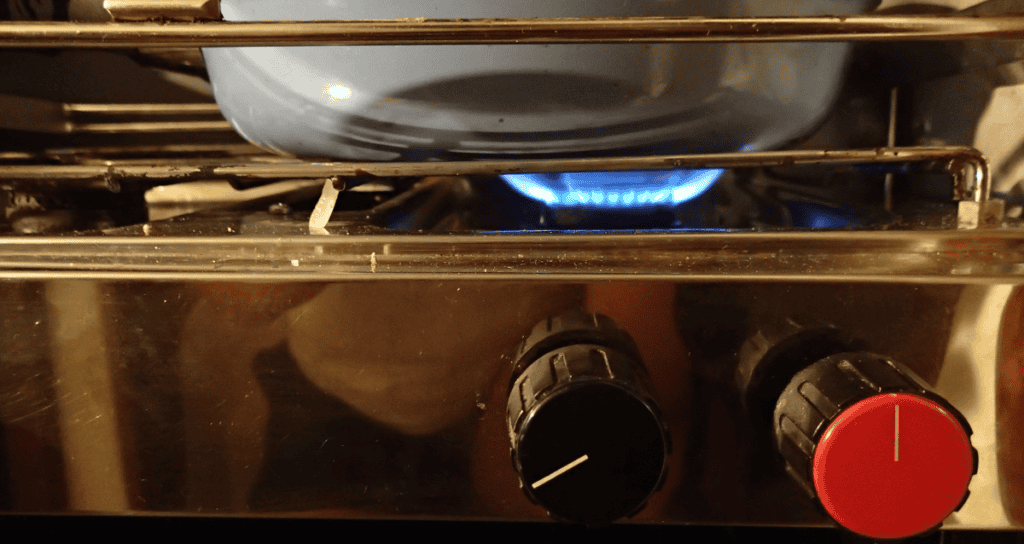
Tired of burning food whenever you try to simmer it? Can’t turn your stove burners down far enough to keep food gently bubbling? Or maybe you turn the flame down low enough, only to have it go out a few minutes later—no burnt food, but also not cooked.
If that sounds familiar, you’re not alone.
Simmering problems are especially common with gas stoves, and even more so with boat, RV, and camping stoves. These stoves are often designed to put out a lot of heat in a small space, which is great for boiling water quickly—but not so great when you’re trying to keep a pot of soup, rice, or sauce at a gentle simmer.
On many small stoves, the lowest flame setting is still too hot. And if you try to turn it down further, the flame may become unstable and go out entirely. Add in the motion of a boat, uneven cookware, and burners that aren’t perfectly regulated, and simmering can feel nearly impossible.
The good news is that there’s a simple, inexpensive solution.
The Simple Fix: A Flame Tamer or Heat Diffuser
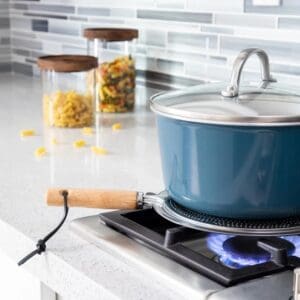
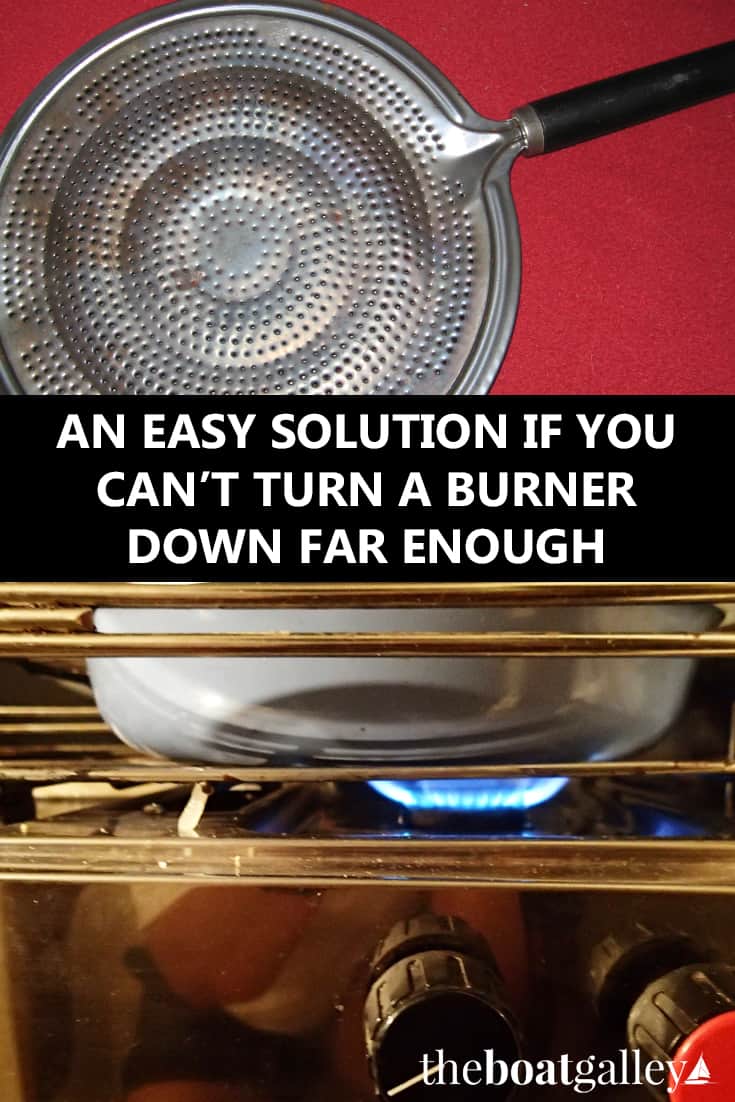
What you’re looking for is called a flame tamer, heat diffuser, simmer ring, or simmer plate. These are all names for essentially the same tool. Some are solid metal plates, while others have air channels or holes to help spread heat. Either type works.
Using one couldn’t be easier. You simply place the flame tamer directly on the burner grate, then put your pan on top of it.
What this does is spread the heat more evenly across the bottom of the pan. Instead of the flame hitting one small spot, the diffuser absorbs and redistributes the heat. This reduces hot spots, lowers the effective heat reaching the food, and makes it possible to simmer even when the burner itself is set a bit higher.
You should still use the lowest burner setting that will stay lit. But when that lowest setting is still too hot—or unreliable—the flame tamer bridges the gap.
Why Simmering Is So Hard on Small Stoves
Boat and RV stoves often have burners that are either “on” or “almost off,” with very little control in between. They’re built for efficiency and compactness, not finesse.
In addition, smaller burners concentrate heat in a tight area. That’s why you can scorch rice or burn the bottom of a stew even though the rest of the pot seems barely warm. Thin cookware makes the problem worse, since it transfers that concentrated heat directly to the food.
A flame tamer adds a buffer. It gives you a wider margin of error and turns a finicky stove into something far more forgiving.
Choosing a Flame Tamer
You’ll find a wide range of flame tamers available, from very inexpensive to surprisingly pricey. In my experience, the inexpensive ones work just as well—sometimes better—than the fancy versions.
Amazon has a wide selection and is where I bought mine.
One thing to pay attention to is the handle. Some flame tamers have wooden handles, which can be a concern on a boat where motion might bring the handle closer to the flame than intended. I eventually removed the wooden handle from mine for peace of mind.
Models with metal handles that fold or can be removed entirely are often better suited to boats. They store more easily and eliminate the risk of a handle overheating.
When a Flame Tamer Helps Most
A flame tamer is especially useful for:
- Simmering soups, stews, and sauces
- Cooking rice, beans, or grains
- Keeping food warm without scorching
- Cooking with thin or lightweight pans
- Dealing with burners that won’t stay lit at very low settings
It won’t fix every cooking challenge, but for the common problem of “too much heat, too fast,” it’s one of the simplest tools you can add to your galley.
Adapting to Imperfect Equipment
Cooking on a boat—or in any small or unconventional kitchen—often means adapting to equipment that isn’t ideal. You may not have perfect temperature control, heavy cookware, or a wide range of burner sizes. Tools like flame tamers help, but so does understanding how heat, pans, and techniques interact.
Problems like not being able to simmer are common in small or quirky kitchens. In The Boat Galley Cookbook, I explain practical ways to adapt techniques, cookware, and heat so everyday cooking works better—whether you’re on a boat, in an RV, or at home

Carolyn Shearlock has lived aboard full-time for 17 years, splitting her time between a Tayana 37 monohull and a Gemini 105 catamaran. She’s cruised over 14,000 miles, from Pacific Mexico and Central America to Florida and the Bahamas, gaining firsthand experience with the joys and challenges of life on the water.
Through The Boat Galley, Carolyn has helped thousands of people explore, prepare for, and enjoy life afloat. She shares her expertise as an instructor at Cruisers University, in leading boating publications, and through her bestselling book, The Boat Galley Cookbook. She is passionate about helping others embark on their liveaboard journey—making life on the water simpler, safer, and more enjoyable.
Jan Bogart says
never knew such a thing existed! only bugs me making rice. i just move the pan halfway off.
Debra Turner says
I removed the wooden handle from mine as it was getting too hot and charred one day! Thanks for reminding me to put that on my shopping list to replace the old one!!
The Boat Galley says
I cut it off mine — I like the new one that I linked to in the article since the handle is metal and also folds/removes for storage. A much better design for about the same price!
Debra Turner says
The old one came from a Villiages in Guatemala! I am in Cartagena, Colombia now so have more options! The removable handle is a great option!!
Stephanie Hyman Holden says
Thank you for this!!! I am ordering one today!!
Michael Ard says
In Spain They had a similar thing, It was a round steel plate about 6″ across perforated. I have used one for years Easy to make too. like this but not as elaborate:
Michael Ard says
This is from J Lewis.
Tod Mills says
Boy, if this thing works as advertised, it is just what I need. Not sure why boat burners can’t be fine tuned as well as my home stove.
Elaine Gustafson says
I found a porcelain coated cast iron heat diffuser/reducer by Ilsa on Amazon. After using one of the lightweight, perforated ones that got rusty, I found this cast iron flat plate with removable handle was just perfect for the boat and also for my gas stove at home. It is always on the stove and gets used daily. I don’t miss the old rusty one ! It also seems to turn any pan into a cast iron pan.
EJDakins says
Take it from a gas guy, burners can be adjusted to simmer,gas stoves like all other items on a boat need to be serviced and cleaned like any thing else.
Anonymous says
I have one of these and looking for a second one.
The Boat Galley says
https://amzn.to/2HEuxkN
Anonymous says
I got mine from ebay. Handle fell off but it works fine 😀
The Boat Galley says
Caroline Sharpe I’ve been known to cut the wooden handle off to make it easier to store and also reduce the risk of it catching on fire.
Fran McLaughlin says
I ve used one for 35?years aboard my boat “AKA” I gave a folding one with a plastic handle. They last for years. Just a wipe every once in awhile.I always have acouple on board as all my pans are stainless steel bottoms from Revereware which I ve had for 35 years. Fran McLaughlin S / V “ A KA” currently in Opua New Zealand heading to Fiji now that borders have opened up.