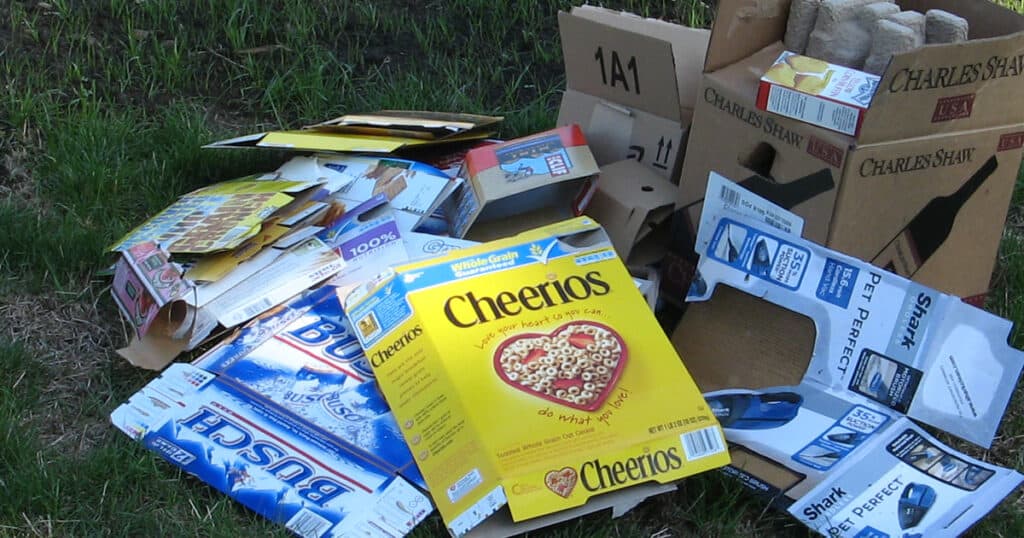
When you’re thinking of ways to avoid bugs on a boat, most cruisers will advise you to avoid bringing them on board by keeping cardboard on shore. But many products we use frequently come in cardboard packaging. Think of things like facial tissues, pasta, cereal, and boxed wine (check out my tip for getting rid of wine boxes).
Does cardboard actually attract bugs? And is the problem severe enough to justify the extra work of eliminating cardboard from your boat?
Why Bugs Like Cardboard
Cardboard attracts bugs, particularly cockroaches and silverfish, for several reasons. Corrugated cardboard provides hiding places where bugs can lay their eggs. Cockroaches are also believed to like the equal pressure the corrugations provide on the top and bottom of their bodies. But even thin cardboard, like cereal boxes, is appealing to bugs.
Some eat the starchy glues used to seal boxes. Others feast on the cellulose itself.
And cardboard doesn’t just mean boxes. Books can also harbor insects in their spines. Makes that free library at the marina a little more suspect, doesn’t it?
Signs of Insects on Cardboard
Before bringing cardboard on the boat, look at it carefully. Signs of an infestation include:
- irregular discolorations, often yellow
- small holes in the surface
- black droppings in box corners.
In addition, cockroaches deposit their eggs in a casing that looks similar to a kidney bean. Pay special attention to corners and flaps where boxes are glued together.
But really, how much time do you want to spend analyzing cardboard? It’s simply easier to avoid bringing it onto the boat in the first place.
Tips for Eliminating Cardboard From Your Boat
When I first moved aboard Que Tal, I fumbled my way through. Over years of cruising, I’ve discovered many ways to replace cardboard to contain my provisions. I never eliminated cardboard entirely, but I got rid of most of it.
Small Bottles in Boxes
This is the easiest box to eliminate. Simply take the vitamins, vanilla extract, aspirin, whatever, out of the box it came in.
Blister Packs
Yes, you can take the pack out of the box. But you may need the directions. Small tubes with directions on the side can be difficult to read. Don’t toss the box without keeping the instructions.
I’ve often taped instructions to the item and stored them both in a resealable plastic bag. Cruiser Steve recommends taking photos of the instructions with your phone. Note on the product that you have a picture of the directions. Just make sure you save it somewhere easily accessible from the cloud or on an easily found thumb drive. You don’t want to be scrambling when you need the dosage for medication.
Personal Hygiene Products
Many hygiene products come in boxes. Tampons and sanitary pads are worthless if drips or leaks get into them. So storing them in plastic bags is preferable. If you prefer to take them onboard in the box for modesty’s sake, transfer them to bags and quickly take the boxes back off the boat.
Pet Food (in Bags or Boxes)
I took the box or bag on board and transferred the contents to a good plastic container with a locking lid and got rid of the bag or box immediately. Read more about storing pet food.
Again, note feeding guidelines and serial numbers (in case of a recall) before tossing the original packaging.
Soda, Beer, and Other Drinks
For soda and beer, I got rid of any boxes and put the cans in bags to carry onto the boat.
If wine was in a case, I removed the bottles and left the cardboard in the trash ashore. For boxed wine that has a “plastic bag” bladder inside a box, I removed the bladder from the box and left the box ashore. This is for any boxed wine with a fancy push-button pouring mechanism. You can put the bladder(s) in a solid plastic storage bin to keep them from wearing a hole, and it’s really not that hard to pour a glass from one. Read a great idea from a reader on how to easily make a plastic wine box. If you buy several different varieties of wine — other than just one red and one white — be sure to use a permanent marker to label them.
Tetra Paks
Tetra Paks are what we think of as “juice boxes,” although lots of other things come in them — boxed milk, wine, even some veggies and fruits (instead of cans). Tetra Paks are designed for long-term storage of their contents, and you shouldn’t try to repackage the item.
Plastic Bags and Wraps
These often come in a roll inside a cardboard box. I took the roll out and put it in a plastic grocery bag or other container. I’d throw the cardboard away before it even got on the boat. Read my tips for organizing bags without boxes.
I never found a better alternative to leaving these in their boxes. However, reader Donna suggested plastic holders sold under the name Wrap Master and Foil Master. Amazon sells a number of dispensers with cutting edges for replacing plastic wrap boxes.
Toilet Paper and Paper Towels
Yes, there’s a cardboard tube in the center. No, I never figured out how to avoid it. The best I can suggest is to check various brands and choose the rolls with the most sheets. This will save a lot of storage space, too, as some brands of toilet paper are extremely loosely rolled in foreign countries. I’ve seen some with only 60 sheets per roll; at the same time, I’ve bought rolls with 500 sheets! As a side note, we tended to use a few pieces of bath tissue as a replacement for Kleenex, so we didn’t have the boxes on the boat.
You can buy toilet paper without a cardboard core. Toilet paper made from bamboo fibers is often advertised as “tree-free.”
Food Items
Rice, pasta, and couscous often come in boxes. I took them on board in the box, and immediately transferred them to plastic storage containers. I cut the directions out of the box and taped them to the container. The box was immediately returned to shore. You could take your plastic storage containers in the dinghy, I suppose, but my method worked well enough for us.
Most cereal comes in a plastic bag inside a box. I pulled the bag out of the box and left the box ashore. Sometimes, you can buy cereal that’s just in a resealable plastic bag, which eliminates the box problem and is often cheaper.
Most cracker boxes have plastic bags inside. I took the bag and left the box behind. With both cereal and crackers, I put a bunch of the bags together in one storage bin in a location where heavy stuff can’t fall on top of it. For crackers that come in waxed paper sleeves, I put several together in one resealable plastic bag. Otherwise, they’ll quickly pick up moisture in the air and get stale.
Box mixes often have liners. I either wrote the directions on the inner bag or cut them out of the box, then put the liner and instructions inside a resealable plastic bag (along with a bay leaf as protection against weevils). Be sure to label the contents!
Eggs have their own challenges because they are fragile. I used Lock & Lock egg containers (Amazon). I found they locked more securely than those you buy at camping supply stores.
Other Cardboard to Get Rid Of
In addition to all the galley stuff, also beware of cardboard from other sources and try to reduce as much as you can. Things like spare or replacement parts, tools, galley equipment, and gadgets all tend to come with cardboard. Sometimes, though, we just didn’t want to get rid of it: either we needed to keep the packaging in case we needed to return the item, or in some cases, the box and packaging were really the best way to store spare parts.
In those cases, if the item was small enough, we put the whole thing in a resealable plastic bag (or vacuum sealed it), figuring that if there was no fresh air or food, any critters in the cardboard would soon die. Some larger items, like our spare bilge pump, we couldn’t do anything about. We just accepted the fact that we had some cardboard.
Watch Out For Books
Even though it’s not “cardboard” per se, we also learned to watch out for books from book exchanges that didn’t have a lot of turnover. More than once, they were serving as homes to numerous bugs (book lice is a thing). We learned to put them in a plastic bag, gave them a squirt of bug spray, and left them in the bag in the cockpit overnight. With more and more boats carrying their books digitally — on a Kindle or iPad, for example — this might be less of a problem for some (those with e-readers) and more of a problem for others (as print books sit longer in exchanges with fewer people reading them).
Life on a Boat is Better Without Bugs
In my years of cruising the Sea of Cortez, Florida, and the Bahamas, bugs were a major issue. Anyone who is traveling in the tropics should take common sense measures to keep them off your boat.
Cruisers from the Pacific Northwest claim this is less of an issue for them, with more concern about spiders. But if your cruising grounds put you at risk for a bug infestation, hopefully these tips will give you some ideas to keep from bringing them on board.
Related Posts

Carolyn Shearlock has lived aboard full-time for 17 years, splitting her time between a Tayana 37 monohull and a Gemini 105 catamaran. She’s cruised over 14,000 miles, from Pacific Mexico and Central America to Florida and the Bahamas, gaining firsthand experience with the joys and challenges of life on the water.
Through The Boat Galley, Carolyn has helped thousands of people explore, prepare for, and enjoy life afloat. She shares her expertise as an instructor at Cruisers University, in leading boating publications, and through her bestselling book, The Boat Galley Cookbook. She is passionate about helping others embark on their liveaboard journey—making life on the water simpler, safer, and more enjoyable.
Leave a Reply