If you’re like most of us, your Lifesling sits on your boat year after year. You know it’s there, but have you really looked at it?
When we bought Que Tal (our first cruising boat), we decided to do a practice retrieval in a sheltered anchorage. We left the boat anchored; we wanted to figure out the best way to get someone aboard once we got it to them. The first thing we discovered was that the Lifesling had never been tied to the boat. So when we threw it overboard, it was just there, floating. By itself. Oops. Glad it wasn’t a real emergency.
That should have taught us to thoroughly double-check the safety gear when we bought Barefoot Gal. We did check to make sure that the Lifesling was tied on . . . and it was. But we didn’t make sure it was ready to use in an emergency.
Last spring, when we put the boat into storage for the summer, I realized that our throwable was in pretty sad shape (read more about checking safety gear). And for some reason, that made me pull the Lifesling out of its cover.
Check Your Lifesling
I found a rat’s nest of knotted line.
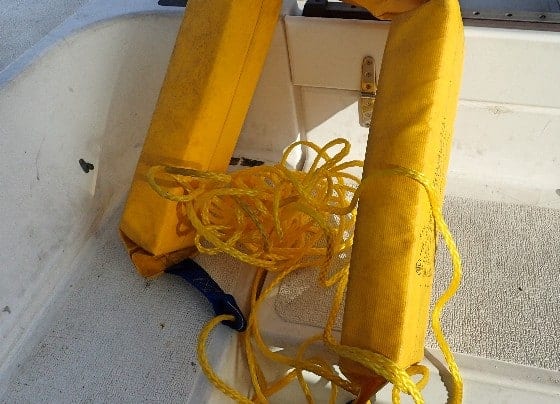
It took me over 30 minutes to untangle the Lifesling. That would have been horrible in an emergency! I couldn’t have gotten it more than 3 feet from the boat.
So now I had to repack it properly so someone could grab the Lifesling, toss it in the water, and have the line play out behind the boat so it could be dragged around the COB for them to grab.
It’s not hard, but it is critical to do it right. The owner’s manual states it best: “The Lifesling is like a parachute: it only works if you pack it correctly.” (Get a copy of the Lifesling owner’s manual here.)
How to Pack a Lifesling
So, here’s how to pack a Lifesling, complete with photos. While you’re repacking it, check that the line is in good condition — if any little bit of it has been left out in the sun, chances are good that pieces of the line will flake off in your hand. In that case, don’t bother repacking it: get a new line, then repack it.
Start with the end of the line that is NOT attached to the Lifesling — it should be covered in nylon webbing. Leave the end out and place where the webbing ends (that is, where it becomes just the polypropylene line) in the bottom of the line pouch in the case. Polypropylene is great because it floats, but it is very susceptible to damage from the sun, hence the webbing cover on the exposed end. You’re making a big “U” in the line.
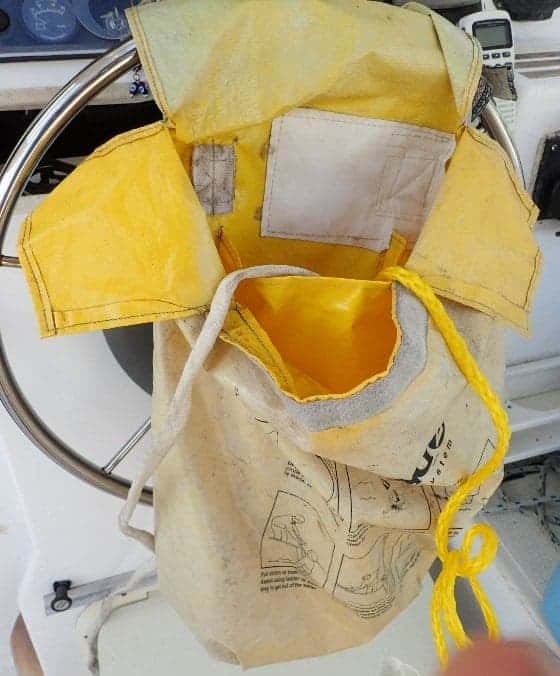
Then start putting 12″ at a time of the colored line down into the line pouch, making a zig-zag as you go. Do not coil the line! Keep the white webbing-covered line to one side and don’t get it tangled with the line you’re packing.
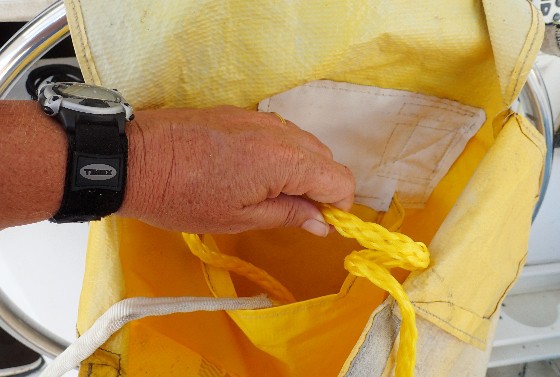
When you get to the point where the line is attached to the Lifesling, take the two sides of the Lifesling and slide them down the two sides of the case to fit over the line in the center.
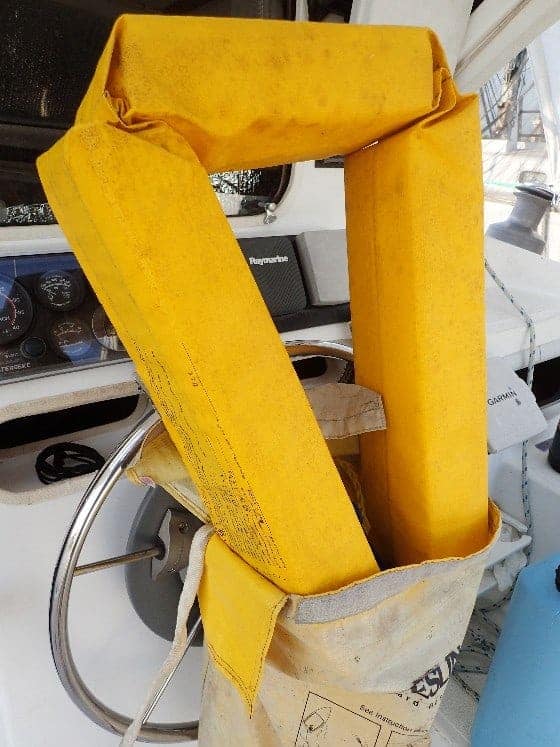
Slide it down (it’s tight!) and Velcro the top in place.
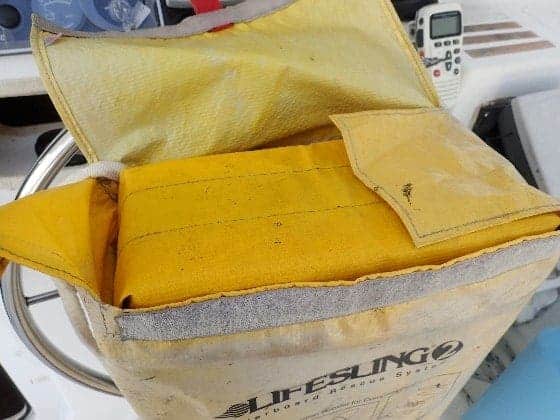
Mount it back in its place and secure the free webbing end. It’s hard to get just a knot to hold in polypro (even covered), so the company recommends seizing it. Remember, if the end comes unattached, you won’t be able to get the Lifesling to the COB.
Check That Your Lifesling Will Deploy
Want to check your work? It’s easiest if you’re in a boatyard or at a dock, but it can be done at anchor too. Assuming you’re at a dock:
- Open the case and grab the Lifesling out.
- Toss the Lifesling onto the dock.
- Get on the dock yourself.
- Pick up the Lifesling and walk away from the boat.
- Can you extend the full distance of the polypro line (125′)?
- Did it stop extending at that point?
If yes to both of these questions (which test the packing and how it’s secured to the boat), repack it just like you did. If not, figure out what the problem is, repack it or re-secure it, and test again.
Pulling Someone Aboard
And the next time you’re in a nice, warm swimmable anchorage, have one person jump in the water with the Lifesling (leave the boat at anchor; don’t worry yet about the whole issue of getting the Lifesling to them). (Don’t do this at a dock — there is a danger of electrocution.)
See what it takes to get the “swimmer” back on deck. Figure out the best way(s) of hoisting someone. And make sure that everyone who is regularly on the boat takes a turn as the victim and as the rescuer. I am not nearly as strong as Dave, and we had to devise a different way for me to winch him aboard our Tayana 37, which has fairly high freeboard.
Someday, your life or the life of someone you love may depend on the Lifesling working properly. Are you willing to bet your life on yours?
Read Next

Carolyn Shearlock has lived aboard full-time for 17 years, splitting her time between a Tayana 37 monohull and a Gemini 105 catamaran. She’s cruised over 14,000 miles, from Pacific Mexico and Central America to Florida and the Bahamas, gaining firsthand experience with the joys and challenges of life on the water.
Through The Boat Galley, Carolyn has helped thousands of people explore, prepare for, and enjoy life afloat. She shares her expertise as an instructor at Cruisers University, in leading boating publications, and through her bestselling book, The Boat Galley Cookbook. She is passionate about helping others embark on their liveaboard journey—making life on the water simpler, safer, and more enjoyable.
Leave a Reply