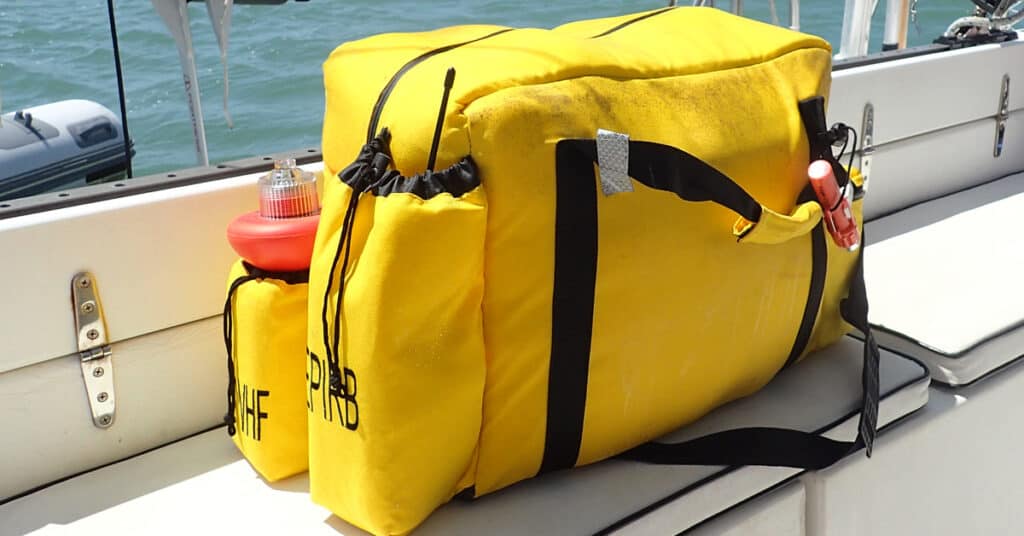
Your ditch bag is a critical piece of safety gear on your boat. It’s the one thing you’ll grab if you ever have to abandon your boat. Our ditch bag was pretty good sized and not exactly light. We hoped to never use it. But we were experienced enough cruisers that we knew it had to be close at hand. So where did we store our ditch bag?
When Things Get Bad, Can You Find Your Ditch Bag?
My philosophy is that if we needed the ditch bag, something bad was happening. Most likely we were sinking or there was a fire. Both can happen very quickly, and there is not likely to be time to get anything out from a “stored away” place. Or even perhaps from a cabin.
When we were on passage or traveling the majority of days, we put the ditch bag under the table in the saloon. It’s about five feet from the companionway door, and is the most accessible place we had. If we stayed in one place for a bit, we’d move it back to a less accessible place. Before we got underway, we’d move it to a more accessible spot.
Important Tips For Your Ditch Bag
Here are several more tips for making sure that you’ll be able to use the ditch bag and its contents should you ever need it:
Make sure your ditch bag floats
It’s bad enough if you have to abandon your boat. You don’t want to have your emergency gear sink to the bottom. Who wants to be left with nothing, or only what’s in your life raft? Our bag came with 25 pounds of flotation, but the bag weighed over 40 pounds. We had several Lock & Lock containers (Amazon) containing emergency items, plus air. I also cut up a swim noodle and stuck pieces in every nook and cranny to add additional flotation. If there is any question about whether your bag will float, test it. It’s also a good way to test that things that need to be kept dry will be.
Make sure it won’t float away
Tie a long, strong 1/8″ line (paracord — available on Amazon) to the bag. The line should be at least 25′ long; 50′ is better. If an emergency occurs and you put it in the cockpit, tie the other end of the line to a padeye or stainless rail. You don’t want it to wash overboard and get lost or disappear as you try to load the life raft. You may want to tie a knife to the outside of the bag so you can cut it free when ready.
Make it visible in the dark
Emergencies always seem to happen in the dark. I used a fair amount of SOLAS reflective tape. It’s much more reflective than less expensive reflective tape. The tapes makes it more likely you can find your bag in moonlight, or with a quick sweep of a flashlight. Buy SOLAS reflective tape on Amazon.
Attach a light on the ditch bag
In an emergency at night, light is going to be the first thing you want. I clipped a waterproof ACR C Light (Amazon) to the outside of the bag. These are the same lights that go on your PFD. Turn it on before tossing the bag to the life raft. If you miss the life raft, you’ll have one more way to find it. Or it will serve as immediate light in the raft. 
Check the contents at least twice a year and before any major trip
Do it far enough in advance that you can get replacements for anything you need, particularly batteries. And be sure to operate anything that uses batteries or a solar charger to make sure that connections have not corroded.
It’s tempting to try to get by with a less complete ditch bag and not make the effort to put it out where it’s easily accessible or not to check it and replace items as needed. But if an emergency were ever to happen, you really need that ditch bag and the items in it need to be in working order. Spend the money to put together a good kit and figure out the logistics to keep it readily available. You never know when you may need it.
Read Next


Carolyn Shearlock has lived aboard full-time for 17 years, splitting her time between a Tayana 37 monohull and a Gemini 105 catamaran. She’s cruised over 14,000 miles, from Pacific Mexico and Central America to Florida and the Bahamas, gaining firsthand experience with the joys and challenges of life on the water.
Through The Boat Galley, Carolyn has helped thousands of people explore, prepare for, and enjoy life afloat. She shares her expertise as an instructor at Cruisers University, in leading boating publications, and through her bestselling book, The Boat Galley Cookbook. She is passionate about helping others embark on their liveaboard journey—making life on the water simpler, safer, and more enjoyable.
Sue Peck says
We have the same bag as in the photo. We are on passage from Mexico to Hawaii and we were keeping it on the floor of the cockpit. We did take some water into the cockpit and to my dismay found the bottom of the bag was not waterproof. I am considering changing to 2 smaller waterproof dry bags when I pack for our next leg to PNW
Carolyn Shearlock says
No, the bag itself is NOT waterproof. It does have floatation but everything inside has to be waterproof itself or in waterproof containers.