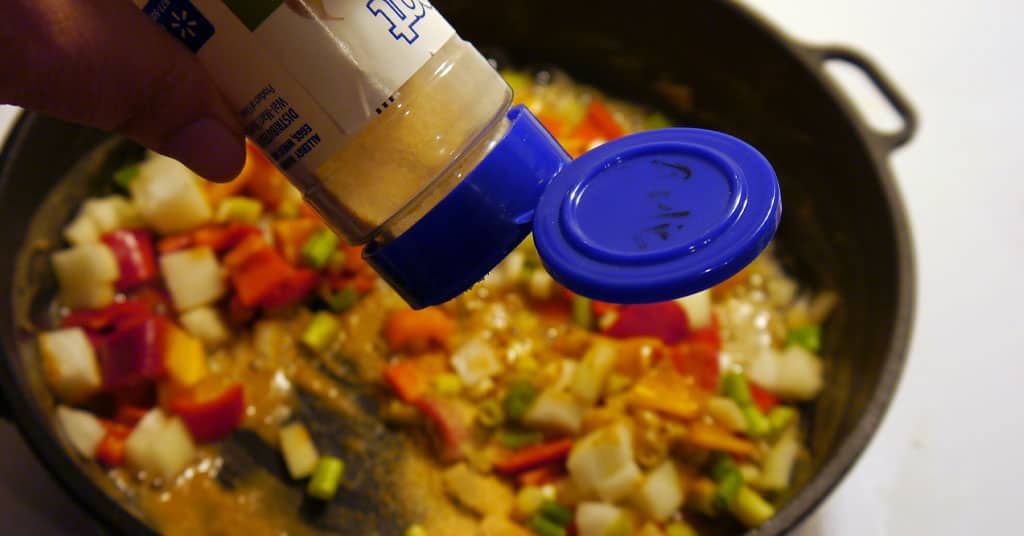
What’s wrong with the picture above?
Six weeks ago, I would have said “nothing.”
Like a lot of people, when I’m making something I’ve cooked dozens of times before, I rarely measure spices carefully. I just shake a little over the bowl or pan and judge by eye. If I only want a dash, that seems faster and easier than grabbing a measuring spoon. In this case, I was making gumbo and adding plenty of garlic, just shaking it right over the pan.
Shaking spices over a hot, steaming pan is one of the leading causes of dead spices on a boat.
By “dead,” I mean spices that have all the flavor of sawdust. You know the kind. They look fine, they smell faintly like what they’re supposed to be, but when you taste the food, there’s just nothing there.
I’ve known for years that heat and humidity are the enemies of spices. Living on a boat makes that worse. Cabins get warm. Humidity is often high. Storage space near the galley is limited. That’s why I’ve always recommended storing spices away from the stove and as low in the boat as practical.
What never dawned on me was that the way I was actually using my spices was killing them even faster.
I stumbled across this realization while researching something else and reading handling tips on a spice manufacturer’s website. It finally clicked. When you turn a spice container upside down over a hot pan, you’re doing two damaging things at once.
First, you’re exposing the spices to direct heat. Second, and even worse, the rising steam goes straight up into the container. Once that moisture gets inside the jar, it has no easy way to escape. You’ve just created a warm, damp environment that speeds up flavor loss dramatically.
On land, that’s bad enough. On a boat, where heat and humidity are already working against you, it’s a recipe for spices that go flat far sooner than they should.
Since realizing this, I’ve been trying to change a habit that’s been ingrained for decades. Now I make a point of measuring spices away from the stove. Sometimes I use a measuring spoon. Other times, I’ll pour a bit into my palm and add it from there. Anything is better than holding the bottle over a hot, steaming pan.
To help myself remember, I’ve even removed shaker tops from several spice containers. It’s a small inconvenience, but it forces me to slow down and scoop or pour instead of shake.
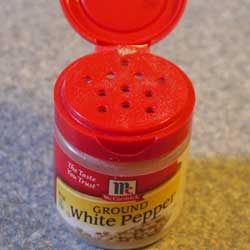
The irony is that many spice containers come with shaker tops that almost encourage the very behavior that shortens their life. Convenience wins in the moment, but flavor pays the price later.
Another related tip that’s especially important on a boat is to always use a completely dry measuring spoon. Moisture is just as damaging as heat. It’s easy to accidentally wipe a spoon with a damp cloth and then dip it into a spice jar, or to reuse a spoon that’s been hovering over a steaming pot without realizing condensation has formed on it.
I still catch myself doing this occasionally. Old habits die hard. But every time I do, I’m reminded why that jar of paprika or basil lost its punch long before it should have.
Spices aren’t cheap, and on a boat they’re not always easy to replace. Treating them gently makes a noticeable difference in how long they last and how good your food tastes. Simply keeping steam and moisture out of the jar can extend their useful life by months.
If you cook regularly aboard and want meals that actually taste good, protecting your spices is one of those small, easy changes that pays off every single day.
And if you’re looking for boat-friendly recipes that assume real galley conditions — limited space, limited storage, and ingredients that need to work hard for you — you’ll find plenty of ideas in The Boat Galley Cookbook.

Carolyn Shearlock has lived aboard full-time for 17 years, splitting her time between a Tayana 37 monohull and a Gemini 105 catamaran. She’s cruised over 14,000 miles, from Pacific Mexico and Central America to Florida and the Bahamas, gaining firsthand experience with the joys and challenges of life on the water.
Through The Boat Galley, Carolyn has helped thousands of people explore, prepare for, and enjoy life afloat. She shares her expertise as an instructor at Cruisers University, in leading boating publications, and through her bestselling book, The Boat Galley Cookbook. She is passionate about helping others embark on their liveaboard journey—making life on the water simpler, safer, and more enjoyable.
Dearbhla says
Im loving all of these tips, Carolyn! Keep ’em coming! Can’t wait to be responding to you from my own galley!
Terri Flynn on Facebook says
Interesting as I do the same thing just sprinkling from the jar.
Terri Flynn on Facebook says
Good idea about removing the shaker top.
tami says
who knew? Thanks!
Annual Salvador Rally on Facebook says
Over the years we have culled our spice selection because age also affects spices and a lot of spices we only use a couple of times during the year. We probably have 6 different spices and we toss them as soon as they “clump” in the jar. We started buying spices in small containers. I mean who can use 1/2 cup of ground ginger in 1 year (the average lifespan of spices). Whole spices keep much longer like Bay leaves, whole pepper, whole… well anything. You can get most spices everywhere so there is no reason to stock up unless you use exotic spices like unobtainium or virgin bee pollen.
Mary Makepeace on Facebook says
I use a spice mix called Mexican Adobado for meat and one called County Claire for fish and poultry which I get from the Savory Herb company. Tired of throwing away spices.
Andy Gallup says
Another reason to use the extra step I learned from a friend who was a restaurant cook. You do not want a whole container of oregano in a recipe meant to serve two. Of course you do not believe it until you do loose control.
JB says
In addition to the palm method of eyeball measuring (one of your old articles), away from the heat and steam of course, I also store the spice jars in OXO Good Gripes Pop-Top storage bins. I like them as I can open and close them one handed and they help keep them as fresh as possible. Most of them don’t seal worth a darn on their own.
Robin Bean says
I have also found that putting a few dreid beans like pintos in the container keeps the spices longer like rice in salt. The beans absobe any humidity during storage !!!
The Boat Galley says
Me too!
Dolores M. Ik'Nal says
We buy the spices in bulk at the hispanic stores, and to keep them safe, we use lock and lock little containers from Daiso, and upcycle little square milk containers (washed them very well and let them dry) since they are waterproof. No shakers to dispense them.
Sara Burns says
Just spent a good chunk of yesterday using a hammer and chisel to free onion powder and garlic powder from their containers so I could give them a spin in the food processor. The silica gel packets I keep in the containers are no match for ocean humidity.
The Boat Galley says
Oh my. I can just picture that!