
Choosing a cruising boat is mostly a process of elimination, and the majority of the work happens before you ever step on a boat.
There are hundreds of thousands of listings on YachtWorld, SailboatListings, Craigslist, and elsewhere at any given moment, and the initial question isn’t which boat should I buy — it’s which 30 boats are even worth a closer look. This article is about getting to that shorter list. Or, if you already have one, making sure it’s the right one.
The trap most first-time buyers fall into is starting in the middle of the process. They pick a length they like, a brand they remember from a YouTube channel, a boat that looks pretty in a marina, or a budget number and work from there. It’s only later, hopefully not after buying it, that they realize the boat is wrong for them.
A better way is to start with the decisions that have the most influence on what boat is right for you, in roughly this order:
- Where you’ll cruise
- What you can insure (and finance, if you’ll need a loan)
- Whether you want to sail or power
- Monohull or catamaran
- Length
- How loaded with systems
- How old
Seven filters. Each one rules out a slice of the market, and by the end you’re looking at a manageable pool of boats that actually fit your life. Then you can start sifting through them by price and where they’re located, and read the full listings. But until you narrow the pool, you’re just hoping to randomly stumble on the four or five right boats in that whole sea of boats for sale. This framework points you towards the right ones.
Many first-time buyers are surprised to see insurance named as the second item. Unfortunately, boat insurance has gotten dramatically harder to get in recent years, with real restrictions on age, hull material, owner experience, and intended use — and for liveaboards, a much narrower set of options still. If a boat isn’t insurable for your situation, it does not matter how perfectly it passes the other filters.
There is no one perfect cruising boat. There are boats that are perfect for different things. In 2002, Dave and I bought a Tayana 37 monohull and cruised it through the Sea of Cortez and Central America for seven years. Then in 2014, we bought a Gemini 105M catamaran and spent a decade in the Florida Keys and Bahamas.
Two tremendously different boats. The Tayana was a heavy offshore monohull made for longer passages, when we had younger bodies and bigger horizons. The Gemini was shallow-draft, easier to handle, and more comfortable at anchor — the right boat for island-hopping and what Dave called “geezer cruising” (he was 75 when we bought it). Both were the right boat at the time. Neither would have been right at the other time. That’s this article’s whole thesis in two boats.
Let’s look at the various filters.
Where Will You Actually Cruise?
This is the preliminary question. The honest answer determines what kind of boat you should be looking at, and it rules out whole categories before you ever filter for any other fact.
Be realistic. The cruising you’ll actually do in the first three to five years matters more than the trans-Pacific dream that may or may not happen. Most cruisers who buy a bluewater boat never do an ocean crossing (we didn’t!).
A coastal boat is plenty of boat for what most people actually do, costs less to buy and maintain, is often more comfortable to live on, and won’t punish you for not crossing the Pacific.
Five rough cruising profiles, each pointing at a different kind of boat:
- Coastal and ICW. This is the most common kind of cruising — East Coast, Gulf Coast, Pacific Northwest, Great Lakes. A coastal cruiser is exactly what you need. The Atlantic ICW also caps your air draft at 65 feet at most fixed bridges, which rules out tall-masted boats with little room to spare.
- Bahamas and Florida Keys. Asks for a boat that can handle a Gulf Stream crossing or open-water passage but isn’t a true bluewater boat. Draft is the binding constraint. Five to six feet or less opens up the islands. Seven feet locks you out of the best anchorages.
- Bluewater and ocean crossings. A genuinely seaworthy boat with the construction, rigging, tankage, and cockpit drainage that come with that. The Caribbean, West Coast offshore, and Alaska in summer all fall into this group unless you pick your weather windows extremely carefully.
- High latitudes (Pacific Northwest year-round, Alaska, the Maritimes, the Baltic). Their own category. Heating, hull material, and rigging considerations that don’t apply to warm-water cruising.
- The Great Loop. Most Loopers do it in trawlers or motor cruisers, but some sailors do it in boats with masts that come down. Air draft is the binding constraint here too — Chicago bridges, parts of the Erie Canal, and the Tenn-Tom all have their own limits, far lower than the ICW’s 65 feet.
Pick the cruising you’re actually going to do, not the version that sounds best at a dinner party. That decision alone rules out big swaths of YachtWorld and makes the rest of the filtering possible.
Will You Be Able to Insure It? Finance It?
Now that you know roughly where you’ll cruise, the question becomes what type of boat you can insure for it.
As noted before, boat insurance has gotten much tougher to get. Multiple bad storm seasons drove insurers out of the marine market, and the ones still writing cruising-boat policies have tightened underwriting, narrowed what they cover, and shrunk where they cover it.
What that means for filtering: insurance availability has to inform your shortlist now, not after you’ve fallen for a 1985 ferro-cement ketch and spent three weeks negotiating.
Several factors stack together to determine whether you can actually insure a given boat.
Boat age. Roughly: under 20 years is straightforward. From 20 to 30 narrows your options and almost always requires a recent survey. Past 30, many mainstream carriers won’t write a new policy at all. Past 40, you’re shopping specialty markets at significantly higher cost.
None of these are hard rules — a well-documented refit history can help — but the thresholds are tightening, not relaxing.
Hull material. Fiberglass is by far the easiest. Wood, steel, aluminum, and ferro-cement narrow the carrier pool dramatically and can be uninsurable in some markets at any age.
Your experience and ownership history. Insurers want to see owned-boat history, not crew or charter time. They also apply something called a ten-foot rule — usually they want experience on a boat within 10 feet of what you’re buying.
For example, jumping from a 30-foot weekender to a 45-foot cruiser (more than a 10-foot increase) will trigger extra scrutiny and may preclude getting a policy. The classic workaround was to hire a USCG-licensed training captain for 20 to 30 hours and get their sign-off.
That path still works with some carriers, but where it does, they’re now often requiring up to 100 hours, and many carriers won’t accept it at all. The industry view is that it didn’t keep claims down as underwriters had hoped. Don’t count on it being available.
We have a full piece on gaining boating experience to qualify for insurance. If your résumé is light, read it before you start serious shopping. Building the experience insurers want takes time, and you can’t fix that the week before you make an offer.
Liveaboard status. This is the single biggest factor for full-time cruisers, and it deserves its own treatment. Ben Belyea, who runs underwriting at Global Marine Insurance, calls liveaboard insurance harder than ever right now, especially for older boats worth less than $100,000. His full piece, Liveaboard Boat Insurance: Coverage for Full-Time Cruisers, is worth reading before you go further on any specific boat.
Liveaboard status alone reduces your underwriter pool dramatically. One cruiser told me that their broker said ticking the liveaboard box on an insurance application cut the available carriers by about 80 percent.
Some major carriers for US-only policies (State Farm and Progressive among them) won’t write a boat policy at all if the boat is your only home. But if you own a house or condo and will be using the boat only in the US, these companies become real options — and in today’s tight market, having more carriers willing to consider you is meaningful leverage on whether you can get a policy.
This one factor has encouraged several cruisers I know to hang onto their house while cruising rather than sell it.
The financial side of keeping the house is its own decision: mortgage, maintenance, taxes, what happens to the place while you’re gone. But if you think it might be an option, ask your agent if owning real estate might make it easier to get a boat policy. Sell Your House to Go Cruising? The Insurance Factor covers this question in depth.
For most full-time cruising buyers in the U.S. right now, the practical path is working with a marine specialist broker rather than a general insurer. A knowledgeable specialty agent will know which carriers are still writing liveaboard policies, what each one requires, and how to present your case. Insurance If You Live On A Boat — Where to Start walks through how to build the application file and shop the market.
The bad advice you’ll hear, and why not to take it. Cruisers and forum posters routinely tell prospective buyers to lie to lenders and insurers — “don’t tell the bank you’ll live aboard,” “don’t tell the insurance company you’re a liveaboard.”
This is genuinely terrible advice. A loan obtained under false pretenses can be called the moment the lender finds out, meaning the full balance is due immediately. Insurance obtained by misrepresentation can be canceled, and worse, claims can be denied at exactly the moment you need them — after a fire, sinking, or major loss.
The right path is to work with a broker who knows the cruising market and who can pitch your case honestly to underwriters who’ll accept it. There are real options. They just require honesty.
The financing layer. First off, lenders require insurance — every lender, every loan. No insurance, no loan.
Beyond that, lenders have their own rules about which boats they’ll finance. Most marine lenders won’t finance boats over 20 years old. A number specifically won’t finance liveaboards.
A few specialty lenders work the older-boat segment, but rates and terms are less favorable, and the lender pool is much narrower than for newer non-liveaboard boats. If you’re shopping older or planning to liveaboard, confirm financing exists for your situation before you commit to a specific boat.
What to do at the shortlist stage. You don’t need a bound insurance policy yet or a loan preapproval. You need to know enough about the insurance and financing landscape to filter intelligently.
That means getting at least one conversation with a marine insurance broker about what’s realistic for your experience, your cruising plans, and the kinds of boats you’re considering. If you’ll need a loan, the same conversation with a marine lender.
Both conversations are free — brokers are paid by carriers when a policy binds, and lenders are paid by interest on the loan. Both can be done in a week or two. And both can save you months of looking at boats you fundamentally can’t put on the water.
Sail or Power?
Most people walk into this with a strong lean — they’ve imagined themselves under sail, or they’ve imagined themselves on a trawler — and the lean is more emotional than analytical. The point of this filter isn’t to talk anyone out of a preference. It’s to make sure the preference matches the cruising you said you’d actually do.
My husband Dave loves to sail, but even he describes sailboats this way: “We call them sailboats with an auxiliary engine. Really, they’re powerboats with auxiliary sails.” He’s not exaggerating much.
If you’re leaning toward a sailboat but aren’t fully committed, here’s the gut-check: coastal cruisers routinely motor about 85 percent of the time, and on the ICW the figure is higher. Even bluewater cruisers who plan to sail the trade winds end up motoring more than they expect, because the wind is rarely in exactly the right direction.
Pamela Douglas (a member of our team) makes the case in Sailing the Intracoastal Waterway: Yes, You Really Can Do It that sailors on the ICW can sail more than the average snowbird if they’re deliberate about it — but her honest version is occasional magnificent sailing days against a backdrop of motoring days, not the other way around. Most sailing-boat cruisers, most of the time, are running an engine.
That said, sailboats are still the boat most cruisers buy, and there are real reasons for that. Here’s how the trade-offs actually fall.
Cost of entry. Sailboats are dramatically cheaper than trawlers. For the same money, you can often buy more than twice the boat — meaning a used cruising sailboat in good condition can cost less than half what a comparable trawler does. For first-time cruisers and budget-conscious buyers, this is the single biggest factor in the decision, and it’s the reason a sailboat is the cheapest path into the cruising life.
Simpler systems on smaller boats. We go deeper into systems complexity in the How Loaded? section below, but the directional point matters here: even a simple trawler almost always has far more systems aboard than a simple sailboat — twin engines instead of one, often a generator, sometimes a watermaker as standard. Less to break. Less to learn. Less to maintain. For first-year cruisers, that translates directly into a less stressful learning curve.
The option to sail when conditions are right. This is the argument that doesn’t always make the spreadsheet but matters more than the spreadsheet suggests. Yes, you may motor most of the time. But the days the wind is up and the angle is right and you can shut the engine down and listen to the water against the hull — those are the days that explain why people buy sailboats in the first place.
If you grew up sailing, or you fell in love with sailing somewhere along the way, the option of those days is the point. A trawler doesn’t offer it.
Cruising range and ocean crossings. If you’re planning long ocean passages — Pacific, Atlantic, around the world — sailboats are by far the most accessible path. Ocean-crossing trawlers do exist (Nordhavn and Kadey-Krogen are the best-known names), but they’re a specialty category that costs dramatically more than a typical coastal trawler, and the fuel bill for an Atlantic crossing in one is its own line item.
For most cruisers, the practical answer is: oceans = sails. A typical coastal trawler’s range is what its tankage allows; a 600-gallon tank on a Grand Banks 32 covers roughly 740 miles. Plenty for the Great Loop, the Caribbean island chain, the U.S. East and Gulf coasts, and the West Coast up to Alaska. Not enough for an Atlantic crossing.
If your real cruising plan stays within a few hundred miles of land — which is most cruisers’ real plan — a coastal trawler can take you anywhere you actually intend to go.
Engine failure and what that actually means. “A sailboat with a dead engine still has its sails” is something sailors say, and it’s only sometimes true. It depends on whether there’s wind, whether there’s sea room, and whether you’re in a place where sailing in is even possible. A sailboat with a dead engine in a windless inlet is calling for a tow just like a powerboat would.
Meanwhile, most trawlers and power cats have twin engines — losing one doesn’t mean a tow, it means a slower trip home. Larger sailing cats also typically have twin diesels. Redundancy varies more by boat than by category.
Speed and predictability. Trawlers run on schedules. They go their cruising speed in just about any conditions short of really bad weather, which makes voyage planning simple. Sailboats can run on schedules too — by motoring. And that’s exactly what most sailing-boat cruisers do, most of the time, when the wind isn’t going to get them where they want to be by sundown.
Sailboats burn less fuel than trawlers when they’re actually sailing, but the gap shrinks the more you motor — which is most of the time. The “predictability” advantage of a trawler is partly real (a trawler at displacement speed is roughly the same six-to-seven knots as a sailboat motoring) and partly an illusion that disappears once you accept that sailboats motor when they have somewhere to be.
Living space at the dock or at anchor. A 40-foot trawler typically has noticeably more interior living space than a 40-foot sailboat — wider, taller, no rigging or interior rig posts to work around. For full-time liveaboards who spend significant time at the dock or at anchor and only travel periodically, that matters.
Sailboats win on different dimensions: motion underway in some sea states under sail, the engagement of working the boat, and the lower upfront cost of getting out there.
Stage of life. Some cruisers cross over from sailboats to trawlers as they age, finding the physical work of sailing harder on aging joints. Others sail well into their 70s and beyond. Both arcs are common. If you’re shopping for what might be your last cruising boat, the physical demands of your candidate boat are worth thinking about now — but the answer isn’t automatically “trawler.”
The honest gut-check: do you want the option to sail, or are you fine to motor every day to get where you’re going? If the answer is “I want the option, even if I don’t use it as often as I’d like,” look at sailboats — and accept that you’ll motor more than you expect. If the answer is “I just want to live on the boat and travel comfortably; how I get there isn’t the point,” a trawler or power cat may fit you better than the sailboat you assumed you wanted.
All that said, our last boat probably “should” have been a trawler. We bought a sailboat anyway. Why? Dave and I had both sailed since we were teens, and sailing was just part of who we were.
We didn’t sail as much as we’d pictured when we bought our first cruising boat. We knew we wouldn’t sail as much as we’d like with this one, either. But we wanted the option when conditions were right, and that mattered more to us than the analytical answer.
Plenty of cruisers make the same call, for the same reasons. Just be honest with yourself that you’re making it.
Monohull or Catamaran?
The next fork shapes nearly everything downstream — living space, price, motion at sea, marina access, anchoring depth, and the daily rhythms of life aboard.
Cats give you more living space, more stability at anchor, shallower draft, and they don’t heel. They also cost more to buy, more to dock (most marinas charge by the foot of beam too, not just length), and don’t fit in as many slips, lifts, or boatyards.
Monohulls cost less, fit more places, often sail better to weather, and have a different motion at sea. Many cruisers find a heeling monohull more comfortable on a long passage than a cat hobbyhorsing in following seas. Many other cruisers feel exactly the opposite.
Neither is universally better. Where you’ll cruise is part of the answer, but a lot of it is personal — how you sleep, how you cook, whether heeling makes you queasy, what your budget tolerates. Most people lean one way emotionally before they ever do the math. The math sometimes confirms the lean and sometimes blows it up.
Before you commit, read my full real-world comparison: Catamaran or Monohull? Once that fork is settled, the question is how much boat.
Length
Length is a consequential filter, and the instinct almost always pulls toward too much.
A starting framework for monohulls:
- Solo sailor: 30 to 34 feet
- Cruising couple: 35 to 40 feet, though many couples land in the low 40s
- Family with kids: 40 to 47 feet
Cats run shorter for equivalent living space. A 38-foot cat lives more like a 45-foot mono down below.
You’ll see plenty of 50-foot cats on the market, often advertised as ideal liveaboards. They are a lot of boat for someone new to cruising, and the buyers most attracted to that size are often the least equipped to handle them — drawn in by the living space they remember from their house ashore, not by the sailing or maintenance reality. By the time the bow thruster fails in a 20-knot crosswind in an unfamiliar marina, the size has stopped feeling like an asset.
The trade-off in plain language: comfort and speed against cost, manageability, and safety.
Bigger costs more, and not just proportionally. Slip fees, bottom paint, cleaning, haulouts — all priced by the foot. Boatyards that can handle larger boats are fewer and farther between, which means less competition and higher prices.
Every piece of gear gets bigger and more expensive to service. All of it compounds in ways you don’t see until you’re paying the bills.
Bigger is harder to handle, and that’s a safety issue. A larger boat feels manageable to a newcomer because of bow thrusters, electric primary winches, and powered furling. And it is — as long as everything works.
The trouble is what happens when something doesn’t. The thruster goes out as you’re entering a strange marina at dusk. The autopilot fails on the second day of a passage. The electric mainsheet winch quits when you need to reef in a building wind.
A boat you can sail and dock with muscle alone is fundamentally safer than one that depends on its electrical and hydraulic systems to be physically controllable. Many couples have learned this the hard way and downsized.
Too small has costs too. Storage gets tight on long passages. Provisioning for weeks at sea is harder. Comfort underway suffers.
And longer boats are generally faster — on a multi-day passage, half a knot of average speed can mean the difference between arriving in daylight and beating into a squall at three in the morning.
The instinct to add a foot pulls in the same direction as the instinct to add a system. That’s the next filter.
How Loaded?
More systems means more comfort and capability — and more things to manage, maintain, replace, and have break at the worst possible moment. Some of that trade-off is worth it. Some of it isn’t. The trick is knowing which is which.
This section is long, because it’s an area that most people don’t think about before choosing a boat. On land, most things simply work and when they don’t, it’s simple to call a repair technician or just replace the item. That’s not true on boats. You need to make a conscious choice about what systems you want.
We think about the initial cost of a system, but the reality is that every system also has a second price tag: ongoing maintenance, repair, and the consequences of failure.
You pay that price tag in some combination of three things: money, skill, or tolerance, with tolerance being the ability to live with something being broken without it eating at you.
When you’ve spent thousands on a system that’s now broken in a place where nobody can fix it, some cruisers shrug and work around it. Others lose sleep over it, get bitter, and start questioning whether the whole cruising thing was a mistake.
Most cruisers have some mix of all three. But which one dominates, and where you’ll be cruising, determines what level of complexity actually fits.
| Your situation | Right level of complexity |
|---|---|
| You’re handy and willing to do the work | Complex is fine, anywhere |
| You’re not handy but you’re okay with things being broken until you reach somewhere with parts and technicians, and you have the money to pay them | Complex is fine, anywhere |
| You’re not handy, but you have the money for hired help and you’ll cruise where techs are available | Complex is fine as long as you don’t wander outside the range of techs |
| You’re not handy and you don’t have the budget for hired help | Keep it simple |
| You’re not handy, you don’t love living with broken things, and you’ll cruise where help is hard to reach | Keep it simple |
| You’re not sure, or you’re new to all of this | Keep it simple |
One warning before you locate yourself on this table: don’t overestimate your tolerance.
Most people find tolerating not having something at all is much easier than tolerating having paid for something that’s now broken. The simple boat that never had a watermaker doesn’t generate the same daily aggravation as the boat with the dead one in the engine room.
The important realization is that money isn’t always the answer. In a marina with a tech a phone call away, you can just throw money at the problem. But you’re still going to have a certain amount of mental energy invested in finding that technician, and tolerance for the broken system until it can be fixed.
Anchored in the Exumas or off the Mexican coast, there’s no one to call. Money can’t help you. The second price tag has to be paid in skill or tolerance. Without one of those, you’re just going to be miserable.
A boat unit, by the way, is always more than a dollar figure. It’s also time, hauled-in parts, dinghy rides to the post office, and the mental energy of diagnosing the problem before you can solve it.
The sharpest version of all of this came from a boating forum, and it’s stayed with me:
The less handy you are, the simpler your boat should be.
If your instinct when something breaks is to reach for the manual, possibly YouTube, and figure it out, a complex well-equipped boat can be a real pleasure. You’ll have more creature comforts and feel genuine satisfaction every time you sort a problem out.
But if that’s not you, or if it’s not how you want to spend your days at anchor, a simpler boat will make you far happier than a loaded one. This isn’t about being less capable. It’s about knowing yourself before you buy the wrong boat.
The systems that are easy to say yes to
Let’s look at how this plays out in real life. First are the systems that come with a lower second price tag than what they replace. If you can afford the upfront cost, they will simplify your life.
Modern lithium batteries fall into this category. They cost more upfront than the flooded lead-acid banks they replace, but they remove the watering, equalizing, and careful charge management that lead-acid demands. They legitimately lessen the number of things you have to think about every day. For most boats, they’re an upgrade in the form of more usable power and longer life, and simpler to manage.
Solar panels are similar. They take virtually no maintenance: wipe them off periodically, possibly tilt them a time or two each day to catch more sun. They have a very low failure rate. And they significantly reduce your dependence on a generator or engine to recharge the boat’s batteries, both of which have much higher failure rates.
Then there are the systems that are worth the second price tag for almost any cruiser, such as:
- Refrigeration
- Engine
- Basic electronics
We put an electric windlass in this category, but many cruisers are satisfied with a manual. For us, it’s the difference between I’ll re-anchor as many times as I have to in order to get a good set and I’ll just hope this hold is good enough. And most do come with a manual mode should the motor fail.
The systems where frustration shows up
Where frustration shows up is where you think you’ve swapped money for an easier life, but it’s not turning out that way.
There are three different types of system failures, each with its own frustration levels:
- Those where you have an adequate backup system
- Those where there isn’t an adequate backup system
- Those that cause cascading failures
Systems with an adequate backup are frustrating when they fail, but generally not catastrophic. They’re great when they work. When they don’t, you’re left with the same simple-boat solution you would have had anyway, except now you’ve paid thousands of dollars for the privilege. Most people find that frustrating.
A watermaker is the cleanest example. When it’s working, it’s wonderful: fresh water on demand, no hauling jerry cans.
When it’s not, you’re back to filling jerry cans in the dinghy and bringing them out from shore, which is exactly what the cruisers without watermakers are doing. The difference is that you paid thousands of dollars for the watermaker, and now you’re doing the simple-boat solution anyway, while staring at the broken expensive thing in your engine room. Frustrating, yes, but unlikely to be catastrophic unless you’re crossing an ocean and don’t have adequate tankage.
Having no adequate backup raises the frustration considerably. A good example is a boat that was originally designed with air-conditioning and a generator to run it even at anchor. The problem is that a boat designed to be air-conditioned is built differently: smaller portlights, less hatch ventilation, sometimes interior layouts that count on conditioned air to be livable.
When the AC works, it’s wonderful. When it fails, the boat itself becomes harder to live in than a boat that was designed for natural ventilation in the first place. The problem isn’t just AC stopped working. It’s that the boat was designed assuming AC works, and now it doesn’t.
The systems that cause a failure cascade tend to be the most infuriating when they fail.
An inboard generator is the classic example. It’s a real workhorse on many boats: running AC, powering a large watermaker, allowing an induction stove, and charging a big battery bank fast at anchor. Those items generally can’t run without the generator.
So when it stops working, everything that depends on it is also down. Suddenly, “no AC” is just one of your problems. You’re also having to ferry water from shore and figure out how to cook your food (hopefully you’ve got a grill). And you’re having to run the engine to recharge the batteries so you even have lights.
Even if you’ve got the skills to fix the generator, you may not have the parts. And if you need a technician, how long until they’re available? Or will you have to make your way somewhere else to even find one? The frustration level is through the roof.
The tradeoff
The tradeoff is creature comforts versus lack of frustration. We want both.
Creature comforts are cold drinks, fresh-water showers, AC on a hot night, and a washing machine. Lack of frustration is mornings when nothing on the to-do list is fix the broken thing, conversations not about money for repairs, and anchorages where you’re swimming instead of bent over an engine.
Some of the most mechanically capable cruisers I know have less gear than you’d expect. They understand exactly what each system would cost them in time and attention, and they’ve decided they’d rather spend that time and attention elsewhere.
Lin and Larry Pardey are the famous examples. Larry was a master shipwright who could build and repair anything, including their two cruising boats. Yet they chose boats with almost nothing on them: no engine, no head, no refrigeration. Not because they couldn’t have maintained those systems, but because they didn’t want to spend their lives at sea dealing with them. Lin’s 7 Tips for Choosing Your Cruising Boat explains the reasoning more deeply.
You have to figure out where you fall on the continuum between lack of frustration due to maintenance, repair, and complexity of operation versus creature comforts and safety features. The cost of getting this trade-off wrong shows up most painfully in the first year. The learning curve is steep no matter what boat you’re on: anchoring, provisioning, weather, seamanship, and the small daily rhythms of life aboard, all at once.
That learning curve is itself a frustration source. But if stuff is breaking at the same time, it can be overwhelming. The more complex your boat, the more systems you have to learn at the same time as well as figure out how to maintain and quite possibly repair. And make no mistake: even if you hire out maintenance and repair, they take a certain amount of mental energy on your part to arrange.
When I hear from readers who quit cruising before they’d planned to, the most common reasons are running out of money and everything always breaking. Both trace back to size and complexity that didn’t match what the crew could actually manage, afford, or learn fast enough.
How Old?
Age affects the boat in two distinct ways, and you need to think about both. The first is the age of the hull and systems themselves: what’s been replaced, what’s worn out, what’s coming due. The second is insurability, which we covered as its own filter earlier in the article.
Insurability is the harder gate of the two, and the one that can rule a boat out before any of the rest matters. If you skipped or skimmed the Insurance and Financing section, go back to it before you spend serious time on older boats.
Once you’ve confirmed a boat is in your insurable range, the honest question to ask yourself is what do I want to be doing in my first year of ownership — cruising, refitting, or outfitting and shaking down a new boat? All three are legitimate answers. They just lead to different boats.
Cruise in year one. Look for boats whose major systems are recent, not just whose hull is recent. This can be a 10-to-25-year-old boat that’s been well-maintained, or it can be a well-refit older boat where someone else paid for the renewal.
What matters is effective age, not calendar age. A 1998 boat with rigging replaced in 2022, refreshed sails, and updated electronics is functionally a recent boat for your first-year purposes. The reverse is also true — a poorly-maintained 2008 boat may have older everything.
At the shortlist stage, what matters is what the listing says. Listings that volunteer recent refit details — sails replaced 2022, standing rigging replaced 2020, repower 2018 — are signaling something the listings without those details aren’t. Verification of refit quality comes later, when you’re walking the boat with a surveyor.
Refit before you go. Boats needing some work can be a good buy if the list is short and you have the time, budget, and yard access to do it before you leave. Carefully consider the cost, not just in dollars but in time spent in the boatyard instead of cruising.
The trap is sliding from refit-before-you-go into project-boat territory without realizing it. Project boats are the boats that look like a bargain on paper, where the price reflects what’s wrong, and where the math in your head starts to get optimistic. But they need not one or two items, but seemingly everything: engine work (or a new engine), rigging, sails, electronics, new wiring, upholstery, canvas, and more.
For nearly every first-time cruising buyer, this is the wrong path. The reasons are covered in detail in A Project Boat for a First Boat? Why It’s Usually a Trap, but the short version: you can’t honestly assess what’s wrong with a project boat unless you’ve already worked on the systems involved, the time and money required almost always exceed your estimate, and the cruising you intended to do gets postponed by years.
Skip them. Buy a boat that’s already cruising-ready, even if it costs more upfront.
Buy new. The “low maintenance” promise of a new boat is partly real and partly a different kind of work. New boats arrive without cruising gear: ground tackle, dinghy and outboard, solar, possibly a watermaker, and all the personal kit have to be bought, fitted, and tested.
New construction has its own first-season failure curve too — production-line glitches, dealer deficiencies, hoses and fittings that need redoing. Plenty of new-boat owners spend their first year more on the hard than at sea. New doesn’t skip the work; it changes its shape from refit to outfit-and-shakedown. And it has its own special frustration when things don’t work.
The Almost-Perfect Boat
Larry Webber, one of our team members and a co-author of several TBG cruising guides, spent about six weeks searching before he found his boat. Not perfect. But his line when he found it: “I’d rather have an ‘almost perfect’ boat than still be looking for the perfect boat.”
He sent me a photo. The grin said everything.
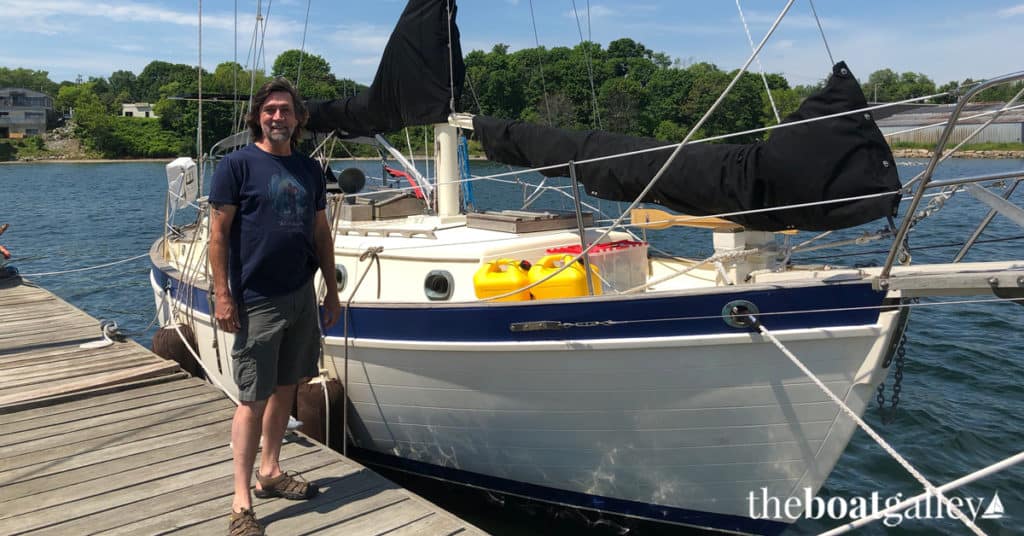
What Larry had actually done was filter. Where he’d cruise. Sail or power. Mono. Length range. Systems he’d maintain. An age and condition that matched his budget for the whole project. By the time he was looking at specific boats, he wasn’t choosing among thousands — he was choosing among a handful, all of which were genuinely viable, none of which were perfect. He picked the one whose remaining trade-offs he could live with.
That’s what choosing a cruising sailboat actually looks like when you do it right. The reader who keeps searching for the boat that wins on every dimension is the reader who spends three years on YachtWorld and never goes cruising.
The right boat is the one whose trade-offs you can live with. The one that fits the cruising you’ll actually do, the systems you’ll actually maintain, the budget you actually have. The one you actually buy.
When you’re ready for the mechanics of the buying process itself — surveys, offers, sea trials, closing — here’s a step-by-step guide to finding and buying a cruising boat.
From Buying the Boat to Casting Off the Docklines
The boat is one piece. There’s also the question of what kind of cruising actually fits your life, what it really costs (not just the boat — everything around it), the skills to build and the order to build them in, and how to put a realistic timeline together for actually leaving the dock.
If you’re working through any of that, may I suggest our course From Dreamer to Cruiser. It’s a step-by-step planning roadmap from Pamela Douglas, built for exactly the stage you’re in: serious about going, still figuring out the full picture.


Carolyn Shearlock has lived aboard full-time for 17 years, splitting her time between a Tayana 37 monohull and a Gemini 105 catamaran. She’s cruised over 14,000 miles, from Pacific Mexico and Central America to Florida and the Bahamas, gaining firsthand experience with the joys and challenges of life on the water.
Through The Boat Galley, Carolyn has helped thousands of people explore, prepare for, and enjoy life afloat. She shares her expertise as an instructor at Cruisers University, in leading boating publications, and through her bestselling book, The Boat Galley Cookbook. She is passionate about helping others embark on their liveaboard journey—making life on the water simpler, safer, and more enjoyable.
Wally Moran says
As always, a well thought out and thorough analysis. I’m not fully in agreement with everything here – for example, Lin and Larry’s choosing to travel without a head. I’ve been faced with head repairs over the years, or having to clean or replace the filthy, disgusting hose when it becomes clogged. Unpleasant, but the thought of “bucket and chuck it” doesn’t work for me, or indeed, most people. There are certain creature comforts worth whatever hassle they create.
You mentioned the problems that complexity creates, including watermakers in that mix. Yes, I agree, keeping it simple on a boat is the way to go.
As you know, I sell watermakers. My advice is, if you purchase a watermaker with complex electronics, at some point you’re absolutely going to have a problem. Salt air and water don’t play well with electronics. Choose a robust, SIMPLE system that doesn’t depend on electronics to function and you’ll be much, much less likely to be stranded with a non-operating system.
I spent 15 years cruising without a watermaker. The minute I put one on board, my cruising life was that much better. No worries about how much water I was using, no worry about having to go somewhere because I was running low.