
If you’ve started looking at boats as a way to afford liveaboard life, or as your entry into cruising, you’ve probably noticed something: some boats are remarkably cheap. A few thousand dollars. Sometimes free, just to get them off the current owner’s hands.
Those ultra-cheap boats are almost always project boats. And for a first boat, they’re almost always a trap.
I say this after 17 years of living aboard and watching many people try this route. I strongly recommend against it, even if someone offers you a project boat for nothing.
What Is a Project Boat?
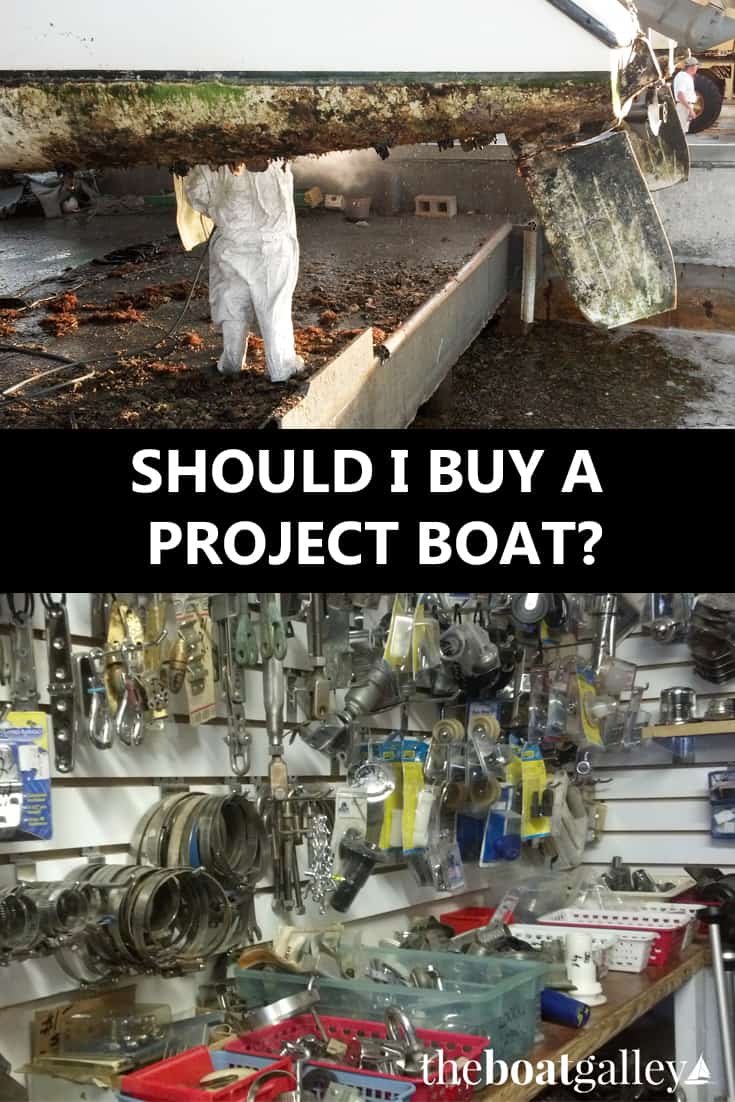
A project boat is the nautical version of a fixer-upper or handyman’s special. It’s a boat you cannot actually use in its current condition. The engine doesn’t run, the systems don’t work, the hull needs repair, or all three. The owner often gives it away or sells it cheaply just to stop paying storage fees.
There’s real appeal in the idea. Books like This Old Boat (Amazon) by Don Casey make the process look manageable and even satisfying. And compared to the cost of a ready-to-go cruising boat, a project boat looks like a bargain.
It’s not. Here’s why.
The Real Cost of a “Cheap” Boat
The purchase price of a project boat is just the beginning. Before you can live aboard or go anywhere, you need the boat to actually work. That means:
- A functioning engine
- Working electrical systems
- Reliable plumbing, including the head
- Sails and rigging in safe condition (for sailboats)
- A sound hull, deck, and keel
- Safety equipment that meets current standards
Every one of those items costs money. Boat parts are expensive. Labor at a boatyard is expensive. And without boating experience, you won’t know what all needs doing until you’re already in it.
Experienced marine surveyors miss things on project boats. You will miss far more. What looks like a straightforward fix routinely turns into three more problems underneath it.
Boats also depreciate quickly. So buying a cheap boat and putting serious money into it rarely produces a boat worth what you spent. You’ll likely come out behind compared to buying a tired-but-usable boat in the first place. And that’s before counting the value of your own time.
The article The Hidden Costs When Buying a Boat covers how the numbers stack up beyond the purchase price. Worth reading before you decide anything.
The Time Problem Is Just as Real
Project boats take longer than you think. Far longer.
Everyone I’ve known who bought a project boat said they could finish it in six months to a year. Most took two to three years. Some never finished at all.
Running wires through a boat is not like running wires in a house. Installing any system in a confined, irregularly shaped space packed with other gear takes longer than any reasonable estimate. And when you haven’t done it before, you’ll do some of it twice.
During all of that time, you’re not living on the water. You’re not cruising. You’re in a boatyard, or in a marina slip, working on a boat that isn’t going anywhere.
The Learning Curve Problem
Getting any boat and learning to live aboard is already a significant learning curve. Boat systems, anchoring, provisioning, seamanship, weather, maintenance. All of it is new.
A project boat adds a second learning curve on top of that: how to actually repair and refit a boat. Skills from home renovation and construction are helpful, but they don’t transfer directly. Boats are built differently, use different materials, and require different techniques.
If you don’t yet know what you like and don’t like in a boat, you also don’t know what to prioritize in a refit. You might spend significant time and money upgrading a galley layout, only to discover after a season of sailing that the layout was fine and what you actually needed was better sail handling gear.
Living aboard a working boat first teaches you what matters to you. That knowledge is worth a lot when it comes time to spend money on upgrades.
Do You Want to Be on the Water or in the Boatyard?
This is the question worth sitting with. Project boats require a genuine labor of love. Some people find deep satisfaction in restoring a boat. If that sounds like you, a project boat might eventually be right.
But it should not be the first boat. Not if your goal is actually getting out on the water.
As one experienced cruiser put it: you need to decide whether you want to be doing carpentry, engine work, electrical, fiberglass, and canvas repair, or whether you want to be sailing and living aboard.
What to Do Instead
Get a boat that works. It doesn’t have to be new, and it doesn’t have to be perfect. A well-maintained older boat with dated electronics but sound systems and a reliable engine will serve you far better than an inexpensive project boat.
You’ll still have plenty to do. Every used boat has a list. You’ll learn about your systems, discover what frustrates you, and find out what upgrades actually matter to you. That experience is invaluable. It will make you a much smarter buyer when it’s time to move up.
When you’re looking at boats, pay attention to the things that are expensive to change later: galley layout, ventilation, and the placement of major systems. Galley Features to Look For When Buying a Boat covers what to evaluate before you commit.
Maybe a Project Boat for Your Second Boat
I’m not saying never. After you’ve owned and lived aboard a working boat, maintained her, repaired her, and upgraded her over a season or two, you’ll have a much clearer picture of what you’re getting into. At that point, a project boat is a real option, and you’ll be able to assess one with experienced eyes.
But as a first boat, especially when your goal is to actually get on the water and start living this life, a project boat almost always delays that goal by years.
Want to Take the Next Step?
If you’re figuring out what cruising really involves, what it costs, and whether it’s the right move for you, my course From Dreamer to Cruiser walks you through the whole picture step by step. Whether or not you have a boat yet, it helps you build a realistic plan and move from ideas to action.

Carolyn Shearlock has lived aboard full-time for 17 years, splitting her time between a Tayana 37 monohull and a Gemini 105 catamaran. She’s cruised over 14,000 miles, from Pacific Mexico and Central America to Florida and the Bahamas, gaining firsthand experience with the joys and challenges of life on the water.
Through The Boat Galley, Carolyn has helped thousands of people explore, prepare for, and enjoy life afloat. She shares her expertise as an instructor at Cruisers University, in leading boating publications, and through her bestselling book, The Boat Galley Cookbook. She is passionate about helping others embark on their liveaboard journey—making life on the water simpler, safer, and more enjoyable.
Chris Reynolds says
You did a great job with the first boat. No need to redo a class when you’ve already gotten an A+.
Carolyn Shearlock says
Wally, I think that even in that case, they’re better off buying a tired but usable older, smaller boat. Many can be picked up for less than the price of parts (even used parts) to make a project boat at least functional. I’m not saying never buy a project boat, just that for the vast majority of people, it’s not a good FIRST boat. Even your project boat was your SECOND boat — you had some experiece to call on in the work you did.
Carolyn Shearlock says
Glad it worked out for you and the whole family!
Carolyn Shearlock says
It’s normal to get to sail a boat before buying it . . . but the first two (small) sailboats that I bought I did not put in the water before buying. Like you, the previous owner simply wanted to get rid of the boat and made a very good deal on the boat. If you have a friend who has more boating experience, you might get him/her to look at it and give an opinion (that’s what I did). Also, be sure that you get everything that goes with the boat: sails, covers, any tiller that might have been taken off, and so on.
Bottom line is that it really depends . . . is the deal good enough that you’re willing to risk it? For a first boat, I’m inclined to say get one with a seller who is a little more helpful, but it may cost a bit more.
Jackie Hammer says
Thanks for the reply. I do need to find someone that could take a look at it. I just dont want it to sink, and make sure the tiller works. That is the plan then. I will not pay the asking price though, no matter what. Guess if I don’t get it, it wasn’t the boat for me. Thanks again.
Carolyn Shearlock says
Very sage advice!