An easy maintenance boat is one where you can actually reach the things that need to be maintained. The hull, the engine model, the layout — all of it matters. But if you can’t get to the parts that need oil changes, filter swaps, water added, or wires traced, none of the rest of it saves you.
This is the question most first-time cruising buyers don’t think to ask. And it’s the one that will quietly shape every passage, every season aboard, and every repair bill for as long as you own the boat.
Why Maintainability Gets Overlooked
When you’re shopping for a boat, you’re focused on what you can see at the dock and on the sea trial. The lines. The salon. The galley layout. Whether the cushions need recovering. Whether the engine starts and runs.
What you’re not doing is opening every panel, lying on your back in the engine compartment, or trying to imagine yourself changing a fuel filter while the boat is rolling at anchor. So the access problems stay invisible until you own the boat. Then they become the reason routine maintenance gets put off, which becomes the reason something fails at the worst possible moment. Read Cory’s story for what that actually looks like — a hard-to-reach transmission dipstick that almost cost him his boat in a tight basin in the Bahamas.
The good news is you can spot a lot of access problems during a careful walkthrough if you know what to look at.
Why Access Gets Sacrificed
Two forces work against access on almost every production boat, and they’re worth understanding before you start looking.
Buyers reward volume and clean surfaces. Walk any boat show and watch what gets the “wow.” Open salons. Big galleys. Lots of stowage. Sleek headliners with no visible screws. Nobody at a boat show says “I love how I can pop this panel off to trace wiring.” Nobody buys a boat because the engine compartment is roomy enough to actually work in. So builders give buyers what buyers reward, and access space is what gets squeezed to make room for the things that sell.
Builders have no incentive to give you access. It costs more to design and build a boat with thoughtful access. More access panels mean more cuts, more trim work, more fasteners, more hours of labor. There’s no market pressure pulling for it, and a clear cost pressure pushing against it. You get what the market rewards.
The same dynamic plays out in aftermarket additions. Every previous owner — and every yard hired by a previous owner — has added gear over the boat’s life. Inverters, watermakers, second freezers, windlasses, solar controllers, AIS units, and additional pumps. Each one had to go somewhere, and “somewhere” usually means whatever empty space was available, with little thought given to ever servicing it again. Owners want sleek finished surfaces too, and they don’t want to pay extra labor for access cuts. So a boat that was reasonably maintainable when it left the factory can become a nightmare after thirty years of additions stuffed into corners.
When you’re looking at a used cruising boat, you’re looking at the result of both forces compounded. That “watermaker installed!” line in the listing is good news only if you can actually reach the prefilters.
Three Kinds of Access — All Worth Asking About
There are really three different access questions, and a buyer should think about all three.
Routine access is the work you do every month or every season. Checking oil. Watering batteries. Changing fuel filters. Checking the fuel-water separator bowl. Adjusting the alternator belt. Exercising seacocks. If routine access is bad, you’ll skip these jobs, and skipped maintenance are how systems fail.
Repair and replacement access is the work you do once every several years — or once in the life of a part. Replacing the alternator. Pulling the starter motor. Changing the heat exchanger. Replacing batteries. Pulling the engine itself for a rebuild. Replacing a fuel tank.
If this access is bad, the cost shows up in one of two ways. If you hire the work out, the bill goes from a few hundred dollars to several thousand the day you finally have to do it — because the yard has to fight the same access you couldn’t. If you do it yourself, the cost shows up as time and aggravation: hours, days, knuckle skin, and the slow accumulation of jobs you keep putting off because the access is so bad. And often the aggravation is enough to push you into hiring it anyway, where you’ll pay through the nose for someone else to deal with what you couldn’t. Either way you pay. Just in different currencies. And sometimes the work isn’t possible at all without major surgery to the boat.
Emergency access is when there’s a problem right now and you need eyes and hands on it in minutes, not hours. A bilge alarm at three in the morning. Smoke coming from somewhere. A hose just blew. You need to get to the problem fast, and you need to be able to see what’s happening once you’re there.
We had this play out in the Bahamas on Barefoot Gal. The bilge alarm went off and we could trace water coming in to the engine area easily enough — but where exactly? A hull crack? A through-hull failure? Something else? We finally figured out it was related to the engine, because when we shut the engine off, the water stopped. Then we spent over an hour trying to find the actual failure point before we could see that a hose clamp on the engine cooling water had broken and fallen into a place we couldn’t see from any normal angle. And then I had to do the repair, because Dave’s hands wouldn’t fit into the spot where the broken clamp had ended up.
Whose Hands and Whose Body?
A boat that’s accessible to one body may be inaccessible to another. The relevant variables aren’t just hand size. They’re hand size, arm length, shoulder width, body flexibility, what your knees can tolerate, and raw strength. Each one rules out different access points. Big hands can’t reach into a narrow centerboard trunk. Short arms can’t reach to the back of a deep locker even if the hand would fit. Wide shoulders won’t pass through some hatch openings. Stiff shoulders can’t reach overhead. Bad knees can’t kneel on fiberglass for an hour. Limited strength means a battery you can’t lift back into place is a battery that doesn’t get replaced.
This matters most for singlehanders, and it’s worth being blunt about why. If you’re shopping for a boat to cruise alone, the boat has to work for your one body. Whatever you can’t reach, you can’t reach. There’s no partner to call in, no “let me get the smaller-hands person.” If a job comes up underway and your hand doesn’t fit the spot, you’re stuck. And from a remote anchorage, you can’t pay a yard to come fix it either. The body-fit questions on this page aren’t optional for singlehanders. They’re disqualifying criteria.
If you’re shopping as a couple, two body types give you partial coverage — but not full coverage, and you should walk through it explicitly. Can both of you fit into the engine compartment? Can either of you reach into the anchor locker if the chain piles up wrong? Can the smaller person reach the back row of batteries, and can the larger person fit through the lazarette hatch? You’re not looking for a boat one of you can maintain. You’re looking for a boat the two of you together can maintain. And remember that one of you may at some point be incapacitated, injured, or off the boat, leaving the other to handle whatever comes up alone. The body that can’t reach is the body that can’t fix.
There are real situations on cruising boats where hand size or body size has been the difference between a fixable problem and a sinking boat. Our article on small hands and the access they let you reach tells some of those stories — the centerboard trunk, the motor mounts, the transmission cooler hose clamp that only my smaller hands could reach.
Engine and Engine Room Access
Start here. The engine is the thing you’ll touch most often, and engine access tells you a lot about how the rest of the boat was thought through.
On our Gemini catamaran, the engine sides were accessed by removing side panels. Fine in theory. In practice, to do any work you had to lean in over a quarter-inch piece of fiberglass that dug into your ribs. It hurt even with a pillow over the edge. Once, when Dave was changing the zinc on the heat exchanger, he moved the wrong way and badly bruised his ribs. That’s the routine-access problem.
The replacement-access problem on the same engine was a nested set of disasters. The engine compartment had been designed so that the oil pan couldn’t be removed without first removing the engine itself. That’s the original mistake. Compounding it: the engine had been installed before the deck went on, so the only way to actually remove it was to take off everything that could possibly come off — alternator, heat exchanger, transmission cooler, header tank — and even then it barely squeezed out. Compounding it further: you couldn’t reach the oil pan well enough to wipe up any drips, so any small saltwater leak from the cooling system would sit on the pan and slowly rust it through. Each of those three problems made the others worse. A pan that we should have been able to easily wipe out became something that would have to be replaced when it rusted out, and replacement was going to be a major job.
A designer somewhere never thought about how anyone would do this work. So when you’re looking at a boat, walk through the actual jobs in your head:
- How will you change the engine oil? Where does the dipstick come out and where does the drain go?
- Can you reach the transmission dipstick without dismantling half the lazarette?
- Where’s the alternator belt, and can you actually tighten it?
- Can the alternator itself be removed without taking off other components first?
- Are the fuel filter and water separator bowl visible and reachable, or buried behind something?
- Could the engine be removed from the boat if it ever needed a rebuild, and what would have to come off first?
- Can both of you fit into the engine compartment? Can either of you?
Open the engine compartment and physically reach for things. If you can’t get a wrench on it standing in the cabin, you won’t get a wrench on it at anchor either.
Batteries and Electrical
Batteries need to be checked, watered (if wet cells), and eventually replaced. All three jobs require access, and battery access is one of the most commonly compromised areas on a boat.
On our Gemini, the batteries went in under the nav station and slid forward under another locker. Once the batteries were in place, one of them was literally impossible to reach for watering. The only way to add water was to disconnect everything, remove two batteries, slide the third one out, water it, and put everything back. That wasn’t going to happen monthly.
We worked around the routine-access problem with a battery watering system that lets us water all three batteries from a single fill point in about five minutes. (Read about Easy Battery Watering if you have the same problem.)
But the replacement problem stayed. Batteries weigh fifty to seventy pounds and have to be lifted out and back in every several years. Getting one into our compartment meant holding it at arm’s length straight in front of you, sitting on a step, and wiggling around in mid-air until it lined up perfectly to slide into place. Every time we did it I threatened to take a Sawzall to the locker. The watering system solved the monthly problem; the install-and-remove problem was permanent.
When you’re looking at a boat, ask:
- Can you see all the batteries without moving anything?
- Can you reach the tops of all of them to check water and clean terminals?
- Could you actually lift one out and put it back by yourself, or would it require dismantling the area around it?
- Is the path in and out of the compartment straight, or do you have to maneuver the battery around obstructions?
- Are the cable connections accessible for cleaning corrosion?
If the answer to any of those is no, factor in the cost of either changing battery technology (lithium or AGM eliminate the watering issue and lithium often weighs much less) or building a workaround into the locker.
Wiring Runs and Access Panels
Wiring is the silent killer on boat maintainability. You won’t think to check it during a viewing because it’s mostly hidden. But every system on the boat depends on it, and every future upgrade you make will require running new wires.
Builders’ priorities make this into a problem. The cheapest, sleekest way to install wiring is to run it through molded-in tunnels in the fiberglass — no exposed wire, no access panels needed, clean finished surfaces everywhere. Once that’s done, there’s no opening it up. You can’t cut an access panel in because there isn’t a panel. The wire is buried inside structural fiberglass. To pull a new wire through, you need a fish tape, luck, and sometimes a lot of cuss words and then hiring someone else to do the work.
So two questions matter:
Can you trace existing wiring? Pick a wire at the breaker panel and try to follow it. Where does it run? Can you actually see the route, or does it disappear into a fiberglass tunnel or behind a headliner that’s been screwed and caulked shut? When something stops working three years from now, you’re going to need to find the break. If the wires are buried where nobody can see them, you’re going to be cutting open finished surfaces — or trying to fish a new wire blind.
Can you add new wiring? Every cruising boat acquires new gear over time. Solar panels. A new chartplotter. A windlass upgrade. A second bilge pump. Every one of these means running wires from a power source to wherever the gear is mounted. If there are no chases, no access panels, no removable headliner sections, every project becomes a battle.
What to look for at the dock:
- Is the headliner removable, or is it permanently installed?
- Are there access panels behind wall liners and at the base of bulkheads?
- Can you see how existing wires are run, or are they entirely hidden?
- Is wiring labeled, bundled, and supported, or is it a tangle of mismatched additions from different decades?
A boat with thoughtful wiring access will save you thousands over the years. A boat without it will cost you a yard bill every time something needs tracing or adding.
Tanks: Fuel, Water, and Holding
This is the section first-time buyers most need to read, because tank access is rarely thought about until something goes wrong, and by then it’s too late to do anything about it.
Tanks have a finite life. Eventually, any tank will need to come out and be replaced. The question is whether the boat was designed to allow that.
I’ve seen boats — and heard of plenty more — where the tanks were installed before the deck went on. The tank is physically larger than any opening to the space it sits in. To replace it, you would either have to cut up the existing tank in place to remove it (and then no replacement of the same capacity will fit through the openings you have), or cut the deck or cabin sole open to lift the tank out and a new one in. Either approach turns a tank replacement into a major boat surgery costing many thousands of dollars.
Glassed-in tanks present the same problem. If a tank has been glassed into the structure of the boat, removing it requires cutting through fiberglass.
This is true for fuel tanks, water tanks, and holding tanks. Fuel is the most common problem because fuel tanks fail more dramatically — a leak is a serious safety issue and an immediate environmental problem. But water and holding tanks suffer from the same access constraint. Fiberglass tanks of any type can also have permeation problems over time, which is its own reason to want them out eventually.
What to look at during the viewing:
- Can you see the fuel tank? If it’s glassed in or hidden behind permanent structure, that’s a flag.
- Is the tank obviously larger than any opening in the cabin? Look at the largest hatch, deck plate, or removable section in the area, and look at the tank. Could the tank actually come out through any of them?
- Open the engine compartment and other tank-area lockers and smell. Does it smell like diesel or gas, or just like a closed-up boat? Any fuel smell at all is a flag — tanks are sealed when working properly.
- Look at the bilge under and near the fuel tanks. Any sheen on the surface of standing water? A fuel sheen means the tank is already leaking, not might leak someday.
- Same questions for the water tank and holding tank, with smell adjusted accordingly. A holding tank with a persistent odor problem may be telling you something.
A boat with inaccessible tanks isn’t necessarily a no, depending on the age and condition of the tanks and how much you’re willing to spend on eventual replacement. But you need to know what you’re getting into.
Anchor Locker and Ground Tackle
You can’t really see an anchor locker during a viewing because the chain is in there filling it. What you can see is whether you can get into it.
That’s the question. The locker is where you’ll need to be at exactly the moments you don’t want to be there — when an anchor doesn’t set, when chain is piled wrong and won’t deploy, when something has fouled the rode, or when you need to inspect the chain end-for-end.
What to look at:
- Can you actually fit into the locker? Some are sized for a forearm only; some allow a full upper body in. Both bodies on board should try.
- Is there an inspection hatch that lets you reach the chain pile from a different angle?
- Is the chain pipe straight enough that chain feeds without piling up against itself?
- Can you reach the bitter end attachment to release it in an emergency?
- Does the locker drain, and where does the water go?
A locker you can’t get into is a locker where small problems become big ones at the worst possible moment.
Lights Aloft
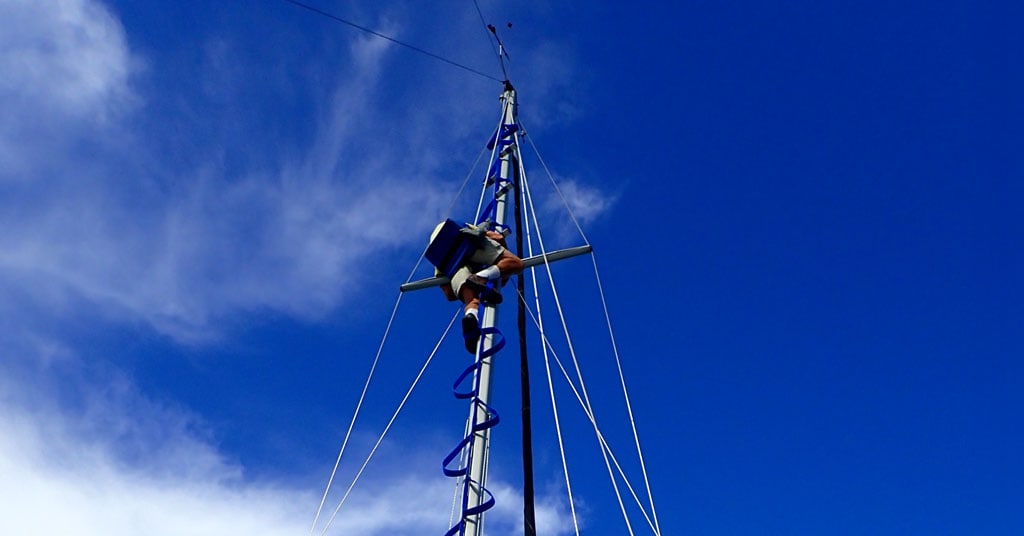
Any light up the mast will need its bulb changed eventually. That much is a given. The question is how the fixture was designed for the moment when someone is hanging in a bosun’s chair forty feet up trying to do the work.
Our steaming light went out, and changing the bulb should have been simple. Instead, the only way to access the bulb was to remove the entire fixture from the mast, then remove two tiny screws from the back of the housing, at which point the lens fell off into open air. You needed one hand on the mast to keep yourself in place, one hand on the fixture, and apparently a third hand to catch the screws and lens before they hit the deck or the water.
This thing was sold as a masthead light. Someone, somewhere, knew it would be serviced in mid-air. They designed it anyway.
Most buyers won’t go up the mast during a viewing — that’s reasonable. But you can ask whether there’s a record of any work done aloft, and you can look at the masthead with binoculars to see whether fixtures look like they pop apart sensibly or look like they were designed for a workbench.
Plumbing, Pumps, and the Other Stuff
The full list of things that need maintenance access is longer than any one article can cover. But the same questions apply:
- Can you reach all the seacocks to exercise them?
- Can you get to the head plumbing without contortion?
- Where are the bilge pumps, and can you actually replace one?
- Can you reach the stuffing box?
- Are the freshwater pump and accumulator tank accessible?
- Where does the watermaker live, and can you change its filters?
- Where do all the hose clamps live, and can you check them?
Every one of these is a job you’ll do, eventually. Every one is easier or harder based on choices someone made when the boat was built or modified.
What to Actually Do at a Viewing
When you walk a boat, bring a flashlight and a willingness to look slightly ridiculous. Open every locker, every panel, every hatch. Lie on your back in the engine compartment if there’s room. Stick your nose in the bilge.
Pick three or four routine maintenance jobs and physically simulate them. Reach for the dipstick. Try to imagine getting a wrench on the alternator. Trace a wire from the breaker panel to wherever it goes. Try to fit into the anchor locker. Have both people on board do the same things — what one of you can reach matters less if the other is the one who’ll usually be doing the job. If you’re shopping single, try everything yourself and be honest about what your body can and can’t do.
The boat is telling you, in those moments, how the next ten years of ownership are going to feel.
The Surveyor and Mechanic Question
Most surveyors don’t formally evaluate maintainability. They check structural condition, systems function, and safety. Access is generally outside their scope.
If you’re buying your first cruising boat, it’s worth specifically asking the surveyor for their thoughts on access during the survey. Even better, if budget allows, pay a marine mechanic for an hour or two to look at the engine and major systems with maintainability in mind. They’ll see things in five minutes you wouldn’t notice in five hours. This is optional and most buyers skip it. The ones who don’t skip it tend not to regret the spend.
While you’re checking access, also look at the safety features that are hard to retrofit. Our article on checking handholds when buying a boat covers another easy-to-overlook thing in the same vein.
The Bottom Line
No boat is going to be perfect on access. The Gemini wasn’t, and we loved her anyway. Every boat is a series of compromises made by the designer, the builder, and every owner who came after. Your job as a buyer isn’t to find a flawless boat. It’s to know which compromises you’re walking into so you can decide whether you can live with them.
Maintainability won’t be on the broker’s listing. It won’t show up in the marketing photos. But it will shape every passage and every repair bill for as long as you own the boat. Spend an hour during the viewing looking at access. It’s the cheapest insurance you’ll ever buy.
Want Some Company on the Way?
If you’re spending time looking at boats and figuring out what cruising life is actually going to look like, I’d love to send you our free weekly newsletter. It goes out every Wednesday morning and is a real slice of cruising life — boat systems, seamanship, provisioning, the practical realities, the lifestyle pieces. Written by someone who’s been living aboard and cruising for seventeen years. Sign up here — it’s free.


Carolyn Shearlock has lived aboard full-time for 17 years, splitting her time between a Tayana 37 monohull and a Gemini 105 catamaran. She’s cruised over 14,000 miles, from Pacific Mexico and Central America to Florida and the Bahamas, gaining firsthand experience with the joys and challenges of life on the water.
Through The Boat Galley, Carolyn has helped thousands of people explore, prepare for, and enjoy life afloat. She shares her expertise as an instructor at Cruisers University, in leading boating publications, and through her bestselling book, The Boat Galley Cookbook. She is passionate about helping others embark on their liveaboard journey—making life on the water simpler, safer, and more enjoyable.
Carolyn Shearlock says
Both ways of transporting it are going to be expensive if done right. If you don’t yet have the skills or time to sail/motor the boat to your location, you need to add the transport cost to the purchase cost to see if it’s really such a good deal. In general, I’d opt for the delivery captain as taking the mast down and putting it back up and transporting a boat on the boat can cause a number of problems unless done very carefully.
Buying one at a distance isn’t necessarily a bad idea, but I am concerned about your ability to evaluate the boat if you don’t feel confident to move it on your own. Be sure to get a very thorough survey done, and consider going with the delivery captain if he/she will let you — you will learn more on that trip than in three years of courses!
Stephanie Martin says
Oh ouch! “I am concerned about your ability to evaluate the boat if you don’t feel confident to move it on your own.” Interesting. When you own your own business or more appropriately when it owns you, getting two weeks away is difficult so say the least.
We will add the price of moving to the purchase and see – so many boats in the 20 yr age range seem to have many years of neglect. When we find one that is well taken care of, we get excited. We would like to spend our time sailing than rehabbing a project.boat. We are also finding that pricing is highly fluid.
Carolyn Shearlock says
Sorry about that! Usually when someone is buying a boat and talking about someone else moving it, they also tell me that they don’t want to do it themselves as they are still learning. So I was very wrong there and apologize.
There are great boats in the 20-year-old range, but it takes digging to find them!