
Filtering your boat’s water is a good thing to do — and most cruisers who do it wish they’d started sooner. Whether your tank water tastes off, you’re tired of buying cases of water bottles, or you’re heading somewhere remote where water quality is uncertain, a filter solves all of it.
There are three types of water filtering systems you can use on a boat: generic from off-the-shelf parts, temporary options like pitchers and tap filters, and purpose-built marine systems. In 17 years of living aboard on two different boats, I’ve used all three in different situations. Here’s what to consider when making your decision — and what’s likely to work best for different types of boaters.
Why Cruisers Think About a Boat Water Filter
There are several reasons you might be thinking about a water filter for your boat — and understanding which ones apply to you matters, because not every system handles every problem:
- Tank taste. Water picks up a flavor from the tank itself. Plastic tanks are the worst offenders, but even stainless tanks can leave a taste.
- Chlorine. Many cruisers add a small amount of bleach (1/4 cup per 100 gallons) to keep the tank clean. Smart practice — but freshly chlorinated water tastes bad and can kill yeast in bread dough and yogurt cultures.
- Bacteria and other growth. Without chlorination, all sorts of unwanted things will grow in a warm tank. A filter is your last line of defense at the tap.
- Rainwater contaminants. Caught rainwater travels through the atmosphere and across your deck or tarp before it hits the tank. It brings particles, debris, and whatever else it picked up along the way.
- Bugs. We discovered that tiny insects were getting into our tank through the vent — even after we screened it. A filter catches them before they end up in your iced tea. (See keeping bugs out of your water tank vent for how to deal with the source.)
- Bottled water fatigue. Cases of water bottles are heavy, expensive, take up precious storage space, and create a mountain of plastic trash. A filter lets you drink straight from the tap and leave the bottles on the dock.
With a good filter in place, your tank water is genuinely good — not just tolerable. Your coffee and cooking will taste better too.
The Three Types of Boat Water Filters
There are three basic systems, and which one makes sense for you comes down to several things: why you want to filter, how often you’re aboard, how much space you have under the sink, and whether you’re willing to do a simple installation. Read through all three before deciding — the right answer isn’t the same for everyone.
Option 1: Standard Plumbing Filter Housing
This is the workhorse option — a filter housing plumbed directly into your cold water line, typically under the galley sink. Everything you need is available at any hardware or home improvement store, and that availability matters a lot when you’re cruising far from a chandlery.
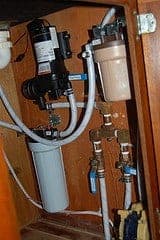
On both of our boats we used 10″ standard filter housings for the watermaker prefilter and as a prefilter at the dock water fill — not for the drinking water tap, where we used purpose-built systems. But for most cruisers, the standard plumbing filter is the practical choice for tap water filtration, especially if you’re doing longer passages or cruising internationally.
Best for:
- Full-time cruisers and liveaboards who want reliable filtration at the lowest long-term cost
- Cruising outside the US — 10″ filter cartridges are available at hardware stores in most countries, far easier to source than purpose-built filters or pitcher replacement filters
- Anyone who wants flexibility: you choose where the housing goes, whether you add a dedicated faucet, and what filtration level you need for your water source
Advantages:
- Low upfront cost: housings run $20 to $30, plus fittings, a short length of hose, and clamps. A complete installation should cost well under $100.
- You choose the filter type and micron rating for your water source — see my article on choosing the right water filter for your boat for the full breakdown
- Least expensive ongoing filter cost of the three options
- A clear housing lets you see the condition of the filter without opening anything
A few installation tips:
- Stick with standard 10″ filters — they’re the most common size worldwide and give you the widest choice of filtration levels
- Avoid housings with quick-connect fittings; they’re more prone to leaks and the proprietary parts can be impossible to find later
- A shut-off valve on the housing is convenient for filter changes but not essential — turning off the water pump works fine, and you’ll likely spill some water in the locker anyway. A rag and a bowl nearby handles it
- A filter wrench is handy but may not fit in tight spaces; a belt or strap wrench works just as well
Which filter cartridge?
For most cruising in well-traveled areas, a 0.5 micron carbon block filter is the right choice. It removes chlorine, taste, and most microorganisms. If you’re collecting rainwater or heading to areas known for poor water quality, a purpose-built system (see below) may be the better call. My companion article on choosing the right water filter for your boat walks through all the cartridge options in detail.
One limitation worth noting: a 10″ housing takes up meaningful space under the sink — nearly twice the length of a purpose-built system. In a crowded under-sink cabinet, that size difference can be the deciding factor.
Option 2: Pitcher or Tap Filters (Brita, PUR, ZeroWater)
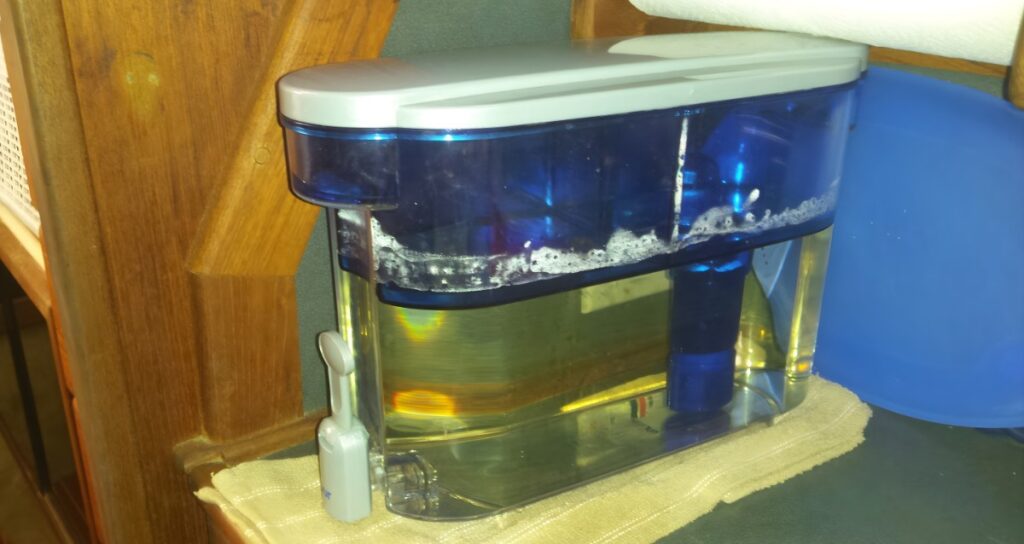
These are the countertop dispensers and tap-mount filters you’ll find at any grocery store. When we arrived at the boatyard to start prepping our second boat, the water there smelled of sulphur and was barely potable. We ordered a PUR dispenser and had it working within minutes of arrival — genuinely great-tasting water with zero installation. We used it as a stopgap until we got our purpose-built system installed, and it did the job beautifully.
If you go this route, my experience — and that of other cruisers I’ve talked to — is that PUR handles tough water considerably better than Brita. We had people in the boatyard ask where our water came from because it tasted so good; they’d been using Brita with much less impressive results. ZeroWater also gets strong reviews and I’d consider it a solid option, though I haven’t used one personally.
Best for:
- Removing bad taste and chlorine from tank water
- Instant setup with no installation — just fill it and use it
- Occasional boaters and weekenders where a permanent installation isn’t worth the effort
- A temporary solution while a permanent system is on the to-do list
Limitations:
- Handles taste and chlorine only — no protection against bacteria, giardia, or other microorganisms. Not the right choice if you’re catching rainwater or in areas with questionable water quality.
- Highest ongoing filter cost of the three options — filters last only 20 to 40 gallons. For occasional boaters the total cost may still be reasonable; for full-time liveaboards it adds up quickly.
- Pitchers spill easily underway — store in the sink or a secured spot when moving
- Filters are available everywhere in the US but very hard to find outside the country
If you’re on the boat occasionally and just want water that doesn’t taste like the tank — or you need something working immediately while you plan a permanent installation — this is the fastest, most affordable upfront solution.
Product links on Amazon:
- PUR 18-cup water filter/dispenser (Amazon)
- PUR replacement filters (Amazon)
- ZeroWater 22-cup dispenser with water quality meter (Amazon)
- ZeroWater replacement filters (Amazon)
Option 3: Seagull and Nature Pure Filters
If you want the gold standard of boat water filtration, this is it.
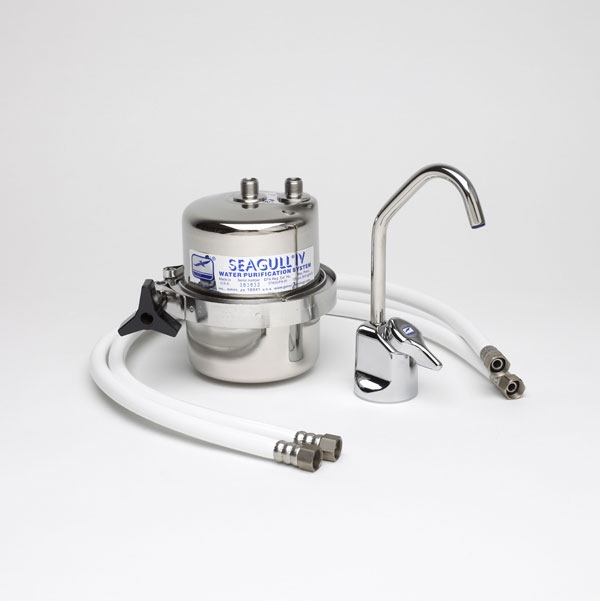
General Ecology’s Seagull IV is independently certified to remove bacteria, cysts, and viruses, and it also handles chlorine, pesticides, herbicides, and anything that makes water taste or smell off. General Ecology also makes the Nature Pure, which uses the same quality filter in a replaceable canister format. Both can be installed with or without a dedicated faucet, depending on your preference and plumbing setup.
I had the Seagull on our first boat, Que Tal, and the Nature Pure on our Gemini 105 catamaran. I loved both. One reason we went with the Nature Pure on the second boat was space — these systems are compact, only about 5″ in diameter and 5″ long, significantly smaller than a standard 10″ housing. When you’re working around pumps, hoses, and valves in a crowded under-sink cabinet, that size difference can make the decision for you, even if water quality isn’t your primary concern.
Best for:
- The highest level of purification — bacteria, viruses, cysts, chlorine, pesticides, and more
- Collecting and drinking rainwater
- Cruising areas with known or uncertain water quality
- Boats with limited under-sink space where a 10″ housing is awkward to fit
- Anyone who wants to turn on the tap and not think about it
Limitations:
- Most expensive upfront: the Seagull system runs around $780, and replacement filters are close to $100 each, good for about 1,000 gallons or roughly a year of use for most cruisers
- Filters are hard to find locally and not reliably available outside the US — order online and carry a spare
- Requires installation: the housing plumbs into the cold water line fairly close to the faucet. The manufacturer says 20 minutes; plan for longer in a typical cramped galley cabinet
- Changing filters requires some contortion
Nature Pure is available directly from General Ecology and at marine chandleries; there is no Amazon link.
Which Boat Water Filter Is Right for You?
- Occasional use, mainly a taste problem, no installation desired: Pitcher or tap filter. Works immediately, no tools required. Also a great stopgap while a permanent system is on your list.
- Full-time cruising, especially outside the US, in well-traveled areas: Standard plumbing filter with a 0.5 micron carbon block cartridge. Best long-term value, easiest to maintain anywhere in the world, most flexible installation.
- Collecting rainwater, areas with uncertain water quality, or limited under-sink space: Seagull or Nature Pure. The higher upfront cost is worth it when you need complete purification — or when a compact housing simply fits your boat better.
Whatever you choose, you’ll wonder why you didn’t do it sooner. Good water makes everything better — from your morning coffee to staying hydrated on a hot afternoon at anchor.
Cruiser’s Advice
Start asking around. You’ll find cruisers have plenty of opinions and experience on a variety of filtering systems. Jeff and Tom prefer the Berkey Water filter, a gravity purification system that is portable. Diane discovered the Ultraviolet filtering system, SafH20 by Water Safe Pro, while cruising in Mexico.
Randy, and other cruisers simply add a small amount of bleach to their tanks. However, bleach is not good for the environment. And if you reverse flush your water maker, you will damage the membranes.
Which system works best for you, depends on your budget and your boat. Next time you’re at a cruiser gathering, ask owners of similar boats to yours how they filter their water.
There’s Always More to Know
Water systems are just one of the things you work out as you settle into life aboard. My course The Basics of Living on a Boat covers 31 topics — boat systems, anchoring, provisioning, marina and anchorage etiquette, and the things most people wish someone had told them before they left the dock. If you’re getting ready to cruise or just getting comfortable with life aboard, it’s a practical place to start.

Carolyn Shearlock has lived aboard full-time for 17 years, splitting her time between a Tayana 37 monohull and a Gemini 105 catamaran. She’s cruised over 14,000 miles, from Pacific Mexico and Central America to Florida and the Bahamas, gaining firsthand experience with the joys and challenges of life on the water.
Through The Boat Galley, Carolyn has helped thousands of people explore, prepare for, and enjoy life afloat. She shares her expertise as an instructor at Cruisers University, in leading boating publications, and through her bestselling book, The Boat Galley Cookbook. She is passionate about helping others embark on their liveaboard journey—making life on the water simpler, safer, and more enjoyable.
Carolyn Shearlock says
We seriously underestimated how much we’d appreciate a water filter. QT came with one, but we hadn’t even considered it. Loved it, though — water always tasted great and we never had tummy troubles due to our onboard water. Hope you love yours just as much!
-C
Carolyn Shearlock says
Hi Charlotte!
I don’t have any experience with them. Looks like a major purifying system. The only downside that I see is the size, but it looks like it removes pretty much everything (although not a watermaker designed to remove sea salt).
-Carolyn
Cheri says
I see that this article and the subsequent discussion threads are a couple years old. I’m hoping that the author is still active as I am struggling to find the right water filtration for two area of our boat. Currently we fill our tank in the US, primarily from a well water source. We live on board year round and the water is refreshed weekly. But I know there is crud in that tank and I get queasy thinking about bugs and other goobers. So I drink bottled water, but do cook with it without any problems. I do not use it for any appliances like coffee or tea. We also shower on board. So, here are my issue I hope to resolve with filtering.
1. At the galley tap…want the purest water possible with everything out. Cold water only and not for dishwater. If I installed a separate faucet…I’d probably have it under the counter. Not sure I have an option for countertop with Corean. And I don’t want to give up counter space.
2. It’s a hair thing. Tank water is killing my hair. We never put choline in. Tried it once and I hated it. Need so,e type of filter at the shower head for hot and cold water, or at least when they are mixed. Figure this will mount in the shower someplace, but not a lot of room. Also want everything filter out.
3. Next year we begin cruising full time so we will install a water maker. Still will want the galley water we consume to be filtered. Although I’ve been told that made water is pure enough, I’m thinking its the tank that puts stuff back in that I don’t want. Expect this may be true of the shower as well, but I don’t know.
Truth is, I don’t know what to do. I’ve been assigned this job on our boat and the more I read the more confused I get. I’m hoping this site is active or that someone who know and is interested,in helping me figure it out will contact me or respond here.
Thank you thank you thank you in advance.
Cheri
Carolyn Shearlock says
I’m not sure why you think the site isn’t active, as I write four new articles every week . . . and there is lots of activity on the Facebook page!
Here’s what I’d do:
Put a 10″ filter housing on each line exiting your water tank (clarification after a question: put it after the pump; some boats have more than one line & pump) and use a .5 micron carbon block filter in each one (read about the different types of filters here: https://theboatgalley.com/choosing-water-filter/ ) — this will give you the purest water possible and will also filter out any chlorine out. You can put these anywhere on the lines, wherever you have space as long as you can get to it to change the filter. If you also put a filter on the water line between the tank and the water heater, your hot water will be filtered, too (and you won’t have gunk settling in the water heater, either). This is the least expensive way to get good filtering that I know of (Sea Gull is good but very expensive and you need a separate faucet). This is option #3 on the article that you left your comment on: https://theboatgalley.com/water-filters/
Next, flush your tanks with a lot of water — it’s the best way to get whatever is is there out. Then start filtering the dock water that you put into the tank, also with a .5 micron carbon block filter. The housing will fit on the end of the hose, then you can put a short stubby piece of hose after the filter to go to the deck fill. This will ensure that the water going into the tank is clean, although it will slow down the fill.
Once all your water is filtered between the tank and the tap, you may want to start using chlorine again to make sure nothing grows in the tank (but only if the tank is stainless). We had a watermaker and still used chlorine. Just FYI, any type of carbon filter will take the chlorine out, so you don’t have to taste it or have it on your hair. If you were noticing the chlorine that much, I suspect that you were using too much.
Jim says
Good site, thanks for the information! I’m looking to equip a new (to us) boat and it needs a water filter. On a previous boat we had a Seagull for drinking water and we were pleased with it, but on this boat I would like a whole-boat filter so we can brush our teeth in the head without worrying about water quality. I also don’t want to cut any new holes in the countertop for a separate faucet.
In your experience, can a 0.5 micron 10″ x 2.5″ filter be used for the whole boat, or only for the small drinking water faucets? The specs on some of the filter manufacturer’s sites indicate low flow rates of around 1 gpm for these fine filters. That sounds a lot lower than the 3 gpm range that our pump will be pumping.
You say “put a 10″ filter on each line exiting your water tank.” Do you mean on the inlet side of the water pump? I would think the filter would need to be on the outlet side of the pump.
We are going to be catching rainwater. Do you think there is any advantage in using a series of 10″ filters–like a 10 micron pre-filter then a 0.5 micron fine filter, or is that just too complicated or too much flow reduction?
Thanks for sharing your experience.
Carolyn Shearlock says
Exactly how you do it depends a lot on the boat configuration, how long the hose runs are and how powerful your water pump(s) is (there does NOT seem to a standard way of plumbing a boat!), but you’re right that the filter will probably be better on the outlet side of the pump (although we had a filter before the low pressure pump on our watermaker and it worked fine). If the filter is after the pump, the pressure switch will simply cut the pump off periodically if the pump is putting out water faster than it is flowing through the filter, and of course the water at the tap won’t flow any faster than it goes through the filter.
Using a filter before the water heater (if you have one; we didn’t, just used a SunShower) will eliminate the gunk that collects in it and thus will lengthen the life of the water heater.
We had a Seagull ourselves, but I do know of at least three boats that did use a single 10″ filter for both the galley and head (one head, and no freshwater flushing). And as you alluded, the biggest problem with using just one filter for the whole boat is the flow rate — although this does help with water conservation! That’s one reason that I like have separate filters on the hot and cold lines.
Finally, on the rainwater catching . . . since that is just a gravity flow, I’d worry about not having enough pressure to push water through a fine filter and just backing up instead (in El Salvador, we would catch 20 to 50 gallons in 20 minutes or less at times). The head pressure is going to be so different on different boats and different catchment systems that I hate to make any blanket recommendations. With the premise that any filter is better than none, I’d probably go ahead and install the 10″ housing, then experiment with what filter is the finest that doesn’t restrict the flow too much (20 micron? 10 micron? you don’t need carbon as you’re not trying to get chlorine out at this point — more trying to catch sediment). While I know of several boats that talked about putting a filter on their rainwater catch, I don’t know of any that actually did (or if they did, I didn’t hear from them after they had installed it). If anyone else here has installed one, it would be great to know what worked for you — please leave a note in the replies.
Jim says
Thanks for the reply. I wasn’t thinking of filtering the rainwater before it hit the tanks, only after it hits the boat’s freshwater system.
I think the inlet filters you had on your watermaker were fairly coarse. We had a boat with a watermaker that used 20 micron filters on the inlet and 5 micron filters on the fresh water flush (which was between fresh water pump outlet and the watermaker inlet).
Maybe the thing to do would be to put something like a 20 micron filter on the intake side of the fresh water pump to screen out any sediment from the tanks, and a 0.5 micron on the outlet side.
But it sounds from what you said like the water flow will drop so low through the 0.5 micron filter that there wouldn’t be enough flow to run the shower. Maybe a better way is to just filter cold water to the galley faucet. That wouldn’t require another hole in the counter top, but it would mean brushing our teeth in the galley instead of the head. Oh well.
Any comments from someone who has used a whole boat filter and who also uses their shower would be appreciated.
Carolyn Shearlock says
Hi Jim!
I guess I should make clear that I don’t KNOW that the pressure drop will be too low for an acceptable shower if you use a 0.5 micron on its line; it’s just what I would be concerned about. I’m going to post a note on The Boat Galley’s Facebook page and see if anyone has tried using a 0.5 micron filter as a whole boat or shower filter and what their result was. Hopefully we’ll get some answers!
If you want filtered water in the head sink, you could put a filter on that line in addition to the one in the galley. I don’t know your boat’s configuration, but our boat had a bunch of otherwise hard-to-access space under the head sink that could easily have been a home for a 10″ filter.
Carolyn Shearlock says
Most filters are installed on the outlet side of the pump so that the pump can push water through it rather than have to pull water through it. I’d try moving it to the outlet side.
Chris says
Belated thanks for your suggestion of moving the filter to the outlet side of the pump.
We have been on the boat continuously since mid-June and can share our findings about our “Home Depot” systems.
As mentioned previously, I moved the filter to the outlet side of the pump and then installed a 1 litre accumulator tank after the filter. The result is, no surprise, good flow from the accumulator tank but an immediate reduction of flow when the tank is emptied. The pump cannot push the water through the filter to provide a continuopus flow.
All in all, an adequate system for us marina based people who have showers available shore-side and enjoy fresh water sailing.
The water quality is excellent.
Carolyn Shearlock says
Thanks for letting me know. I did some investigating and found that the company has recently changed hands and they are trying to re-do the website. Right now, you can contact them by email — click on the contact button on the website (I changed the link so that it goes to the “new” site).
Carolyn Shearlock says
It has a fairly low flow rate, so if that line also goes to the shower, you may want to just have the filter on the line where the drinking/cooking water is. Other than that, sounds great!
Noah Barton says
Also wondering about using a Lifestraw. Our boat is equipped with a “seawater” galley intake and since we are sailing on Lake Michigan would getting either their Lifestraw Go (water bottles with a filter built in), holding up a filter to the tap every time we wanted clean water or getting a family-sized filter unit that we would then use to fill up urns and jugs make more sense? This would be used primarily for the Mac Race, which we figure it should take about 3-4 days to complete. We would have an 8 person crew. We want to shed as much weight as possible so bringing on 65 kilos of water really isn’t option on our already heavy cruiser-racer.
Don Rushton says
I fitted my Hunter 34, Cygnus, sailing Lake Huron with the blue plastic cartridge RV style .5 micron charcoal filter (comes with garden hose connections) downstream of my stored water tanks pressure pump.They are only $20-30. and quick to change out once a season.
I also installed a 2nd lake water pump and faucet in the galley for hand and dish washing etc. which saves the stored drinking water. I guess it could be fitted with a similar cartridge if we wanted to make it potable as well.
Carolyn Shearlock says
Between the pump and the faucet (that is, AFTER the pump).
Carolyn Shearlock says
We do not use bleach in our tanks. Bacteria are too small to go through a watermaker membrane. It also removes dirt, viruses, etc.
Cherie Burch says
Thanks so much for responding. Takes a load off my mind!
Carolyn Shearlock says
Thank you!
The Boat Galley says
Yes, that’s one of the options I mention in the post. Many people use the 10″ filters. Generally costs about $100 to install.
Mike Boyd says
Sorry, didn’t see it specifically mentioned. They are about $50 if you install it yourself. I just like how easy it is to change the filter and how long they last.
The Boat Galley says
Ahh, thanks for the link. That’s actually a bit different, but same type of thing. Looks like it might be a little easier install and take up less room under the counter.
Mike Boyd says
Here is a picture of ours under the galley sink (where the water pump and accumulator also live on our Leopard). Installation is pretty easy and replacement cartridges are easy to replace with a 1/4 turn by hand…no tools required. It also lacks metal parts so corrosion isn’t an issue. It is just a variation of the other options, but I thought worth the mention due to these features I consider boat friendly.
doug says
did you try installing the water filter after the accumulator tank? the pressure from the accumulator tank I would think would increase the force through the filter.
Carolyn Shearlock says
Sounds good! Yes, we use 0.5 micron carbon block filters on the freshwater flush of our watermaker, which runs off our regular pressure water pump. Flow rate is still good! Thrilled that you got your water tasting good!
Carolyn Shearlock says
I haven’t heard of anyone complaining unless the filter gets clogged to the point where it restricts water flow.
Beth Donnelly, Door Prize - 44' MV DeFever says
One thing you didn’t mention is a large bottled water option. We have two 5-gallon water bottles we refill at Walmart or other groceries for about $1.50 per 5-gallon bottle. It is strictly our drinking and coffee water and lasts at least a month if it’s just the two of us on board. It’s significantly cheaper to just refill our own bottles than exchange our empties for new, and eliminates the trash issue of smaller water bottles. We found plastic milk crates designed to hold the bottles that we stack in our salon so have never had the issue of falling over in rough seas.