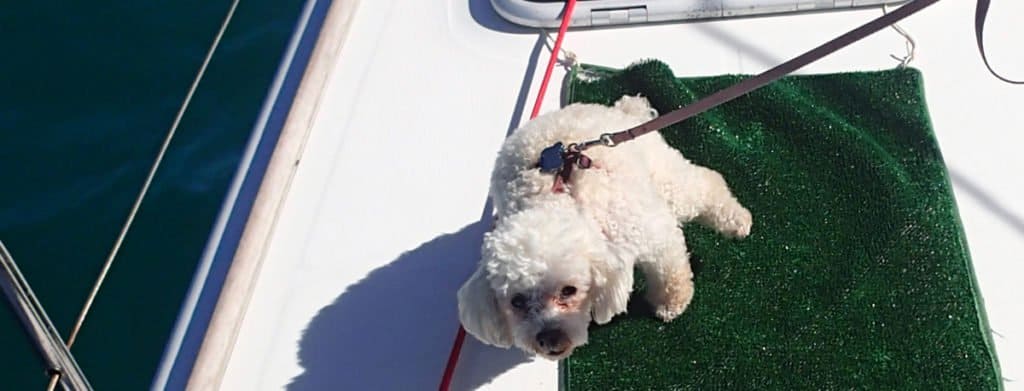
To train your dog to use a pee pad on the boat, you need three things: a pad that already smells like urine, a leash to keep her at the spot, and the patience to wait her out without giving in and taking her ashore first. Get those three things right, and most dogs figure it out faster than you’d expect.
The scent is the real key. Dogs are hardwired to go where other animals have already gone. A pad that smells like urine tells your dog exactly what it’s for. An unscented pad is just a mat — and most dogs will ignore it, or lie down on it and take a nap.
I know this from 10 years of living aboard with our dog Paz — three years on our Tayana 37 in Mexico and Central America, then seven years on our Gemini 105 catamaran in the Florida Keys and Bahamas. Training her to use a pad on the bow was one of the best things we ever did. On passage, there’s no option to pull over. Even at anchor, you really don’t want to be launching the dinghy at 3 AM.
Here’s exactly how to do it — including the part that sounds a little embarrassing but works better than anything you can buy.
And once you’ve read through the article, scroll down to the comments. Other cruisers have shared some great tips from their own experience that are well worth reading.
How to Get a Scented Pad
For this method, you need to find a scented pad to begin. Where will you find one?
Ask a friend with a boat dog for their old pad
This is the gold standard. When we first brought Paz home, our friends Jo and Lance from the boat Milagro showed up with their dog’s old carpet. Jo was a little sheepish about it, but she knew exactly what she was doing.
We put it on the bow, took Paz up there on her leash, and she did her business immediately. Done. Our tiny four-week-old rescue — a little fluffball who’d top out at seven pounds — was trained on the first try.
Most people aren’t that lucky right out of the gate, but don’t worry. There are other ways.
Slip your new pad under an existing one
If you know anyone whose dog uses a pad, ask if you can tuck your new pad underneath theirs for a few days. Urine seeps through and scents the new pad. This is exactly how we handled every pad replacement over Paz’s 10 years aboard, and we passed the technique along to plenty of other cruisers.
Scent it yourself
Yes, really. I know how this sounds. But when we spent a few days on a friend’s boat after three years living ashore, Paz flatly refused the brand-new unscented pad. The moment one of us sprinkled it with our own urine, she used it without hesitation. Several other cruisers I know have done exactly the same thing. If you’re in a marina or there are boat anchored nearby, a specimen cup makes this considerably more civilized.
Skip the commercial scent sprays
They’re marketed for exactly this purpose, but I’ve almost never heard of anyone having real success with them. Save your money.
Choosing the Right Pad
For years, we used a plain welcome-mat-size piece of carpet, and it worked fine — until it didn’t. Once Paz started refusing to step on waterlogged carpet after rain or spray, she’d go right beside it instead. That’s its own special kind of frustrating.
Switching to an artificial grass pad fixed that completely. Wet or dry, she used it every time. The drainage holes help, and most dogs seem to genuinely prefer the texture over soggy carpet. They come in a range of sizes, so you can match the pad to your boat and your dog. Artificial grass pee pad (Amazon)
Real grass is another option worth knowing about. Fresh Patch (Amazon) makes a disposable pad of actual live grass. Some dogs take to it immediately because it smells exactly like what they’re used to going on ashore — no scenting ritual needed. The tradeoff is that it needs replacing every one to four weeks, depending on the size of your pad and how often your dog uses it.
If you have a male dog who won’t go without something to aim at, a few cruisers I know tied a small artificial shrub to a stanchion near the pad. Since Paz was female, I can’t speak to this firsthand, but if your boy needs a target, it’s worth trying.
Teaching Your Dog to Use the Pad
Once your scented pad is on the bow, clip the leash on your dog and take her up to it. The leash matters — without it, she’ll wander around, sniff everything else on deck, and never settle in to do her business. Keep her right at the pad.
Let her sniff. Then wait.
A few things that are critical, especially in those first sessions:
Don’t take her ashore first
If she gets to go on the grass before she’s used the pad, you’ve made training harder. The pad has to come first, every time, until the habit is solid.
Don’t let her lie down on it
The pad needs to mean one thing: bathroom. The moment she starts to settle in, redirect her. If she naps on it, you’ve muddied the message.
Be patient
The first few times may take 20 or 30 minutes, especially with an older dog. Stay calm, stay there, and wait her out. Nearly every dog gets there.
Praise her lavishly when she finally goes
Dogs remember what earns that reaction. Make it count.
After a handful of successful sessions, most dogs start going to the pad on their own without any prompting. At anchor or in a marina, Paz would head up there by herself when she needed to go.
Underway was different. We always kept her on a leash attached to her harness — not her collar, since a collar can injure a dog if she slips and the leash goes taut. We also installed netting on the lifelines as an extra precaution against her going overboard. Both are worth doing before you start bringing your dog forward regularly.
Teach a “Go” Phrase from Day One
The best tip we got came from a couple on our dock the very day we brought Paz home. They puppy-trained service dogs, and they told us to pick a short phrase and use it every single time our dog was about to go — and again while she was actually going.
We used “get busy.” Say it consistently, from day one, and over time it becomes a cue your dog recognizes. You can use it on the pad, on grass ashore, before entering a restaurant, before a long watch. It tells her: right now, in this spot, it’s time. It’s also a lifesaver when you’re somewhere new and your dog isn’t sure whether it’s okay to go.
It paid off for Paz for all 10 years aboard. It’s the first thing I tell anyone who’s starting out with a boat dog.
Keeping the Pad Clean Without Losing the Scent
Here’s the balance you’re managing: the pad needs to stay scented enough for your dog to recognize it, but not so ripe that it bothers everyone aboard.
The solution is simple. Tie a line to the pad and dunk it overboard once or twice a day. Tie the other end permanently to a stanchion so you don’t lose the pad if you drop the line. Your dog’s nose is vastly more sensitive than yours — what smells clean to you still carries plenty of scent information for her.
One Last Story About Paz
We trained Paz to use the pad and to respond to “get busy” both on the boat and on land, starting in La Paz, Mexico, which is how she got her name. About a month later, after a week-long passage across the Sea of Cortez to Banderas Bay, we took her ashore.
She wouldn’t go on the grass.
She’d become so thoroughly trained that the pad was the only acceptable bathroom in her mind. We eventually found a spot where another dog had been, said “get busy,” and watched the lightbulb slowly come back on.
It was the exact opposite problem from what everyone else describes. I was mildly exasperated in the moment and genuinely proud of her about five minutes later.
Plenty of boat dogs have learned this at all ages. The scent does most of the work. Be patient, stick to the rules in those first few sessions, and you’ll have a dog who can go wherever you take her.
Help From Other Cruisers with Dogs
Of course, the cruising community is extremely helpful. Here are a few other tips we’ve received.
Kim noted that her dog didn’t want to use a pad scented by another dog. Her method was to take the pad along when they took their dog for a walk. After she relieved herself, they rubbed the pad over the spot to get her own scent on it. Related to this, Pamela Douglas (creator of the Boating with Your Dog course), reminds cruisers to observe their own dog’s personal habits. Some always mark over another dog’s scene; some never do. City dogs might find it easy to pee on fiberglass. Others prefer an absorbent surface. Use the method that aligns with your dog’s tendencies.
Richard shared that he met a cruiser who coiled rope on the deck and trained his dog to use it as a mat.
A wash down hose on deck is helpful to cleaning up after your pet relieves themselves. But if you don’t have one, Mary suggests investing in a chemical sprayer pump (Amazon) you can fill with water. Rick relied on disposable puppy pee pads (Amazon) set into a tray. They come pre-scented. If you trained your dog using these pads when they were a puppy, it might ease the transition to the boat. You can also buy washable pads (Amazon).
Finally, Jackie reminds us to always discuss your cruising plans with your vet. If your dog waits too long to pee, they can develop urinary tract infections. Female dogs are more subject to infections than males (because of the shorter length of the tract to the bladder). You never want to take chances with the health of your boat dog.
Want to Know More About Cruising with a Dog?
Our course Boating With Your Dog covers everything beyond the basics — gear, health care underway, keeping your dog safe on passage, international entry requirements, and a lot more. Everything in one place, so you’re not piecing it together from a dozen different articles.
Hopefully we’ve given you some ideas for working with your dog. Remember, the sooner you begin, the faster training will be. There’s no reason you have to wait until you move onto the boat. Begin training in your dirt home to make boat life easier for everyone.

Carolyn Shearlock has lived aboard full-time for 17 years, splitting her time between a Tayana 37 monohull and a Gemini 105 catamaran. She’s cruised over 14,000 miles, from Pacific Mexico and Central America to Florida and the Bahamas, gaining firsthand experience with the joys and challenges of life on the water.
Through The Boat Galley, Carolyn has helped thousands of people explore, prepare for, and enjoy life afloat. She shares her expertise as an instructor at Cruisers University, in leading boating publications, and through her bestselling book, The Boat Galley Cookbook. She is passionate about helping others embark on their liveaboard journey—making life on the water simpler, safer, and more enjoyable.
Carolyn Shearlock says
It’s very do-able, particularly if you use the dog’s natural instincts. And very worthwhile to have your best friend along! Paz really enriched our cruising.
Carolyn Shearlock says
Great idea with the flower pot — I asked some friends with male dogs and they said the dog seemed to find “something” (sometimes imaginary) that he was going on. But I love the idea of the flower pot. And the beanbag in the cockpit sounds workable, too. Paz always curled up on the laundry bag under the “notch” of the V-berth.
Love to hear a follow up on how it goes!
Carolyn Shearlock says
Thanks, Bill!
I love how we’re starting to get a list of ways that have worked for people.
Another reader, Kim, added this note on Facebook of what worked for her, too, and I wanted to add it here:
“We just moved onboard with our 12 year old dog… We prefer to use a patch of fake grass (we tried the carpet but after 12 years of being told not to pee on carpet she wasn’t about to start now… & we tried the urine thing too but she wouldn’t even touch the carpet after that – fussy little thing!)… We worked out that we could get the scent on the new patch by rubbing it vigorously over her wee every time she went for a wee on the lawn… Took a few rubbings along with a bit of encouragement & some perserverance but we eventually got there! The biggest mistake we made was giving in & taking her ashore to toilet when she refused to use the grass patch (I was worried she’d get a bladder infection). Once we got strict & refused to let her off until she went on the grass patch she was fine, & from that day forward we’ve had no worries! She still prefers going ashore (& will hold if she knows we’re going) but at least she’s now willing to use onboard facilities when we’re away for a few days at a time *phew*… thanks for the tips – yours was the only site I found that offered any decent suggestions… Until then I had absolutely no idea how I was going to tackle that little issue :)”
Mary Dixon says
I should clarify, we use the sprayer after picking up the solid.
Carolyn Shearlock says
What a great name for the canine officer! Lucky dog!
-Carolyn
Carolyn Shearlock says
We only had one piece of carpet and I don’t know of any boats that used two separate ones. I’m not a vet and thus couldn’t tell you about the medical consequences of holding it for certain.
Good luck and have fun!
Carolyn
Carolyn Shearlock says
Oh, the things we do for our boat dogs! Here’s to no more 2AM trips!
Dar*Dar says
We’ve been cruising with our cat for 6 years; he’s done two trans-Atlantic crossings with us. He was 11 years old when we started. He’s done just fine & established his own ‘routine’. When he hears the anchor going up, he goes inside (we have a catamaran) to hang out. As soon as he hears the anchor dropping, he’s out in the cockpit looking around. We have had zero problems with having him with us. If I know it may be rough, I cut off any food to him several hours before. When we’ve had a few days in a row of rough conditions & he doesn’t want to eat/drink, I open a can of tuna in water & pour the water into a bowl. It works every time in getting some liquids into him. (He doesn’t want the tuna itself; I eat that! He’s spoiled & only wants fresh tuna!)
Brenda Martinez says
I’ve been looking for a straight forward article on how to train a dog to do this aboard. This one was great! I saw a comment about what someone does if weather will be rough but it was a cat. I was wondering if anyone has experienced a dog that gets sea sickness?
Carolyn Shearlock says
Talk with your vet, but ours recommended liquid (kids’) Dramamine and told us the proper dosage for our dog. She was sick her first time out and never again, even in some pretty hairy conditions, so we only used it that once, but it did seem to help her.
Judy says
We have just retired and bought our sailboat to go cruising. We have watched several youtube videos and saw that using ginger powder in their food that works. Has anyone triec and did it work?
Carolyn Shearlock says
I know that ginger works for some people, not for others. Probably the same for dogs!
Carolyn Shearlock says
Another trick to to have a dog who is not afraid of the water walk with the one who is. Our dog has guided numerous dogs onto the dock and into the dinghy — funny to see the 7-pound “brave” dog encouraging the 90-pounder who’s trembling with fear!
The Boat Galley says
Hey, whatever works!
The Boat Galley says
Looked for a site about dogs and got mostly cooking, huh? 🙂
Alex Miller says
I have very much enjoyed the galley articles also! After a year of setback in progressing in our sailing plans due to a relocation (from Boston with the wonderful harbor for sailing, to Nashville with freshwater lakes) we are finally getting back on track. We have started looking at boats to purchase. And yesterday, I took Badger, our 45 pound Border Collie mix to the marina to check out the docks and see the scary boats and take a ride in a kayak as a test. She did great and was not spooked by anything but the cleats on the dock which poked her in the nose. The dock was scary at first, but quickly found to be safe, and she appeared to want to get in the boats. She also did great in the kayak and didn’t cause any capsizing, minimal standing or leaning out, and mostly sat or lay down calmly. Got in and out with minimal coaxing. She actually hates swimming, and I think this is an advantage, because she won’t be inclined to go launching off the boat.
Anyway, my question relevant to this article… and it sounds elementary. Does the configuration of the foredeck matter in selecting a boat that will be compatible with doggie carpet? Obviously, there needs to be a large enough flat area easily accesible. But many boats have hatches in the foredeck. Are those out of the question? It seems leakage might be messy. Or does it not matter if it is just going into the anchor well?
Carolyn Shearlock says
Sounds like you had a great first experience with the dog!
I’ve never heard of anyone having problems with pee leaking below through a hatch and causing a problem. Paz was very good at actually going ON the carpet, and it soaked it up (we dunked it overboard a couple times a day). I doubt it’d be a problem.
Carolyn Shearlock says
Both poop and pee. Pick the poop up and put it in the toilet, or if allowed, directly overboard (i.e., same as human waste).
The Boat Galley says
Now that’s a GREAT doggie!
Carolyn Shearlock says
Once you’re out of the marina, he may realize there’s no other option. Paz is that way sometimes, wanting to wait until we go for a walk. But she knows the pad is there and if we’re at anchor readily uses it.
Denise Peter says
Peeing on it is actually a pretty good idea. “Hey Buddy, can you pee on my mat for me?” LOL!!! I’m really surprized that didn’t work.
Red Canoe says
haha. yeah I got “you can’t be serious???” oh yes PLEASE pee on my mat. Maybe i’ll try mine next? I like the idea of another dog’s scent on it…
Red Canoe says
Denise Peter I am a Cedar girl!
Douglas Iosbaker says
Its not the best photo… If you look down on the bottom left corner of the photo you will see it on the dock…I used a Well Tank tray from Home Depot. It has a drain hole where you can attach a hose for overboard draining if it left out in the rain. We would change out the sod once a month. We also made 1 out of a square washing machine tray. When it was left on the dock other dogs would use it and would enforce our dogs to do so
LaDonna Thomas says
My pup was 10 years young when we moved aboard and she was much easier to train on the boat compared to puppy house breaking! Good luck, it’s worth it They add so much to the quality of life
Manon Pilon-Fry says
Thanks.
Carolyn Shearlock says
Depends on where we are. You can toss it overboard if offshore. Put it in the trash (pick it up with a doggy-do bag and tie it up just as on shore ). Put it down the toilet.
The Boat Galley says
Paz is both embarrassed and proud of that picture, I think.
Carolyn Shearlock says
Our dog has never done that! Interesting . . .
Susan says
We have a male spaniel who has turned into a wonderful boat dog. We got him as a puppy and he has rarely (3 times) lifted his leg to go pee. He’s now 2 years old and still squats. If they are not around other male dogs as they mature (approx 6 months) they don’t always learn to lift their leg to pee. This is my husband & my 4th dog we have raised together & about the 11th dog we have had in total, all but one have been males. The last 3 male have continued to squat throughout their lives.
Rebecca Frazier says
I have a dog, and he grew up around another male dog, but still he always squats
Carolyn Shearlock says
Woo-hoo!
The Boat Galley says
It has both pros and cons, but we keep seeing more and more boats with dogs. Most, but admittedly not all, dogs love the life of being with their people and getting to explore new places. I wrote a long piece about it and rather than rehashing it all here, I’ll let you read that: https://theboatgalley.com/dogs-on-boats-101/
Carolyn Shearlock says
We have a line tied through one corner and dunk it.
Carolyn Shearlock says
I think I’d put the pad in a shallow waterproof tray — just to be on the safe side. I’ve heard of very few seasick dogs, interestingly. Paz got seasick her first day out — and it was a rough day when I was seasick too. Also, she was only about 2 months old then. Since then, and in worse conditions, never.
Carolyn Shearlock says
Just a little pee on the pad will give the dog the idea! And we actually pick the poo off the pad (just like you’d pick it up ashore) and put it in the toilet. We’ve never had to do anything more than dunk the pad and wiggle it around in the water to clean it off.
Rebecca says
My first dog was so timid. Took a few tries and tons of treats. Then she was in and out like crazy. I used the best treats for special occasions so she associated the boat with amazing treats. Now she’s happy with or without them. I used her to help train the 2nd one. Try not to force them bc it can create a negative association.