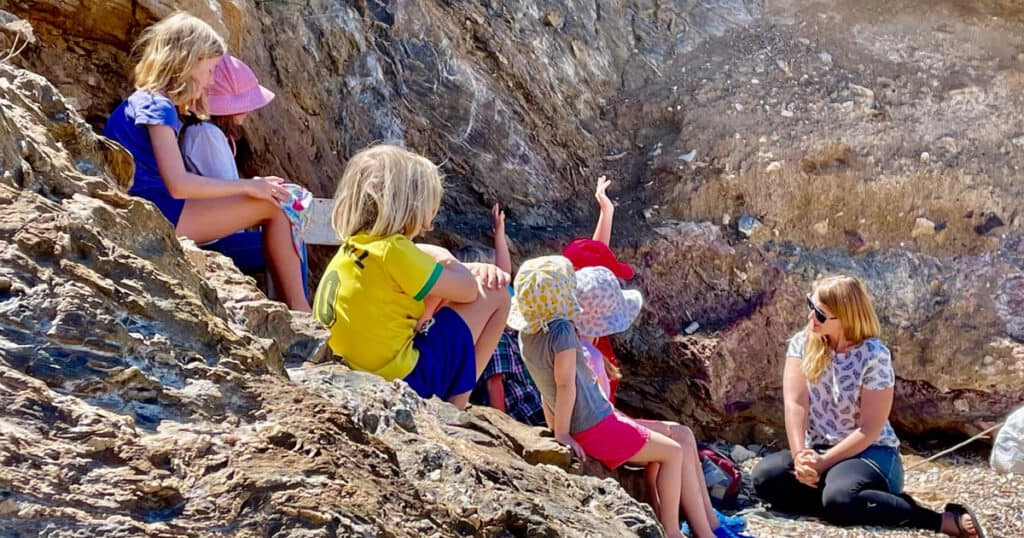
Yes, sailing with kids works, and for most families it works beautifully. Over 14,000 miles of cruising, we’ve met several hundred boat kids, and only one family where it genuinely didn’t work out. If you’re thinking about cruising with your children, the real question isn’t whether it’s possible. It’s whether you’re ready to trade soccer practice and video games for watch-standing, snorkeling, and real responsibility.
Most families who go find they wouldn’t trade it for anything.
Dave and I came to cruising late. His kids were already grown, and I don’t have any, so I can’t tell you what it’s like to teach long division at anchor or deal with a teenager’s feelings about leaving friends behind. But I’ve watched hundreds of families figure it out, and I’ve kept in touch with many of them. Here’s what I’ve learned from watching them do it.
Should You Take the Kids or Wait Until They’re Grown?
Take them. That’s the short answer, and almost every cruising parent I’ve ever talked to agrees.
The longer answer: waiting “until the kids are grown” often means never going at all. Life doesn’t pause. Jobs get more demanding, parents get older, health gets trickier, the boat dream quietly slides to the back of the shelf. Meanwhile, the window when your kids would actually love this with you (roughly ages 4 to 14, based on what I’ve seen) closes fast.
There’s also this: cruising with your kids is a fundamentally different experience than cruising without them. You see the world through their eyes. You’re forced to slow down. The family unit gets tighter because you can’t escape each other, which sounds terrible and often turns out to be the best thing about it.
The families I’ve watched who waited until the kids left home had a great time. The families who took the kids had a great time and gave their kids something most children never get.
The Two Big Questions: School and Other Kids
When parents first start thinking about sailing with kids, two worries dominate everything else: What about school? And will there be other kids around?
Both have solid answers.
Boat Schooling Actually Works
Homeschooling on a boat (most cruisers call it “boat schooling” or “boatschooling”) is legal in all 50 states and in most countries cruisers visit. It’s not a fringe arrangement anymore. There are curriculum options for every style of learner, every budget, and every grade level.
Here’s what surprises most parents: cruising kids often end up ahead academically, not behind. Some reasons why:
- Learning is one-on-one, not one-on-thirty
- Lessons can be tailored to the child’s way of learning
- The world becomes the classroom, with history where history happened, marine biology off the swim ladder, foreign language at the dock
- Kids see the real-world application of what they’re learning, so it sticks
It’s not all easy. Boat schooling takes discipline, especially on passage days when regular routines go out the window. Veteran cruising parents will tell you the hardest part isn’t the material. It’s being the teacher and the parent at the same time. But thousands of families have figured it out, and the kids come out the other side sharp, curious, and confident.
For practical tips on how to actually run boat school day-to-day, former primary school teacher Emily’s guest post Boat School Lessons for Parents is a good starting point.
Other Kids Are Everywhere
The socialization worry comes up in every conversation with non-cruising friends and relatives. “But what about friends? Won’t they be lonely? Won’t they be weird?”
Here’s what I’ve seen: cruising kids have more friendships across more ages, cultures, and backgrounds than most land kids ever will. Popular cruising grounds like the Bahamas, the eastern Caribbean, the Sea of Cortez, and parts of the Mediterranean are full of boat families. Facebook groups like Kids4Sail do monthly location roll calls so parents can find other boats with similar-aged children in the same area. Anchorages like Boot Key Harbor in Marathon and Georgetown in the Bahamas have informal boat-kid groups that meet up regularly.
And boat kids don’t care about age the way land kids do. A 13-year-old will happily play with a 6-year-old if they’re the only two kids in the anchorage. That flexibility turns into a social skill that follows them for life.
Your kids will also spend real time around adults: dock neighbors, charter captains, local shopkeepers, other cruisers at potlucks. They learn to hold a conversation with a 70-year-old retired engineer and a 10-year-old Bahamian kid within the same afternoon. It’s a kind of social fluency most kids never develop.
What Boat Kids Actually Gain
Beyond school and friendships, cruising gives kids things that are hard to find on land.
Real responsibility. Boat kids stand watches. First alongside parents, then solo in good weather, eventually as full crew. They handle lines, they spot hazards, they make decisions. That kind of genuine responsibility is rare for kids under 12 on land, and it shapes who they become.
Problem-solving as a default. Things break on boats. Weather changes. Plans get abandoned. Cruising kids learn early that problems aren’t catastrophes. They’re puzzles. When they have questions, they learn how to find answers instead of waiting to be told.
A different relationship with the natural world. The ocean is the front yard. Kids learn to read weather, understand tides, identify fish, respect wildlife, and move through the natural world with an ease most adults never develop.
Cultural exposure that can’t be simulated. Whether you cross oceans or stay in your home country, cruising exposes kids to people whose lives look different from theirs. Kids who cruise abroad often pick up a second or third language casually, the way they picked up their first.
A tight family. You can’t escape each other on a 35-foot boat. Families that cruise together have to learn to communicate, share space, give each other room, and work as a team. The relationships that come out of that tend to last.
What About the Naysayers?
Every cruising family deals with the naysayers. Parents, in-laws, friends, neighbors, random people at the dock. Someone is going to tell you you’re crazy, irresponsible, or both.
Three things help:
Start telling people early. Give your extended family six months to a year to absorb the idea before you leave. Big announcements trigger big reactions; gradual conversations let people adjust.
Have real answers ready. “What about their education?” has an answer. “What about safety?” has an answer. “What if something goes wrong?” has an answer. The more specific and calm your answers, the less ammunition the naysayers have.
Point them to real cruising families. Behan Gifford’s Sailing Totem blog has been running for over a decade and documents life aboard with three kids through a near-circumnavigation. Her Homeschooling section specifically addresses the school question, and she and her husband Jamie offer cost-effective personal coaching for families considering cruising. Showing skeptical relatives real families doing this well is often more persuasive than anything you can say yourself.
You’re not the first family to do this. You’re not even the thousandth. There are currently thousands of families cruising all over the world, and most of their kids are thriving.
The Honest Trade-Offs
Sailing with kids isn’t all sunsets and dolphins. A few honest things:
- Laundry in a remote anchorage with three kids is a genuine ordeal
- Medical situations abroad can be stressful even when the care is good (and it usually is)
- Kids get seasick, and there’s not much sympathy from the ocean
- Boat schooling is hard work for the parent-teacher, and some days nothing gets learned
- You will live in very close quarters, and “very close” means very close
- Re-entry to land life, whether for middle school or college, takes adjustment
These are real. They’re also manageable, and every cruising family figures out their own version of managing them.
Where to Go Next
If you’re seriously considering this, two books are essential reading.
Voyaging with Kids: A Guide to Family Life Afloat (Amazon) is the book on cruising with children. Written by three cruising moms, including Behan Gifford of Sailing Totem, with contributions from more than 65 other families. Covers every question you’re likely to have, from choosing a family boat to handling relationships back home.
Homeschool Teacher: A Practical Guide to Inspiring Academic Excellence (Amazon) is by Kate Laird, who homeschooled her two daughters aboard from grades K through 8 while the family sailed from Alaska to Antarctica. The most practical guide I’ve seen for parents who’ve never taught before.
Beyond those two, Behan’s Sailing Totem blog includes a continuously updated list of cruising family blogs, which is a good way to see how different families make this work at different stages.
Still Thinking It Through?
Cruising with kids is a big decision, and most families take a year or more to work through it. If you want steady, practical content delivered to your inbox while you’re figuring it out, consider joining The Boat Galley newsletter. Every Wednesday, I send out one main article geared to newer cruisers, plus a roundup of recent posts across boat life topics like provisioning, systems, safety, seamanship, and the day-to-day realities of living aboard. 22,000 cruisers and cruisers-in-planning get it each week. It’s free.
Whatever you decide, you’re asking the right questions. That’s more than most families do before making a big lifestyle change.

Carolyn Shearlock has lived aboard full-time for 17 years, splitting her time between a Tayana 37 monohull and a Gemini 105 catamaran. She’s cruised over 14,000 miles, from Pacific Mexico and Central America to Florida and the Bahamas, gaining firsthand experience with the joys and challenges of life on the water.
Through The Boat Galley, Carolyn has helped thousands of people explore, prepare for, and enjoy life afloat. She shares her expertise as an instructor at Cruisers University, in leading boating publications, and through her bestselling book, The Boat Galley Cookbook. She is passionate about helping others embark on their liveaboard journey—making life on the water simpler, safer, and more enjoyable.
Brittany McCardle says
So great to see this post! We’ve been cruising with our kids for a few months now! Here’s our blog
http://familyatsea.com/
Laine Common says
We live aboard with our 6 kids ages 5 months to 9 years, as well as our two cats. 🙂
The Boat Galley says
That’s quite a crew!
Laine Common says
They’re surprisingly helpful and also compliant when it comes to safety, it was such a relief.
The Boat Galley says
Good news! Has to be fun to watch them exploring all the new places and meeting new people.
John Brethauer says
I want the duck
The Boat Galley says
Isn’t it adorable?
suzette says
“But seriously, it’s not a weird lifestyle ”
Best line this week!
Heather Picot Walton McCarthy says
The bit about teaching responsibility is so true. If they don’t do their job on a boat, very bad things could happen. We watched our kids whine and resist in the beginning, but maturity, confidence, and pride skyrocketed after a month or so. We’ve been back on land for 8 months now, and all 3 still sleep on the floor next to each other at night… we hear them chattering at night… they’re inseparable. Cruising with kids yields rewards beyond measure.
Anonymous says
We have 7 ages 1 month to 10 years. The youngest two were born after we moved aboard and the very youngest was actually born in the master cabin. The kids love it and have gotten to experience things most kids will only read about.
The Boat Galley says
Love hearing that! Boat kids are the best kids!