Sailing to the Bahamas for the first time means more major passages, more weather decisions, and more logistical surprises than most boaters expect.
We’ve now done three trips to the Bahamas and loved every one. But on that first trip, there were things we knew in theory that we hadn’t really taken to heart. And a few things that caught us genuinely off guard.
Here’s what we wish we’d understood before we left.
1. There Are More Major Passages Than You Think
Most first-timers spend a lot of energy preparing for the Gulf Stream crossing — and rightly so. But we were so focused on that first passage that we didn’t give enough thought to what came after it.
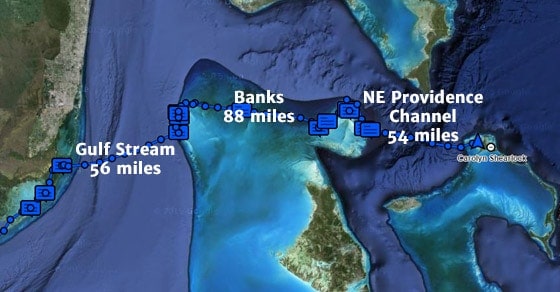
There are actually three major passages involved in getting to the eastern Bahamas. The Gulf Stream crossing gets all the attention. Then there’s the Banks crossing.
It’s too long for most boats to make in a single day, so you anchor partway across in the middle of nowhere, with no protection from any direction. The shallow water means large waves don’t build, but short-period three-footers can make the crossing tiring and the night at anchor rough and sleepless.
We talked to several other boats in Great Harbour Cay Marina — both sail and power — who had a tough time with it. Every first-timer said the same thing: they hadn’t given the Banks crossing enough respect. We chose to cross in the calmest conditions we could find. Not our first choice as a sailboat, but the right call for a passage with nowhere to hide.
And then, if you’re heading to the eastern islands as we were (Eleuthera was our destination), there’s a third passage across deep water channels. That one requires waiting for winds from a direction other than the prevailing easterlies — and when the right window finally opens, you need to be ready to move immediately..
2. Weather Rules Everything
You already know that weather shapes every day of your cruising life. It determines:
- Where you anchor each night — you need protection from the forecast wind direction
- When you go through tidal cuts — wind against current creates dangerous conditions even when wind speed looks fine
- When you stay put — squalls, wrong wind direction, and high winds are all good reasons to sit tight
- When you go ashore — nobody wants to be in a dinghy in rain and chop
- How long you stay somewhere — sometimes you’re waiting days for the right window to move on
All of that is true everywhere you cruise. In the Bahamas, the stakes are higher. The same remoteness that makes the anchorages so spectacular means your options when things go sideways are fewer and further apart. You can’t improvise your way out of a bad forecast decision. There’s no bail-out spot around every corner. That demands thinking two or three days ahead and going deeper into the forecast.
Checking wind, wave height, and maybe the chance of rain is a start. But wave period and direction matter as much as height. You also need to know how the wind direction compares to current, and whether the various models agree. And that 20% chance of rain could be a passing shower or a squall with 40-knot gusts. The apps can tell you which, if you know where to look.
Better app usage is a learnable skill. You don’t need to spend years learning meteorology. Great forecasts are already out there, built by professionals using supercomputers. What you need is to know which layers to pull up and the rules of thumb for evaluating what you find. That’s why I wrote Weather Basics for Boaters — with screenshots showing exactly how to do it in Windy and other apps. You can read it in an evening and use what you learn the very next time you check a forecast.
Anchoring is a good example of how all this forecast work pays off in practice. Wind direction determines which anchorages are usable on any given night — and you need to know your options before you’re already underway trying to figure it out.
East protection is easy to find throughout the Bahamas. But anchorages with westerly, northerly, or southerly protection? They exist — you just need an easy way to identify them so it doesn’t become an hours-long chore to plan each day’s stop.
On our first trip, we were figuring it out day by day and paying marina prices when we couldn’t find the right spot quickly. That frustrating experience led us to add a key feature to our Bahamas Cruising Guide: every anchorage lists protection direction — N, E, S, W — in a quick-reference table. When you know what the forecast is calling for, you look down that column, find the viable stops near you, and go. No scrambling, no hours of research. For most cruisers, that one feature saves them marina nights they hadn’t budgeted for. The guide more than pays for itself.
Anchoring is just one example. The same kind of thinking — knowing what’s coming, knowing your options, making the call before you’re committed — applies every time you decide whether to move, whether to go through a cut, or whether to stay put and let a front pass. The boaters who thrive in the Bahamas aren’t the ones with the best luck. They’re the ones who’ve made this kind of planning a daily habit.
3. Your Anchor and Anchoring Technique Matter More Here
The Bahamas is gorgeous — but the anchorages can be genuinely challenging. Many are noted as “poor holding.”
Tides are generally 3 to 4 feet, but large areas drain and fill through small channels that scour the bottom down to rock. Other areas have thick grass with only scattered sand patches — and many anchors don’t set well in grass, or don’t set quickly enough to catch a sand patch before dragging past it.
A quality anchor is critical. We love our Mantus and wouldn’t trade it. But even the best anchor can’t compensate for poor technique. If you’re not 100% confident in your anchoring technique, check out our complete walkthrough — chain, rope, snubbers, and more. In the Bahamas, you simply must have your technique down pat.
A windlass is real safety gear here. It lets you make as many attempts as necessary to get a solid set, and it lets you move quickly if conditions change overnight.
4. Watch the Tides
Anchoring well gets you settled — but then the tides demand their own attention. In the Bahamas, tidal awareness is a constant.
A few situations where getting this wrong can ruin your day:
- Tidal cuts: Entering a narrow cut at mid-tide with strong tidal flow can be either a slow slog or an E-ticket ride. Aim for slack water, especially if wind is opposing the current — locally called a “rage” when severe. Less intense versions are still something to plan around.
- Snorkeling: Never snorkel where the current could carry you out to sea through a pass. Snorkeling on an incoming tide is generally safer, and visibility is usually better near slack water too.
- Dinghy on the beach: If you pull the dinghy up on a falling tide, you may find yourself carrying or dragging it a long way back to the water. Come ashore on a rising tide and anchor the dinghy even if you drag it up the beach — a rising tide can float it free.
One more thing: there are very few official tide stations in the Bahamas, which means standard tide tables don’t cover most anchorages. You need a tide app that extrapolates tidal data for locations without a station. Not all apps do this well — in my course, I cover which ones do.
5. Fresh Water Is Scarce
You either need large water tanks or a watermaker. Without one or the other, water availability will start shaping your route — you’ll be making decisions about where to go based on where you can fill up rather than where you want to be.
Water is available in many towns throughout the Bahamas, but cost and availability vary widely. Some places provide it free, others charge extra, and some anchorages have none nearby at all. Our Bahamas Cruising Guide tracks water availability and cost for each stop, so you know what to expect before you arrive rather than after.
We had a watermaker on Barefoot Gal and it was one of the best decisions we made. We never had to chase water or let it dictate where we went. Not everyone has that option, which is exactly why we built water information into the guide.
6. Fresh Food Is Expensive — and So Is Beer
Fresh food in the Bahamas is expensive and the selection is often poor — both in variety and quality. In Bimini and Great Harbour Cay, I was paying two to three times what I’d paid in the Florida Keys for produce that wasn’t nearly as good. I’d been warned before we left. I still wasn’t fully prepared.
Provision heavily before you leave the US. I brought a large supply of dehydrated vegetables and was glad I did — lighter and more compact than cans, and they hold up well for extended time away from a provisioning stop.
And if you like beer, brace yourself. Expect to pay around $65 a case. Stock up before you cross.
7. Dinghy Rides Are Long
In most Bahamas anchorages, the dinghy is your only connection to shore — town, beach, other boats, all of it. Expect one- to two-mile trips to be the norm rather than the exception.
We were very glad we upgraded to a dinghy that would plane before leaving the US. A dinghy that only goes slowly makes every trip to shore longer and wetter than it needs to be.
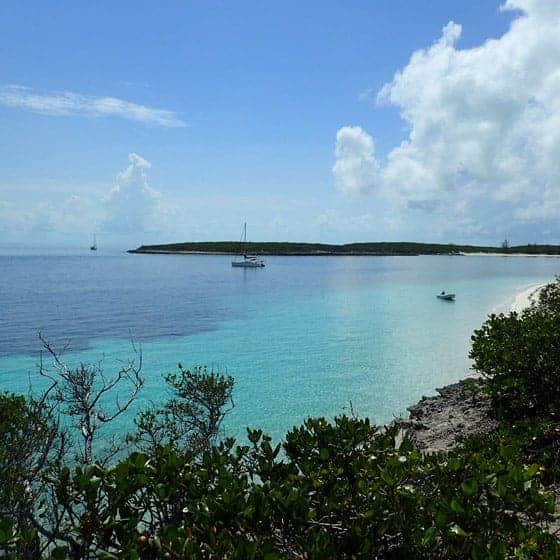
At Devil’s Hoffman Cay, we had a beautiful beach and snorkeling right near the anchorage — but the Blue Hole and other area attractions were over a mile away by dinghy. A fast dinghy makes all the difference for that kind of exploring.
8. Take Ciguatera Seriously
If you’re planning to fish in the Bahamas — or eat fish caught by someone else — ciguatera needs to be on your radar before you go. Most cruisers have “heard of it.” Very few know enough about it until someone they know gets it.
Ciguatera is a toxin carried by reef fish. The biggest risks are grouper and barracuda — particularly large ones — but the list of known carriers has grown well beyond the usual suspects and now includes species that were long considered safe. The fish that’s ciguatoxic looks, smells, and tastes exactly like one that isn’t. Cooking and freezing don’t neutralize the toxin. There’s no reliable test and no antidote.
Symptoms can start anywhere from 15 minutes to 24 hours after eating a contaminated fish. The gastrointestinal symptoms — vomiting, cramping, diarrhea — are bad enough. The neurological symptoms are worse: a classic sign is temperature reversal, where cold things feel burning hot and hot things feel cold. Numbness, tingling, joint pain, and extreme itching are also common.
And it doesn’t just go away. Symptoms can last months to years, and relapses can be triggered by alcohol, nuts, fish, chocolate, and caffeine long after you think you’ve recovered.
Read the full article on ciguatera poisoning before you go. It’s one of those things that’s easy to dismiss until it isn’t.
Ready to Go?
The Bahamas is as beautiful and rewarding as you’ve heard. But the logistics are real, and the preparation matters.
My course Get Ready to Cruise the Bahamas walks you through everything you need to sort out before you leave — Gulf Stream crossing, Bahamas customs and entry paperwork (including Click2Clear), charts and cruising guides, provisioning for the islands, and communications setup. If you’re in the planning process, it will simplify all your preparations.

Carolyn Shearlock has lived aboard full-time for 17 years, splitting her time between a Tayana 37 monohull and a Gemini 105 catamaran. She’s cruised over 14,000 miles, from Pacific Mexico and Central America to Florida and the Bahamas, gaining firsthand experience with the joys and challenges of life on the water.
Through The Boat Galley, Carolyn has helped thousands of people explore, prepare for, and enjoy life afloat. She shares her expertise as an instructor at Cruisers University, in leading boating publications, and through her bestselling book, The Boat Galley Cookbook. She is passionate about helping others embark on their liveaboard journey—making life on the water simpler, safer, and more enjoyable.
The Boat Galley says
Anywhere from $4 to $5 for both gas and diesel. Explorer Charts website has a list of fuel and marina prices, updated monthly.
Jan Bogart says
Thank you
Jan Bogart says
Are you going down island?
The Boat Galley says
Jan Bogart Yep! At least that’s the hope . . . I don’t like to use the word “plan”!
Jan Bogart says
Will see you if/when you stop here! The land of provisions……
The Boat Galley says
Finally got enough of a connection . . . here’s the link: https://www.explorercharts.com/fuel-dockage
Carolyn Shearlock says
I am not complaining, just stating facts for people who are planning to cruise here. Most people on smaller boats do not have unlimited money and have to plan for their expenses. And in the US — where many of us come from — water is usually free, marinas are less expensive and so is food. I am enjoying the islands!
Carolyn Shearlock says
So sorry to hear about your problems — I’ve known several people who have had problems. And also really sorry to hear that dorado is now on the list of “do not eat” fish. I had looked at the list a year or so ago, guess I need to look again.
The Boat Galley says
Jan Bogart — somehow I guess I mis-read that last night. This year, we’re planning to stay in the Bahamas, then need to go back to the US for a bit. Possibly to VI in another year?
Liz says
In reply to Island Guy:
Stating a fact is not complaining. The fact is, many places in The Bahamas charge 50 cents per gallon of water. Mrs Shearlock did not criticize Bahamians, Bahamian businesses, or the government of The Bahamas. She simply stated a fact: water may cost 50 cents per gallon.
One of the things I respect and admire about cruisers is an open honesty about what to expect. In fact, cruisers rely on honest and accurate reports from those who have gone before us to help us prepare responsibly. We wish to be responsible visitors; we hope to have a positive effect on the local economy; we do not want to burden local resources.
To accomplish these responsible goals, we need accurate information…which Mrs Shearlock supplied in an open, honest, and non-judgmental manner.
Cruisers come from all walks of life. Some are, in fact, wealthy. Others have very small budgets, have worked for years scrimping and saving to be able to visit your country, and rely on accurate information to budget appropriately.
While 50 cents for a bottle of water may seem like, “what’s the big deal?” to you, I don’t think it’s one bottle of water any of us are concerned about. It’s meeting the water needs of the crew and vessel day in and day out for weeks or even months that requires planning. Part of that planning is making sure we have room in our budget to meet those needs. If we don’t know what water costs, we cannot plan appropriately for those costs. We would be irresponsible mariners to arrive in your country without having the resources necessary to sustain ourselves there. Clearly, we either need to be able to supply our own water, or to have sufficient funds to buy water when we’re there.
I appreciate Mrs Shearlock’s honest, accurate, non-judgmental information because it helps me understand what to expect so I can plan appropriately and responsibly.
Although you didn’t specifically state that you are Bahamian, your words suggest that you are. If so, please understand that YOUR comment and sentiments are also being noted by those of us gathering information and hoping to cruise in your beautiful country.
Many of us have never before met a citizen of The Bahamas and have been looking forward to getting to know both your beautiful islands and your countrymen.
Bahamians have a reputation as warm, welcoming, honest, hard-working people. The Bahamian people are one of the reasons many cruisers want to visit The Bahamas.
It’s troubling for me to see how quickly you judge Mrs Shearlock without fully understanding before you condemn. While my experience is that your views (all boaters are rich complaining cheapskates) are not common among Bahamians, I hope that isn’t changing, and that I’ve been able to clear up the misunderstanding that led to your misjudgment.
Carolyn Shearlock says
Thanks for your comments!
Liz says
Thank you for a website I learn from and enjoy!
Jan Bogart says
Cool, we are in PR.
Carolyn Shearlock says
Yes, I can certainly see where it would be hard with that size boat. We’ve had a couple in anchorages we were in and they certainly had a bit of stress . . .
Charlie says
I, too read your reply.
I’ve been visiting the Bahamas, both for pleasure and business, for nearly 40 years. With 99% happiness, fun and enjoyment.
Yes, things are expensive there, and generally, for good reason. Inbound transportation and high import duties. And we don’t begrudge ‘making a reasonable profit.’
But, let’s not forget that other 1% who are quick to assume that boat owners are ‘marks’ from whom maximum toll must be quickly extracted. 50 cents a gallon, when we need 50 or more gallons, is just plain extortion, against which we boaters need be wary.