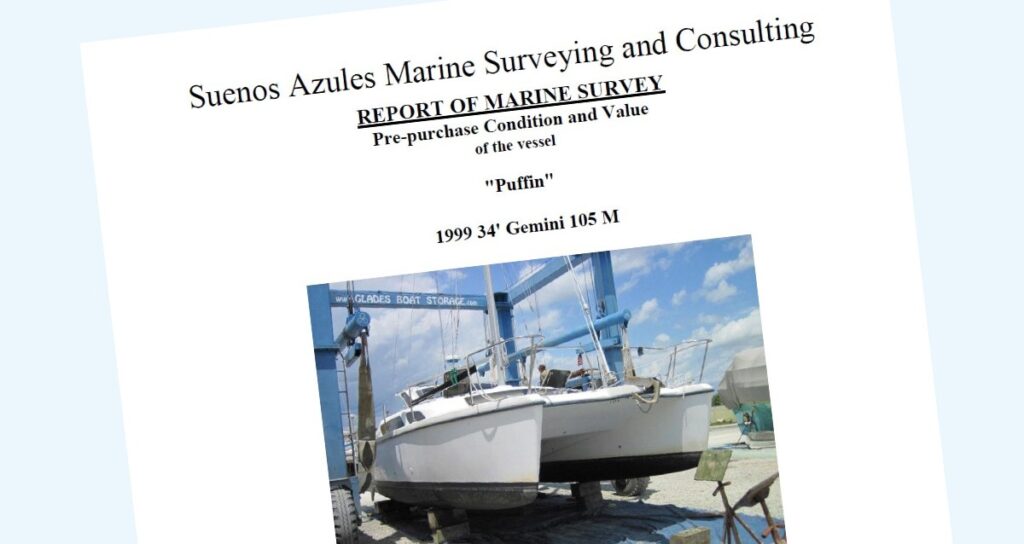
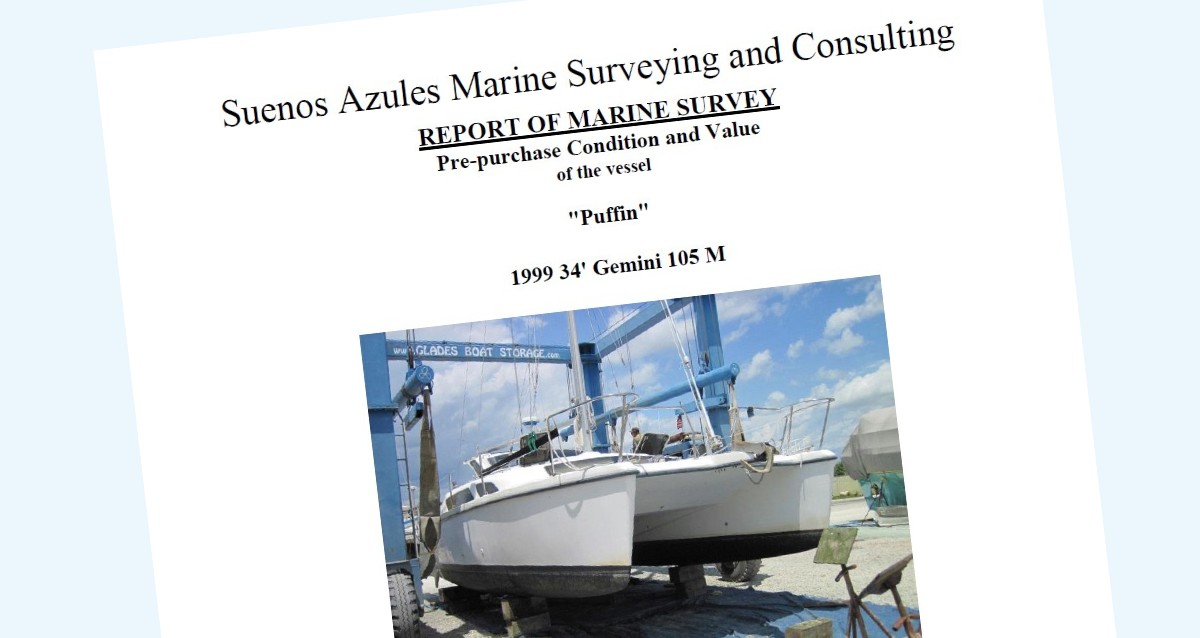
A pre-purchase boat survey is a paid, independent inspection of a used boat by a qualified marine surveyor, ordered by the buyer after an offer is accepted and before closing. It tells you the boat’s true condition, its fair market value, and whether the deal you’ve negotiated still makes sense. On any used boat you can’t fully evaluate yourself, it’s the most important money you’ll spend before signing.
I’ve bought two cruising boats and walked away from a third because of what a surveyor found. The survey on that third boat saved us from a money pit. The survey on Barefoot Gal showed us we’d already negotiated a fair price. Same process, very different outcomes, both worth every dollar.
If you’re shopping for a cruising boat, here’s what to know before you write the check.
Do Your Own Pre-Inspection Before You Make an Offer
Walk through any boat you’re seriously considering with a critical eye before you make an offer. Your own inspection happens before the offer. The paid survey happens after an accepted offer, as a contingency. They’re two separate steps that serve two different purposes.
A pre-inspection on your own does three things:
- Helps you decide whether to make an offer at all. If you find serious problems on your own walkthrough, you’ve saved yourself the cost of a survey on a boat that wasn’t going to work out.
- Sets your offer price intelligently. Anything you find becomes part of how you frame the offer, not a surprise that comes up later.
- Gives you specific concerns to flag for the surveyor. Once you have an accepted offer and bring in a surveyor, you can tell them about the spots that worried you and ask them to check those carefully.
The single best resource for your own pre-inspection is Don Casey’s Inspecting the Aging Sailboat (Amazon). It walks through every system on a used boat with photos and clear explanations of what good and bad look like. You’ll come away knowing what soft deck feels like, what crazing in fiberglass means, what to look for at chainplates, and dozens of other things that aren’t obvious until someone shows you what to look for.
Line Up Your Surveyors Before You Make the Offer
Before you submit an offer, find out what’s involved in actually getting the surveys done in your area. Some places have plenty of qualified surveyors, mechanics, and riggers. Others have very few — and the good ones are booked weeks out, especially in spring and early summer. The same goes for the haul yard.
Why this matters before the offer goes in: the contract window for completing the survey is something you negotiate with the seller. Too short and you’ll be scrambling, hiring whoever’s available, or skipping pieces of the survey. Too long and the seller may push back. Knowing roughly what the wait looks like before you sign means you can ask for a window that actually works.
This is also when you find out whether you’ll need to bring someone in from outside the area, which adds travel costs to the survey budget. More on that below.
The Buying Sequence, Briefly
So you understand where the survey fits in the bigger picture, here’s the order:
- Your own pre-inspection. Decide whether the boat is worth pursuing.
- Make an offer, contingent on a satisfactory survey and sea trial. The contract sets a window for completing the survey, often 14 to 30 days, and a closing date. Both need to be negotiated with realistic numbers based on surveyor availability and haul yard wait times in your area.
- Offer accepted. Now you book the surveyor.
- Survey day. Hull, systems, engine, rigging (on a sailboat), and sea trial.
- Review the report and negotiate based on the findings, ask the seller to fix specific items, or walk away. If pieces of the survey come back at different times (oil analysis, rigging report), the accept/reject window should run from the last result, not the first survey day.
- Close, or move on.
The rest of this article is about steps 3 through 5.
What a Pre-Purchase Survey Actually Does
A marine surveyor is the only person in the entire transaction who works for you. Brokers earn a commission only if the boat sells, and they’re paid a percentage of the price, so their interest is the deal closing, and closing high. The seller wants the deal closed too, and at the highest price they can get. The surveyor gets paid the same whether you buy the boat or not, and the price doesn’t affect their fee. That, plus their expertise, makes the report worth what it costs.
A standard pre-purchase survey is a “Condition and Valuation” inspection, often called a C&V. It typically covers:
- Hull and deck for structural integrity, moisture, blisters, prior damage, and core problems
- Through-hulls and seacocks for corrosion, function, and proper installation
- Electrical wiring and panels to current standards
- Plumbing, tanks, and bilge systems for leaks and condition
- Safety equipment against current standards (extinguishers, flares, ground tackle, lifelines)
- Basic engine running check — does it start, run, and shift normally
- Deck-level rigging visual on sailboats — chainplates, terminals you can see, and obvious damage
- Overall valuation against comparable boats on the market
What the survey does not do is guarantee the boat. Surveyors protect themselves with careful language because they can’t take apart permanent structure or predict every future failure. The report tells you the boat’s condition on the day they looked at it. That’s a snapshot, not a warranty.
Two other things most pre-purchase surveys do not include:
- A full engine survey. The hull surveyor confirms the engine runs. They do not pull samples, do compression tests, or open anything up. For that you hire a marine diesel mechanic separately, on the same day.
- Going up the mast. General surveyors almost never go aloft. Standing rigging visible from the deck gets a look. Anything above eye level is essentially uninspected unless you arrange a separate rigger to go up.
We strongly recommend both an engine survey and, on a sailboat, a rigging survey. Both cost extra. Both can save you from very expensive mistakes — a tired diesel or aging standing rigging are two of the most expensive surprises in cruising, and both hide easily from anyone who isn’t looking specifically for them.
What the Survey Can’t Test
Some systems on the boat may not be testable on survey day, and you need to think about this in advance.
The classic example is a pickled watermaker. A watermaker that’s been pickled for storage can’t be run without unpickling it, and many sellers won’t unpickle just for a survey. So the watermaker doesn’t get tested.
Other systems that may not be testable depending on conditions:
- Air conditioning if the boat is on the hard or shore power isn’t available
- Refrigeration, especially deeper systems that take hours to come down to temperature
- Generators that have been winterized
- Heat in warm-weather seasons or AC in cold weather
- Sailing performance beyond what the sea trial reveals if conditions are calm
You decide how important it is that each of these works. Options:
- Negotiate that the seller demonstrate the system before closing if the survey is otherwise acceptable. Reasonable for high-value items the seller can reasonably activate.
- Accept that you don’t know and adjust the price to reflect the risk that the system may need work.
- Walk away if the unverifiable system is critical and you can’t get a demonstration or a price adjustment.
This isn’t a flaw in the survey process. It’s just something to plan for so you’re not caught off guard reading “system not tested” in the report.
How a Pre-Purchase Survey Is Structured
A typical pre-purchase survey happens in two or three parts:
- Out of the water. The boat is hauled and pressure-washed so the surveyor can see the bottom. They check the hull below the waterline, the keel, rudder, prop, shaft, struts, and through-hull fittings. Moisture readings on the hull happen here, and they need a dry hull to be meaningful — many surveyors want the boat hauled and the bottom dried for at least a few hours before they take readings.
- In the water (or back in the slip). Systems testing happens here: electrical, plumbing, head, refrigeration, electronics, propane system, and so on. Interior inspection for soft spots, leaks, prior repairs, and general condition.
- Sea trial. The surveyor often comes along on the sea trial. They watch how the boat handles, how the engine performs under load, how systems behave underway, and listen for anything that sounds wrong. Some surveyors include this in the base fee, others bill it separately.
All three parts happen on a typical pre-purchase survey of a cruising boat.
What a Pre-Purchase Boat Survey Costs
Survey pricing varies by region, surveyor, and boat. Estimates below are 2026 ranges in the US for a typical 35 to 40-foot cruising sailboat. Get specific quotes for your boat.
- Hull survey: $25 to $35 per foot is the typical base rate, but a loaded boat costs more. Boats with extensive electronics, watermakers, generators, multiple AC units, and complex systems take longer to inspect. Some surveyors charge an hourly add for systems-heavy boats; others quote a higher per-foot rate; others give a flat number after looking at the listing. On a 38-foot boat with average systems, the hull survey runs about $950 to $1,330. A heavily equipped boat the same length will run higher. You’re paying both for their time and expertise looking at the boat, and also in writing it all up for you, your lender, and your insurance company.
- Haul-out and pressure wash: $14 to $20 per foot. The boat has to come out of the water for the bottom inspection.
- Engine survey by a marine diesel mechanic: roughly $500 per engine, sometimes more with a thorough inspection.
- Oil analysis: about $25 to $85 per sample. Cheap, valuable, almost always worth it. (More on why below.)
- Rigging survey by a rigger going aloft: varies widely by boat and region. Budget several hundred dollars on a typical cruising sailboat.
- Sea trial: the seller typically covers fuel, but confirm.
A thorough survey package for a 38-foot used cruising sailboat lands somewhere around $2,500 to $3,500 all in. Multihulls run higher because fewer yards can haul them and the work takes longer.
This is real money, and it adds up before you’ve bought the boat. The cost of one survey is dramatically smaller than the cost of one major mistake found six months in.
For the bigger picture on what owning a cruising boat actually costs beyond the listing price, The Real Costs of Owning a Boat walks through the numbers in detail.
Why Oil Analysis Is Worth the $25 to $85
Oil analysis is the single cheapest thing on the survey list, and on a used diesel it’s also one of the most valuable. A small sample of engine oil sent to a lab gets analyzed for wear metals, contaminants, and fuel dilution. What you mostly care about as a buyer is the contamination side.
If there’s saltwater in the oil, the lab will see it. That points at a cracked head, a failed heat exchanger, or another major internal failure that no visual inspection of a running engine will reveal. Same with coolant or antifreeze in the oil — that’s a head gasket or worse. These are catastrophic, expensive problems that can hide inside an engine that starts up and idles smoothly.
Wear metal data is harder to interpret on a single sample (you really want a service history to compare against), but contamination is binary: it’s there or it isn’t. Pull samples from the main engine, the transmission, and the generator if there is one.
One critical detail: the oil has to have run time on it. A sample of fresh oil with no hours since the last change tells you almost nothing. Sellers occasionally do an oil change right before showing the boat, which means the only useful sample is one drawn after the engine has been worked. Pull the sample after the sea trial. (More on this in the survey-day section below.)
How to Find a Good Marine Surveyor
The marine surveying industry is essentially unregulated in the US. Anyone can call themselves a surveyor. For the hull surveyor, two professional organizations set the meaningful standards:
- SAMS — Society of Accredited Marine Surveyors. Look for the AMS designation (Accredited Marine Surveyor).
- NAMS — National Association of Marine Surveyors. Look for the CMS designation (Certified Marine Surveyor).
Both require testing, experience, continuing education, and a code of ethics. Either credential is a meaningful baseline. A few excellent veteran surveyors don’t belong to either, but unless you have strong personal references, start with SAMS or NAMS members.
Engine mechanics and riggers are different. There’s no equivalent accreditation. You find good ones by reputation. Several paths work:
- Ask the hull surveyor once you’ve hired them. Hull surveyors work with mechanics and riggers all the time and have a sense of who’s good in their area. They aren’t paid by the seller, so the conflict-of-interest concern that applies to brokers doesn’t apply here.
- Local cruisers at the marinas where you’re shopping
- Owners’ associations for the make and model of boat you’re considering
- The boatyard doing the haul, especially yards with a long-standing local presence
Check with your insurer and your lender before you hire. Many insurers require a pre-purchase survey to bind a new policy, and they’ll tell you which credentials they accept. Some accept either SAMS or NAMS. Some specify only one. If you’re financing, the lender will require a survey too, and they’ll pay particular attention to the valuation. Get answers from both before booking, so the same survey serves all three purposes (you, insurer, lender).
A note on broker recommendations. A reputable broker won’t recommend a specific surveyor, because it’s a conflict of interest. If a broker pushes one, there are usually two possible reasons: that surveyor finds fewer problems, or that surveyor is reliable about hitting valuations high enough for loans to go through. Both work in the broker’s interest, not yours. An inflated valuation gets the deal closed but it doesn’t change what the boat is actually worth — and you’re the one paying.
Some areas have very few good surveyors. When that’s true, bringing one in from outside the region is sometimes the right call. You’ll pay travel costs on top of the survey fee — mileage if they drive, or flight, hotel, and meals if they fly. The same can apply to engine mechanics and riggers. Spending an extra few hundred dollars in travel to get a surveyor with a real reputation is cheap insurance against the much larger problems a less competent surveyor may miss. A clean bill of health from a good surveyor isn’t wasted money. The alternative is a missed problem that costs ten times the travel.
Sources for hull surveyor names:
- SAMS and NAMS online directories, searchable by location
- Owners’ associations for the boat you’re considering — they know who understands their boat
- Local cruisers, especially people who’ve recently bought
- Marine insurance brokers, who see survey reports constantly
Build a short list of three or four candidates. Then call each one and ask:
- Have you surveyed boats like this one? Boat-type experience matters. A surveyor who works mostly on production powerboats may not be the right fit for an older bluewater catamaran.
- Are you accepted by my insurance company and lender? Confirm before you book.
- Can I be there during the survey, and will you talk through what you’re seeing as you go? Every surveyor I’ve worked with has done this, and it’s one of the most valuable parts of the day.
- Can I see a sample report?
- How long after the survey will I have the report, and will you be available afterward to talk through the findings?
- Cost and acceptable payment methods
The answers, and how the surveyor handles being asked, will tell you a lot.
Pre-Purchase Survey vs Insurance Survey
Both are usually part of the purchase process, and they get confused all the time. The distinction matters because they’re different events serving different audiences.
A pre-purchase survey is buyer-driven and comprehensive. It includes condition, valuation, full systems check, and usually a sea trial. The report is detailed, often 20 to 40 pages with photos, and is built for you to make a buying decision and negotiate.
An insurance survey is underwriter-driven. The insurance company specifies what they want checked, often focused on safety items, structural soundness, and current value for risk assessment. It’s typically narrower than a pre-purchase survey and frequently skips the sea trial.
A current pre-purchase survey will satisfy most insurers when you bind a new policy, which is why it pays to confirm credentials and requirements before you hire. Lenders, similarly, want a copy of the pre-purchase survey rather than a separate document — they’re particularly focused on the valuation section. Confirming what your lender requires before you hire the surveyor means one survey serves all three audiences.
Two things to expect on the insurance side:
- Conditional coverage is common. Insurers often issue coverage that takes effect immediately but requires specific items from the survey (safety equipment, gas system issues, certain structural recommendations) to be addressed within a stated window. Miss the deadline and coverage will lapse. If you do the work yourself, the insurer will typically require the surveyor (or another qualified professional) to certify that the work was done to standards. They won’t take your word (or even pictures) for it.
- Insurance is harder to get than it used to be. Boats over 20 years old, full-time liveaboards, and hurricane-zone coverage all face limited options and higher premiums. The survey alone doesn’t solve that, but a clean recent survey gives you the best shot.
Practical Tips for Survey Day
A mix of logistics, requests, and things to watch out for. None of them are complicated, and all of them save you money or improve what you learn.
Be there. Some surveyors say it isn’t necessary. It is. You’ll learn an enormous amount about the boat in those few hours, and you’ll be able to ask questions in real time. Bring a notebook. Bring a phone for photos. Take notes on everything the surveyor flags, even small things.
Confirm the haul-out cost in writing. The boat has to come out somewhere, and your options are usually limited by where the boat is and what yards can lift it. Confirm the haul, pressure wash, and any block or stand fees in writing in advance, so there are no surprises on the bill.
Ask the surveyor to inspect deal-killers first. This is the single most useful trick I learned from buying boats. Tell the surveyor up front: please inspect the major structural items first — hull integrity, soft decks, rigging at the chainplates, anything that would be a deal-killer for me. If you find anything serious, stop and tell me before you keep going. This protects you from paying for a full survey on a boat you’re already not going to buy.
When the surveyor on that third boat I mentioned found significant structural issues a couple of hours in, we cut the survey short. We paid for the time he’d put in, not for a full report on a boat we were walking away from. That decision saved us well over two thousand dollars at exactly the moment we needed to redirect our money toward finding the right boat.
Have the engine mechanic and rigger work the same day as the hull surveyor. Two big reasons to coordinate everyone on one day:
- Yard charges. If the yard bills by the hour or by the day, getting everyone done in one day saves real money.
- You get all the information at once. Staggered surveys mean staggered findings, which means you’re trying to make a decision with partial information. All findings together gives you a clear picture and a clean negotiation.
The exception is the oil sample, which should be drawn at the very end, after the sea trial — the engine has to have actually been worked for the sample to mean anything.
If for any reason the surveys can’t all happen on the same day, make sure the contract window for accepting or rejecting the boat runs from the last result (including oil analysis), not the first survey day. Otherwise you can run out of time before you have the full picture.
What to Do With the Report
A pre-purchase survey will almost always find issues. That’s its job. The report sorts findings into categories, typically something like critical, recommended, and cosmetic. What you do with it depends on what’s there.
No deal-killers, normal age-related wear. This is the common outcome. You now have a list of things to fix or budget for, and a clear picture of what you’re buying. Normal wear and tear isn’t usually leverage for a price reduction — it’s expected on a used boat, and a fair offer already accounts for it. What this survey buys you is confirmation that the boat is what it appeared to be.
One or two significant issues, otherwise sound. This is where renegotiation lives. Get written estimates for the repairs. Decide whether to renegotiate the price, ask the seller to fix the items before closing, or walk. Don’t accept a verbal “I’ll take care of it.” Always get it in the contract.
Major structural issues, or many serious findings stacked together. A boat that needs significant structural repair is rarely a bargain, especially as a first cruising boat. The work tends to cost more and take longer than the buyer expects, and during that time you’re not on the water. A Project Boat for a First Boat? Why It’s Usually a Trap makes the full case.
The hardest part of getting bad survey results is emotional. By the time you’ve made an offer, paid for the survey, and shown up on survey day, you’re already attached to the boat. Walking away feels like loss. It rarely is.
The Bottom Line on Pre-Purchase Boat Surveys
A pre-purchase survey gives you one of three outcomes, and all three are worth what you paid for it.
- Best case: it confirms you got a great boat at a fair price. You walk into ownership knowing what you’ve bought. That confidence is worth real money even when no negotiation follows.
- Middle case: it surfaces issues that give you grounds to renegotiate. Significant findings become the basis for a price adjustment, seller-completed repairs, or a revised closing.
- Worst case: it saves you from a financial disaster by uncovering problems that make the boat the wrong purchase at any price.
If you’re early in the process and the whole boat-buying path feels like a lot, may I suggest our course From Dreamer to Cruiser. It walks through the full planning roadmap, including how to evaluate boats, how to find the right surveyor, what the real costs of cruising look like, and how to build the skills you need in the right order.
A good marine surveyor doesn’t just inspect a boat. They protect you from the most expensive mistake in cruising — buying the wrong boat.

Carolyn Shearlock has lived aboard full-time for 17 years, splitting her time between a Tayana 37 monohull and a Gemini 105 catamaran. She’s cruised over 14,000 miles, from Pacific Mexico and Central America to Florida and the Bahamas, gaining firsthand experience with the joys and challenges of life on the water.
Through The Boat Galley, Carolyn has helped thousands of people explore, prepare for, and enjoy life afloat. She shares her expertise as an instructor at Cruisers University, in leading boating publications, and through her bestselling book, The Boat Galley Cookbook. She is passionate about helping others embark on their liveaboard journey—making life on the water simpler, safer, and more enjoyable.
Leave a Reply