
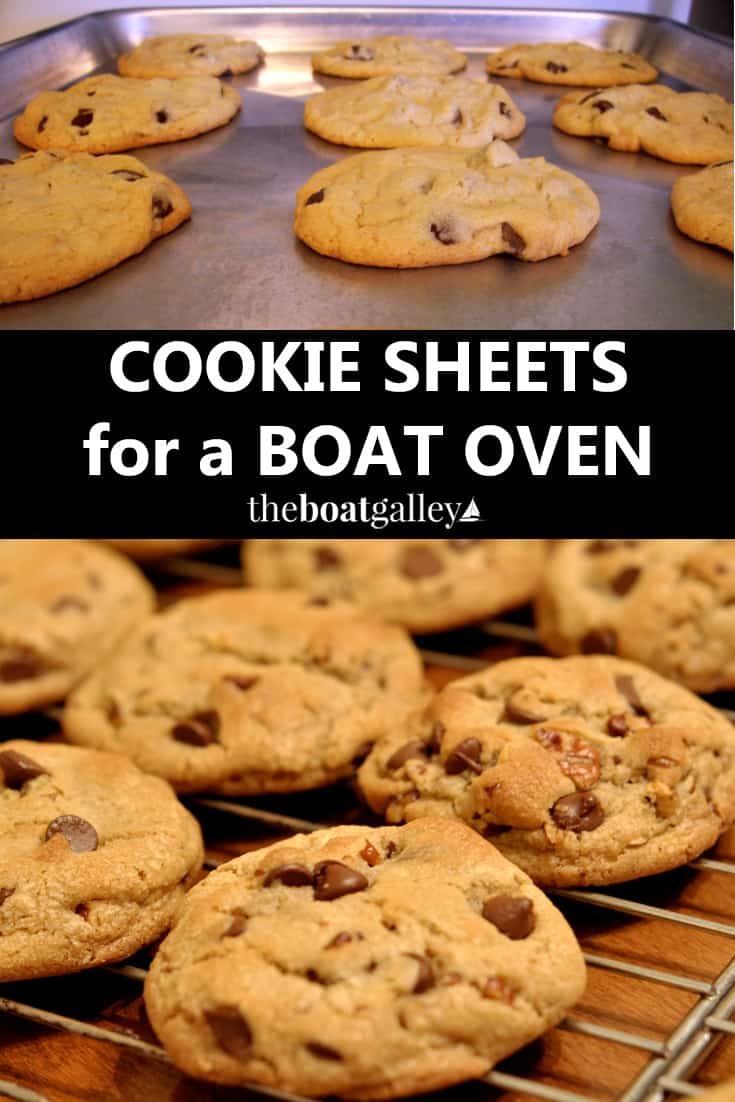
Finding cookie sheets that fit a boat oven can be tough. After all, most galley ovens are a little smaller than “shore” ovens. And thus standard-sized cookie sheets won’t fit in them. And the ones for toaster ovens are so small that they’re often not useful. So what’s a galley cook to use?
Well, you can use a sheet of aluminum foil, but that’s really a pain. That’s what I did before I found ones that would fit. But I finally found some that do work!
Before You Shop
Once again, I’ll start by saying that before you buy anything, measure YOUR oven. Any pan you get should have about an inch of airspace on all four sides for airflow. Hot spots are enough of a problem in galley ovens, and restricting the airflow will only make matters worse.
Heavy pans will do a lot to lessen hot spots as they’ll distribute the heat more evenly. That’s one reason that baking on a piece of aluminum foil generally isn’t all that satisfactory.
And yes, heavier pans are generally more expensive initially. But I found that “cheap” pans actually cost me more as I had to replace them every couple of years as they’d develop rust spots or other problems. My preference is to have fewer pans (you don’t have much room on the boat anyways!) but to have good ones.
Cookie Sheet Options
My choice are those made by Chicago Metallic — they’re good and heavy, don’t have problems with rust, come in sizes that work in most boat galleys and aren’t as expensive as some of the “premium” brands. They come in both nonstick and plain. The Chicago Metallic nonstick is very high quality and scratch-resistant, unlike many cheaper brands which also seem to lose their “nonstick” quality after a year or two.
If you’re wondering about the Baker’s Secret pans that you can find everywhere, my experience — and that of several cruising friends — is that they lose their nonstick properties in a year or two and begin having rust spots even sooner. They also have a lot of little crevices that are hard to really get clean when washing by hand — something you don’t really think about until you’re living aboard with no dishwasher.
I personally prefer a cookie sheet with sides on it — technically a jelly roll pan. I often bake bread on a cookie sheet (baguettes, braided bread) and the sides keep the dough (and egg wash when I use one) from spilling over. It’s also good for things like pizza on the boat — the motion of the boat can otherwise cause sauce and toppings to spill over a bit and the sides make this less likely (not impossible, though!). I also sometimes use the pan to contain messy kitchen projects and the sides help here, too.
My Recommendations
Depending on your personal preferences and what size pan you can use, here are my recommendations for a good “cookie sheet.”
Non-Stick Jelly Roll Pans:
- Chicago Metallic Non-Stick Small Jelly Roll Pan, 12-1/4 by 8-3/4 by 1-Inch (my choice)
- Chicago Metallic Non-Stick True Jelly Roll Pan, 14-3/4 by 9-3/4-Inch (looks similar, slightly larger)
- Chicago Metallic Commercial II Non-Stick Jelly Roll Pan, 16-3/4 by 12-Inch (even larger)
Non-Coated Jelly Roll Pans
- Chicago Metallic Commercial II Traditional Uncoated True Jelly Roll Pan, 14-3/4 by 9-3/4-Inch
- Chicago Metallic Commercial II Traditional Uncoated Large Jelly Roll Pan, 16-3/4 by 12-Inch
Non-Stick Cookie Sheets
- Chicago Metallic Non-Stick Small Cookie Sheet, 14-3/4 by 9.3-Inch
- Chicago Metallic Non-Stick Large Cookie Sheet. 15-3/4 by 13-3/4-Inch
Uncoated Cookie Sheets
I’m not recommending the Chicago Metallic ones in this category, as I can’t find anywhere that carries them in anything but a full-size, and the full size ones are too large for virtually all boat ovens — they’re more the size that a commercial bakery would use.
Further, I’ve spent several hours looking online for a uncoated cookie sheet without sides in a size that is likely to fit in boat ovens, and I simply can’t find any. Anthing that’s small enough has sides. If anyone reading this HAS found one, please leave a note and I’ll research further.
NOTE: I don’t recommend the air-insulated sheets as I don’t like the way they bake. I’ve had two different ones, and they both were re-purposed as I hated baking with them.
Toaster Oven Size
If you need an even smaller pan, you can get “toaster oven” cookie sheets that are about 7 x 10. There aren’t a lot of choices, but here is one that got good reviews (leaving aside the reviews talking about how small it is):
Hopefully this gives you a few options that will work for your galley oven.

Carolyn Shearlock has lived aboard full-time for 17 years, splitting her time between a Tayana 37 monohull and a Gemini 105 catamaran. She’s cruised over 14,000 miles, from Pacific Mexico and Central America to Florida and the Bahamas, gaining firsthand experience with the joys and challenges of life on the water.
Through The Boat Galley, Carolyn has helped thousands of people explore, prepare for, and enjoy life afloat. She shares her expertise as an instructor at Cruisers University, in leading boating publications, and through her bestselling book, The Boat Galley Cookbook. She is passionate about helping others embark on their liveaboard journey—making life on the water simpler, safer, and more enjoyable.
Carolyn Shearlock says
Since I read Gloria’s note, I have looked and looked for the small Farberware cookie sheet, and can’t find it still being sold anywhere — online or at my local Wal-mart. The one Farberware one that’s similar in size now has “oversized handles” which make it too large for most galley ovens.
Has anyone seen the smaller ones recently?
Carolyn
barb krieger says
I started to do live abord may 1st 2013 I started to collect silicone pans bake ware and muffin silicone I love them I do recommend a metal one to slide under for putting in and taking out but fit nice in my oven. I started to use silicone when I lived in the apartment. I love them
Carolyn Shearlock says
Yes, you can. But they’re hard to transfer into and out of the oven without a “real” cookie sheet under them. They aren’t stiff at all and food spills very easily!
Brim Stone says
sUe a metal pizza peel to remove the silicone pans. You can get an aluminum one with a dowel type handle and cut down both the sides and the handle to make it fit. good for moving all kinds of hot things from the oven. Like…pizza.
Carolyn Shearlock says
You really should have one inch of air space on all sides. Otherwise, the air won’t circulate and yes, hot spots will develop.
Carolyn Shearlock says
Almost anything that is microwave compatible is going to be breakable to a greater or lesser extent. I mean, a lot of ceramics are also microwave friendly, but they’re just as liable to break. On both our boats, I have had a couple of Pyrex pans and they haven’t broken. I’ve always been worried, but they’ve been okay. I think Pyrex is pretty heavy duty; I’m not sure I’d have some thinner knock-offs.
The Boat Galley says
Depends on your oven size . . .
Anonymous says
The Boat Galley True, they have smaller and less expensive sheets.
Harlene Ward says
We use an 8.5×12 aluminum sided pan made by Vollrath (Wear-Ever). Handles easily, and spill-proof.