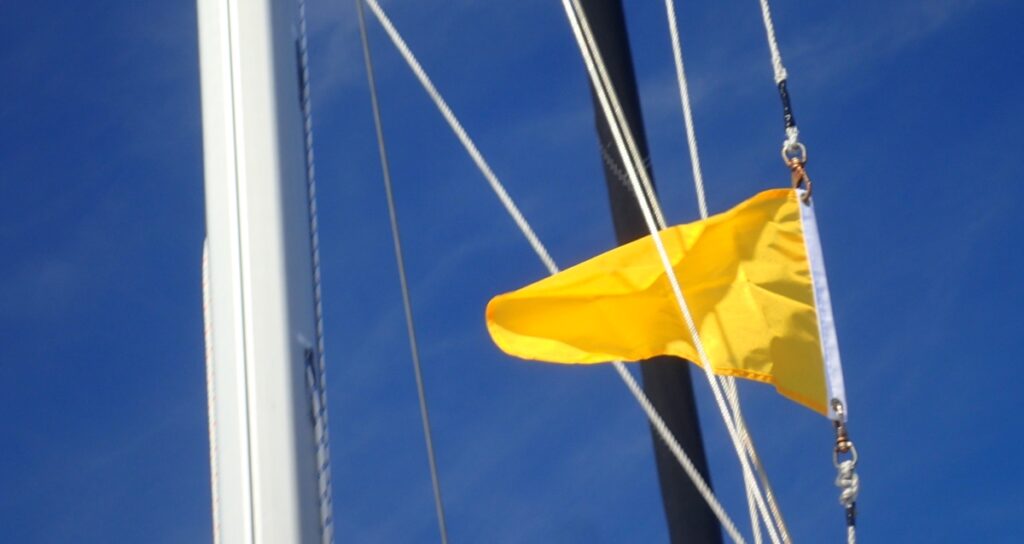
The Q flag. The symbol of a cruising dream, heading into foreign ports and adventures in new countries. Here’s what you need to know to fly yours.
What is a Q Flag?
Q stands for quarantine. In this case, a quarantine in that you’re a new arrival, not yet officially checked into the foreign country. In the boating world, it does not have anything to do with quarantining for illness.
How to Fly a Q Flag
I’ve seen several “arguments” online. Apparently authoritative sources have different interpretations about exactly when and how the Q flag should be flown. The basics are the same, but some disagree about the details.
Here’s my understanding, from going down the Pacific coast of Central America:
Hoisting the Q Flag
As you enter the territorial waters of a country, hoist the Q flag on the starboard spreader to indicate that you have not yet checked in. Some say you should fly the courtesy flag above it.
The courtesy flag is a small flag of the country you’re visiting. Most of the ones you can buy measure 12 inches x 18 inches. On a mast-less powerboat, fly the courtesy flag from the bow (in place of any burgee you might otherwise fly). It’s custom for Americans to fly their flag on a separate halyard from the courtesy and Q flags.
Checking In
Theoretically, no one can go ashore until you check in the boat with customs, immigration, and other (usually health) authorities, who come to the boat. In practice, in many places the captain or the entire crew goes ashore to check in. Even within a country, the practice may change from one place to another. The bottom line, however, is that the first place you go ashore should be a Port of Entry and the first thing you should do is check in, following whatever the local custom is. Be sure to check cruising guides and Noonsite to learn the Ports of Entry as well as local practices!
Lowering the Q Flag
After you attend to the formalities and have checked in the boat and its crew, lower the Q flag and fly the courtesy flag of the country on the starboard spreader. Nothing should be higher than the courtesy flag, and any burgees should be on the port spreader. In many countries, you will offend locals by flying ratty-looking courtesy flags. If you intend to be in a country for more than a couple of months, you may want to look into higher quality flags or carry several spares.
After Clearing Out
There is almost no guidance on what to do after clearing out of a country, while you are still in its territorial waters. We were told to fly the courtesy flag as long as we were in a country’s waters, then to change it to the Q flag of the “new” country we were now in. When you return to your home country from a foreign country, you should fly the Q flag until you are fully checked in.
Acquiring Your Q Flag
If you sew, you can make your own Q flag pretty easily. However, I discovered that since I would only be making one flag, the supplies would cost far more than buying a Q flag. West Marine’s isn’t too outrageous, but I found one for a little less on Amazon (yes, the shipping is more than the flag, but the total is still less than others I found).
P.S. I’ve always thought that a Q flag is a great boat-warming present for would-be international cruisers, showing that you believe in their dreams!
Learn Before You Go to the Bahamas
Do you dream of taking your boat to the Bahamas? Understanding how to check in is only one of the new things you need to learn. That’s why I’ve created Get Ready to Cruise the Bahamas, a course that fills you in on everything you need to know. Why learn everything on your own when you can learn ahead of time?
The cruising life is easier when we share with each other, right?


Carolyn Shearlock has lived aboard full-time for 17 years, splitting her time between a Tayana 37 monohull and a Gemini 105 catamaran. She’s cruised over 14,000 miles, from Pacific Mexico and Central America to Florida and the Bahamas, gaining firsthand experience with the joys and challenges of life on the water.
Through The Boat Galley, Carolyn has helped thousands of people explore, prepare for, and enjoy life afloat. She shares her expertise as an instructor at Cruisers University, in leading boating publications, and through her bestselling book, The Boat Galley Cookbook. She is passionate about helping others embark on their liveaboard journey—making life on the water simpler, safer, and more enjoyable.
Leave a Reply