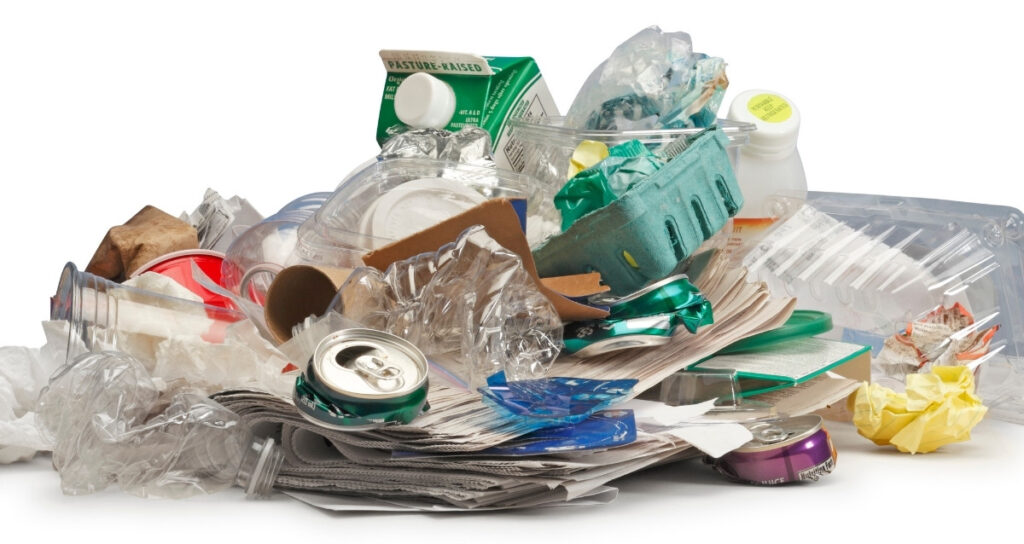
The best way to reduce trash on a boat is to keep most of it from ever coming aboard. Handle the packaging before you go, and you’ll have only a fraction of the garbage to deal with once you’re anchored out.
Trash takes over a boat faster than almost anything. There’s never much room to store it, and depending on where you’re cruising, you might go days or even weeks before you reach a place to throw it away. In truth, the recommendations below may require some tweaks for different cruising grounds. The best action, however, is always to avoid bringing more rubbish aboard than you have to.
On our very first charter, in the British Virgin Islands, the four of us were stunned at how much trash we generated in just a week. After years of cruising, from the Sea of Cortez to the Bahamas, I learned the real fix isn’t a bigger trash can. It’s a handful of habits, and they start before you ever load the boat.
My system, in four steps: set the boat up with reusables, buy less packaging at the store, strip and repackage before you head out, and give whatever is left a second life.
Step 1: Choose Reusables Over Throwaways
The first step is thinking about where you can have a reusable item instead of something that you use once and toss. Simply put, trash you never generate is the easiest kind to deal with.
Use Cloth Over Paper
Number one was using rags instead of paper towels. Paper towels eat up storage, are expensive and hard to find once you leave the US, and every sheet is more trash. A good cloth rag worked 90-95% of the time.
In the galley, I switched to cotton bar mops, sometimes sold as bar rags. I bought a pack of 24, so I always had a fresh one on hand. They’re 100% cotton and wonderfully absorbent, and I used them for everything from wiping up little spills to mopping out the fridge when I defrosted it. These are the ones I’ve bought: cotton bar mops (Amazon).
Cloth Rag Tips
A few things I learned the hard way:
- Stick to plain white 100% cotton. I don’t pay extra for microfiber or “pretty” ones because they stain, and I want to be able to bleach them. The microfiber washcloths I tried didn’t absorb nearly as well, so I gave up on them.
- Check the label. Anything with polyester in it doesn’t soak up much. I usually found the good cotton ones in the housewares aisle of big-box stores.
- Outside the US, look for cloth baby diapers and burp rags. I could never find decent cotton rags when we were cruising in Mexico, but diapers and burp rags were easy to find. They’re absorbent and made to be washed and bleached over and over.
For the engine and workshop, I skip the cheap “shop towels.” The bargain ones are loaded with polyester and do little to soak up grease or liquids. Old 100% cotton t-shirts worn through to holes, and bath towels past their prime, make far better shop rags.
Paper Towel Hacks
When I really do want a paper towel, I use only half. The US half-sheet perforated rolls aren’t available everywhere, so here’s a trick I stumbled upon: paper towels tend to tear lengthwise rather than crosswise, so let them. Start a small tear in the center of the roll, hold one side down, and tear the other side off. A perfect half sheet, every time.
Finding More Reusables
Rags are just where it started. Once you’re in the habit, you start spotting throwaways everywhere that you can swap for something you keep:
- A water filter instead of cases of bottled water. Bottles are heavy, expensive, and they make a mountain of plastic trash. We filtered our tank water and drank straight from the tap. If you’re weighing your options, read how to choose a boat water filter.
- Real dishes and cloth napkins instead of paper. This one isn’t automatic, though: some boaters use paper plates on purpose to save the water they’d otherwise spend washing dishes, so it’s a trade between trash and water. Only you know which is tighter on your boat.
- A French press, percolator, or reusable filter instead of a coffee maker that uses single-use pods. Pods are about the worst offenders there are. They’re expensive, they don’t recycle, and you’d be hauling and storing a mountain of them with nowhere to dump them.
- Silicone covers and containers instead of foil and plastic wrap. Foil and wrap take up space, can’t really be reused, and just become more trash. Read more about the reusable silicone covers I use to cover bowls and open cans.
- Rechargeable batteries for electronic gizmos, with a USB charger. Dead single-use batteries are bulky to store, you can’t always buy more where you are, and they’re hazardous waste you can’t just drop in any bin.
- A refillable-ink printer, if you keep one. Refillable tanks beat a drawer full of throwaway cartridges, and the ink tends to stay good longer, even in hot climates.
Step 2: Buy Less Packaging at the Store
The next step is at the grocery store. When I’m choosing between two versions of the same thing, I think about the packaging each one leaves me holding.
Pouches Instead of Cans and Jars.
I grab tuna and condiments in pouches whenever I can find them. They flatten to almost nothing with no effort, while a can has to be crushed and still won’t lie as flat.
Cans Over Glass, Especially Beer
Empty cans crush flat, but bottles can’t, so that’s a real space saver for beer and soda. Given the choice, I go cans first, then plastic (I can cut it up before putting it in the trash), then finally glass, which doesn’t compress and can break.
Boxed Wine Instead of Bottles
Tetra Pak or a bag-in-a-box holds the same wine in a fraction of the trash, and there’s nothing to shatter. Check out one cruiser’s suggestion for how to keep wine on board without the box.
Tetra Paks for Juice, Sauces, and “Canned” Vegetables
They flatten flat and pack square, with none of the wasted air around a round can. The catch is they can’t be burned, and few places recycle them. Whether they are worth it for you depends on your cruising grounds.
Skip Individually Packaged Products
Single-serving snacks bury you in little wrappers that don’t recycle or break down, and they blow overboard the second you turn your back.
I also learned not to trust “resealable” packaging. So many of those seals don’t hold up to repeated openings, let alone the motion of a boat. When the seal quits, I end up dumping the food into a Ziploc anyway, so the “resealable” package just became extra trash.
One more thing I started doing: I look at how easily I can strip a package down to something boat-ready without having to repackage it. Chicken breasts that come in individual vacuum-sealed pouches inside one big bag are perfect, because I toss the bag and the pouches are ready to stow. The same chicken on a foam tray means I’m repackaging each breast into a Ziploc or vacuum-seal bag (to save space in the freezer). Given the choice, I take the pouches.
Step 3: Strip and Repackage Before You Head Out
Here, the goal is to leave as much trash ashore as possible: strip what you can on shore, do any repackaging immediately when you take it aboard, and get the resulting trash into a trash can on land before you head out.
Start with the cardboard. Anything that you’ll just take out of the cardboard box to put away, take out of the cardboard box while still ashore. Same with other packaging. And remember, if something is in an inner bag, you probably don’t need it in the box as well. This helps with both trash generation and the space needed to stow the item once aboard.
Common Culprits
The following products include unnecessary cardboard.
- Cereal boxes
- Wine boxes
- Toothpaste
- OTC medicines
- Cases of drinks
Cardboard is also a favorite hiding spot for bugs and roach eggs, so leaving it ashore does double duty. I’ve got a full rundown on getting rid of cardboard if you want the specifics for things like blister packs and boxed wine.
Repackaging
Then comes the repackaging, and this part happens aboard as I stow things. I’d take the meat off its foam tray and bag it, dump a jar of peanuts into a Ziploc, and so on. The key is to do it before you leave, so the foam trays, boxes, and anything else you can’t reuse go into the trash ashore instead of riding along with you. And once the food’s eaten, that flat bag takes up far less room in your trash than the original tray or box would have.
I’ll admit that repackaging everything into Ziplocs isn’t the greenest choice in the world. The better long-term answer is to reward the companies that use less packaging in the first place. But out cruising, you sometimes make the call that works for your boat and your space. Another good option is to invest in silicone baggies (Amazon). They are expensive, but they do last.
Whatever does come on the boat, you can crush down or cut up to take up far less room, because a lot of “trash” is really just air. Read how I compact boat trash for more specifics.
Step 4: Give What’s Left a Second Life
An awful lot of “trash” can be repurposed. Those bar rags from earlier are proof: when they’re too stained for the galley, they become engine and shop rags, right alongside the worn-out t-shirts. The empty containers your provisions came in are the same story, so before something hits the trash, I ask what else it can do:
- Plastic grocery bags become liners for your wastebasket and trash can, so you’re not buying bin liners on top of everything else.
- Glass and plastic jars from peanut butter, mayo, and jelly make great airtight containers for the food scraps you do generate, which is half the battle in dealing with garbage on a boat.
- Jars and tubs also hold dry goods like rice, beans, and spices in the galley, and screws and small parts in the workshop.
- Juice bottles, with the tops cut off, become storage bins sized to a particular locker. I once bought the same brand of juice for months just to collect enough of the right size.
- A laundry soap bottle makes a good dinghy bailer. I’ve actually picked my laundry soap based on which bottle would work best for it.
- Sturdy sports-drink bottles, like the heavy 12-ounce Gatorade ones, become refillable water bottles for hikes ashore.
- Old socks cushion glass bottles and jars so they don’t break in a rolling locker, and a koozie does the same for the oil and sauce bottles you reach for often.
- Styrofoam egg cartons are worth keeping if you cruise where eggs are sold loose, which is common outside the US. Skip the cardboard ones, though, since they harbor bugs.
None of this is about being perfect. It’s a hundred small choices that add up to a boat that isn’t drowning in trash, and a lot more room for the things you want aboard.
Getting the Hang of Life Aboard?
Trash is just one of a hundred everyday things nobody really warns you about when you move onto a boat. If you’re sorting out the daily rhythm of it all, the heads, the laundry, the mail, the marina etiquette, may I suggest my course, The Basics of Living on a Boat? It walks through the ordinary realities that make the difference between feeling overwhelmed and feeling at home on the water.

Carolyn Shearlock has lived aboard full-time for 17 years, splitting her time between a Tayana 37 monohull and a Gemini 105 catamaran. She’s cruised over 14,000 miles, from Pacific Mexico and Central America to Florida and the Bahamas, gaining firsthand experience with the joys and challenges of life on the water.
Through The Boat Galley, Carolyn has helped thousands of people explore, prepare for, and enjoy life afloat. She shares her expertise as an instructor at Cruisers University, in leading boating publications, and through her bestselling book, The Boat Galley Cookbook. She is passionate about helping others embark on their liveaboard journey—making life on the water simpler, safer, and more enjoyable.
Leave a Reply