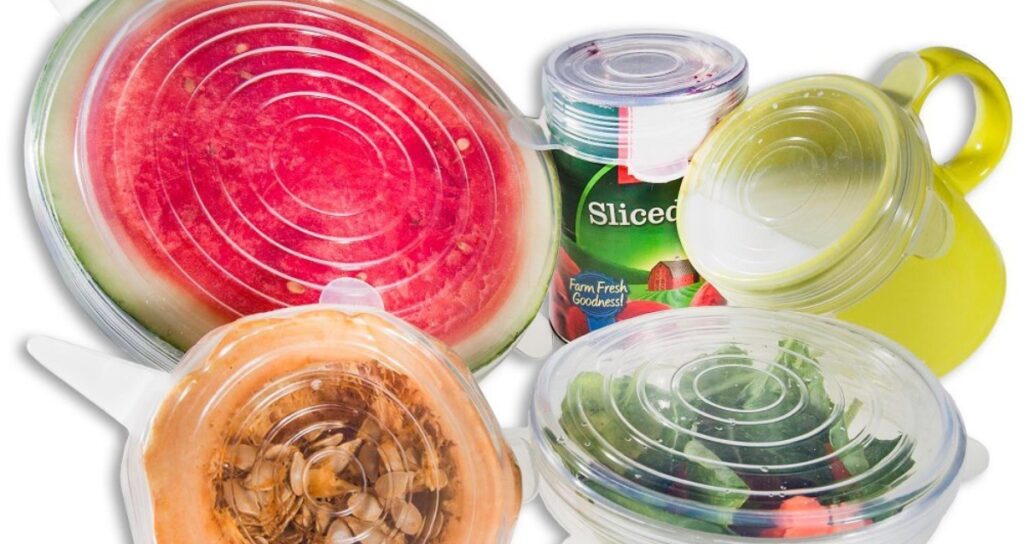
How do you cover leftovers on the boat so they stay fresh? And what’s the best cover that doesn’t add more trash to your cruising boat? We came to appreciate reusable silicone covers.
The Problem
Aluminum foil and plastic wrap both have issues. They take up too much space. And since you can’t reuse them, you generate more trash. They’re also packaged in cardboard. In foreign countries, both can be expensive, so you carry more rolls with you from places where they’re cheaper.
Yes, you can put the food into a plastic container with an airtight lid. But then you have an extra container to wash. If you’re trying to conserve water, that’s a problem.
OOr you can put the original container inside a Ziploc. But it doesn’t always fit. If you want to reuse the Ziploc, you have to wash it. And if you don’t reuse it, it’s no better than using aluminum foil or plastic wrap.
Here’s a solution we loved.
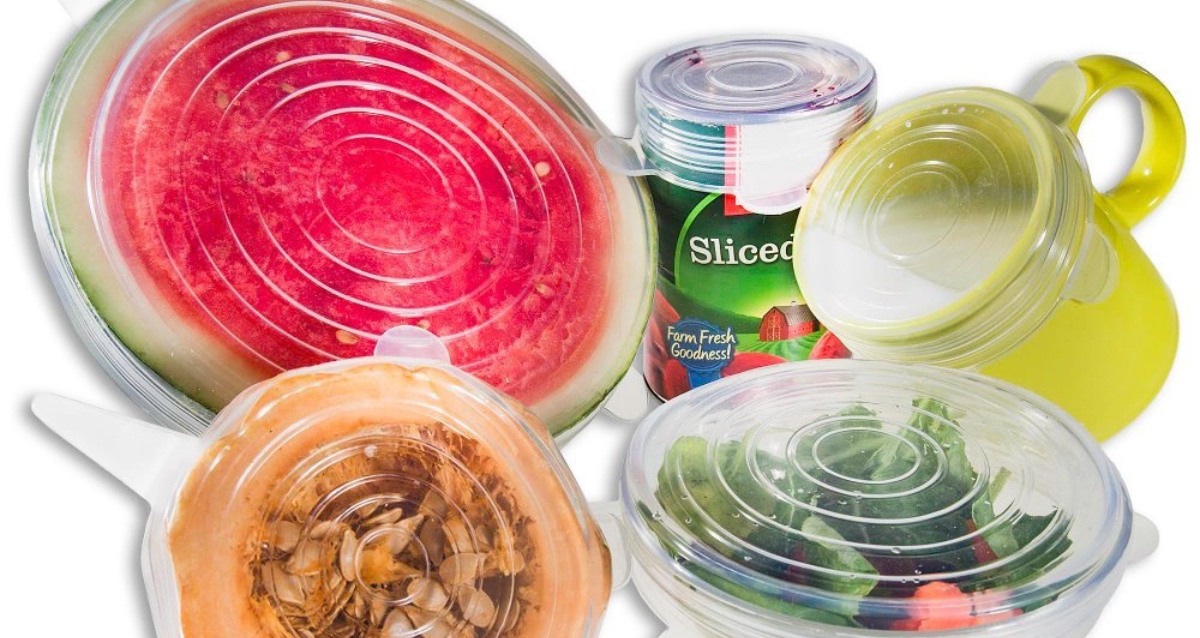
The Solution: Silicone Covers
I picked up a package of these reusable silicone covers at the Annapolis Boat Show. I also misplaced them when I got back to the boat, so I ordered another set (different brand) from Amazon and then promptly found the first set.
While they haven’t totally replaced aluminum foil and plastic leftovers containers, we cut down their use by about 90%.
The silicone covers are round and very stretchy, so they’ll fit on either round or square containers. They don’t work very well on rectangular pans. That’s where I still have to use foil or plastic wrap.
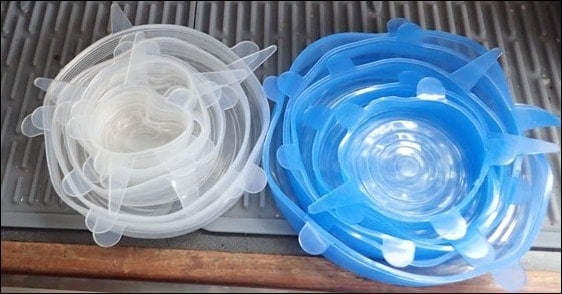
How to Use Reusable Silicone Covers
For a round container, choose one that’s a little smaller than the diameter of the can or bowl and stretch it over the top. For square containers, choose one nearly the same diameter as the width of the pan. Put it over two corners and stretch to fit over the other two. Because they stretch to fit, these covers do not work well on disposable foil pans. They bend and collapse as you try to stretch the lid.
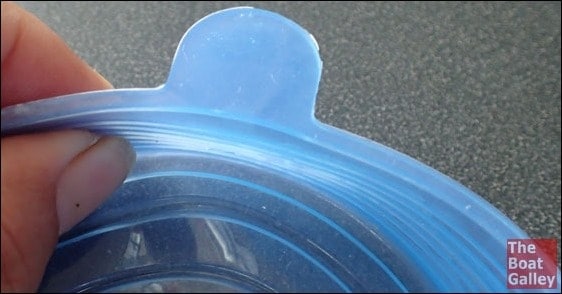
To get the best seal, wipe off the top and outer edge of the container. I usually don’t bother to, unless the cover just isn’t staying on. The only other “trick” is to make sure that it’s right side out. The two sides look very similar, and it’s easy to get it inside out. A close look or running your finger over the surface reveals which way it really folds. Ribs on the inside help it stay in place. If the cover slides off, it’s usually because you’re putting it on inside out.
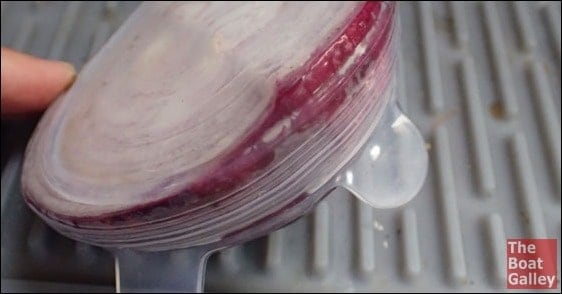
You can also use them to cover hard fruits and vegetables that have a cut surface. I’ve used them on both onions and oranges. Don’t use them on soft foods that will bruise easily, such as apples or avocados.
They wash up easily by hand – far easier than trying to get gunk out of the corners of Ziplocs to reuse them.
What Covers Work Best?
Okay, so what set to buy? I found that I used the small covers far more than the large ones, and I often needed several at the same time. So a set that has multiple small ones is a plus for me. The two sets I had looked identical except for one being clear and one being blue; the clear one is actually a stretchier silicone (seems to be slightly thinner) and is therefore easier to use.
The original set I bought on Amazon is no longer available, but I bought this set as a gift for a friend, and it seems to be just as good.
NOTE: The blue set that I got were “Kitchen+Home” brand. There was nothing wrong with them. I just found the clear, thinner ones easier to put on. See the blue silicone covers on Amazon.
Other Cruisers Recommend
Some of my favorite ideas have come from other cruisers. While several have shared that they also like silicone reusable covers, a few have suggested some other reusable options. Pamela H. likes Bee’s Wrap (Amazon), a reusable cover coated with beeswax. And Jennifer L. suggests Food Huggers (Amazon) for keeping cut fruits and vegetables fresh.
Whichever method you prefer, I hope you’ve found some good options here for keeping leftovers without loading up your boat with stuff or generating more trash.

Carolyn Shearlock has lived aboard full-time for 17 years, splitting her time between a Tayana 37 monohull and a Gemini 105 catamaran. She’s cruised over 14,000 miles, from Pacific Mexico and Central America to Florida and the Bahamas, gaining firsthand experience with the joys and challenges of life on the water.
Through The Boat Galley, Carolyn has helped thousands of people explore, prepare for, and enjoy life afloat. She shares her expertise as an instructor at Cruisers University, in leading boating publications, and through her bestselling book, The Boat Galley Cookbook. She is passionate about helping others embark on their liveaboard journey—making life on the water simpler, safer, and more enjoyable.
Leave a Reply