When you’re dropping the anchor, you want to know how much rode you’re putting out to determine if you’ve got enough scope. To know that, you have to mark your anchor chain.
People have come up with all sorts of systems for marking chain (or rope). The most popular two are using cable ties or paint. You can also buy colorful plastic pieces that fit into links in the chain on Amazon.
Color Coding
With any system to mark anchor chain, you come up with a color scheme (in the US, red-white-blue is popular) and a distance apart for the markings. On our previous boat, 300 feet of chain was marked every 50 feet.
- First red = 50 feet
- First white = 100
- First blue = 150
- Second red = 200
- Second white = 250
- Second blue = 300
Ways to Mark Anchor Chain
The problem with cable ties is that they get chewed up by the windlass and the bottom, and fall off over time. You can put on multiples so that there will still be another one there for you to see, but that ignores the other problem with cable ties: all those bits of broken plastic in the water. The plastic pieces that snap into chain links are better, but still can pop out and end up as plastic trash in the water.
Individually, they’re not large. But added to the rest of the plastic trash in the oceans? No thanks. I hope others will move away from using cable ties (or other plastic markers) and switch to paint.
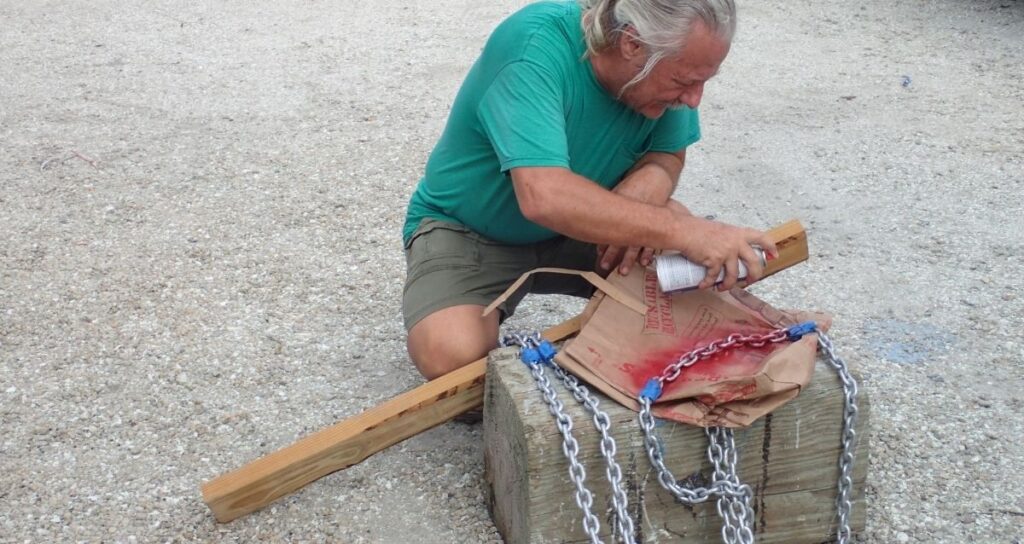
How to Paint Galvanized Anchor Chain
To paint the chain, start by laying it out and determining where you’re going to paint. It’s usually easiest to zig-zag it back and forth at whatever interval you’ve decided upon. A bit of painter’s tape marking off a two foot length will help you mark the chain accurately.
Be careful if you’re doing this job on the dock. The last thing you need is to lose slippery chain in the water.
Tips From Fellow Boaters
Cruisers have no end of opinions about anchoring tackle, marking chain included. We got a great tip from a fellow cruiser.
Paint will appear to adhere to galvanizing when first applied, but actually flakes off easily. Our friend Greg Delezynski told us the secret to getting it to adhere well: vinegar! The vinegar will etch the galvanizing so that paint can adhere. Just pour it over the sections of chain that you intend to paint and let dry, then paint. Greg uses either white or cider vinegar.

Greg’s other tip is to use yellow paint for the “white” in the red-white-blue color scheme. White can be hard to spot if you have new galvanized chain — it will blend right in with the galvanizing. Yellow shows up much better.
Steven W. shares that when he bought his boat, the previous owners had used cloth ties with lengths printed on them. They won’t last long, but they are another option. Jim S. suggests making your own “flags” out of nylon webbing recycled from old lift jackets or cockpit cushions. The nylon is, he claims, tough enough to go through the windlass without harm. Steve B. also likes nylon webbing, but he uses 3/4″ wide rolls in a variety of colors. He sewed them on with whipping twine and a needle. He claims they look good after two seasons of use.
Dave S. prefers wire ties. He suggests that if you apply them between the links instead of around the outside of the link, they won’t get chewed up in the windlass.
We were always happy with the paint job we did. If you try it, I hope these tips give you good success.
Learn More
Marking your anchoring chain and actually anchoring are just a couple of the many everyday skills that come with living on a boat. If you want a clear, practical overview of what boat life actually involves day to day as well as step-by-step instructions for all the unfamiliar tasks, our on-demand online course The Basics of Living on a Boat walks through the things most people don’t even realize they need to know.


Carolyn Shearlock has lived aboard full-time for 17 years, splitting her time between a Tayana 37 monohull and a Gemini 105 catamaran. She’s cruised over 14,000 miles, from Pacific Mexico and Central America to Florida and the Bahamas, gaining firsthand experience with the joys and challenges of life on the water.
Through The Boat Galley, Carolyn has helped thousands of people explore, prepare for, and enjoy life afloat. She shares her expertise as an instructor at Cruisers University, in leading boating publications, and through her bestselling book, The Boat Galley Cookbook. She is passionate about helping others embark on their liveaboard journey—making life on the water simpler, safer, and more enjoyable.
Carolyn Shearlock says
Any exterior spray paint works well. A foot or two is usually sufficient.
little latitudes says
Thank you, Carolyn 🙂
Dennis Fria says
My wash down pump inspires I never bring stinky bottom mud inside MY boat!
Gord Wedman says
I sprayed 5 feet on either side of the actual measurement point. It has held up well these past 5 years. My chain was new when I painted it and I do not recall cleaning it in any way.
A friend just uses lengths of old spinnaker cloth tied onto links.
Donald Rushton says
Primer paint for galvanized metal is yellow. Combined with the vinegar etching it should stick well. .I don’t know its durability in underwater, but I’m going to try it this year.
Steve B says
I also use nylon webbing. i some 3/4″ wide rolls in a variety of colors from a different project and just sewed them on with a few stitches of whipping twine and a needle. I went faster than I thought and they are still looking good after 2 seasons.