

Cabbage lasts longer without refrigeration than almost any other fresh vegetable. A head that was never refrigerated almost always keeps a month to six weeks at room temperature, and one from the grocery store’s cooler can last over a month, though you should count on three weeks.
That makes it one of the most valuable vegetables you can have on a boat, at a campsite, or anywhere your fridge is tiny or missing. In 17 years of living aboard, cabbage was a constant in our provisioning. When we’d been away from a store for a few weeks, it was often the last fresh vegetable we had.
How to Store Cabbage Without Refrigeration
The less you do, the better.
Keep the head whole and unwashed, and put it somewhere with good airflow where it won’t get bumped or crushed: a hanging veggie bin, a basket, or any ventilated spot. Some people wrap each head in newspaper or an old t-shirt to protect it from bruising. I never found that necessary.
Don’t put it in a plastic bag. Plastic traps moisture, and moisture is what makes cabbage mold and rot. If you’ve ever had cabbage turn slimy, trapped moisture was almost certainly the reason.
Leave the outer leaves on until you’re ready to use the head. They’ll get dry, tired, or a little spotty, and that’s fine: they’re protecting the leaves underneath. If you peel them off early, the next layer starts to go, then the next, until there’s not much left.
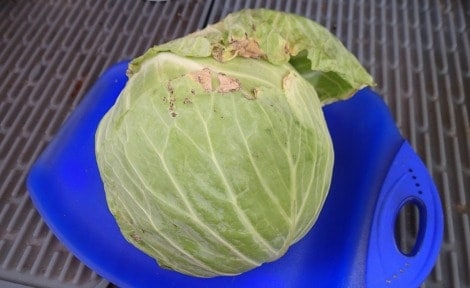
Cabbage that has never been refrigerated (from a farmer’s market or produce stand) is ideal, because no condensation forms on it as it warms up. But most of the time I bought mine at a grocery store, straight from the cooler. I just put it in the open, let any surface moisture dry off, and left it alone. The head in this photo was store-bought and kept without refrigeration for just over a month.
How Long Does Cabbage Last Without Refrigeration?
- Never refrigerated: almost always a month to six weeks
- Store-bought, from the cooler: count on three weeks, though it can last over a month
A cooler, darker spot makes it last longer. That’s longer than almost any other fresh vegetable; here’s how long others last without a fridge.
Once it’s cut, cabbage still keeps out of the fridge. When you go back to it, trim a thin slice off the cut face if it has browned, and use the rest.
What to Watch For
Check your cabbage every few days. Dry or spotty outer leaves are normal: leave them on, and when you’re ready to use the head, peel them off and the cabbage inside will be fine.
What you don’t want to see is soft spots or sliminess. That means moisture got in. Cut out the bad part right away and use the rest soon.
Why Cabbage Earns Its Space
By the third week of a passage or a remote stretch, most fresh produce is gone and meals lean on canned and dry foods. Cabbage fills the gap.
- It’s real nutrition. One serving has about 54% of your daily vitamin C and 85% of your vitamin K, plus fiber, with very few calories.
- It’s your salad. Lettuce barely keeps without a fridge, so cabbage takes its place: slaws, shredded into tacos and wraps, or tossed with whatever else you have.
- It brings back crunch. When everything else is soft, a little raw cabbage, or a quick sauté next to canned meat, makes a meal feel fresh again. It’s one of the vegetables to build around when you’re planning meals without refrigeration.
If it goes limp, soak it in water for 20 minutes to an hour and it’ll crisp right back up. Chopping it first speeds that up, though whole leaves are easier to dry afterward.
No Fridge, or Not Enough Fridge?
Whether you’re cruising with no refrigerator at all or a small one that can’t hold everything, cabbage is just one of the foods you can keep without it. My book, Storing Food Without Refrigeration, covers hundreds of them, including fruit, vegetables, eggs, cheese, meat, and condiments. It tells you how to choose them, how to store them, and how long they’ll last, so you can save your fridge space for what truly needs it.
From The Boat Galley Store
Storing Food Without Refrigeration
Confidently store fresh food and cook real meals without a refrigerator
- Store fruits, vegetables, cheese, eggs, meat, and more so they stay fresh and usable without refrigeration
- Choose foods and quantities with confidence: no more guessing what will spoil first
- Get 60+ meal ideas plus a 4-day sample plan you can follow step by step
- Stop depending on ice, constant grocery runs, or a bigger fridge to eat well
Paperback also available on Amazon
Do you have other questions we could help you with?
The real picture
Budget, health, age, family
How to make it happen
Help for tough times
Keep reading


Carolyn Shearlock lived aboard full-time for 17 years, splitting her time between a Tayana 37 monohull and a Gemini 105 catamaran. She’s cruised over 14,000 miles, from Pacific Mexico and Central America to Florida and the Bahamas, gaining firsthand experience with the joys and challenges of life on the water.
Through The Boat Galley, Carolyn has helped thousands of people explore, prepare for, and enjoy life afloat. She shares her expertise as an instructor at Cruisers University, in leading boating publications, and through her bestselling book, The Boat Galley Cookbook. She is passionate about helping others embark on their liveaboard journey, making life on the water simpler, safer, and more enjoyable.
Some links in this article (including all Amazon links) are affiliate links, meaning that we earn from qualifying purchases.