Wondering whether your dog (or one you’re considering getting) will enjoy life on a boat? The honest answer is: probably yes. Most dogs take to boat life surprisingly well. The constant company, new anchorages, and endless interesting smells suit them.
But it takes real planning: training before you cast off, a safety setup for underway, and an honest look at how a dog will shape your cruising.
We adopted our dog Paz in Mexico and cruised with her through Central America, then later through Florida and the Bahamas. She spent 10 years living full-time aboard with us and was one of the best decisions we ever made. She also changed our cruising in ways we hadn’t fully anticipated. Here’s what to know going in.
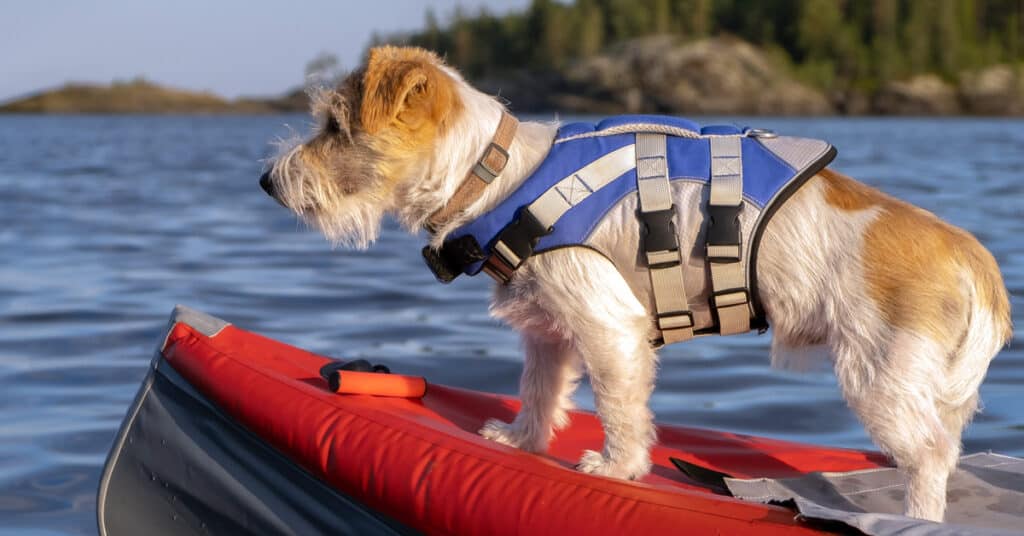
![Happy dog looking out over the water from the deck of a cruising boat]](https://theboatgalley.com/wp-content/uploads/boat-dog-1-1024x427.jpg)
Can Any Dog Live on a Boat?
Most dogs adapt well, but a few things matter.
Energy level. High-energy dogs can struggle if they can’t get ashore often enough to burn off steam. A dog that needs two hours of hard running every day will be frustrated living at anchor. A calmer dog, or one content with shorter bursts of activity, settles into boat life much more easily.
Age and adaptability. Puppies are usually the easiest. They learn that boat life is simply normal life. Older dogs can make the transition too, especially if they’re already calm and good on their feet. An agile, surefooted dog takes to a moving platform more naturally than one that isn’t.
Breed restrictions. Some countries restrict certain breeds at the border. More on that below.
Small Dogs vs. Large Dogs on Boats
Small dogs are easier on a boat. That’s the honest truth. Plenty of people cruise with large dogs and make it work beautifully, but if you’re still deciding, the size difference has real practical consequences.
A dog you can tuck under one arm is far easier to hand into a dinghy, lift over a bridge deck, or carry down a 10-foot boatyard ladder. A small dog that can’t climb the companionway on its own stays safely below during docking and anchoring, so you’re not trying to manage the dog at exactly the moment you have the most going on.
Small dogs are also generally more willing to eliminate on the boat and train more quickly for it. Larger dogs take more patience, and some never fully adapt. That matters a lot when you’re planning a passage of any length.
A small dog that’s having a bad day can do less damage than a large one. It’s worth noting, though, that boat dogs rarely have bad days. Their people are around almost all the time, and boredom and destruction tend to happen when dogs are left alone for hours, which cruising life mostly prevents.
Small dogs also need less food storage, less water, and less space aboard.
If you’re actively cruising, land travel is much easier with a small dog. Depending on the country, you may be able to take a small dog on buses and trains. Motels are far more likely to allow them. If you need someone to watch the dog, it’s generally easier to find someone willing to take in a small one. And if you ever have to fly with your dog, one small enough to ride in the passenger cabin is simpler and cheaper than one that has to go in cargo.
If you already have a large dog and are committed to making it work, it absolutely can. See Cruising with a Large Dog for tips specific to bigger dogs.
How a Dog Will Change Your Cruising
A boat dog will shape your plans in ways worth thinking through before you commit.
Going ashore. You cannot leave your dog in a closed boat in hot weather. In tropical anchorages, if there is any threat of rain or you are in an area where security is a concern, you may not be able to leave hatches open. A dog cannot safely stay in a closed, hot boat.
That means someone stays with the dog, or you find dog-friendly places to go ashore together. It is a real constraint, and in some anchorages it comes up often.
Breed restrictions. More and more countries restrict certain breeds at the border. Pitbull mixes are the most commonly affected, but any breed with a reputation for aggression can face problems. Your dog may be the sweetest animal in the world, but breed restrictions are a fact of life for boat dogs. Regulations change constantly, so check before you go and don’t assume your dog will simply be waved through.
International paperwork. If you plan to cruise internationally, a dog adds a layer of logistics at every border. Each country has its own requirements: a veterinary health certificate, entry fees, specific forms, and procedures that vary by destination and change without notice. It is manageable, but it takes advance planning at every stop.
Australia, New Zealand, and the South Pacific. If these destinations are in your cruising plans, be aware now: bringing a dog is extremely difficult, often effectively impossible, and always very expensive. It is not just paperwork. Plan accordingly, or plan to leave the dog behind.
The good news. In most popular cruising grounds, dogs are genuinely welcome. Mexico, Central America, the Caribbean, the Bahamas, and the US East Coast and Gulf Coast all offer dog-friendly outdoor restaurants, cruiser gatherings, beach walks, and warm local encounters. We never had a problem at a marina, though a few marinas do have restrictions, so it’s worth checking ahead.
Europe is wonderful for dogs day-to-day once you arrive, though getting a dog into Europe from the US requires significant advance planning on vaccinations, health certificates, and timing.
It may not be entirely fair, but a friendly, well-behaved dog will be allowed more places than one that isn’t. Paz was known as a chick magnet, and we even had guys want to rent her for an hour just to meet girls on the beach. A dog like that opens doors everywhere.
Keeping Your Dog Safe on a Boat
Safety at sea is different from safety on land, and a little planning before you leave the dock makes a big difference.
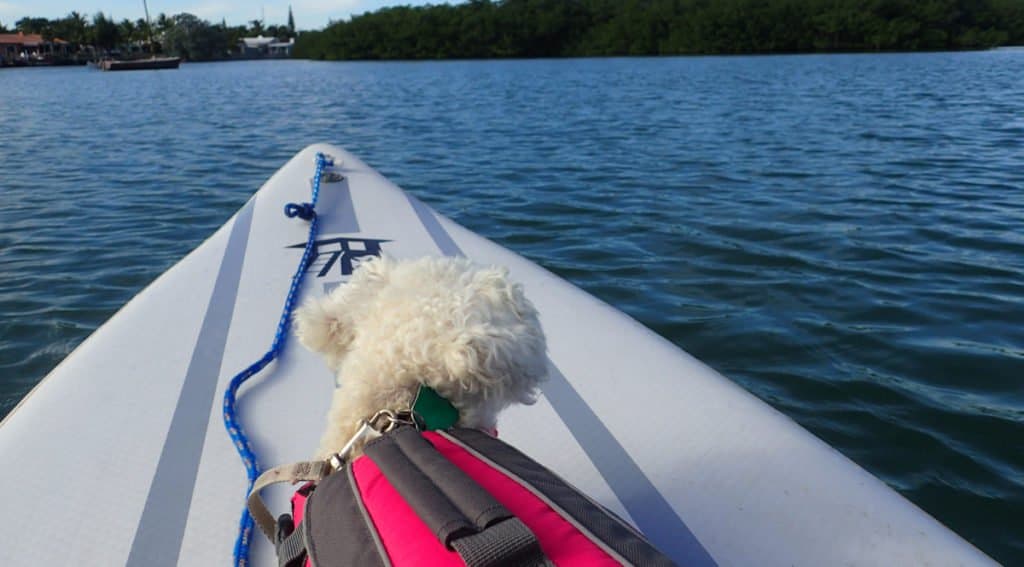
Use a harness, not a collar. This is the single most important safety rule for dogs on boats. If your dog slips on deck or slides while tethered, a collar can injure or kill them. A harness distributes the load safely across their body. Always.
Keep them tethered underway. Do not rely on lifeline netting to keep your dog aboard. Netting has gaps, and dogs find them. When underway, tether your dog to a jackline or keep them below.
Plan the recovery before you need it. If your dog goes overboard, how will you get them back aboard? Work this out before you leave the dock, not during an emergency. For a small dog, a simple lift may work. For a larger dog, you may need a dedicated boarding ladder, a sling, or another system. Know your plan and make sure everyone aboard knows it too.
Create a safe place below for rough weather. When conditions get boisterous, your dog needs a spot where they feel secure and where nothing can fall on them. A puppy trainer for guide dogs once told us to get Paz playing games when thunder or rough weather made her nervous. It worked beautifully. She never became fearful of thunder, fireworks, or the diesel, and having a calm familiar place aboard kept her settled when conditions were uncomfortable.
Practical Matters for Boat Dogs
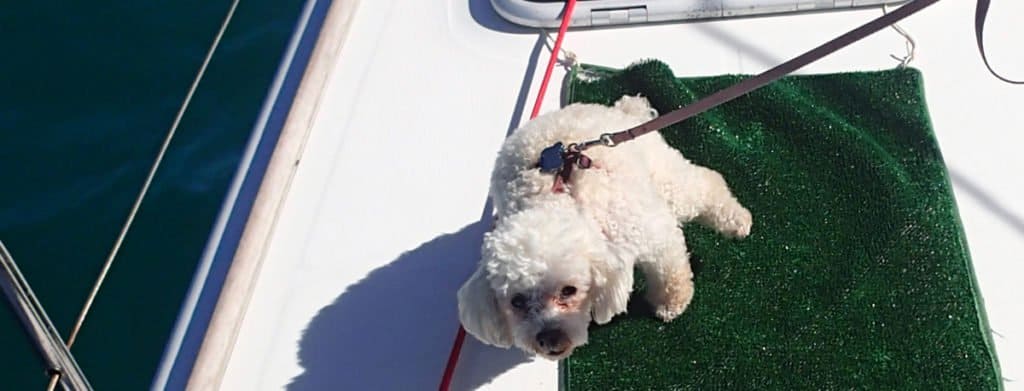
Potty training. Training your dog to eliminate on the boat is one of the most valuable things you can do before any longer trip. Almost every boat with a dog has a piece of carpet or artificial turf on the bow as the designated spot.
Once trained, your dog can go longer stretches without needing a stop ashore at all. And when you are at anchor, you won’t be taking them to the beach at 3 AM or in the pouring rain.
Small dogs generally take to this more readily than large ones. For the full how-to, see Train Your Dog to Pee on the Boat.
Vets. You will find vets in most cruising areas, but sometimes only with a detour or a long taxi ride. Stock a basic canine first aid kit and ask your vet before you leave about medications worth keeping aboard for common issues.
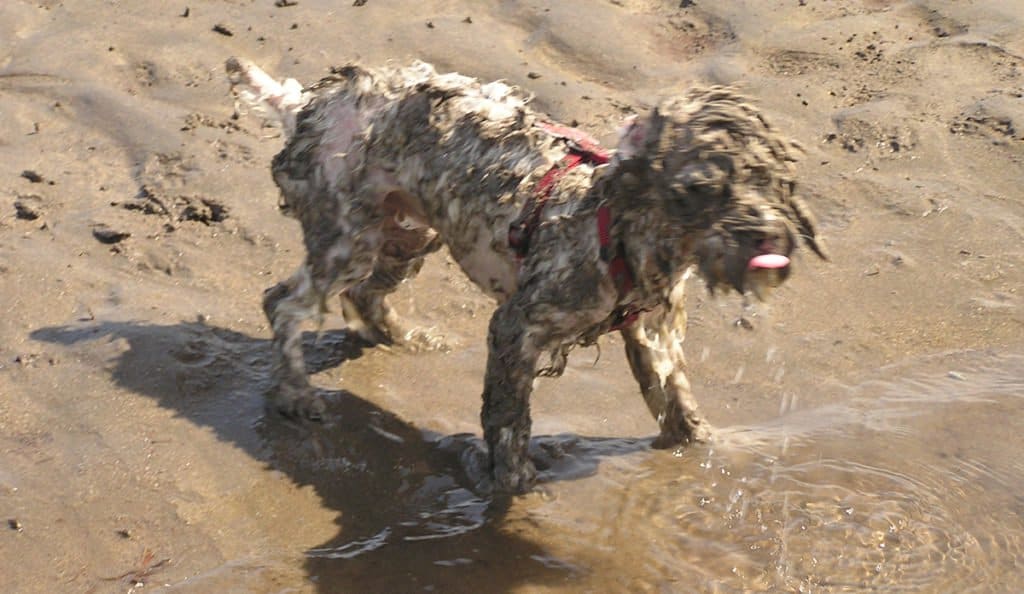
Saltwater and sand. Give your dog a quick freshwater rinse after every swim in saltwater. Otherwise the salt ends up on your cushions and in your bedding, and it never fully dries out. Budget enough fresh water to make this routine.
And do not be surprised when your dog discovers the joy of rolling in beach sand immediately after a rinse.
Feeding. Put a non-slip mat under your dog’s bowl. On a sailboat that heels, or any time there is chop, it makes a real difference.
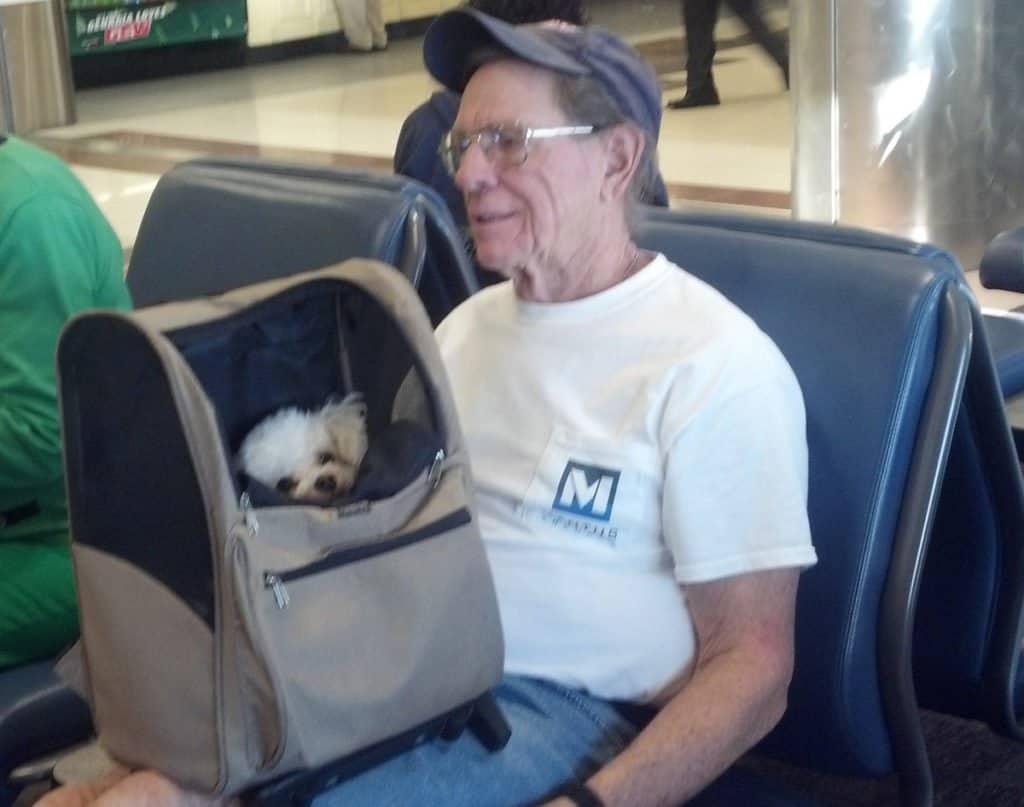
Flying. If there is any chance you will need to fly home with your dog, bring an airline-approved carrier from home. They can be nearly impossible to find in some cruising areas. We spent a frantic afternoon in El Salvador trying to track one down.
Is a Boat Dog Right for You?
Paz spent 10 years living aboard with us, cruising from Mexico through Central America and later through Florida and the Bahamas. She was worth every complication. But there were real complications, and going in with open eyes made all the difference.
The number of boats with dogs aboard keeps growing every year. Most boat dogs are genuinely happy dogs: constant company, new adventures, and a life that would make any land-bound dog envious.
The key is going in with a plan, not just enthusiasm.
Want to Go Deeper?
This article gives you the overview. Our course Boating With Your Dog covers everything in depth: training before you cast off, health care underway, making the boat truly dog-friendly, international entry requirements for cruising with a dog, and choosing the right dog if you are still deciding. Everything in one place, so you are not piecing it together from dozens of articles.

Carolyn Shearlock has lived aboard full-time for 17 years, splitting her time between a Tayana 37 monohull and a Gemini 105 catamaran. She’s cruised over 14,000 miles, from Pacific Mexico and Central America to Florida and the Bahamas, gaining firsthand experience with the joys and challenges of life on the water.
Through The Boat Galley, Carolyn has helped thousands of people explore, prepare for, and enjoy life afloat. She shares her expertise as an instructor at Cruisers University, in leading boating publications, and through her bestselling book, The Boat Galley Cookbook. She is passionate about helping others embark on their liveaboard journey—making life on the water simpler, safer, and more enjoyable.
Michelle Beatty on Facebook says
think you so much for this..xo
John Ahern on Facebook says
I have a black lab and have made the decision not to cruise with my buddy and that choice was tougher than selecting a boat…..
The Boat Galley on Facebook says
Oh John, that would be a tough choice. But sometimes the best one, unfortunately.
Michelle Beatty on Facebook says
Hmmmm i am taking my Ridgeback…he is my water baby!! loves the water!!
Shirlee Smith on Facebook says
We took our 9-year-old mini dachshund on our 5-year cruise. In the beginning, she could jump out of the cockpit, so we added netting to catch her if she went sliding out of control. Largely because of her, we went to Europe instead of the South Pacific, and we did skip the UK because we couldn’t bring her in on our own boat. She adjusted fine, we enjoyed having her with us, and she liked having us full time.
The Boat Galley on Facebook says
Amazing the things we do for “family” 🙂
John Forsyth on Facebook says
We hear conflicting reports about whether or not there are dangerous snakes ( eg. Rattlesnakes ) on the Baja peninsula. As we will be taking our dog ashore often, this is a concern. What has been your experience along the anchorage beaches on the Baja ??
Christine says
There is a dude that does de-snaking classes for dogs. I think he is in Texas? I would look him up. Maybe he has some online content that can help you train your pup. If not, contacting him and explaining your situation may get you some ideas.
The Boat Galley on Facebook says
I never heard of anyone running into one. That’s not to say there aren’t any, though — just that I never heard of any dog or person encountering one. The bigger problem is coyotes, which are around many beaches. Most cruisers kept dogs on leashes or if they let them go off leash, had them trained to stay fairly close. We hiked all over in Baja with Paz (we kept her on leash except right on the beach) and the only problem we had was once she got a few fire ant bites. Be sure to take lots of water and give it to them often!
Leigh says
We started cruising with a 60-pound Border Collie (Skyler) and a 12-pound mutt (Pepper). We thought for a LONG time about whether or not we would bring Skyler with us before deciding we didn’t want to delay the start of our cruise and couldn’t give her away. We lost her to a brain tumor about two months ago, but are so glad she got to share in a bit of our adventure with us. However, I must admit that life is MUCH easier with just our little dog aboard. For one thing, we marvel how long the dog food lasts! It is also much easier to lift Pepper up and down the companionway, on and off the boat, and to have her in the cockpit while underway etc. than it was to manhandle Skyler. We miss her terribly and definitely wish she was still with us. But if we do get another dog, it will probably be a little one.
Diane Sullivan says
We had thought about the idea of having an animal aboard with us, a dog or cat, but decided we want to simply sail by ourselves for awhile. We had two dogs, who have since passed on, that we adored. However, they took a lot of extra energy, money, planning time for vacations without them, etc. Loved them to pieces and still miss them terribly. Now is time for us. (Our granddaughter suggested getting a fish, or a hamster. haha)
Nikki says
We just became the proud owners of a 67 Chris Craft Cavalier and are looking forward to weekend trips in the San Jaun Islands with our 28 lb puggle, Cooper. Thank you so much for the great insight and advice on dogs on boats and doggy potty training on the boat!
Carolyn Shearlock says
You and Cooper are going to love it!! San Juans sound great, too!
Laura says
We have a 54 pound pit bull living with us. I’m a huge dog lover so I’m okay with limitations due to having a dog on board. However, this is not for everyone! We had no problems cruising the Bahamas with him but we also know we will never go to the BVI (and many other ports) because of restrictions. Our worst experience was the Chesapeake during a hotter than hell summer and we couldn’t leave him locked down below in the heat. And thanks to the good old USA laws, there were very few places on shore that would allow a dog (even parks!!), so my husband would usually go ashore for supplies and I’d stay (and sweat) with Wilbur. We sometimes questioned our selves as to whether we were being fair to him but in the end I’m glad we have him along with us. He’s our family!
Barbara says
I’d love to know the destinations you were able to go with your pit. We have one and are soon planning to be liveaboards. We would love to know where we can travel with her. Are places with banned breeds slowed to enter the country as long as they stay on board?
Carolyn Shearlock says
Generally, banned breeds are not allowed into the country, period. I know that’s unfortunate for you, but better to know before you get refused entry somewhere.
Pamela Shubert says
Had to share this one for Lia Noland!
Lia Noland says
Smart! Thanks Pam!
Lisa Novak says
This is our third year sailing the Sea of Cortez with Sparky the Salty Dog. Having him onboard has forced us to make two trips to shore daily. We have not regretted one of them. Keeping up his portion of our website with his views can be challenging at times. Soon he will have his underwater doggy cam posted. Sparky is 13 now and we have taken him to the vet just about every three months down here. There are a lot of “bugs” they sniff that can make the belly not feel so well. Sparky is work but always a joy to have.
Kalan Harvey says
My dog Odie is loving being a “boat” dog! 🙂 Awesome article!
Monika Ludewig Bradley says
Got a sheltie onboard at 12 weeks. She adapted quickly, knows what “boating” means and is still pee pad trained at four years old. We never have to row to shore, just drop a peepad on the floor of the head and tell her to go. Awesome.
Paulette says
Our 9 year old lab beagle loves to go with us on the boat, until we start moving. She pants and really never relaxes. We are going on a 10 day trip next month – wiTh Gracie. This time I am bringing Rescue Remedy drops and Rescue Remedy collar as well as home made dog ginepfer treats. (We tried Benadryl and vet prescribed Xanax without much changeh. Hopefully, this will help her settle in because she wants to be with us and we want her as well. Also, we have never been able to get her to potty on the boat so we make stops and never sleep on the hook. I have tried wee wee pds and the fake grass. Friends’ dogs have gone on it and i have slud it under her to go on it while in land. Both my husband and I have gone on it and still she hasn’t given herelf permission to go on it. Any ideas would be appreciated.
Paulette says
That is supposed tomsay ginger treats.
Paulette says
Oh my gosh I am so sorry for the stupid typos in this message. Sometimes it gets downright comical.
Carolyn Shearlock says
Some of the panting may be that it’s hot. I know that we have to close hatches, which makes it hotter where Paz likes to sit. So we make sure to turn a couple of fans on for her, and I’ve gone so far as to make a couple of ice cubes and let her lick them.
Another big tip that some friends — puppy trainers for service dogs — gave us was whenever we’d do something that we knew made Paz nervous, not to coddle her then but to start playing with her. The diesel starting up, thunder, fireworks . . . I won’t say any of these are her favorite now, but she stays calm and goes to her safe place.
On — and that’s another important one. Make sure that there are a couple of “safe places” on the boat for your dog. Where nothing can fall on her, slide into her, or anything else. Paz likes a corner where she can really wedge herself in (on our previous boat, she’d lie on top of and semi-under the dirty laundry bag).
As far as going potty, you may just have to wait her out and then praise lavishly. We didn’t have a lot of problems teaching Paz to go on the boat (and even after living ashore for 5 years, she remembered exactly what to do when we were back on a boat), but some other readers did and in the comments on my “Potty Training” article you’ll find a number of things that worked for them: https://theboatgalley.com/training-dog-boat-dog/
Good luck!
Maryalice Falconer says
Thank you for this article!! I do have one question….
What documentation do we need to bring our dog sailing with us into Mexico? I know I have to have my vet fill out an International Health Certificate (APHIS form 7001), but it looks like it is only good for ten days. If we plan to stay in Mexico for 6 months, what do we do beyond the 10 days? Will the dog need a dog passport? 🙂
Thank you so much for your thoughts.
Maryalice
Carolyn Shearlock says
You just need the Health Certificate and proof of rabies shot. Once the dog is in, nothing further is needed — the 10 days is just for the initial entry. No dog passport. We always had all the docs for Paz, but were never asked when we crossed the border by car or boat, only by plane. But they have the right to require them . . .
Maryalice says
Thank you SO much!! Your reply is very helpful! We can’t wait to take our Labradoodle sailing with us to Mexico!
Maryalice
Norm Pettett says
Happy Birthday Doggie!
Frances Liz Fernandez says
Happy birthday Paz!
Patti Holma says
Happy birthday pretty girl!
Charlotte Caldwell says
What an adorable wee doggie. May she have many more happy years ahead.
Tracy Mazzeo says
Happy Happy Birthday Paz!!
Anne Ellingsen says
She is so cute! Happy Birthday Paz!!!
Donna Richard says
Happy Birthday Paz! From Jack the Cat Aboard!
Sonjashootingstar Wells says
Meridee Marsh says
Happy Birthday !!!!!!!!!!!!!!!!!!!!!!!! from Jack’s Next Dock Over Friend, Belle.
Terri Zorn says
Happy Birthday Paz !!!
Miriam Webster says
Happy Birthday Paz-you are adorable❤️
The Boat Galley says
Love your photo of her!
Miriam Webster says
Thanks-she is pretty photogenic..give her a hug from Mimi ?❤️
Carolyn Shearlock says
I did — and let her have my WHOLE pillow last night (normall I try to claim at least 3% for my head). 🙂
Sandy Schaaf says
Thank You, Great advice!
Karla McGaugh Vialle says
Happy birthday Paz!!
Karla McGaugh Vialle says
Thanks for continuing to use the picture of our girl!!
The Boat Galley says
I love that pic!
Karla McGaugh Vialle says
Me too!
Sue Webb says
Sweet pup!
Paula Richard says
Happy Birthday Paz! Many more.
Carol Ann says
Happy Birthday, pretty Paz! You look Marvelous!! 🙂
LaDonn Yhomas says
thanks for including the pic of Baguette…..still miss her so very much
Carolyn Shearlock says
We are still so sad about Baguette — I think of her all the time. She was a great hostess to Paz (and us)!
Emmie Richmond says
Emmie wishes Paz a very happy (yappy!) birthday!!! you are such an inspiration
Jenn Cole says
You can’t keep a good dog down … happy birthday Paz 😀 ★
Diane Dashevsky says
Happy Birthday Paz!!! Looking forward to seeing you in Marathon! 🙂
LaDonna Thomas says
Happy Birthday Paz
Susan Lynn says
Happy Birthday, Paz. So glad You bounced back after the injuries from that mean-mannered dog. You are the cutest!
Janice Steele says
Happy Birthday Paz and here’s to many more healthy years!!!!
S.V. Cambria says
Excellent article! And, as a boat that had a dog aboard for 13 years, we couldn’t agree more. Our Sally enriched our cruising life in so many ways but impacted where we could and couldn’t cruise. We started off in New Zealand and imported her — you’re absolutely correct, it’s a very difficult and expensive proposition. It’s a little easier now (quarantine is only 10 days rather than 30) but it kept us from sailing to the islands and back with our pup. Basing ourselves in the US and Canada made things a lot easier!
Boni Rothmann says
Not fair to a dog. Running off leash,….hello!
Patty Thompson says
I love your advice. It is always very timely for us and needed!! We are becoming full time live aboards in a week with two dogs!! We will be at a marina for about two years to get adjusted but great advice. Thank you for sharing.
Abigale says
Brilliant article. We have two medium sized dogs, but later on I would really like a large one. I have seen large dogs on boats so it seems possible, I just hope it isn’t too hard… I guess I’ll find out one day.
One thing I have noticed no one seems to mention, we have a mat that the dogs use for their business, but when we go on long trips or are at anchor, we just put them in the water. They go for a swim and do their business, we never trained them, they just figured it out for themselves. they much prefer it to the mat.
Philip says
Never thought of them going in the water. Great advise! Thanks,
Carolyn Shearlock says
Thanks for sharing!
Julann Cather says
Thanks for a great article. Our 2 mini daushaunds potty trained themselves to the front deck mat. I saw one comment that they don’t go to the BVI’s because of the dogs – what are the special requirements there?