An inverter on a boat does one thing: it takes the 12-volt DC power stored in your batteries and converts it to 110-volt AC power, so you can plug in regular household appliances.
That’s the gap it bridges. Your boat runs on 12V DC from the battery bank. But your laptop charger, blender, and microwave all need the same 110V AC power they’d get from a wall outlet at home. Without an inverter, those appliances won’t work unless you’re plugged into shore power.
After 17 years of living aboard, I can tell you that understanding your inverter (or deciding whether you need one) is one of those things that makes everyday boat life a lot less frustrating.
(Note: This article covers US/Canadian/Mexican 110/120V systems. I have very little experience with European 220/240V systems.)
Portable vs. Hard-Wired Inverters
There are two types, and they serve very different needs.

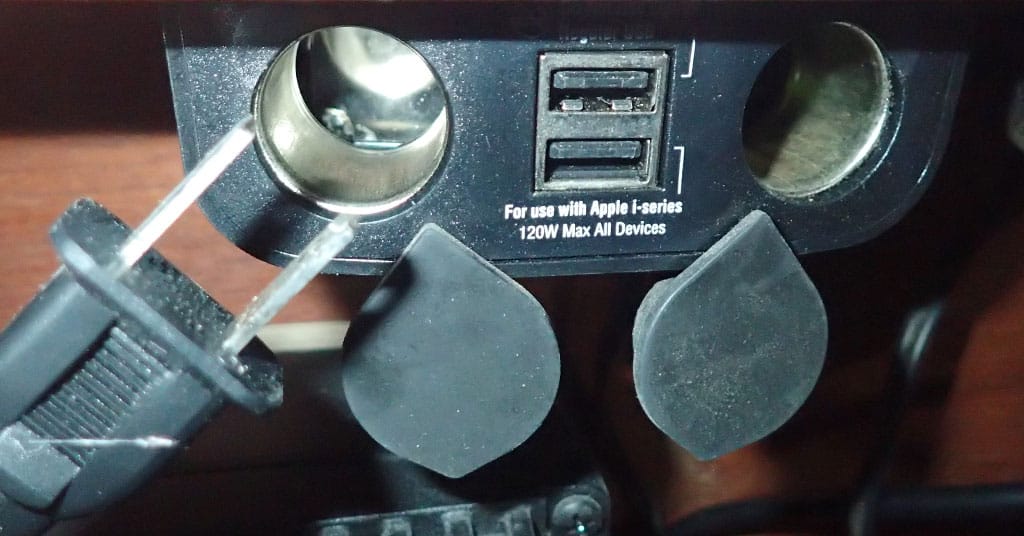
Portable inverters plug into a cigarette lighter socket and give you one or two regular outlets. They’re inexpensive, require no installation, and are easy to move around. But they have real limits — more on that in the sizing section below.
Hard-wired inverters are permanently installed, typically in a locker, wired directly to the boat’s battery bank. They can handle much larger loads. Many are also combination inverter/chargers, meaning they charge your batteries from shore power when you’re plugged in and switch to inverting when you’re not.
The wiring on boats varies quite a bit. On our catamaran Barefoot Gal, we had to physically plug appliances into the inverter itself. On our previous boat, Que Tal, the inverter fed regular household-style outlets throughout the boat. If yours works that way, you’ll usually need to turn the inverter on AND flip a switch on the AC panel to energize those outlets.
Pure Sine Wave vs. Modified Sine Wave: This Matters More Than Price
This is the most important thing to understand before buying any inverter. Get it wrong and you can damage expensive electronics.
Shore power from the grid produces a smooth, continuous wave, technically called a pure sine wave (the red line in the diagram below). For years, cheaper inverters used a shortcut called a modified sine wave, essentially a stepped approximation (the blue line).
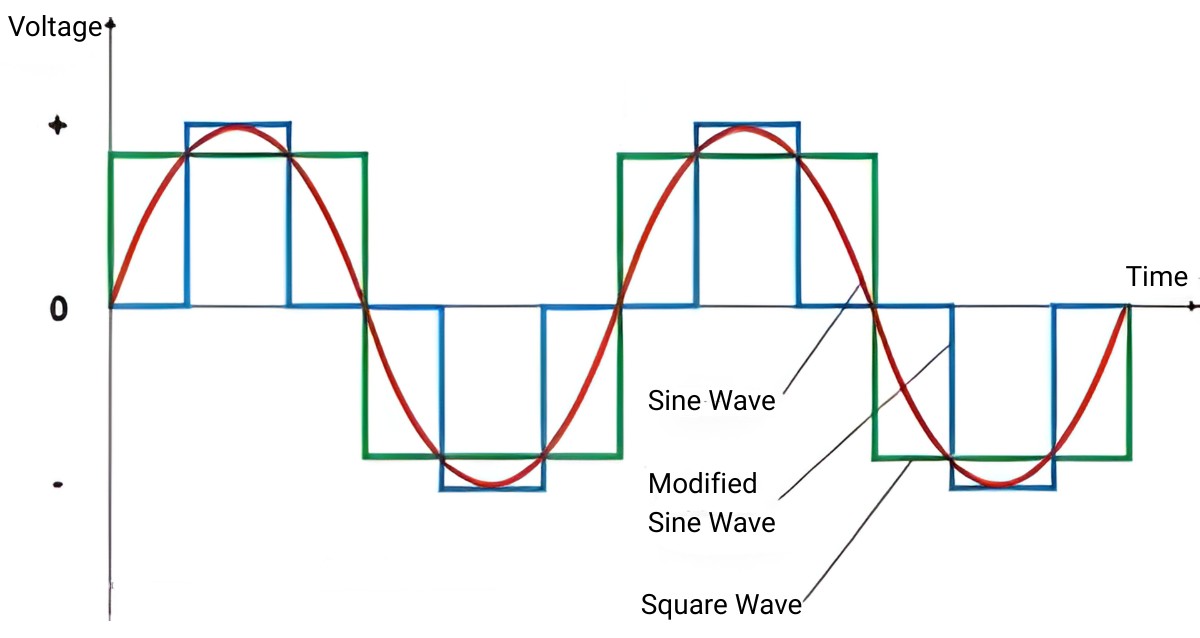
The problem is that a lot of electronics don’t tolerate modified sine wave power well:
- Battery chargers for phones, cameras, and cordless power tools often won’t charge properly or will charge very slowly
- Variable-speed motors, blenders and mixers especially, perform poorly
- TV displays may show interference lines, and audio equipment may have a buzz
- We once completely fried the charger and battery pack for a cordless circular saw by running it on a cheap modified sine wave inverter. The cost of replacing those far exceeded what we would have spent on a better inverter.
The bottom line: always buy a pure sine wave inverter. They cost more, but the price gap has narrowed considerably over the past decade. For a hard-wired inverter especially, there’s no good reason to accept modified sine wave. Somewhere on your boat you will plug in something that’s sensitive to it.
Pure sine wave inverters will say so in their specs. If an inverter’s specs don’t specifically say “pure sine wave,” that’s a sign it probably isn’t one.
What Size Inverter Do You Need?
Inverters are rated in watts, and the rule is simple: the inverter must be rated higher than the total wattage of everything you plan to run at the same time. If the inverter is undersized, it simply won’t run the load. It will shut off, blow a fuse, or trip its internal breaker.
The key word is simultaneously. It’s not just the biggest appliance you plan to use. It’s the sum of everything that’s plugged in and turned on at the same time. If your microwave is 1,200 watts and your toaster is 800 watts, running both at once requires an inverter rated above 2,000 watts.
Most appliances are labeled with their wattage. If an appliance only states its draw in amps, use this formula:
amps × 120 = watts
So an appliance rated at 5 amps draws 600 watts.
Start-Up Load
Here’s a wrinkle that catches people off guard: appliances with motors (blenders, vacuum cleaners, power tools with a spinning bit or blade) draw significantly more power for a brief moment when they first turn on. This start-up surge can be several times the normal running draw. Appliances without motors, like phone chargers or laptop chargers, don’t have this issue.
Because manufacturers almost never publish the exact surge number, there’s no reliable rule of thumb for how much extra capacity you need. What this means for buying an inverter:
- Never buy an inverter that’s just barely adequate for your running load. Always size up to at least the next increment.
- Look for a “peak surge” rating in the inverter’s specs. Not all inverters list one, and the absence of that spec is often a sign the surge capacity isn’t anything to brag about. A good 400-watt inverter, for example, might list “peak surge: 1,000 watts,” meaning it can handle that brief spike at startup even though it can’t sustain that level continuously.
Portable Inverter Limits
Portable inverters plug into a cigarette lighter socket, which means they’re limited by what that socket and its circuit can handle. Portable inverters generally range from 75 to 400 watts, but very few cigarette lighter circuits are rated to handle the high end of that range. A 400-watt load pulls roughly 35 amps DC. Unless you know for certain that your circuit is rated for a higher load, limit yourself to 200 watts or less. Pushing past what the circuit can handle will blow the fuse, either the fuse in the tip of the inverter’s plug or the breaker on your electrical panel.
This is also why microwaves, blenders, and vacuum cleaners won’t run on a portable inverter. Those loads far exceed what any cigarette lighter circuit can supply. Once you’re above 400 watts, you’re in hard-wired territory.

Power Output: Expect a Small Drop
Because converting power from one form to another isn’t perfectly efficient, appliances run slightly less powerfully on an inverter than on shore power. Everything we cooked in the microwave took about 25% longer on the inverter. After a whole summer at anchor, Dave would inevitably burn the first batch of popcorn back at the marina. He’d forgotten to shorten the timer.
It’s a small adjustment, but worth knowing so it doesn’t catch you off guard.
If Your Inverter Isn’t Working
Here’s a quick checklist before you assume something is seriously wrong.
Portable inverter:
- Is the cigarette lighter circuit breaker on?
- Is the inverter’s switch on?
- Is the fuse in the tip of the plug blown? (This happens when the load was too large for the socket.)
- Did it overheat? If it’s hot to the touch, let it cool somewhere with better airflow.
- Is the inverter simply too small for what you’re trying to run?
- Did you actually turn on the appliance? (Yes, I’ve done this.)
Hard-wired inverter:
- Is the inverter on?
- If your inverter is wired to outlets around the boat rather than requiring you to plug directly into the inverter: is the outlet breaker on at the AC panel? Is the AC master switch on? If a breaker tripped, the load was too large for that circuit. Also check for a ground fault by looking at all outlets on the circuit, not just the one you’re using.
- Is the inverter simply too small for what you’re trying to run?
- Did you actually turn on the appliance? (Still happens.)
If none of those solve it, you likely have an issue that’s worth having a marine electrician look at.
Want to Flatten Out the Learning Curve?
Inverters are just one of the many boat systems that feel confusing until someone walks you through them. If you’d like a clear, practical guide to all of it, propane, heads, shore power, anchoring, daily routines, and more, my course The Basics of Living on a Boat covers the real-world essentials that most new boaters figure out the hard way.

Carolyn Shearlock has lived aboard full-time for 17 years, splitting her time between a Tayana 37 monohull and a Gemini 105 catamaran. She’s cruised over 14,000 miles, from Pacific Mexico and Central America to Florida and the Bahamas, gaining firsthand experience with the joys and challenges of life on the water.
Through The Boat Galley, Carolyn has helped thousands of people explore, prepare for, and enjoy life afloat. She shares her expertise as an instructor at Cruisers University, in leading boating publications, and through her bestselling book, The Boat Galley Cookbook. She is passionate about helping others embark on their liveaboard journey—making life on the water simpler, safer, and more enjoyable.
Carolyn Shearlock says
In theory, there’s a slightly higher risk of fire with every item you leave on. In reality, if the inverter is in good working order, it’s not a LOT bigger risk since you’re already leaving the shore power on.
The Boat Galley says
Glad it’s helpful!
Ken Arnold says
You would need a “Generator Switching Relay” (pricey) to run Shore and Battery/Inverter to the Fridge (at the same time) and have it switch on for Shore power outages. You can’t run it on both at the same time.
You’re inviting a Fire.
Al Felker says
Sad but true.
Al Felker says
400 Watts / 12 Volts = 33.3 Amps .: 400 Watts / 24 Volts = 16.6 Amps : 400 Watts / 120 Volts = 3.3 Amps ; 400 Watts / 220 Volts = 1.8 Amps
As you can see above, different voltages will “draw” different Amps.
The internal fuse of these 12 Volt portable inverters is rated for 35 amps so the fuse will open (power disconnected). Remember, the portable is plugged into a cigar plug, which is always 12 Volts and probably only has a 20 Amp fuse. If the same 400 Watt appliance is plugged into a 120 AC receptacle, this same appliance will only draw 3.3 Amps.
Hope that makes sense.
Carolyn Shearlock says
Steve —
Watts = volts x amps
By doing a bit of math, that means Amps = watts / volts
So with a 12-volt DC system (some boats use 24 volts or 32, but 12 is far more common), 400 watts is going to be just under 35 amps . . . 400/12 = 33.3 amps — I say +/- 35 amps because of variations in the voltage and also how much voltage is lost due to inefficiencies.
Hope that helps!
The Boat Galley says
Hope it helps but sorry there’s a problem.
The Boat Galley says
OUCH!
The Boat Galley says
Thanks so much!
Carolyn Shearlock says
They’ve had a number of issues with suddenly failing and no way to repair.
Dave Innis says
Our boar came with Xantrex, and so far no issues. However, I would appreciate understanding why the folks above don’t recommend this system; are there specific potential issues of which we need to be aware?
Thanks for the info Carolyn.
Tom says
Boars don’t have many issues 🙂 Guess newer boats with newer Xantrex have problems. My 1999 Island Packet has no issues with original inverter.
Les Griffith says
Dont understand the hate, just an opinion with no facts is not useful input. My Xantrex has never given me a problem,.
Dave Innis says
Les, as you can see from the above that I had basically the same question back in January. Our Xantrex is a 2004 vintage, and has been trouble-free as well. A couple months ago we had a marine electrician helping us with a frustrating problem, and he was checking the inverter, so I asked him about this. His opinion (based on his experience) is that the problem began when Xantrex changed owners, with likely the resulting changes in parts suppliers, manufacturing, etc. he confirmed that he ” very rarely” sees issues with “older models”, but “newer” models don’t seem to be as reliable. I didn’t try to follow-up on this further, since we weren’t having problems and his explaination made sense to me. Fully agree with you that unsubstantiated opinions are worse that worthless, but such seems to be the world of social media. Hope this info helps.
Sean Freeman says
We recently had our docks re-wired to the new standard and we kept blowing the GFCI breaker on the pier when we plugged in our boat. Turns out that the ground loop cutoff relay on our 2003 Xantrax likely doesn’t meet the new code so I need to disconnect the ground lines on the inverter when hooking up to shore power to prevent tripping the breaker on the pier.
Carolyn Shearlock says
There are inefficiencies in the conversion of power . . . I know it happened with a 1000 watt microwave running on a 2500 watt inverter. Some brands and combinations of microwave brand, size & model with particular inverter brand, size, model and wiring may not have as much of a problem — or an almost negligible one — but I know it happens to everyone I talk to!