
Every US boat is legally required to carry two boat documents: proof of ownership, which is either a state title or a Coast Guard Certificate of Documentation, and a current state registration if required by the state you’re in (most do; there are very few exceptions). A third, proof of insurance, isn’t required by law but gets asked for constantly, so it belongs aboard too.
Most boats should keep more than that on hand: radio and beacon registrations, a towing membership card, a hurricane plan, any boater certifications, the latest survey, and basic medical information for everyone aboard. Cross a border and the list grows again, adding passports, a crew list, and clearance papers.
It’s a longer list than most new boaters expect, but none of it is hard to assemble. The part that trips people up is different. It’s being able to put your hand on the right document in ten seconds when a law enforcement officer, marina clerk, or customs officer asks for it.
Here’s everything worth keeping aboard, starting with the US list that applies to every boater, whether you go out for an afternoon or live aboard full time.
Boat Documents for US Boating
Proof of ownership and registration
Your boat needs proof of ownership, which is either a Coast Guard Certificate of Documentation or a state title. Most states also require an annual registration on top of that, whether the boat is documented or titled. Keep both the ownership document and the current registration aboard, somewhere dry, secure, and easy to reach, not taped to the helm or buried in a drawer. A water-resistant document folder kept in the ditch bag is the setup we settled on, for reasons I’ll come back to below.
Your dinghy needs its own paperwork too. A dinghy with a motor almost always needs its own state registration and title, separate from the mother ship. A lot of people don’t realize that until an officer asks to see it.
Not sure whether your boat should be documented or state-titled, or how registration fits in? My article on Coast Guard documentation, state titles, and registration sorts out all three.
Boat insurance
Keep your certificate of insurance aboard, along with the full policy and your insurer’s phone number. Marinas, boatyards, and haul-out yards routinely ask for proof of insurance before they’ll let you in or start work. If your dinghy is on a separate policy, carry that too.
Hurricane plan
If you keep your boat in a hurricane zone, your insurance company will likely require a hurricane plan, and it becomes part of your policy. It spells out where you’ll put the boat in a named storm and how you’ll secure it. This is an insurance requirement, not usually a marina one. What a marina is more likely to hand you is a set of named-storm rules you agree to, which sometimes includes a requirement that you leave the marina entirely when a storm is coming.
If you’re not sure what goes into a hurricane plan, here’s how to put one together for your insurer. Keep a copy of the finished plan with your boat documents.
Ship’s Station License and MMSI number
If you have a VHF radio with DSC, you need a Ship’s Station License, which is what officially ties your MMSI number to your boat. An SSB or ham radio aboard brings additional license requirements. Keep all radio licenses with the boat papers, and keep a note of your MMSI number where you can find it.
EPIRB and PLB registrations
Your EPIRB and any personal locator beacons must be registered with NOAA. That registration links the beacon’s signal to your boat and your emergency contacts, which is exactly the information search and rescue uses when a beacon goes off. Keep a copy of each registration confirmation aboard.
Towing service membership
If you belong to TowBoatUS or Sea Tow, keep the membership card and the company’s number handy. You don’t want to be searching for that when you’re aground on a falling tide.
Licenses, certifications, and club cards
Depending on your state, your activities, and where you go, you may also want or need:
- A Safe Boating certificate or state boater education card (required in many states)
- A USCG Operator’s license, if you carry paying passengers
- Fishing licenses for the waters you’re in
- A yacht club membership card, if your club has reciprocal arrangements with other marinas or clubs
Boat survey
A survey isn’t required to operate the boat, but your insurance company may ask for a current one. Keep your most recent survey with the boat papers either way. It’s useful to have on hand.
Inspection papers
If you’ve had a Coast Guard or Coast Guard Auxiliary Vessel Safety Check, keep that paperwork aboard. Showing a clean, recent check tends to make the next stop quicker.
Personal and medical papers
This is the section most people skip, right up until someone needs it. For each person aboard, keep:
- Health insurance cards
- Copies of any Medical Power of Attorney, Living Will, or Health Care Directive
- A short health summary: major conditions, current medications and doses, allergies
- Medical evacuation or travel medical policy documents, if you have them
Fill out the health summary before you go, not after something happens. If someone is hurt and can’t answer for themselves, that one sheet is what responders will want.
If You Cruise to Another Country
Everything above still applies. Crossing a border just adds to the pile.
Passports
Everyone aboard needs a valid passport. Most countries want it valid for at least six months beyond your planned stay; the Bahamas asks for three. Bring paper copies of the photo and signature page of each passport, and a few extra passport photos, since some countries still use them for visas or crew lists. If anyone aboard isn’t a US citizen, check that country’s specific entry rules well before you go.
Crew list
Nearly every country wants a crew list, and the preferred format varies a little from one to the next. Look up the format for where you’re headed, fill it in ahead of time, and print several copies. Walking in with your own crew lists ready is far faster than filling out forms at the counter. Toss a pen in the folder while you’re at it.
Clearance papers from your last port
Some countries want to see your exit clearance, often called a zarpe, from the last country you visited before they’ll clear you in. Here’s the catch: not every country issues one. The US doesn’t, unless you make special arrangements, and neither does the Bahamas as a matter of routine. So before you leave for a new country, find out what it expects to see, and whether your last port can give you the paperwork to satisfy it.
Cruising permit
Many countries issue a cruising permit at or shortly after check-in. Once you have it, keep it with the boat documents for as long as you’re in their waters.
If you’re not the registered owner
Carry a signed captain’s letter or power of attorney from the owner. If you’re married to the owner, some countries will ask to see a marriage certificate. These feel like formalities right up until an official asks.
Vaccination and pet records
The International Certificate of Vaccination, the “yellow book,” is required by some countries and handy to have anywhere. Keep one per person. Pet requirements vary a lot by country and can include microchip records, an international health certificate, specific tests, and import permits that take months to arrange. Research each country’s pet rules early.
Radio operator’s licenses
Some countries, mostly in Europe, require a radio operator’s license beyond the standard Ship’s Station License. Check before you go.
One organizing note for international travel: keep the personal and medical papers in a separate folder, and leave that folder on the boat when you go ashore to check in. Customs has no need for your crew’s medical histories.
Every Marina Wants Something a Little Different
There’s no single set of papers everyone asks for. One marina wants proof of insurance and your registration. The next wants those plus a signed storm agreement. A foreign customs office wants passports, a crew list, and your clearance from the last port. The documents are mostly the same. What changes is which ones get asked for, and when.
So the real skill isn’t collecting the documents. It’s being able to put your hand on any one of them in about ten seconds.
Jessica, the clerk at the Marathon City Marina in Boot Key Harbor, once told me she could pick out the fast check-ins the moment people walked up to her desk. They were the ones who opened a single organized folder and pulled out exactly what she asked for. The slow ones stood at the counter leafing through a stuffed manila envelope or digging through a plastic bin while the line backed up behind them. Same documents. Completely different morning.
Keep It All Where You Can Grab It Fast
We kept our boat documents in the Boat Documents Organizer, and we kept the organizer in the ditch bag. That handled two jobs at once. Day to day, it was easy to pull out and carry to the marina desk or a customs office. And if we’d ever had to leave the boat in a hurry, the ditch bag was the one thing we’d grab, so the documents would have come along automatically.
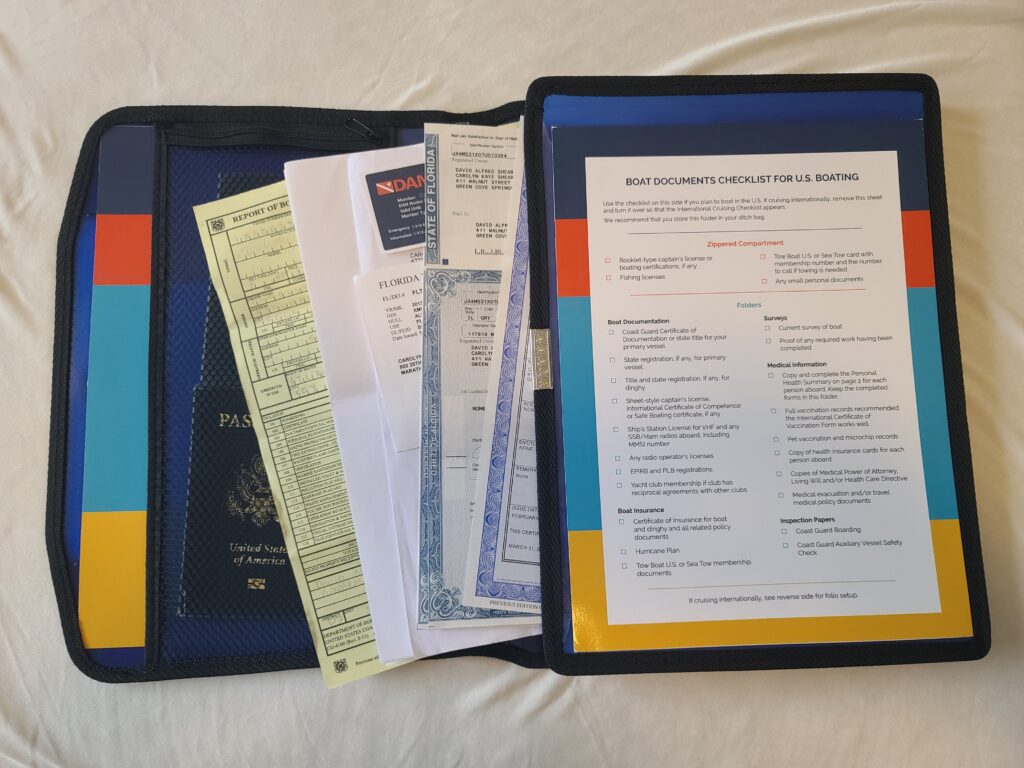
A plain folder or envelope sounds fine until you try to fit all of this into one. There’s the boat documentation, registration, insurance, radio and beacon paperwork, certifications, and personal medical papers, and for international travel, passports and crew lists on top of that. It adds up fast, and it all needs to stay together and stay findable.
Our Boat Documents Organizer is a water-resistant binder built for exactly this job. It holds over 400 pages, has a zippered compartment that keeps passports secure and hidden when it’s closed, and includes a printed checklist covering both US boating and international cruising. The checklist flips to the right side for wherever you’re headed, and is the part everyone says they love, because it’s easy to forget one document until someone asks for it.
Back It Up Digitally
Scan the important documents and store them where you can reach them from anywhere: email them to yourself in an account with web access, or keep them in a password-protected cloud folder. A USB drive in the ditch bag makes a good extra layer.
Digital copies don’t replace the originals. Most officials won’t accept a photo of a passport page. But if the originals are ever lost or destroyed, having copies turns a disaster into an inconvenience and makes replacements far easier to get.


Carolyn Shearlock has lived aboard full-time for 17 years, splitting her time between a Tayana 37 monohull and a Gemini 105 catamaran. She’s cruised over 14,000 miles, from Pacific Mexico and Central America to Florida and the Bahamas, gaining firsthand experience with the joys and challenges of life on the water.
Through The Boat Galley, Carolyn has helped thousands of people explore, prepare for, and enjoy life afloat. She shares her expertise as an instructor at Cruisers University, in leading boating publications, and through her bestselling book, The Boat Galley Cookbook. She is passionate about helping others embark on their liveaboard journey—making life on the water simpler, safer, and more enjoyable.
Leave a Reply