

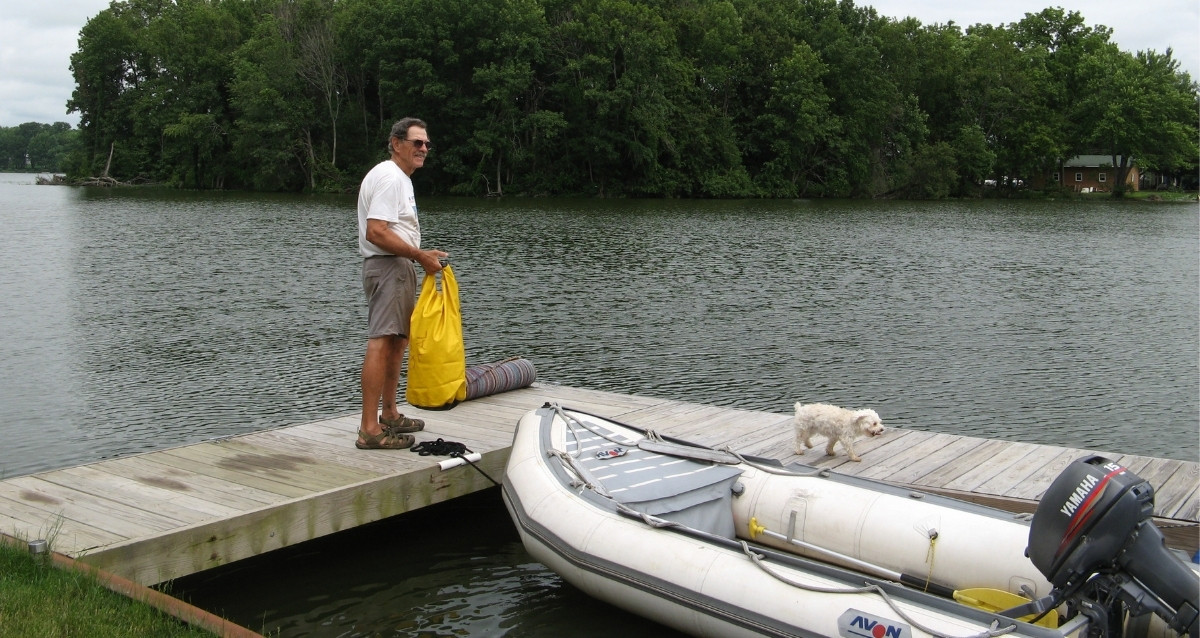
You’ve just done a big grocery run. The cart was full, the checkout line was long, and when you walk back outside, the breeze has filled in.
Now there’s a dinghy ride between you and the boat.
At anchor or on a mooring, every bag rides home in the dinghy, whether it’s calm, windy, rainy, or roasting hot. You can’t just decide to deal with it another day; you’ve already bought it all.
So the question becomes: how do you get it all back aboard dry and sound? With no soggy toilet paper or flour?
On both our boats, we anchored out or picked up a mooring for months, even years, at a time, so we did a lot of provisioning by dinghy. Here’s the routine that worked for us.
There’s Usually Some Water in the Dinghy
We learned pretty quickly that it doesn’t take bad weather to get things wet.
Even on a flat calm day, a passing wake can splash right into the dinghy. When it’s choppy, there’s spray over the bow. And if it’s rained, or the dinghy has even a tiny leak, the floor probably isn’t totally dry before the first bag goes in.
Our Answer: Dry Bags
For us, dry bags made all the difference.
They keep the toilet paper and flour dry, of course. But they also mean the laundry you just did (or paid to have done) doesn’t come home salty. And canned goods and drinks stay out of the salt water, which can lead to corrosion and pinholes if you don’t wash it off right away.
Lots of cruisers use trash bags, and I understand why. They’re cheap and they’re already on the boat. But in our experience, a trash bag gets a hole or two almost immediately. After that, any water sloshing in the bottom of the dinghy gets in, and big splashes seem to find their way in too.
We actually had dry bags before we went cruising, from canoe camping trips. On one of those trips, we had a spectacular whitewater capsize. Everything in the dry bags came out dry, and I’ve trusted them ever since.
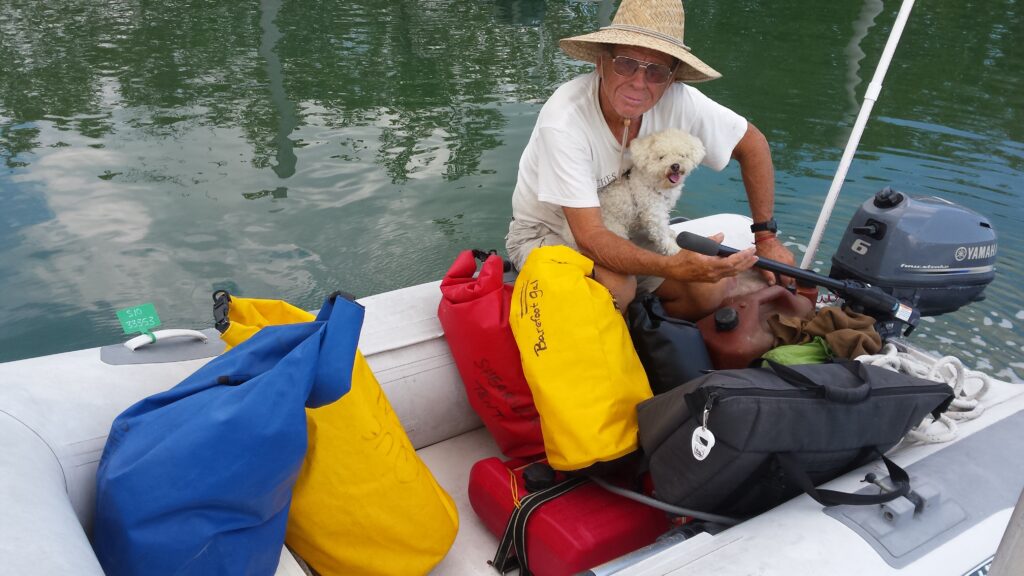
A true dry bag is heavy-duty coated fabric with welded seams, so there are no needle holes for water to get through. The top folds over on itself at least three times and then buckles. The buckle doubles as a handle, and you can clip it to the dinghy when it’s rough.
What I’d Buy Today
The SealLine bags I used for years aren’t made anymore. If I were buying today, I’d get these Sea to Summit bags:
- Big River Dry Bag in the 65-liter size, for groceries and laundry. The same page has a 35-liter size if you want something smaller.
- Big River Dry Backpack, 50 liters. It’s handy if you have to walk a distance to the store or the laundromat.
A few things that haven’t worked for me: Sea to Summit’s Lightweight line (not truly waterproof), Velcro or zipper closures, and anything labeled “weather resistant.” I still use a couple of those inside other bags for prescriptions, but I wouldn’t count on them alone.
Good dry bags aren’t cheap, I know. But I used my old ones for close to 20 years, and they saved a lot of groceries and laundry along the way. They paid for themselves many times over.
Repacking at the Store
We’d repack before anything went in the dinghy, either outside the store or at the dinghy dock. Basically, wherever there was a trash can and a reasonably clean place to work. A concrete sidewalk beats a damp, sandy beach!
First, we’d strip off as much packaging as we could. That cut down on trash aboard and kept bugs from hitching a ride. (More on that in Avoid Bugs in Stored Food on a Boat.)
Then we’d sort everything into three piles:
- Stay dry: toilet paper, paper towels, flour, sugar and anything else that’s ruined if it gets wet went into the dry bags. Cans went in too when there was room; when they didn’t fit and got splashed, we rinsed them in fresh water as soon as we got aboard.
- Keep cold: into a soft-sided cooler, with ice if it was hot out or a long way back. Here’s the provisioning cooler I finally settled on after a few that didn’t work out.
- Everything else: into heavy-duty reusable bags, with the overflow in the store’s plastic bags. We’d tie the handles shut so nothing fell out in the taxi or the dinghy.
Of course, getting from the store to the dinghy dock can be its own adventure without a car. Walking, wagons, taxis and delivery all have their place, and I wrote about them in Provisioning Without a Car.
Getting It All Aboard
Somehow, it always fit in the dinghy.
Back at the boat, we’d tie up first. It’s easiest with two people: one in the dinghy and one on deck, handing everything up. Then it got relayed to the cockpit and down the companionway.
Then came putting it all away. Where it all goes, and buying the right amount in the first place, is a big part of our Provisioning, Meal Planning, and Food Storage course.
After a while, it’s just part of life at anchor. Dry groceries, dry laundry, dry toilet paper. It’s the little things!
From The Boat Galley Store
Provisioning, Meal Planning, and Food Storage (online course)
Feel confident and in control with a clear system for planning, buying, and storing food aboard
- Build a realistic provisioning list based on what your crew actually eats
- Know how much to bring for your trip length and storage space
- Organize your boat so food stays fresh and easy to find
- Make smart tradeoffs when space, refrigeration, or availability is limited

Do you have other questions we could help you with?
The real picture
Budget, health, age, family
How to make it happen
Help for tough times
Keep reading


Carolyn Shearlock lived aboard full-time for 17 years, splitting her time between a Tayana 37 monohull and a Gemini 105 catamaran. She’s cruised over 14,000 miles, from Pacific Mexico and Central America to Florida and the Bahamas, gaining firsthand experience with the joys and challenges of life on the water.
Through The Boat Galley, Carolyn has helped thousands of people explore, prepare for, and enjoy life afloat. She shares her expertise as an instructor at Cruisers University, in leading boating publications, and through her bestselling book, The Boat Galley Cookbook. She is passionate about helping others embark on their liveaboard journey, making life on the water simpler, safer, and more enjoyable.
Some links in this article (including all Amazon links) are affiliate links, meaning that we earn from qualifying purchases.
Jim Almond says
If I didnt order a couple of these (55L) right now I would have forgot. These look like a great idea, thanks!
Carolyn Shearlock says
Hope you find them as useful as we did! -C
Leigh Ann Bishop Long on Facebook says
Must read! Thinking water tight totes, no?
The Boat Galley on Facebook says
I prefer true dry bags. Not sure if that’s what you mean by “water tight totes”
Mary Dixon says
I use a couple for laundry. Always get comments from the ladies in the laundry room.
Claudia Davis Reshetiloff on Facebook says
We also have a dry bag backpack made by Overboard that we LOVE.
Bob Bechler on Facebook says
We have collapsible box as wide as dinghy floor to put bags to control them and keep dryer under most conditions
Molly Stokes on Facebook says
In Minnesota, where I am originally from, we call them Duluth packs, which are backpacks. Easier to get in and out of boats with the pack on your back.
Dave Skolnick (S/V Auspicious) says
Carolyn – spot on with dry bags. I have a couple of small bags for odds and ends on watch and while walking about. My big bag is a 115l SealLine back pack that has not only survived many dinghy runs but more trips as checked baggage on deliveries than I can recall.
On one trip I was feeling cocky and heaved the full bag out of the dinghy onto a dock without tying up properly first. *sigh* In accordance with Newton’s Third Law the dinghy moved backwards as I heaved the bag forward. The bag and I ended up in the sea. My PFD inflated and the bag inflated. The bag full of dirty laundry stayed dry, as did Janet’s laptop also inside. My cell phone in my pocket was not so fortunate.
Now I always always tie up the dinghy before loading and unloading. Now I always always carry my phone in a waterproof bag or case.
sail fast and eat well, dave
Dave Skolnick (S/V Auspicious) says
Oops – the bag didn’t inflate – it just floated. dave
Tammy Swart says
We have been using our dry backpack for provisioning as well. It has been one of our most valued purchases to date. It is still going strong even when we load it up. We got the 30 liter size and it’s about all we can comfortably carry for a distance. http://www.amazon.com/gp/product/B004K6LY5U/?tag=theboagal0a-20
gene koblick says
I was wondering why I cannot save copies of your information to my computer? I have no problems saving Active Captain and West Coast Trailer Sailor why do I have trouble saving The Boat Galley.
Carolyn Shearlock says
I had problems with a few unscrupulous people stealing all the articles here and setting up identical sites, so I had to make it a little harder so that the “robots” couldn’t do it, but real people could.
Evan says
Why not take your empty Lock N Lock containers in the dry bags, and when you are getting rid of the cardboard (prior to the return trip as you said), simply pack it back into your Lock N Locks. Saves a step! And more time for cocktails!!
Carolyn Shearlock says
Good idea!
CJ Grabenstein says
We have been so lucky with weather, it has rained only about 5 days out of the 6 months we have been gone! But I know our luck will run out, purchased dry bag with your link! I think it’ll be perfect for laundry. I’ve been meaning to get one, thanks for the reminder!
The Boat Galley says
Thanks — they are also incredibly helpful with windy days like we’ve been having. Lots of spray in the dink!
Diana K Weigel says
I have personally had good results from the Sea to Summit waterproof bags both camping and kayaking. So go ahead and add them to the OK list.
The Boat Galley says
Great to hear!
Alicia Nunnery says
I absolutely love your blog! You guys Rock on very helpful tips.
The Boat Galley says
Thanks so much — love hearing that!
Scott Sweeney says
In addition to dry bags, I have a rubberaised backpack that I can carry at least 4 bags of ice in or my cold items from the store.
Travis Weaver says
We’ve been living without a fridge for 3 years now and haven’t ever needed ice or anything, and haven’t had an outboard for our dinghy, just paddling even in 30 knots of breeze, with our fatty knees the sides come up pretty high we’ve never really had issues with water, but maybe in other parts of the world dry bags will come in handy.
Joanne Cannon says
Again you covered something I didn’t know I didn’t know. Thanks for all the great tips!