Provisioning without a car is completely manageable — cruisers do it every day using a combination of walking, wagons, rideshares, and delivery services. The key is knowing what options you’ll have at each stop before you get there, and planning your big stock-ups around the times you do have wheels.
If you’re still in the planning stage and wondering whether the car-free life is even doable, the short answer is yes. It takes more thought than pulling into a parking lot, but most cruisers find a rhythm pretty quickly. Here’s what actually works.
Walking
If I didn’t need too much and the store was under a mile away, I walked. The trick is managing what you carry.
Cold items went in a soft AO Coolers Soft Cooler (Amazon) — the 12-can size fits easily over one shoulder and keeps things cold long enough to get back to the boat. For everything else, a heavy-duty tote bag (Amazon) handles cans and heavier items well. A daypack works too, though totes are better for crushable things like bread, chips, and produce.
The limiting factor is weight. Walking back with 20 pounds of groceries is fine. Forty pounds is not fun.
Wagons
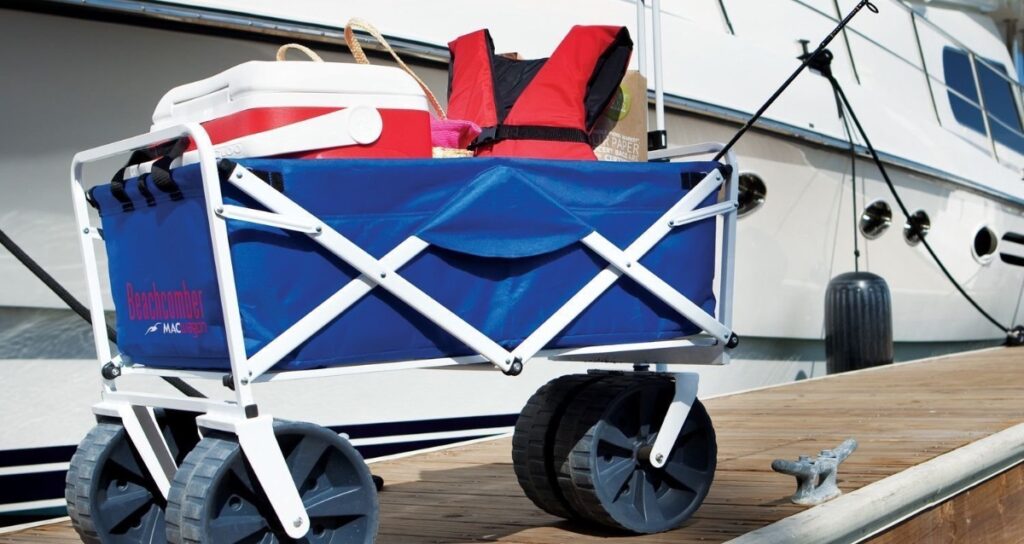
Once you need more than a bag’s worth, a collapsible wagon changes everything. More and more cruisers use them instead of traditional dock carts — they handle longer distances, bumpy sidewalks, and uneven terrain far better.
A few things worth looking at when you’re choosing one:
- Tire size — larger tires handle bumpy roads, gravel, and firm sand much better than small ones
- Frame strength — tougher frames don’t fold as compactly, so think about where you’ll store it
- Handle length — matters if you’re tall
- Weight rating — most are rated for 150 pounds, which is usually plenty (a case of beer is under 20 pounds; canned goods are generally under a pound each)
In hot climates, you can put a soft cooler inside the wagon for meat and dairy — that combination covers almost any provisioning run. Note that wagons aren’t designed to carry kids or pets.
Two models cruisers have actually recommended:
- Mac Sports Wagon (Amazon) — the lighter, less expensive version; folds to just 8″ thick; wheels are designed for hard surfaces. Good for occasional use. Mac is a solid brand — our collapsible chairs from them are going on 10 years old.
- Mac Sports Heavy Duty Beach Wagon (Amazon) — more rugged overall, with extra-large wheels built for uneven surfaces; adjustable handle; collapses to under 10″ high. Better for everyday use.
Taxi, Uber, and Lyft
When you don’t have a car, rideshares become a regular part of life. We used them often — sometimes walking to the store to save money and then taking a cab back with the load.
In Mexico, cabs were almost always waiting outside the grocery store. In the Florida Keys, you could call while you were paying and they’d arrive by the time you walked out. In El Salvador, we’d team up with a few other cruisers and hire a favorite driver for a full day in San Salvador — split four ways, it was very reasonable.
Delivery
Some stores deliver directly to your marina or dinghy dock. In the Bahamas we found a couple that did, and in the BVIs it’s common enough to build your provisioning plan around it. (If you’re planning a BVI charter, this article on charter provisioning in the BVI has the details.)
Since COVID, Instacart has expanded delivery coverage to marinas in many areas. If you can find a store with its own delivery service, the prices are often better than going through a third-party app.
Public Transportation
I’ve provisioned by bus, and I’ll be honest: it’s awkward for anything more than a few items. Bags are hard to manage on a crowded bus, and anything bulky — a case of drinks, a large bag of rice — is genuinely difficult. Last resort rather than a regular strategy.
Rental Car
When you have a rental for another reason — medical appointment, boat parts run, airport pickup — stock up on your way back before you return it. A few hours with wheels is worth taking full advantage of.
How to Know What’s Available Before You Get There
Here’s what makes all of this much easier: knowing what provisioning options you’ll have at your next stop before you arrive, so you can decide whether to stock up now or wait.
Our cruising guides cover the ICW, the Bahamas, the Florida Keys, the Florida Gulf Coast, and the Chesapeake — and every guide lists the grocery stores near each marina and anchorage, with specific store names and distances. Not just “provisions available nearby” — you know exactly what’s there and how far you’ll be walking. That kind of advance knowledge changes how you plan every stop.
For getting groceries when you’re anchored out rather than in a marina, provisioning by dinghy is its own skill worth reading up on.
Plan Ahead So You Need Fewer Trips
The other side of car-free provisioning is reducing how often you need to go at all. If you can stock up well when you do have access — a marina with a loaner car, a town where Uber works reliably — you’re not scrambling every few days.
Our free Provisioning Spreadsheet helps you think through quantities so you’re not guessing, and it’s built around the reality of provisioning for longer passages where restocking isn’t always an option.
It Gets Easier
The first time you do a big provisioning run without a car, it feels like a lot. By the third or fourth time, you’ve found your system — which stores are worth the walk, when to call a cab, when to wait for delivery.
Most cruisers find it more manageable than they expected. A few even prefer it.
Stock Up Smart Before Your Next Passage
If you want to take the whole provisioning system deeper — how much to buy, how to organize it aboard, how to shop confidently in ports you’ve never visited — may I suggest our course Provisioning, Meal Planning, and Food Storage. It covers everything from building your list to stowing it all once it’s aboard.


Carolyn Shearlock has lived aboard full-time for 17 years, splitting her time between a Tayana 37 monohull and a Gemini 105 catamaran. She’s cruised over 14,000 miles, from Pacific Mexico and Central America to Florida and the Bahamas, gaining firsthand experience with the joys and challenges of life on the water.
Through The Boat Galley, Carolyn has helped thousands of people explore, prepare for, and enjoy life afloat. She shares her expertise as an instructor at Cruisers University, in leading boating publications, and through her bestselling book, The Boat Galley Cookbook. She is passionate about helping others embark on their liveaboard journey—making life on the water simpler, safer, and more enjoyable.
Anonymous says
Make sure to do something nice for those that give you a ride. So many don’t, and it turns people off.
Anonymous says
I have a car, I’m just trying to make friends lol.
The Boat Galley says
Most are about 25 pounds . . . but fully loaded? Yeah, more.
Anonymous says
Our collapsible wagon weighs about 10 pounds. Loaded it does take two people to load it into the dinghy. It is by far one of the most useful things we have onboard. I find we use it most in marinas where the dock carts seem to never be available.
Anonymous says
Sherry Matas what brand do you have?
The Boat Galley says
Sherry Matas Don’t you just take the stuff out of the wagon to put into the dinghy?
Carolyn Shearlock says
Thank you! Glad to have you as part of The Boat Galley!
Anonymous says
So you know what I mean….😉