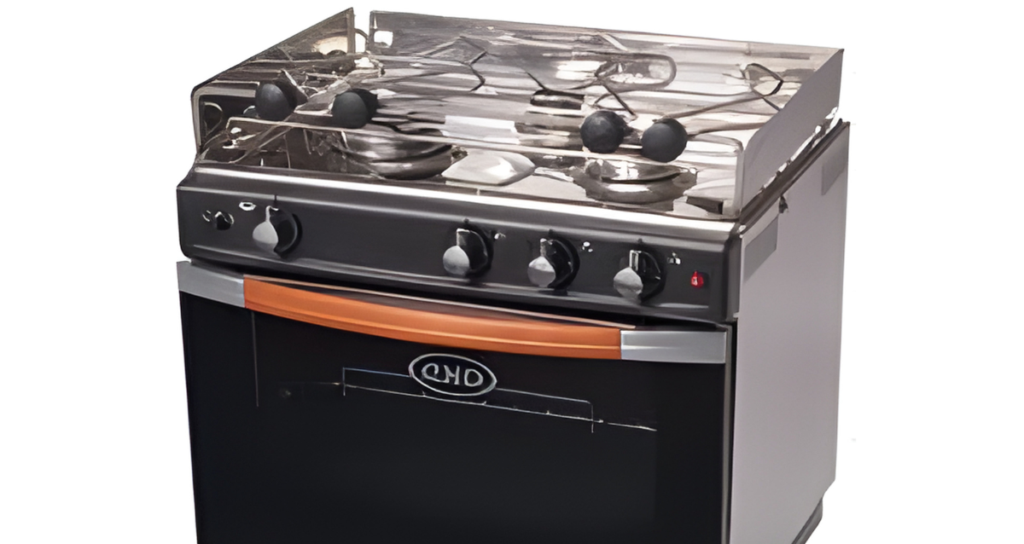
There we were, our first night out of the marina with our new-to-us boat. I’d planned a special dinner, including a rice salad. Little did I know that we’d picked one of the rolly-est anchorages we’d see over the next six years. I did quickly learned the value of pot restraints!
When I had initially explored what the previous owners had left in the galley, I’d come across these funny little metal arms with screws on one end. It had finally dawned on me that they fit on the stove to hold pans in place. On previous charters, I’d used the stove gimbal, but never pot restraints.
That first night at anchor on Que Tal, I put the pan of rice on the burner. Then I watched it slide across to the other burner. It hit me that I’d better dig those pot restraints out . . . quickly! From then on, I never took them off until the day we “prettied up” the boat to sell her.
What Are Pot Restraints?
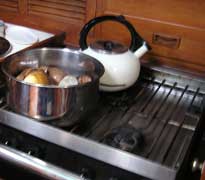
In the photo, you can see the pot restraint holding the tea kettle in place. I haven’t yet put one around the pot with the clams — but I’m about to!
Virtually any stove designed for use in a boat comes (originally) with pot restraints. Or, as they’re also known pot holders, pan holders or pot/pan clamps. These are the first half of the equation for keeping your cooking on the stove and not on the floor or worse – spilling hot food on the cook. I talk about the other half, stove gimbals, in a separate article).
Pot restraints are metal bars that screw into each side of the stove and “hug” a pan on a burner. Loosen the knob a little to swing the bars into the correct position. Then tighten the knob back down so that the pot doesn’t slide with the motion of the boat. Other brands have different mechanisms, but these are the most common. These aren’t just for use underway – they’re also great in rolly anchorages or those with lots of passing traffic. I’ve even needed them in marinas a few times. Once when there was a good norther blowing, we heeled right at the dock!
Unless you spend almost all your time at a very sheltered marina, I highly recommend leaving pot restraints in place. Use them all the time if you have a monohull. If you always use them, you won’t forget when conditions are marginal. You never know when a fishing boat or JetSki is going to go roaring past you, even in a glassy calm anchorage.
Even though we eventually moved onto a catamaran, I still used my pot restraints regularly, both underway and in rolly anchorages.
I generally refrain from saying that you “need” a particular item, but these are an exception. They are truly a safety item. Without them, every pan on the stove is a potential major burn on the cook if it slides while hot. Boiling water or hot oil can be spilled right down the front of anyone in the galley.
Finding Pot Restraints
Unfortunately, pot restraints can be hard to find and expensive ($50 or more) if you have lost the ones that came originally with your stove. However, the cost is slight compared to the pain and healing time — not to mention the doctor bills literally being more expensive — of spilling a pot of boiling pasta or chili down your legs. If you have a Dickinson marine stove, you can find pot restraints online at Defender.
Often, the best place to find them is boater swap meets, boating consignment shops, and places that pull parts from wrecked and abandoned boats. Depending on the brand, you may also find new ones by Googling “[brand] pot holder” or “boat pot holder.” If you search just “pot holder” or “pot restraint” you get too many of the wrong results. You could also check with the manufacturer of your stove.
Safety Tips and Techniques For Cooking Underway
The restraints that came with my stove were always fine for the cruising we did. However, I’ve heard reports of pans flying out of the typical types of restraints when a boat hard on the wind “fell off a wave.” It’s not so much a rolling action, but a sudden drop and stop. Also, when the back of the stove, swinging on its gimbals, hits the side of the boat hard, restraints can fail. If you expect to encounter such conditions (and think you’d be trying to cook in them), try to engineer more sturdy pot restraints specific to your boat.
Additionally, if conditions are rough, it pays to use deep pans that are filled less than half full. This will prevent food splashing out. At such times, I use my pressure cooker without putting the pressure weights on. That allows me to lock the lid for even more protection against spills and burns. Even if the pan falls to the floor, the hot food inside doesn’t spill — although you still have a hot pan rolling around that you need to corral!
If you’ve never been in a rolly anchorage or on a passage where it’s blowing over 10, you may never have seen a need for pot restraints. But just like having non-skid on all your plates and putting drinks in drink holders, pot restraints are a necessity when cruising.
Learn More
Cooking with pot restraints is just one of the many quirks of cooking aboard. If you’re looking for a cookbook that’s designed specifically for real boat galleys — limited space, motion, small ovens, and all — The Boat Galley Cookbook includes over 800 boat-friendly recipes, plus practical tips that make cooking onboard easier and more enjoyable.

Carolyn Shearlock has lived aboard full-time for 17 years, splitting her time between a Tayana 37 monohull and a Gemini 105 catamaran. She’s cruised over 14,000 miles, from Pacific Mexico and Central America to Florida and the Bahamas, gaining firsthand experience with the joys and challenges of life on the water.
Through The Boat Galley, Carolyn has helped thousands of people explore, prepare for, and enjoy life afloat. She shares her expertise as an instructor at Cruisers University, in leading boating publications, and through her bestselling book, The Boat Galley Cookbook. She is passionate about helping others embark on their liveaboard journey—making life on the water simpler, safer, and more enjoyable.
Carolyn Shearlock says
Lots of time it’s not too rough to cook, but you don’t want pans moving on the stove which can happen with very little movement.
Carolyn Shearlock says
I’m betting yours is the new style . . . mine was the new style, and it was new in about 1990 (exact date unknown).
The Boat Galley says
Where/how did you find them on Defender? I’ve looked several times and never any!
The Boat Galley says
Well, duh! How’d I miss that? https://defender.com/en_us/oven-parts-accessories
Carolyn Shearlock says
A GE stove? Like one made for a house? I doubt that you’ll find any pot restraints that will fit. Most likely, you’ll have to have something fabricated to build a “fence” around the stovetop, then hang pot restraints on that . . . and they may need to be altered to fit the larger size of a home stove, too.
John Andrews says
Yes, I’d add the thought that it’s like they say on the airlines: “Please keep your seatbelt fastened at all times, in case of unexpected turbulence”. If a rogue wave pays a visit, sailors would have plenty enough to worry about without hot dinner taking flight, never mind if someone was not clear of the line of fire.
Carolyn Shearlock says
Yes, particularly underway. But we’ve gotten some nasty wakes in anchorages and it just makes sense to secure the pots.
Greg Norris says
🙂
The Boat Galley says
That’s how the sink I hated on our previous boat got changed . . . I was sick and he washed the dishes . . .
The Boat Galley says
These are different from fids just on the edge of the stove 🙂
Carolyn Shearlock says
It would probably have to custom-designed, but would certainly be do-able.
lary schmidt says
Ann
if you are related to Dieter Heinrick who transported a 10mm from Annapolis Md. to Buffalo NY
would you please have him contact me. I am in need or advice on how to prepare my 105m
for transport (PCI couldn’t supply much information)
[email protected]
Carolyn Shearlock says
It would take a bit of metal work or welding to make an attachment point (they’re always unique to the particular stove model and home stoves don’t come with the attachments), but it would be totally do-able. Great to you for thinking of it!