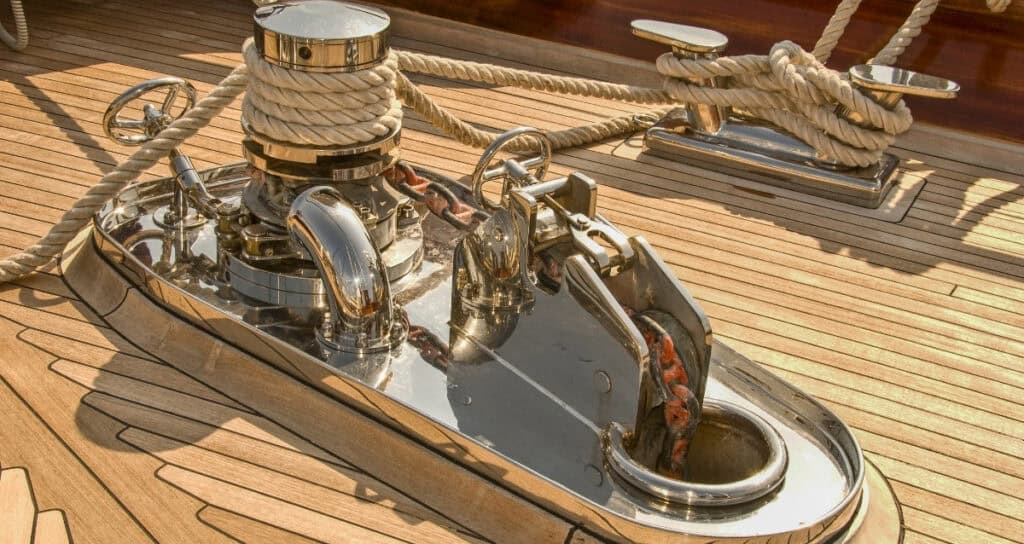
Before we became cruisers, Dave and I thought an electric windlass was something nice to have, but not essential. Ten years later, we considered an electric windlass a crucial safety feature on a cruising boat. What changed our minds? The realization that an electric windlass brings four major benefits:
- allows you to anchor with more scope;
- you can anchor again quickly if conditions require it;
- makes it possible for you to carry more robust ground tackle; and
- allows for single handed anchoring.
Both of our boats came with electric windlasses, and I understand that they are pricey and that wiring can be challenging. Based on our years of cruising experience, however, I argue that it’s money well spent.
Cruising Without an Electric Windlass
Cruisers without an electric windlass tend to anchor in shallower water and often use less scope so that it will be easier to retrieve their anchor. This combination means that they:
- are more likely to drag anchor (being on short scope);
- have less time to react before being aground (since they anchored closer to shore); and
- will have a harder time and take longer to re-anchor, especially in deteriorating conditions.
When we were cruising in the Sea of Cortez, two boats were lost due to this combination of factors, and several others were damaged as they bumped the bottom.
Benefits of an Electric Windlass
With an electric windlass, it’s easy to re-anchor if you decide that you don’t like the spot you’ve picked after you’ve let the required scope out and can see where you’re sitting. Our rule was that we were not anchored until we were both comfortable with where and how we had anchored. If one of us was a little nervous, it wasn’t good. We wouldn’t be able to relax, enjoy ourselves, and wouldn’t get a good night’s sleep. And despite ten years’ experience in choosing our anchoring spot, sometimes we still feel the need to move a little after seeing how we lie.
We were also much more willing to move in response to changing conditions. Once, in the Bahamas, a squall approached as we were in a tight anchorage between Leaf and Allen’s Cays. The wind shifted 90 degrees and put our boat closer to the beach than we were comfortable with. It took us less than 10 minutes to move about 100 feet, and thus it was feasible to do so before the squall actually hit.
The Problems with No Windlass
Obviously, having no windlass is the worst scenario. It is almost impossible to hand pull an anchor as winds build and whitecaps start forming in the anchorage. Injuries also become extremely likely… nasty things like broken bones, crushed fingers, and wrenched backs. Hand-pulling an anchor in a 40-knot squall with 2-foot waves is virtually impossible even if you try to motor up on the anchor, as the wind will keep blowing the bow off and rip the rode out of the puller’s hands.
Even in calm conditions, hand pulling an anchor is tough work and not something that most of us want to do every day. On our Tayana 37, I could not have hand-pulled our 66-pound anchor; if I absolutely had to, I probably could pull the 35-pounder on our current boat, but it would be a very long and slow process. Even if Dave were willing to hand pull the anchor routinely, our rule is that we both have to be able to do everything on board in case the other one is sick or injured. An electric windlass makes it so that I can pull the anchor.
Manual Windlass
A manual windlass is definitely better than no windlass, and even has some advantages over an electric. But electrics also have their advantages.
The primary advantage of a manual windlass is that they are less expensive and simpler to install, as there is no wiring.
In general, manual windlasses are slower than electric ones. The exact speed difference depends on the two models being compared. That can be important in deteriorating conditions.
Manual windlasses are somewhat safer than electric. It’s not that you can’t catch a finger or piece of clothing in one, but you can stop one faster, before serious injuries happen.
Manual windlasses aren’t susceptible to electrical gremlins, but they still have to be maintained to work properly.
Boat Galley reader and cruiser Dan suggested another benefit of having an electric windlass: you can upsize your anchor for safety. He bought an anchor rated for a 45-foot boat, despite cruising aboard a 33-footer. He discovered his vessel had better staying power in weather than boats with properly sized tackle under normal conditions.
Finally, manual windlasses are tough to use if you are single-handing, or effectively single-handing due to an illness or injury. While an electric windlass can be wired to use it from the helm (both of ours had been), you must be up on the bow to operate a manual windlass. It’s tough to motor up to the anchor and then run forward, pull up part of the rode as the boat drifts back, run back and motor back up, etc. Again, this can be a big problem if conditions deteriorate, with winds and waves increasing.
Of course, you can avoid at least some re-anchoring by anticipating changing conditions. I believe all cruisers needs to have a good understanding of marine weather. It’s why I wrote Weather Basics for Boaters, an easy guide to making the most of your varied weather resources. After all, it’s easier to anchor once than it is to have to re-anchor–even with an electric windlass.
Bottom Line
Dave and I firmly believe that an electric windlass is important for safety. Anchoring a little further from shore, using more scope, moving if you don’t like where you are or if conditions change and also so that everyone aboard can raise the anchor if need be.
While we prefer an electric to a manual windlass, there are some advantages to a manual one, and some will find them a better fit for their needs. Just also be aware of the cons and realize the tradeoffs you’re making.
Whichever way you go, your back will thank you!


Carolyn Shearlock has lived aboard full-time for 17 years, splitting her time between a Tayana 37 monohull and a Gemini 105 catamaran. She’s cruised over 14,000 miles, from Pacific Mexico and Central America to Florida and the Bahamas, gaining firsthand experience with the joys and challenges of life on the water.
Through The Boat Galley, Carolyn has helped thousands of people explore, prepare for, and enjoy life afloat. She shares her expertise as an instructor at Cruisers University, in leading boating publications, and through her bestselling book, The Boat Galley Cookbook. She is passionate about helping others embark on their liveaboard journey—making life on the water simpler, safer, and more enjoyable.
Leave a Reply