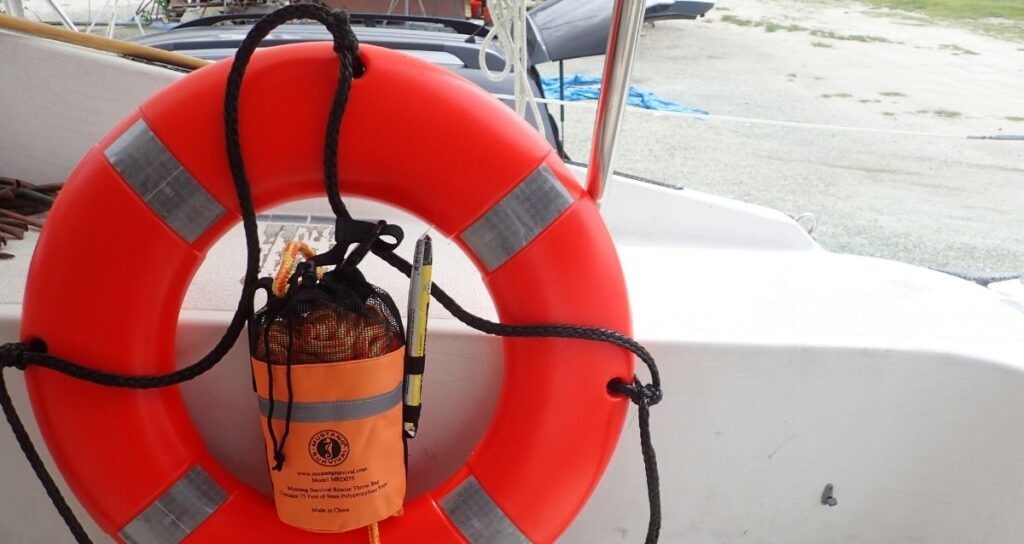
When we were getting Barefoot Gal ready to be put into storage, we stripped everything off the deck—including all of our boat safety gear. While Dave worked on other projects, I took the opportunity to inspect our marine safety equipment item by item.
What I found was unsettling. Several pieces of safety gear would not have worked in an emergency. Thankfully, we hadn’t needed them—but realizing that they might have failed when we did was more than a little scary.
When we bought the then 16-year-old boat, it came equipped with a Jim Buoy horseshoe buoy (a throwable flotation device) mounted on the lifeline, along with a throw bag and line. The idea was simple: if someone fell overboard, you could throw the buoy, then use the line to retrieve it—or help pull a person back to the boat. A throwing line isn’t required safety equipment, but the Coast Guard strongly recommends it. And given my throwing accuracy, it seemed like a very good idea.
As I removed the horseshoe buoy from its mount, the problem became obvious immediately: the line was literally disintegrating in my hands.
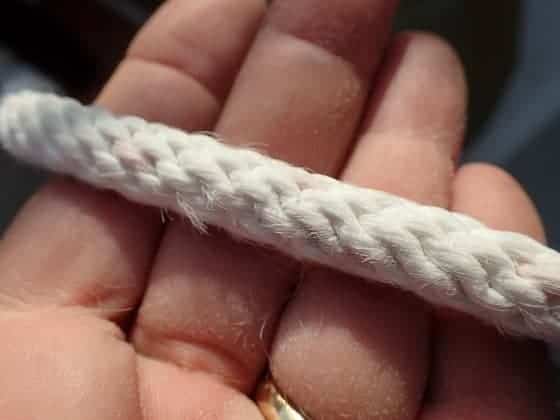
The line was polypropylene, which is commonly used for throwing lines because it floats. But polypropylene degrades badly with long-term exposure to sunlight. Often, only the ends are affected—but when I started pulling the line out of the bag, I discovered that the entire length was falling apart. The bag itself didn’t fare any better; it came apart as soon as I handled it.
Clearly, the throw bag and line needed to be replaced. (And even after replacing them, we later had to do so again—UV exposure is just brutal on safety gear that lives on deck.)
That discovery prompted me to take a closer look at the throwable flotation device itself.
The outer cover showed obvious sun damage, but the real shock came when I took the horseshoe buoy down to the dock and put it in the water. Slowly—very slowly—it sank.
Yes. Sank.
A throwable flotation device that doesn’t float is worse than useless. The horseshoe buoy went straight into the trash, clearly marked “DOES NOT FLOAT” in permanent marker. I didn’t want anyone rescuing it from the dumpster and assuming it was safe to use.
I don’t mean to suggest that the throw bag, line, or horseshoe buoy were poor products. They weren’t. They were simply old and had spent years exposed to sun, weather, and salt. Like all marine safety equipment, they had a service life—and that life was long over.
I continued inspecting the rest of our boat safety gear and discovered that our Lifesling was also not ready for use (I’ve written more about that experience separately).
Like many new boat owners, we’d been so excited to get out cruising that we focused on making sure the required safety equipment was on board—but not that it was actually functional. That was a mistake.
Boat safety gear isn’t something you check once and forget. Man overboard gear, throwable flotation devices, lines, and recovery systems all need regular inspection. Just like engines, rigging, and lifelines, marine safety equipment degrades over time—especially when it lives on deck in the sun.
If your safety gear won’t work when you need it, it doesn’t belong on the boat. Periodic inspection and timely replacement should be part of every boat maintenance routine—and part of your ongoing cruising budget.
Because someday, your life—or someone else’s—may depend on it.
Learn More
Inspecting safety gear is just one of many routine tasks that come with living on a boat. If you want a clear, practical overview of what boat life really involves day to day—and step-by-step guidance for the things most people don’t even realize they need to know—our on-demand online course, The Basics of Living on a Boat, walks you through it all.

Carolyn Shearlock has lived aboard full-time for 17 years, splitting her time between a Tayana 37 monohull and a Gemini 105 catamaran. She’s cruised over 14,000 miles, from Pacific Mexico and Central America to Florida and the Bahamas, gaining firsthand experience with the joys and challenges of life on the water.
Through The Boat Galley, Carolyn has helped thousands of people explore, prepare for, and enjoy life afloat. She shares her expertise as an instructor at Cruisers University, in leading boating publications, and through her bestselling book, The Boat Galley Cookbook. She is passionate about helping others embark on their liveaboard journey—making life on the water simpler, safer, and more enjoyable.
Frances Liz Fernandez says
Great reminder
ChrisW says
We have always found the Coast Guard Courtesy Inspection to be useful in forcing this process on an annual basis. It’s not so much the inspection as it is the self inspecting to get ready for it.
Wanita says
United States Power Squadrons, as well as the sister organization, Canadian Power Squadrons, have a free inspection. Utilizing the same CG checklist and these trained volunteers are more than helpful to talk safety with you. Check out your local squadron!
Annette Cleckner Baker says
Each quarter I go through the list.