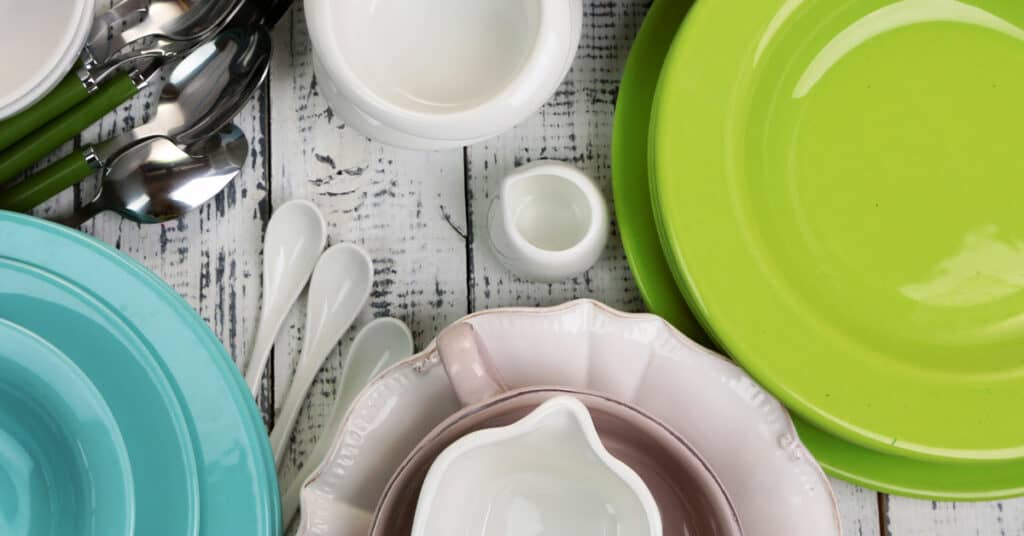
The best boat dinnerware is Corelle (Amazon). It looks like real tableware, holds up beautifully, and still looks good years later. I’ve used it through thousands of miles of cruising, and I’d choose it again without a second thought.
That said, let me tell you about the path I took to get there — and why I don’t recommend the other options.
Why Dishes Break on Boats (It’s Not When You Think)
The surprising thing about dishes on a boat is that they rarely break in rough weather. When conditions are bad, everything is stowed. It’s the ordinary moments that get you.
A plate slips out of your hand on the way up the companionway. You set a bowl down for just a second on a surface without a lip, a passing fishing boat throws a two-foot wake, and the boat gives a quick roll. And there you are, cleaning up broken china, carefully, because you’re barefoot.
Then you realize you’re short a plate. And depending on where you are, replacing it might take weeks.
That’s why I use unbreakable dishes. Or as close to unbreakable as I can get while still having something “nice.”
What to Skip
Plastic Camping Sets and Aluminum
These technically work. But aluminum is thin, dents easily, and makes everything taste faintly metallic. Cheap plastic sets feel exactly like what they are. Good boat dinnerware doesn’t cost that much more, and it makes life aboard feel like a home rather than a campsite.
Skip both.
Tempered Glass
There was one company that made excellent tempered glass dishes specifically for boats. It’s been discontinued, and I haven’t found a worthy replacement. Until something solid comes along, I wouldn’t go this route.
Melamine
Melamine is the one I get asked about most, so let me be clear: it won’t break. If you have small kids aboard, or someone who drops things constantly, that’s genuinely useful.
The problem is how fast it starts to look terrible.
Que Tal came with a set of melamine dishes when we bought her. Within a few months, knife marks had marred the surface. The colors faded just from daily washing. The plates were still perfectly usable — they just looked dingy and worn. Melamine also stains badly. Coffee, tea, and beets were the main culprits for me, and getting the white parts white again required a bleach solution.
One more thing: melamine cannot go in a microwave. If you use one aboard, the plate will bubble up and turn black.
If melamine makes sense for your situation, there are plenty of colorful sets on Amazon (Amazon). Just go in knowing it won’t look new for long.
Why I Choose Corelle
Corelle (Amazon) calls itself break-resistant, not unbreakable, and that’s honest. In years of using it in apartments, camping, and aboard Que Tal, I’ve had two pieces break. The first required dropping a heavy skillet directly onto it. The second shattered, so I want to be upfront: Corelle is not shatterproof. But in normal boat life, it holds up remarkably well.
What I love about it is that it actually looks good. It feels like real tableware, not something you’re making do with. And unlike melamine, it doesn’t show knife marks, the colors don’t fade, and it doesn’t stain. After years of use, it still looks like the day I bought it.
It also stacks thin, which matters when storage space is tight.
One thing to know: Corelle doesn’t have a nonslip bottom surface. Neither does melamine. You can fix this easily though — see Non-Slip Solutions for what works.
Which Corelle Pieces to Get
Before you order, measure your storage cubby. On older boats — Que Tal included — the cubbies weren’t designed for today’s oversized dinner plates. You may find that lunch plates fit better and actually look fine on the table. Square plates, where available, save even more space.
For plates, I went with plain white rounds (Amazon). I pick up textiles as I travel and use them as placemats and table runners, so solid white works with everything. Corelle also makes square plates (Amazon) if that suits your storage better.
For bowls, the Super Soup Bowl (Amazon) is deep enough to actually contain soup when the boat is moving. I also use Corelle’s smaller bowls constantly — the 12-ounce size (Amazon) and the 6-ounce size (Amazon) are perfect for nuts, olives, snacks, and dips.
For mugs, I don’t use the Corelle ones. Instead, I use insulated mugs with lids (Amazon). They keep drinks hot longer, and the lid is a real advantage underway or when you keep getting pulled away mid-cup.
For serving, I skipped the specialized serving dishes on Que Tal and just used extra plates and bowls. Easier to store, and they pull double duty.
How Many Do You Need?
Corelle sets (Amazon) typically come in sets of 4 or 8. For just the two of you, four sounds like enough — but it often isn’t. When guests come aboard, when you need serving dishes, or when the dishes pile up on a passage, you’ll wish you had more.
I started with four and kept adding. If you entertain at all, or plan to take crew, go straight to eight. You can also buy individual pieces to round out a set.
More Info for the Cruising Life
If you found this useful, I send a free newsletter every Wednesday to 22,000 cruisers and liveaboards — covering passage planning, provisioning, boat systems, and the real day-to-day of life aboard. Sign up here.

Carolyn Shearlock has lived aboard full-time for 17 years, splitting her time between a Tayana 37 monohull and a Gemini 105 catamaran. She’s cruised over 14,000 miles, from Pacific Mexico and Central America to Florida and the Bahamas, gaining firsthand experience with the joys and challenges of life on the water.
Through The Boat Galley, Carolyn has helped thousands of people explore, prepare for, and enjoy life afloat. She shares her expertise as an instructor at Cruisers University, in leading boating publications, and through her bestselling book, The Boat Galley Cookbook. She is passionate about helping others embark on their liveaboard journey—making life on the water simpler, safer, and more enjoyable.
lsmith says
Hi Carolyn
I enjoy reading your posts on facebook. I wanted to share my experience with boat dishes. I have a set of Galleyware melamine (the brand West Marine carries) that came with my 20 yr old boat. They were not new but still look great. I added some pieces to the set. In 2009 I spoke to the Galleyware rep at the Annapolis Boat Show. He stated that warming (up to one minute) in a microwave is fine on their dishes. He had the exact specs (time vs. wattage)for different microwave ovens. I found this to be true.
I have a friend on another boat who cautions against Corelle. She had more than one piece shatter. She stated that the shards were far more insidious to clean up than if they had been regular glass.
I hope this is helpful. Happy boating!
Lisa
s/v CHASSEUR
Carolyn Shearlock says
Thanks for adding the info. I know that you can’t microwave bacon on the West Marine melamine (but yes, it takes far longer than one minute). And interesting about the friend who has had multiple pieces of Corelle shatter — we all have different experiences and I love hearing from others about theirs.
Jeanine on Facebook says
I like how the square Corelle styles store so easily and do not roll.
tami says
Second on the Square Corelle! Can you say, “fits in the locker”? I knew that you could.
behan says
Two thumbs up for Corelle!
Living aboard / cruising for 3.5 years and counting… 3 kids and lots of dropped dishes… corelle the whole time… not a single piece broken yet! It felt like a compromise at first because I compared them to the heft of our Williams-Sonoma dishes from land life, but I don’t feel that way any more and would get them again in a heartbeat.
Micheale says
Hi Carolyn,
Thanks for sharing this information. We are excitedly planning a move to the Caribbean to charter our own boat later this year. As I am in the process of liquidated our current household, I have been debating what dishes & kitchenware to take, and what will have no use on the boat. I love my serving platters and nicer dinnerware, but realize it is not practical on the boat. You confirmed that Corelle is probably the best choice!
Thank You,
Micheale
Tamera Buckley says
Micheale,
We like in Texas and are also liquidating our household and was wondering about glass baking dishes like Pyrex, are they considered unbreakable? I have a lot of pyrex baking dishes but not sure if they would be safe on a boat?
Any comments?
Tamera
SV Kooky Dance
Downeaster32 says
Recently picked up a “double walled stainless steel mixing bowl” which is definitely unbreakable and will keep my hot foods hot and cool foods cool. Ridiculously cheap as well, at Cost Plus. Of course it matches all the stainless elsewhere in the galley, shiny and bright.
The small mixing bowl is about the right size for the boat’s “super jumbo salad bowl”, ha. Size is always relative 😀
Nita Knighton on Facebook says
Melamine makes a pattern that looks as if its cut marked ( beige) , any marks you make add to the pattern. I found them at Walmart
Sharon Kay Lough on Facebook says
I have plain Corelle with a blue band.
Chris Link says
For fellow cruisers on the way south, Vero Beach has a Corning Ware Outlet with great prices, huge selection and helpful staff.
Norm Pettett on Facebook says
I’ve dropped Corelle before and have it magically turn to slivers.
Dan Thomas says
I have found that the Corelle Pie dishes make a great boat plate or serving platter. Think of a plate with a 1 ” or so lip around the edge. The side wall helps keep things on the plate, or can be used to cook in.
Gloria Rooney says
Have used Corelle on the boat for over 30 years now and have only broken 2 pieces. I heartily endorse Corelle and just bought one of the square sets!
Roland Aubin on Facebook says
Nancy Bradley Aubin, here’s a good one!
D and Don svsoutherncross says
I concur with Carolyn, for us Corelle is best. We purchased our Pacific Rose pattern at the Corelle outlet store near Cincinnati Ohio, as before we left for cruising we lived in Columbus. As Carolyn says, buying individual pieces was the most cost effective for us since we did not want the coffee cups and saucers in the set. We too keep a set of 8 on board. We have broken one and Corelle replaced it free. It fell on a tile floor from counter height and shattered. It was a job cleaning it up. Even so, I like it better than plastic like melamine. I was going to try and include a photo of the pattern we use, but could not figure out how to do that. I like the tan border as it goes with our teak on the boat. The red and green of the flowers go well with the red and green of our boat colors. I will have to look for those bowls that Carolyn mentioned as I like those better than the ones we have which have sloping sides.
Belinda Wolfe says
I have been using and loving Corelle since before I owned a boat. So, I was thrilled when the previous owner of our boat left me her Correlle. I inherited dinner, breakfast and bread plates in a pattern called “Memphis” which is somewhat nautical and I really like. I’m not sure if they still make it. I also inherited the Souper Soup bowls (blue rim) that Carolyn mentioned which I use a lot – especially as serving dishes. But I added 6 Pasta bowls (all white) which I use a lot for dinner salads, pasta or rice dishes and for serving dishes. I’m thinking of adding two more. I also have the 6 oz bowls that get used for dips, nuts but mostly ice cream! In my 30 years of using Correlle EVERY DAY I have NEVER broken one piece!
Belinda
M/V Rickshaw
(Update: Memphis is still available! https://amzn.to/2OQwyKC)
Kyra Crouzat says
I never seem to come across stuff like this when I’m purchasing items… We have boring yellow melamine plates, I love that design above!
The Boat Galley says
Here’s the link to that set and yes, it’s melamine — very pretty, unbreakable but don’t put in a microwave and they will show wear: http://www.amazon.com/dp/B00CMOYGGQ/?tag=theboagal0a-20
Bill Ryan says
A friend told me about these Deco-plate.com dishes, and We bought a set of 4 to try them out. They are a new kind of food safe plastic that can me microwaved. They are heavier than the melamine dishes we’ve used for years – but they contain no melamine. They appear to be unbreakable (they’ve been dropped many times), , and I’ve put them in a microwave to heat frozen vegetables for 6-7 minutes, and the plate is barely warm. One really nice feature is that they can be customized with your boat name or logo.
Muiris de Buitleir says
Much of the material on your webpage seems to be aimed at a very specific target audience; predominantly American; cruising the east or west coast of the U.S., the Caribbean and South America. The weather involved is mainly hot and humid and the passages would seem to be relatively shorts passages where restocking can be carried out regularly in port, and more importantly food preparation and cooking can be done at an anchorage, in harbour or on passage during relatively calm weather and sea states, although I note that some consideration is given in your articles to long ocean passages and the provisioning issues involved in spending weeks and maybe months at sea. The target crew seems to be predominantly a couple. Refrigeration is a given, and often a considerable degree of refrigeration at that, including a freezer. There is another form of sailing, perhaps more common in European waters, which presents different challenges and invites different solutions.
Food storage, cooking and eating on medium length offshore passages
European Atlantic and Mediterranean sailing needs can be quite different from what seems typical in the United States. Much passage making is short, involving an overnight or two with no more than 48 hours at sea. In these circumstances provisioning and cooking issues are trivial. A crew can easily subsist on pre-cooked food, soup and sandwiches. There is a middle ground of passage making which fits neither the short passage, the more leisurely harbour and anchorage hopping or the long ocean cruise models. Typical of such passages would be crossings from the south of Ireland to southern France, the north of Spain or Gibraltar or, if heading north, from the east coast of Ireland to the Hebridean Islands in Scotland. Such passages would involve, on average, passages of 500-600 NM and five to six days at sea without recourse to land. Atlantic weather and seas can be extremely rough, cold and wet, even in summer, so catering for such passages throws up (no pun intended!) some interesting challenges.
Firstly the boat may be more strongly crewed than the standard husband and wife couple; a skipper and four crew standing watches in twos would be typical. Secondly built-in refrigeration may be non-existent. Cooking will have to be carried out at sea under whatever conditions happen to prevail at the time and there are more mouths to feed. Simplicity and ruggedness in the galley area and careful preparation before sailing are a sine qua non of success. The following are some thoughts on how to deal with these circumstances.
Four particular pieces of technology – the high insulation Eskimo ice box, the vacuum packer, Tefal Wikook pots and the humble stainless steel dogie bowl – provide potential key elements to successful catering at sea in such situations:
The first issue is that food needs to stay safe and edible for at least six day without refrigeration and the primary problem, for carnivores, is meat. Tinned (or canned, as Americans would have it) meats in Europe (particularly Ireland and Britain) leave a lot to be desired. Much of what is on offer in supermarkets consists of cooked meals such as ‘steak and kidney pie’ or ‘chili con carne’ where much of the contents of the tin consists of non-meat components and what meat there is smothered in thick glutinous gravy and cooked into a slurry. Delicacies, which seem to be available on the American market, such as canned whole chicken breasts or canned roast beef simply don’t exist in Europe. If one wants to eat decent meat then tins are not the way to go. The alternative, is relatively simple, but I haven’t seen it proposed anywhere in the sailing literature.
The Ansuo Eskimo Prestige cool box is rated to keep ice frozen for up the ten days, so allowing for manufacturer’s hype and exaggeration, it should be more than adequate for storing frozen meat for six days.
Eskimo Prestige Ice Box Buffalo Domestic Vacuum Packer
A 20 litre capacity box with interior dimensions of 336mm x 215mm x 265mm would be more than adequate to store a five man crew’s meat rations for 6 days. The meat preparation is easy: suitable meats – chicken breasts, round steak, minced beef, leg of lamb, or even firm fish such as monkfish is taken fresh from the butchers or fishmongers, diced, measured into meal-sized quantities (750 grammes to one kilo would be about right for a five person crew), vacuum packed, labelled, and frozen in the home freezer. When fully frozen the packs can be loaded, with crushed ice, into the cool box just prior to departure. If the packs are loaded in reverse order of use, they can be taken out each day as required with minimum disturbance to the temperature in the box. No boat galley preparation is required; the meat is ready to go straight into the cooking pot.
Two pot cooking is ideal. The meat with the flavourings and sauces go into one pot depending on recipe (Thai yellow curry chicken with coconut and carrots; minced steak in Bolognese sauce; Algerian lamb with spices, apricots and sultanas; Beef Gulash or Stroganoff, Monkfish curry; Carbonara sauce with bacon, onions and cream, to mention just a few possibilities). The carbohydrates go into the second pot (Basmati rice, pasta- penne or shells- (spaghetti, tagliatelle or other long pastas are too hard to manage on a boat in motion), couscous, potatoes (either diced or mashed). All these can be vacuum packed into five- man- meal sized portions (around 500 grammes per cooking) reading for decanting straight into the pot without the need for measurement on board. This brings us to the subject of cooking pots.
The French company Tefal have come up with a cooking pot that is tailor-made for small boat sailors. It’s not quite a pressure cooker and has none of the clamps, weights and valves associated with these monsters, but it seals with a simple twist of a knob and provide a degree of pressure which speeds cooking by 25%. It is easy to open in mid-cooking to adjust or add ingredients and the locking lid provides protection against dangerous spills and splashes likely to be caused by a vigorously moving boat. With a 4 litre capacity it is just about ideal for a five man crew, and two of these pots, while somewhat expensive (around €50 each in France, but strangely three times more expensive in the UK and Ireland) would provide all the cooking pots a small boat needs (one for meats, one for carbs.). Because of their compact size and neat side handles they would be easy to clamp to the cooker using high fiddles and spring hooks and would be stable and safe in any seaway. Their other huge advantage is that they are coated with non-stick Teflon inside and out and thus are very easy to clean after use (who enjoys scrubbing greasy pots while being bounced around in a small galley?)
In terms of other foods, most are readily available from supermarkets packed suitably in tins, tetrapaks, vacuum packs, or sealed foil bags, ready for storage on board without any further preparation and capable of lasting, without spoiling, for well over the time period required. Those which do not come in suitable cooking sized portions can be broken down and vacuum packed. UHT milk, orange juice, soups, beans, peas, yogurts, cheeses, cooked meats, tinned fruits, oat flakes, muesli, dried fruit, tea, coffee, biscuits, crackers, rusks, energy bars, etc. come into this category. Fresh fruit and vegetables will easily last the required six days. The only remaining provisioning problem is bread.
Despite scientific advances in food hygiene and preservation, no one seems to have come up with a suitable way of prolonging the life of bread. Staleness and mould are still the enemy. Bread can be frozen but its bulk makes it a poor subject for the limited and expensive space available in a cold box. Best option is to find bread that stays good naturally for 6 to 7 day. A little bit of hardness needn’t be an issue as long as mould keeps its distance. Some proprietary breads that are dosed with preservatives may keep them mouldless a little longer, but the thought of eating chemical additives is not a happy one. Dried bread such as croutons, rusks, crispbreads, etc. will keep without spoiling for much longer than soft bread but they don’t make very manageable or appetising sandwiches. Fruit cakes also last well but a ham, cheese and tomato filling to two slices of sweet fruit cake would not be a great attraction in rough seas. Some rye breads seem to last better than the sliced white variety and could be an acceptable option. They may just last the required five or six days unspoilt. Baking may be a way around this issue but in the circumstances being discussed (six days under way in potentially rough seas) bread making involving, mixing, kneading, raising and baking, is not really viable.
Having dealt with how to cook things, the last issue to be addressed is how to serve and eat them. Crews on the type of passage that we’re talking about will normally eat in the cockpit. Eating in the cabin in any sort of a seaway is not a pleasant experience. Many medium length passages operate informal day watches (crew in the cockpit or taking a snooze as long as there are two crew members on helm and lookout) with formal watches during the hours of darkness. With such an arrangement the entire crew would eat breakfast together at the end of the night watches and dinner together before the beginning of the night watches. Similarly, lunch together, all in the cockpit. Cheap delph, melamine, plastic and Corelle all have their following, but for the sort of cockpit dining we’re talking about, the only practical solution is the stainless steel dog or cat bowl, good and deep and with a wide, silicone non-slip base to provide stability if set down for a moment. The silicone also acts as insulation if the bowl contains hot food or soups. Stainless steel ensures ease of cleaning and more importantly high levels of hygiene, with no porosity, cracking, discolouration or other problems that delph or melamine are prone to. The ultimate improvement would be a click-on plastic lid which would provide further protection against spillage and heat loss.
Glen Adams says
Amen. As a lifelong auxiliary (sail) delivery skipper and passage-maker, I heartily concur – applies on both sides of the pond and everywhere else.
Samantha Pearson Clark says
The trick with Corelle is the age of it. Old vintage Corelle is awesome and was likely the type that broke into two pieces for you. The newer Corelle is awful and shatters into millions of little shards when it breaks.
Jennifer says
Hi ! I would like to know if you recommend buying square dishes as they fit better in cupboards or are round ones fine too ?
Carolyn Shearlock says
I’ve had square dishes and liked how they fit in storage. However, they had other problems (made from a plastic that showed every knife cut) and the dishes that I now recommend don’t come in a square shape. If I could fine ones that looked good, weren’t prone to shattering and were square, that would be ideal.