

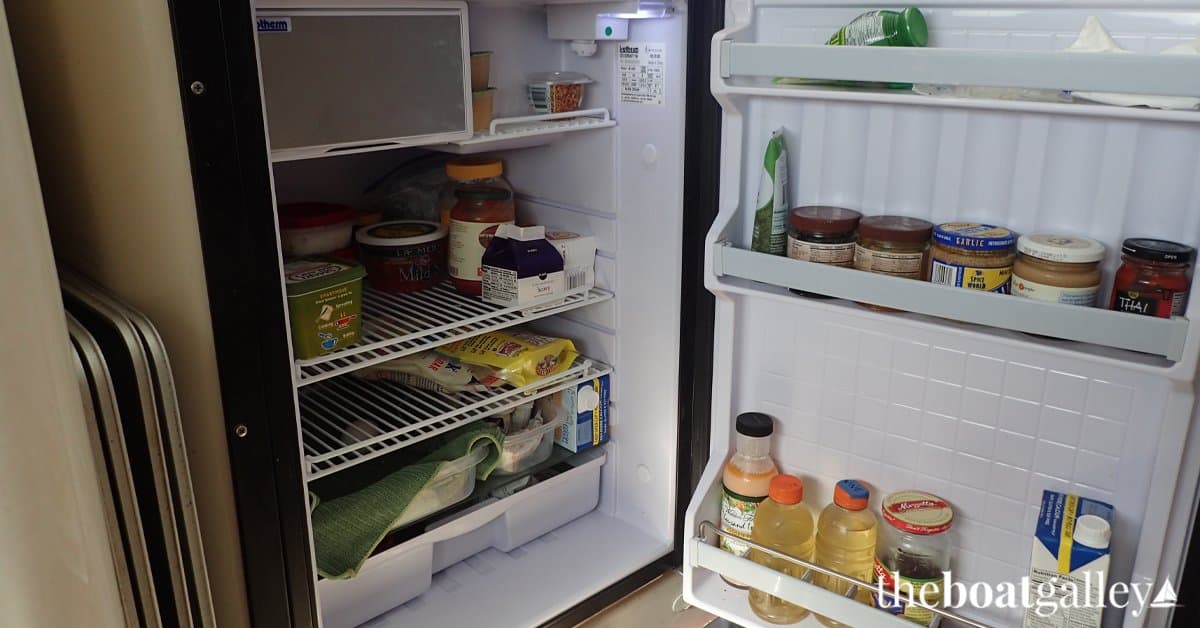
Need to add refrigerant to your boat refrigerator? Or is there another reason it’s not keeping things cool?
Here are a few things you need to know (that no one else will tell you–we found these tips in none of the books we read). But first, know that I’m not a refrigerator mechanic. This won’t be a step-to-step guide to recharging a refrigerator. It’s just a few things I learned in the school of cruiser’s hard knocks. Let’s start with how to make sure you actually need to add it at all.
Other Reasons Your Boat Refrigerator Might Not Be Cold
When the refrigerator isn’t cool, we all assume it needs recharging. It may not. Read why it might be your batteries instead.
It could also be your thermostat. One quick test is to turn the temperature knob down. Does the compressor kick on? Make sure you do this test when the compressor is not already running. As you start turning the knob, the compressor should come on almost immediately. If it doesn’t, you may need to replace the thermostat.
Another possibility is a blown fuse or a bad breaker. Trace your wiring to see if there is an inline fuse. If so, make sure it’s actually there and not burnt out. You can test breakers with a voltmeter. (If you don’t know how, check any boat electrical book. My favorites are Nigel Calder’s Boatowner’s Mechanical and Electrical Manual (Amazon) or Don Casey’s Sailboat Electrics Simplified (Amazon).
If You Do Need Refrigerant…
A refrigerator is a closed system, and refrigerant doesn’t just disappear. If you do need to add refrigerant (and it’s not because you deliberately let some out), you have a leak.
Finding And Repairing a Leak
First, find the leak in the line. Squirt soapy water along the refrigerant line. Where you see it bubbling, you’ll know gas is escaping.
Now you can repair the leak. Rescue Tape is a great “temporary fix” on any of the lines or connectors. JB Weld (Amazon) can fix many holes in other locations, but be careful not to restrict the tube with the epoxy.
Advice from a cruising marine refrigeration specialist is that after a leak, you may have air and moisture trapped in the closed system. After repairing the leak, change the filter drier, and then warm everything up and vacuum down to 30″ Hg for an hour or so, depending on the size of the system. Large cold plate systems may require up to 24 hours of vacuuming.
Don’t Overfill
Most boat refrigeration systems are small and don’t hold that much refrigerant. It is very easy to get too much refrigerant in the system. That will cause over-pressurization and the system will be unable to keep cool. If you just charged it and aren’t really experienced at it, and it’s not chilling like it should, try letting out just a tad of the refrigerant.
Take a Break Between Changes
Whenever you make a change to the system, either adding or letting out refrigerant, give the system at least a day to settle in before you make another change. This will allow the change you made to take full effect and will ensure you can tell what thing you’ve done actually worked.
Carry a Recharge Kit
If you’re doing extended cruising in remote locations, it’s worth getting a recharge kit onboard. You need the hoses, gauges, and correct refrigerant, along with the owner’s manual or other information on how to do it and what the correct pressure is.
It’s actually not that hard to do if you take it slowly. Dave and I had never done it before we recharged Que Tal‘s system. FYI, it’s basically the same thing as recharging a car air conditioning system, and there are tons of YouTube videos showing how to do it. Just know that you can’t use the same refrigerant sold for car air conditioning systems. Although the gas is the same, the oil is different in each bottle, and it’s unwise to mix them (thanks to reader and marine refrigerator engineer Mike W. for this tip).
Good luck — and you’ll LOVE that cold beer (or whatever) when it’s fixed!
Learning Your Boat, One Week at a Time
Confident boat owners are built from small lessons. Our newsletter shares practical tips every Wednesday, from systems and safety to the galley and getting from place to place.
Free from The Boat Galley
The Boat Galley Newsletter
Free, every Wednesday. Unsubscribe anytime.
Keep reading


Carolyn Shearlock has lived aboard full-time for 17 years, splitting her time between a Tayana 37 monohull and a Gemini 105 catamaran. She’s cruised over 14,000 miles, from Pacific Mexico and Central America to Florida and the Bahamas, gaining firsthand experience with the joys and challenges of life on the water.
Through The Boat Galley, Carolyn has helped thousands of people explore, prepare for, and enjoy life afloat. She shares her expertise as an instructor at Cruisers University, in leading boating publications, and through her bestselling book, The Boat Galley Cookbook. She is passionate about helping others embark on their liveaboard journey, making life on the water simpler, safer, and more enjoyable.
Some links in this article (including all Amazon links) are affiliate links, meaning that we earn from qualifying purchases.