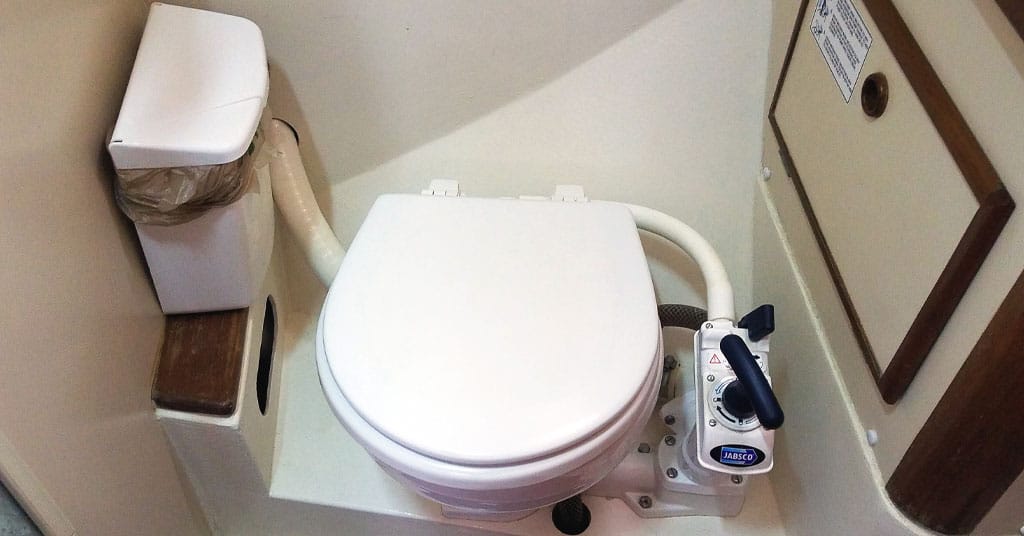
The two most effective things you can do to prevent a clogged marine head are to stop flushing toilet paper and to run a weekly vinegar-and-oil treatment through the pump. Do both consistently and you can go years without a clog.
Don’t Flush Toilet Paper
This is the single biggest thing. Toilet paper is the number-one cause of clogged marine heads, and the fix is simple: don’t put it in the toilet.
Instead, do what people in many parts of the world do with undersized sewer systems. Keep a small lidded wastebasket next to the head, lined with a plastic bag. Drop the paper in there and empty it daily.
To keep odor under control, a spray like Medi-Aire Biological Odor Eliminator (Amazon) works well — a quick spritz after use keeps things completely fresh.
When Dave and I were cruising the Sea of Cortez on our Tayana 37 Que Tal, this was just standard practice. Nearly every cruiser we knew did it that way. After a while it becomes second nature — so much so that we’d come back to the US for a visit and have to remind ourselves it was okay to flush.
If you’re skeptical, consider the alternative. A clogged head in a remote anchorage means you’re the one taking the toilet apart, usually in summer heat, with no plumber to call. That prospect settled the question for us pretty quickly.
Some boats do allow flushing but limit it to two squares per flush. Honestly, I find that more complicated and more unpleasant than just using the wastebasket. But it’s your boat — you know your system and your comfort level.
Educating Guests
Guests are the wild card. They’re used to flushing everything, and they won’t know your head’s quirks.
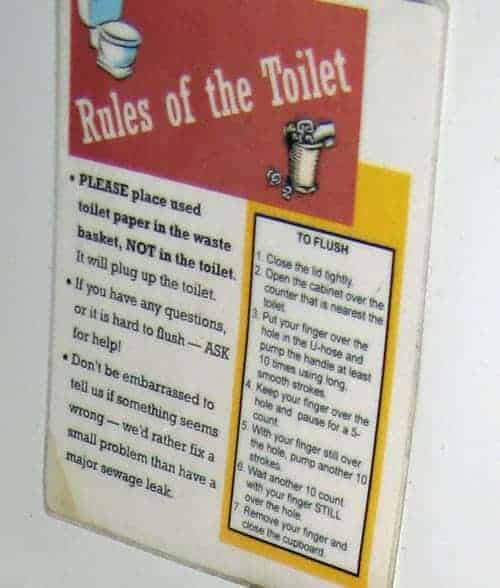
A laminated sign posted in two spots — one above the pump handle and one at eye level from the seat — solves this. Make it friendly and specific to your head, since every marine toilet flushes a little differently. We laminated ours so they’d hold up in a damp environment.
The Weekly Vinegar-and-Oil Treatment
Even if you never flush toilet paper, the pump and hoses need regular maintenance. Urine combines with salt water to create a chalky white buildup inside the hoses. Left alone, it narrows the hose diameter over time and eventually causes a blockage. A weekly vinegar-and-oil treatment slows this dramatically and keeps the pump lubricated.
Check your head’s owner’s manual before starting — most manufacturers are fine with this routine, but a quick check is worth it.
Here’s how to do it:
Pour about one cup of white or cider vinegar into the bowl. Pump a few times to move the vinegar into the hose, but stop before it exits the hose completely. Let it sit as long as you can — right before bed works well. The mild acid dissolves the mineral buildup gradually. It won’t remove heavy existing buildup in one pass, but done weekly it prevents serious accumulation from forming.
Use the head normally the next morning, which pumps the vinegar and loosened deposits out.
Then add about half a cup of vegetable oil to the bowl and pump it through slowly. This lubricates the pump mechanism and keeps the seals from drying out.
That’s the whole routine. It takes a few minutes and costs almost nothing.
When Prevention Isn’t Enough
If you’re already dealing with a sluggish or partially blocked head, the weekly vinegar treatment alone may not clear it.
For stubborn buildup in the discharge hose, a bacterial product like Marine Digest-It can break things down without harsh chemicals — and it’s useful for holding tanks too.
For drain clogs elsewhere on the boat, Super Digest-It is worth having aboard as a non-toxic option.
If you’re thinking about making the switch to a composting toilet entirely, Composting Toilet Tips is a good place to start.
The Head Is Just the Beginning
If the marine head is one of those systems you’re still figuring out, it’s probably not the only thing you have questions about. My course The Basics of Living on a Boat covers the head along with 30 other topics that weren’t discussed in any sailing or navigation class: propane systems, anchoring, provisioning, laundry, marina etiquette, and what to do when things go sideways. It’s the orientation nobody gave you — and you can start reading immediately (no shipping; digital access only).

Carolyn Shearlock has lived aboard full-time for 17 years, splitting her time between a Tayana 37 monohull and a Gemini 105 catamaran. She’s cruised over 14,000 miles, from Pacific Mexico and Central America to Florida and the Bahamas, gaining firsthand experience with the joys and challenges of life on the water.
Through The Boat Galley, Carolyn has helped thousands of people explore, prepare for, and enjoy life afloat. She shares her expertise as an instructor at Cruisers University, in leading boating publications, and through her bestselling book, The Boat Galley Cookbook. She is passionate about helping others embark on their liveaboard journey—making life on the water simpler, safer, and more enjoyable.
Sue says
We have to put the finger over the hole in the siphon break too. We put a blob of bluetac over it when we have guests and discreetly check after they gave been to the head.
Carolyn Shearlock says
🙂
Anonymous says
Does the siphon break create a sinking prevention advantage?
Carolyn Shearlock says
Exactly.
Burt Tandy says
The one thing most dealers of electric toilet and most skippers won’t talk about is how solid solid from a very healthy passenger will sit across the toilet drain or straight as a resisting soldier that no amount of flushing will push down. The other funny and interesting one is the small floating fellow who laughs at you and all your efforts to send him down the drain. In just a few months of use, we’ve had about 8 cases of very embarassing situations, no TP involved in the problem with visitors. Makes you regret the porta potti that you just shake in such a case.
Patrick Marlowe says
Toilet paper is not the problem. It’s the type of toilet paper that causes the problem. Our boat had two of the three toilets clog within days of purchase. We use Scott’s RV Marine toilet paper and not had a clog in 4 years of near full time cruising. This type of paper fully dissolves and does not clog. You should at least talk about this as many people would like an alternative. We actually fly toilet paper back to the Caribbean because marine grade TP is so expensive there.