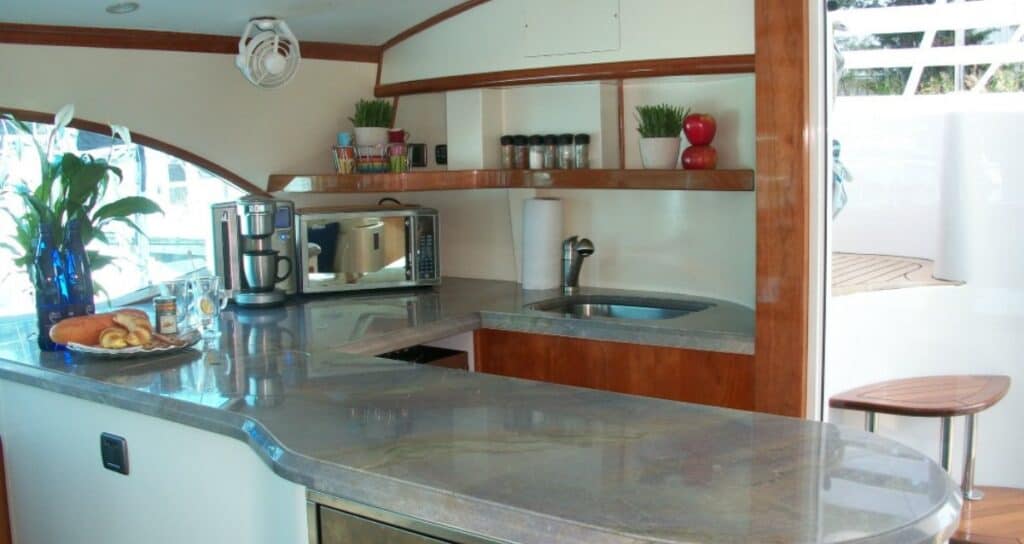
On a cruising boat, you’ll spend a surprising amount of time thinking about where things go. After 17 years of living aboard, I’ve learned that galley storage is less about having the perfect setup and more about understanding what you actually have and making it work.
A reader asked if I’d be willing to post photos of the inside of my lockers and cupboards — as they really are, not staged for a magazine shoot. So here’s an honest tour of my Gemini 105 catamaran, numbered storage area by storage area. No special straightening, no cleaning up first.
Every boat is different, and every person arranges things differently. But if you’ve never lived aboard, it can be hard to even picture how storage works in a galley. I hope this helps.
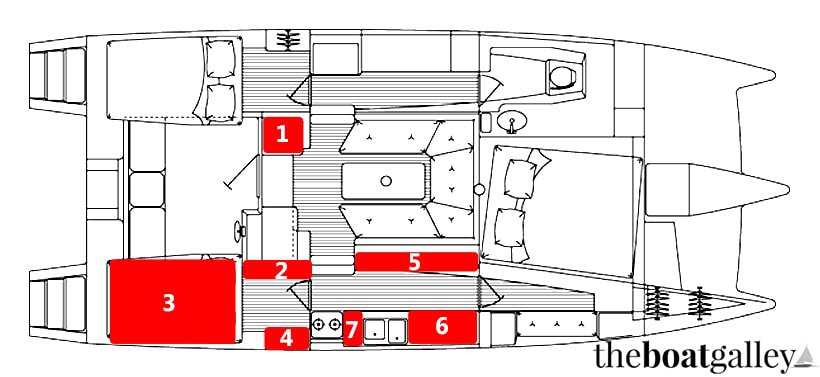
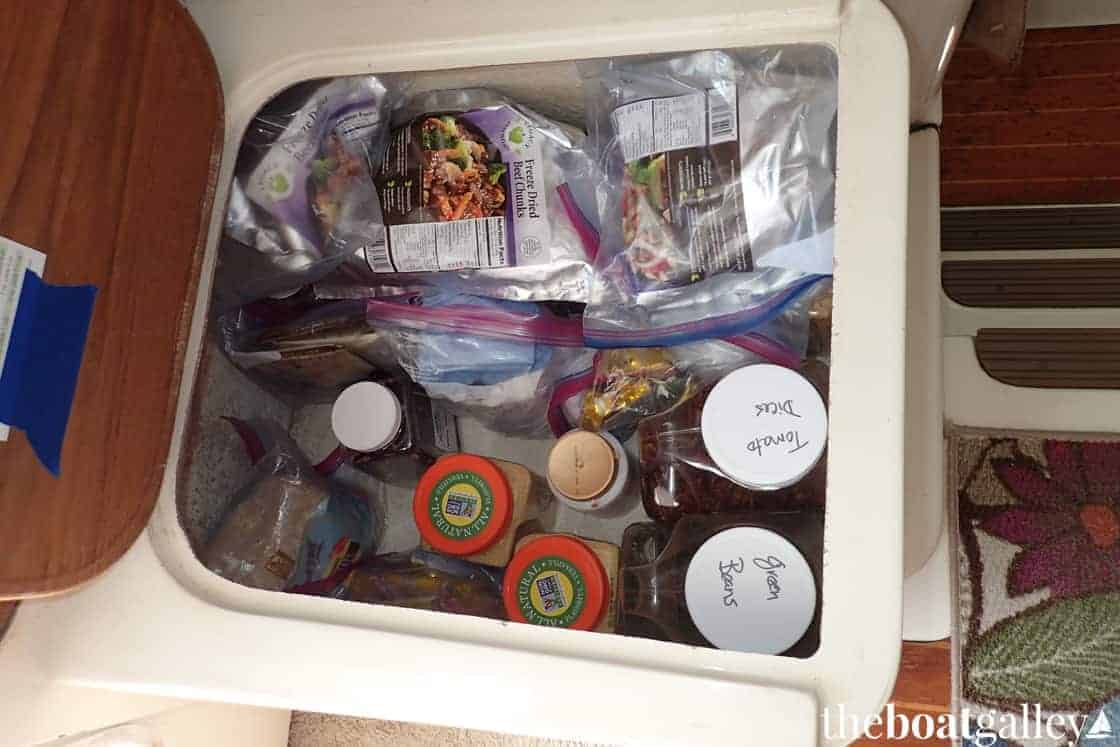
Area 1: Cockpit-Adjacent Storage
Just inside the cockpit door is a low seat with storage inside. It’s top-loading. On later Geminis, this space houses the air conditioning system — but on our boat, it’s usable storage. Right now it’s not full, which is a rare and happy situation.
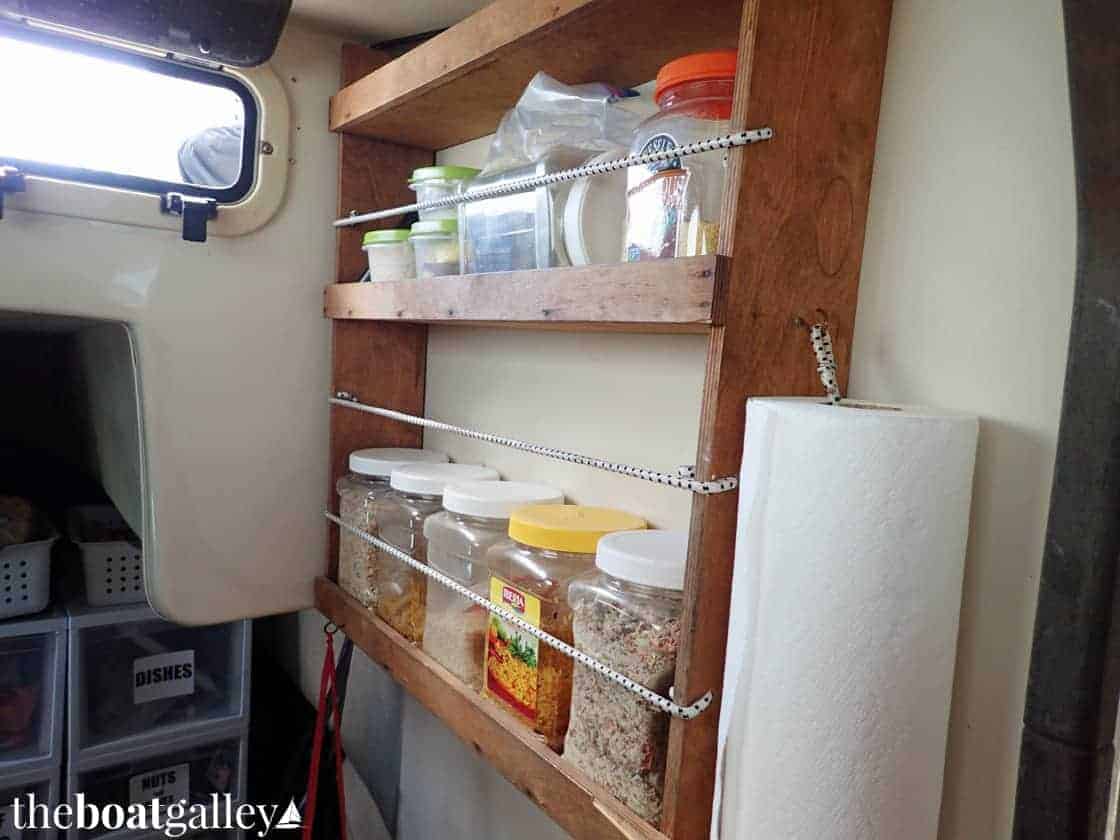
Area 2: Wall Shelf and Shallow Drawer
A wall-mounted shelf unit with a large but shallow drawer underneath. The shelf holds small containers — when we’re underway, I do a better job of securing them with shock cords. Paper towels and trash and recycling bags are here too.
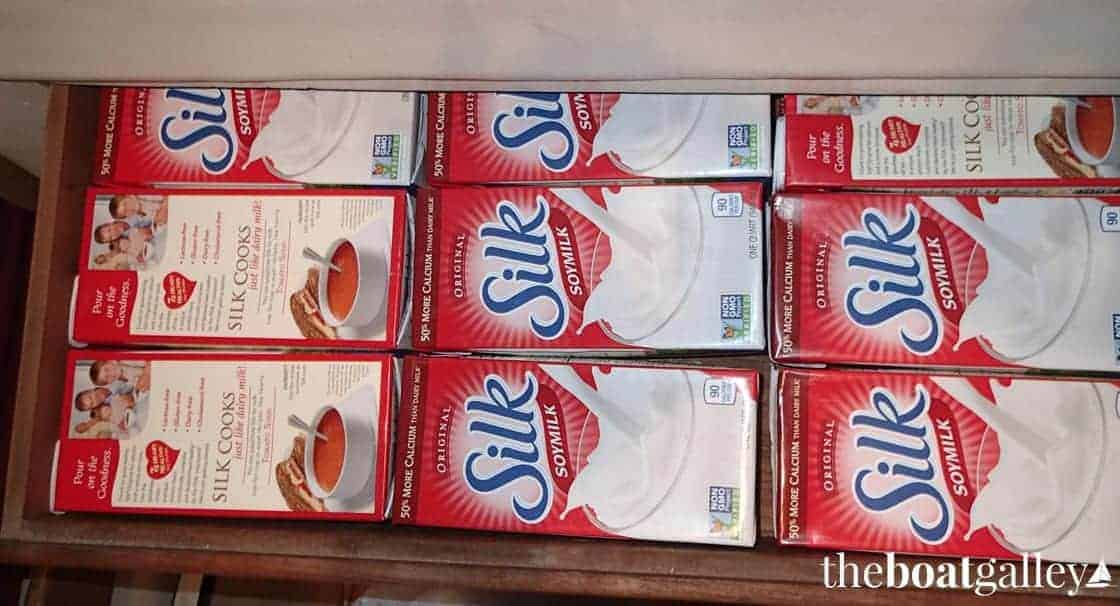
The shallow drawer underneath turns out to be perfect for storing soy milk boxes flat. It’s one of those spots that seemed awkward at first and turned out to be exactly right for something.
Area 3: Aft Cabin Storage
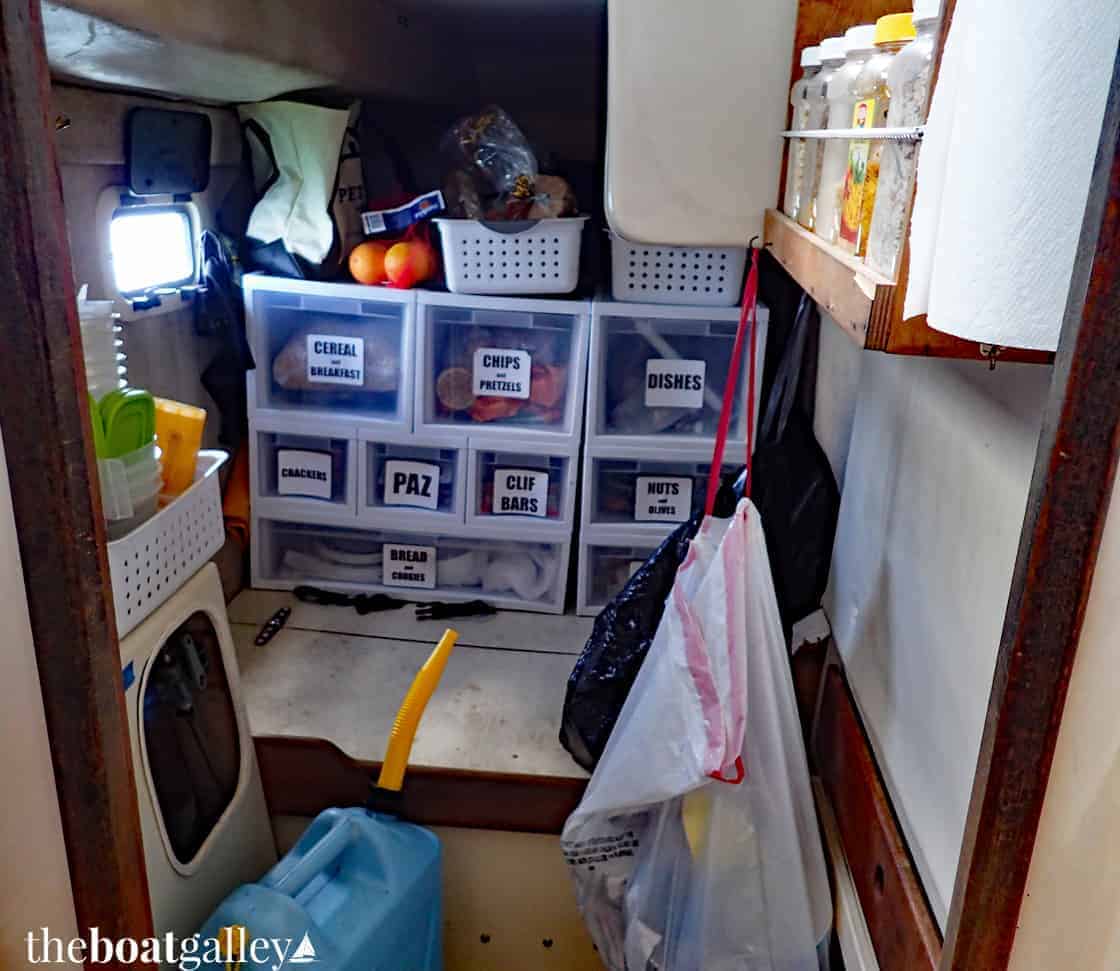
A previous owner removed the cushions from the aft cabin. Our watermaker lives under the bunk, and the front area stays open so we can reach the watermaker controls. Underway, the bins of bread and produce that normally sit on top of the storage drawers move down to the front of this area.
The shopping bag on top holds rags. The water jug on the floor is there because our watermaker isn’t plumbed directly into the tank — we run the hose into the jerry jug and transfer water to the tank through the deck fill.
One note on weight: I’m careful not to overfill this area. Catamarans are weight-sensitive, and it’s easy to get carried away when you’re provisioning for a longer passage.
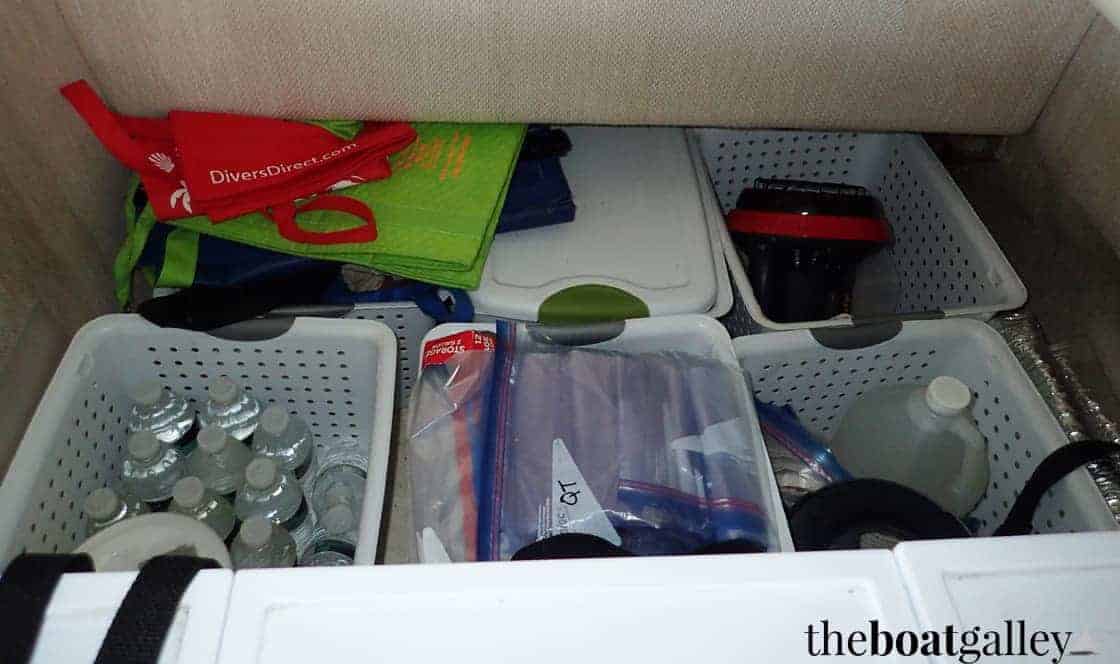
We also keep less-accessible long-term storage bins further back. My dry bags, shopping bags, and soft-sided provisioning cooler normally live on top of those bins. What you see in the photo is our emergency water supply — we don’t use bottled water day-to-day.
Area 4: Shelved Storage
This is a shelved area with drink cans on the lower shelf. A hanging sock holds grocery bags. A fire blanket sits on top of the shelves — easy to grab in a hurry. And a bin held in place with Velcro keeps extra food storage containers corralled. Most of my Lock & Lock containers are in use; these are the extras I keep on hand for leftovers. If you’re still figuring out which containers work best on a boat, The Best Food Storage Containers for Your Boat Galley will save you some trial and error.
Area 5: Odd-Shaped Compartments with Sliding Doors
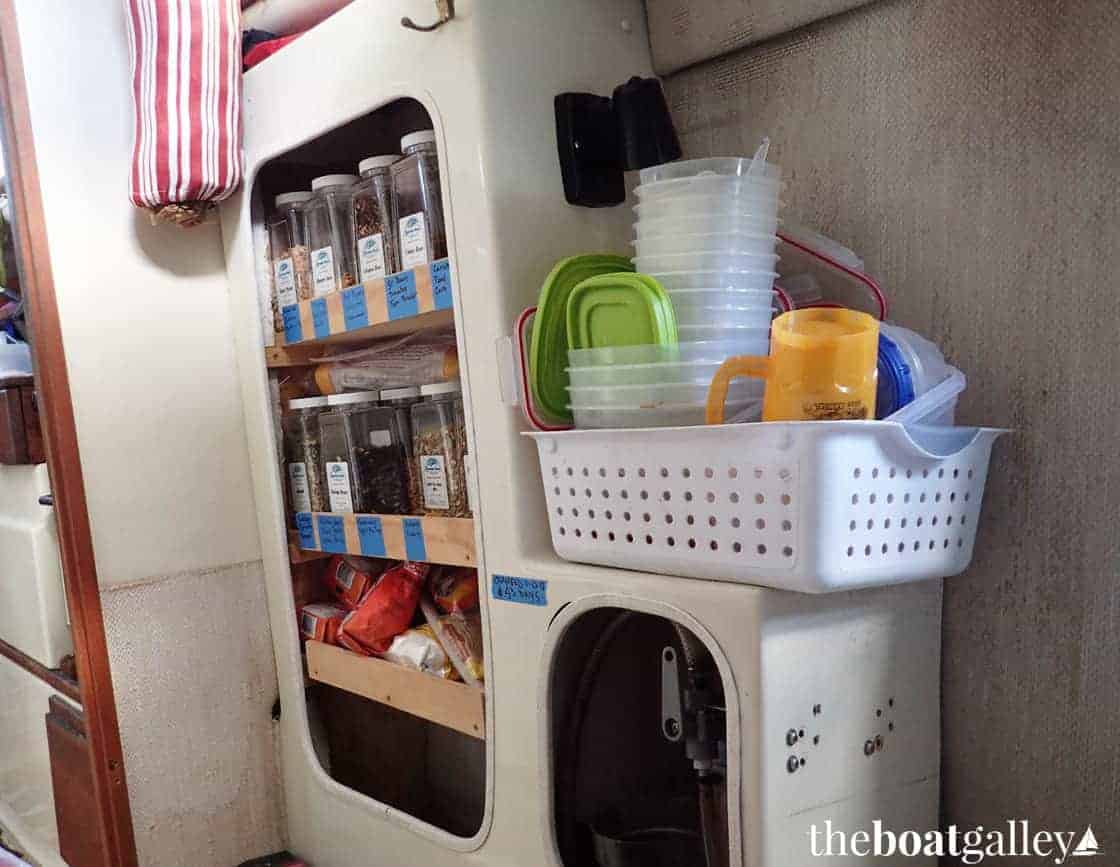
This area has several compartments — above and below, forward and aft — with sliding doors. They’re oddly shaped, which took some creativity to organize.
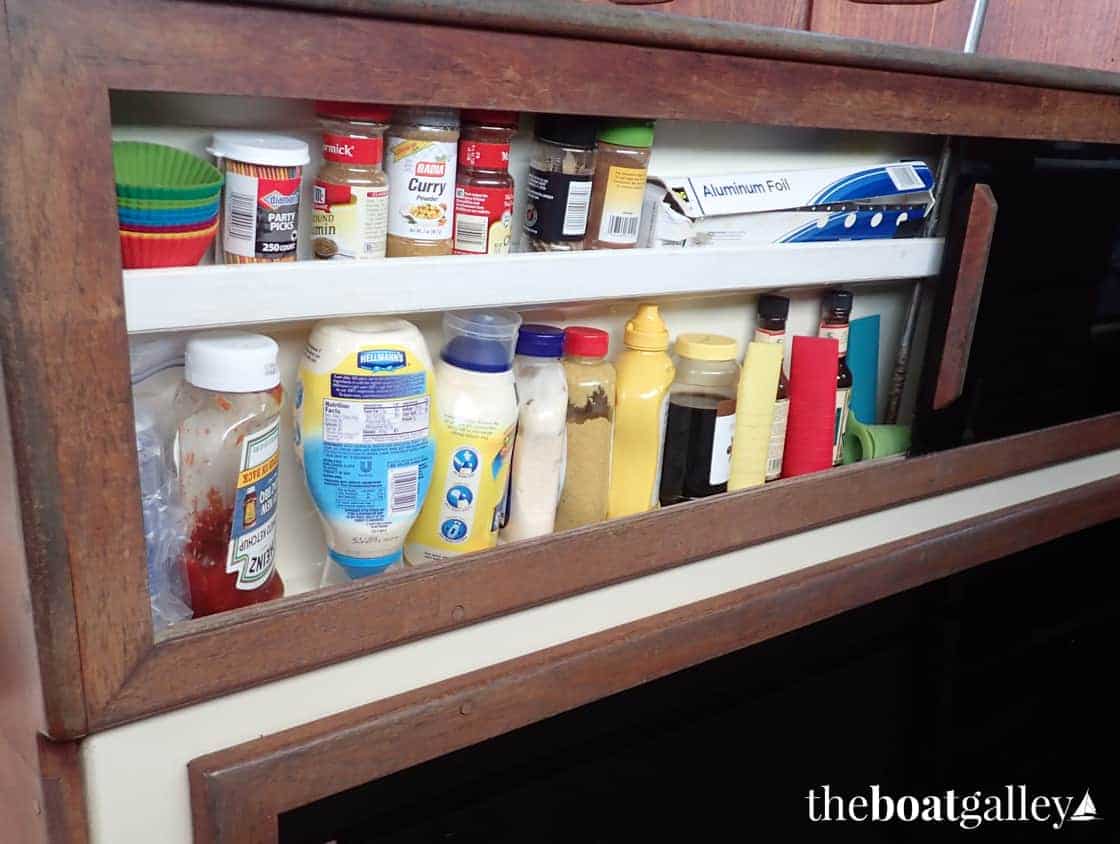
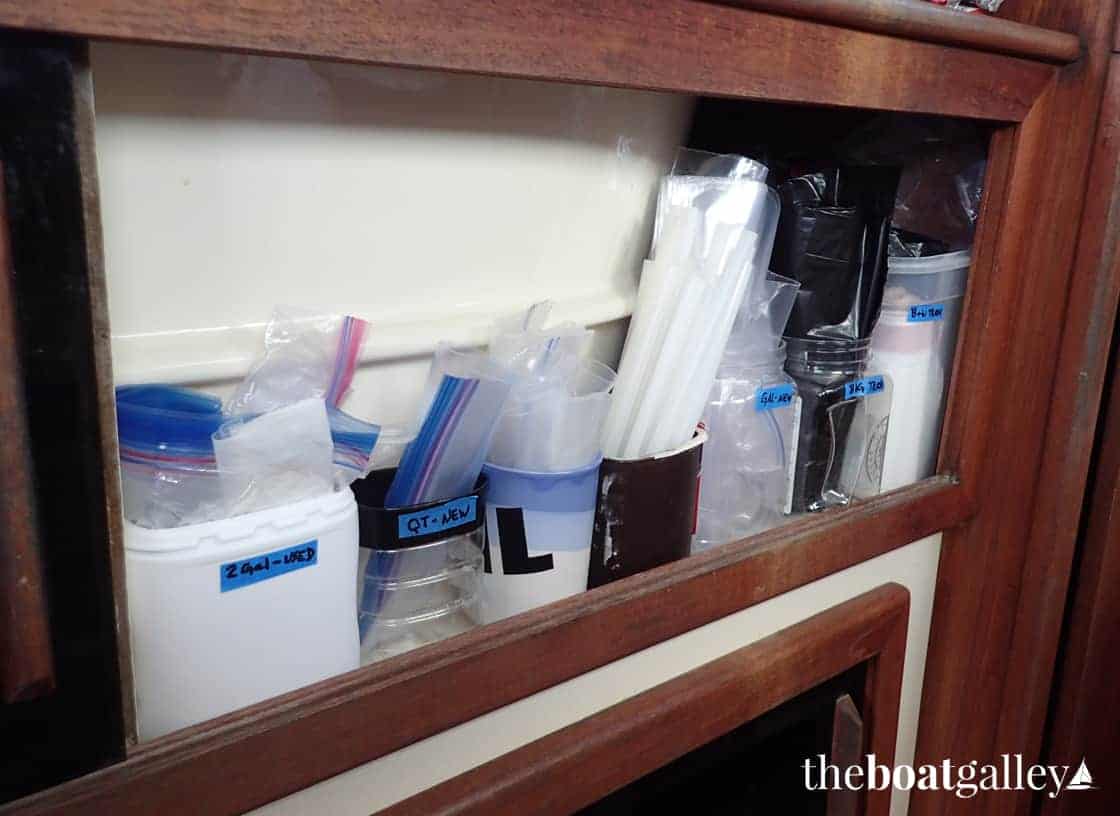
The aft lower section holds baking supplies and cereal up front, with baking pans behind. If I’m baking, I already have the flour and sugar out, so reaching the pans behind them is easy enough. I do have a couple of glass pans — they fit my odd-sized oven, so they stayed.
In summer and when we’re underway, I use plastic bags over the Gatorade, Nido, and bottles on the bottom shelf for a little extra protection from humidty, which will turn the powders rock hard.
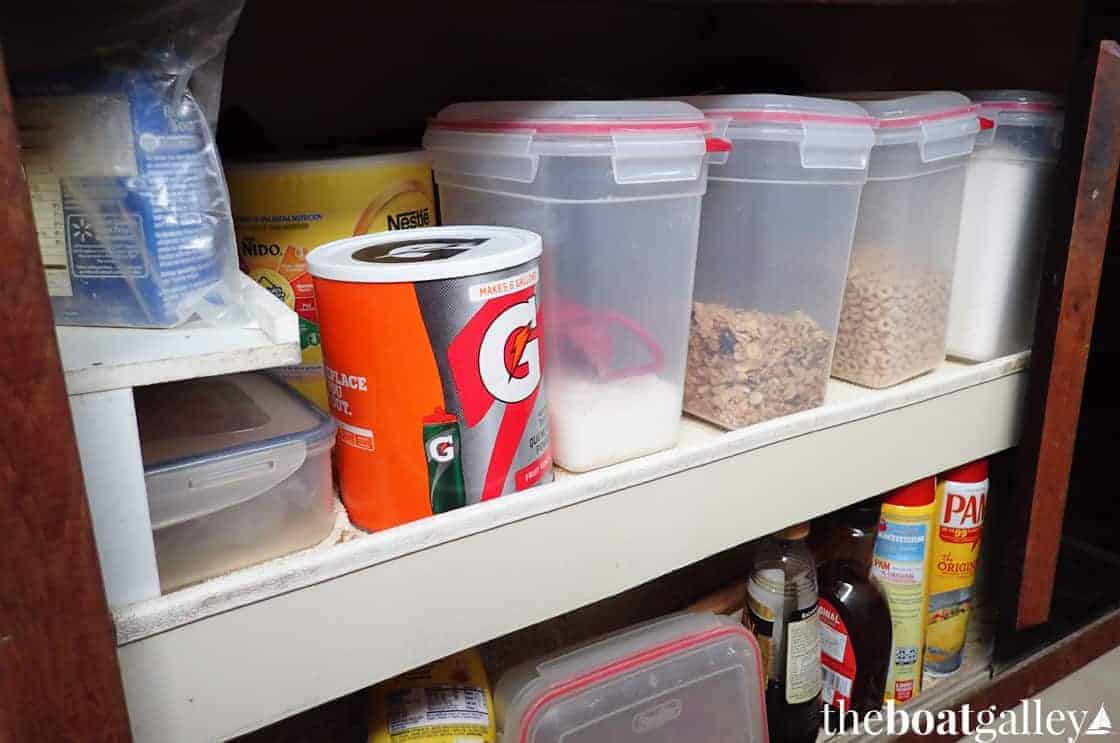
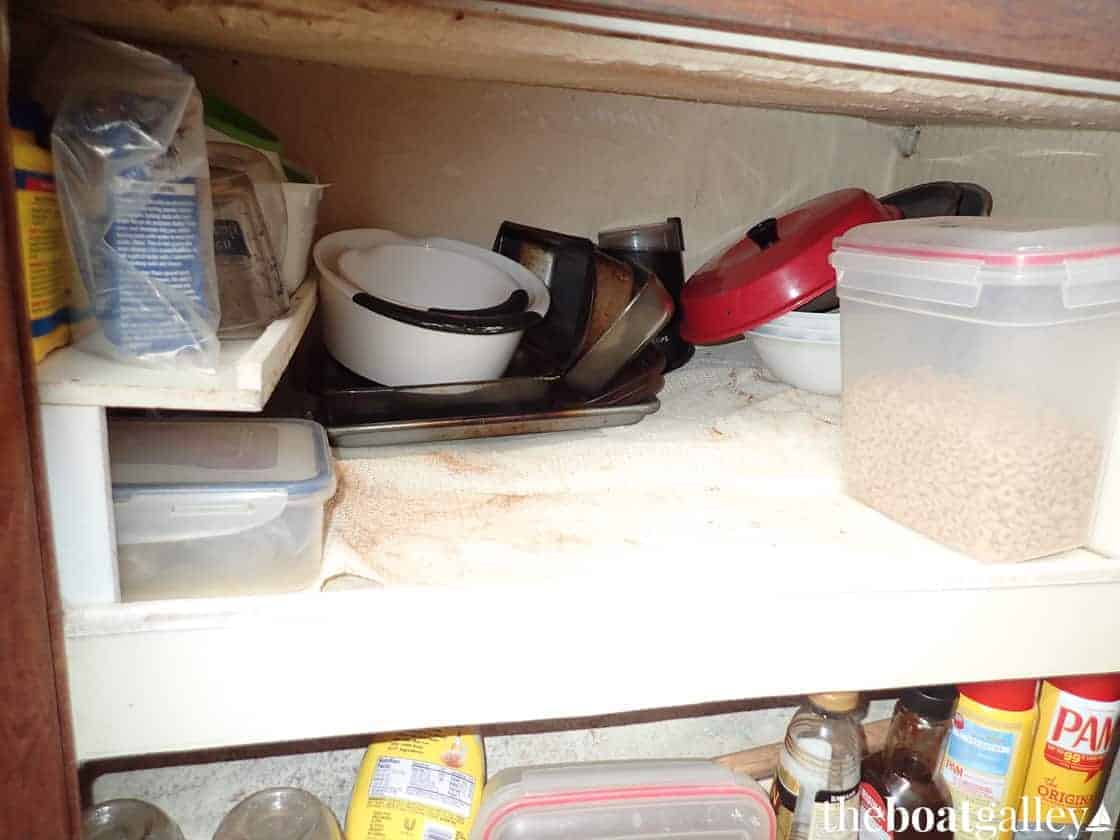
The forward area has a bin for canned meats and storage for dried beans, rice, and similar staples. My American Press coffeemaker, grilling tongs, and grilling sheet live back here too.
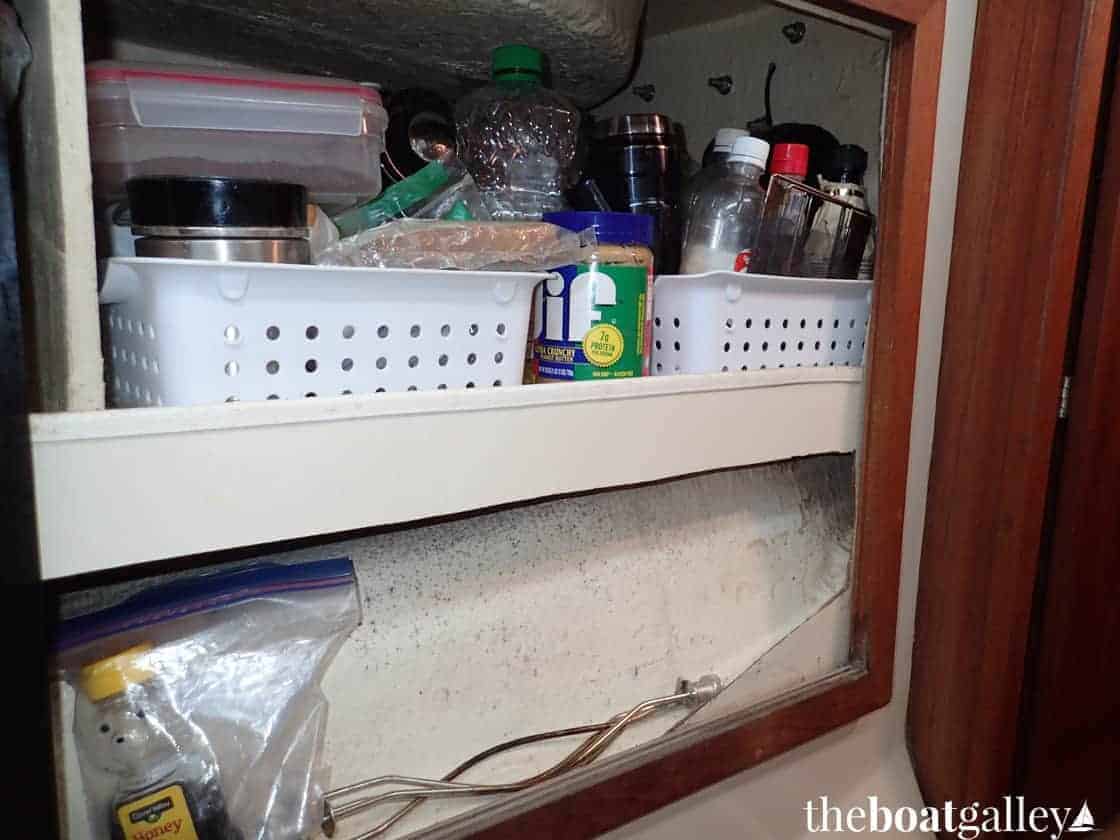
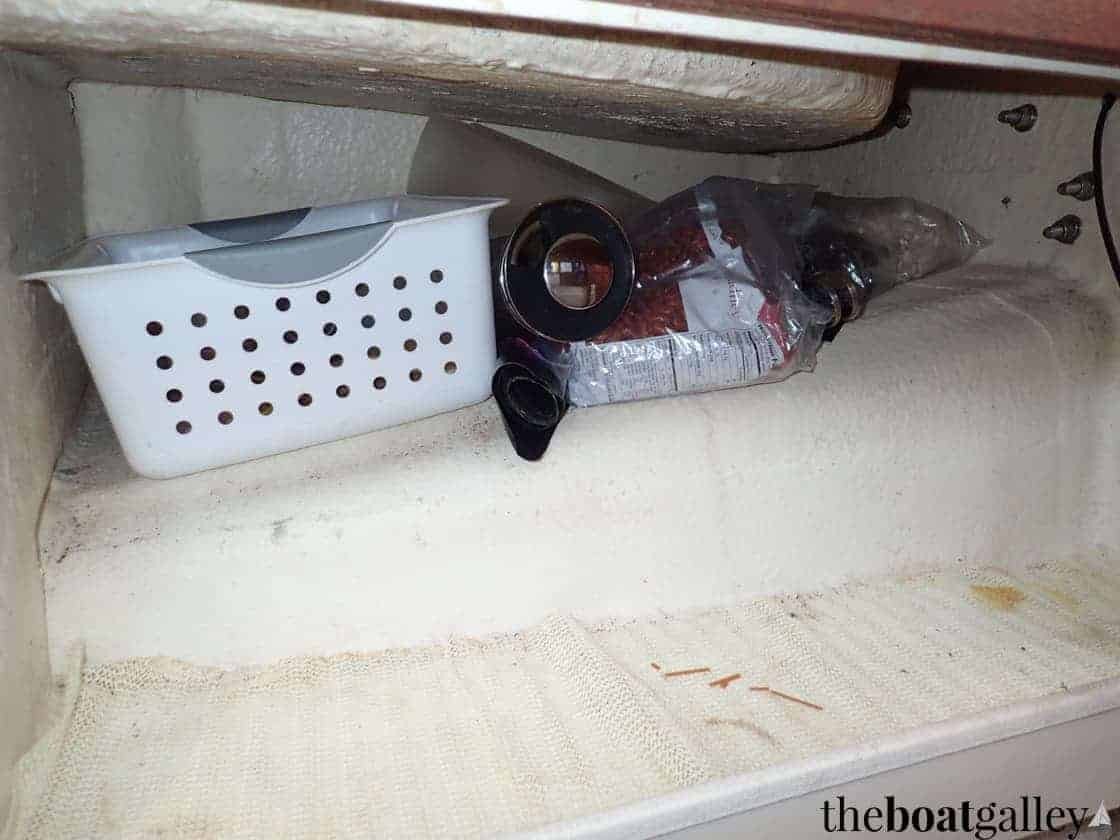
Area 6: Forward Counter Area
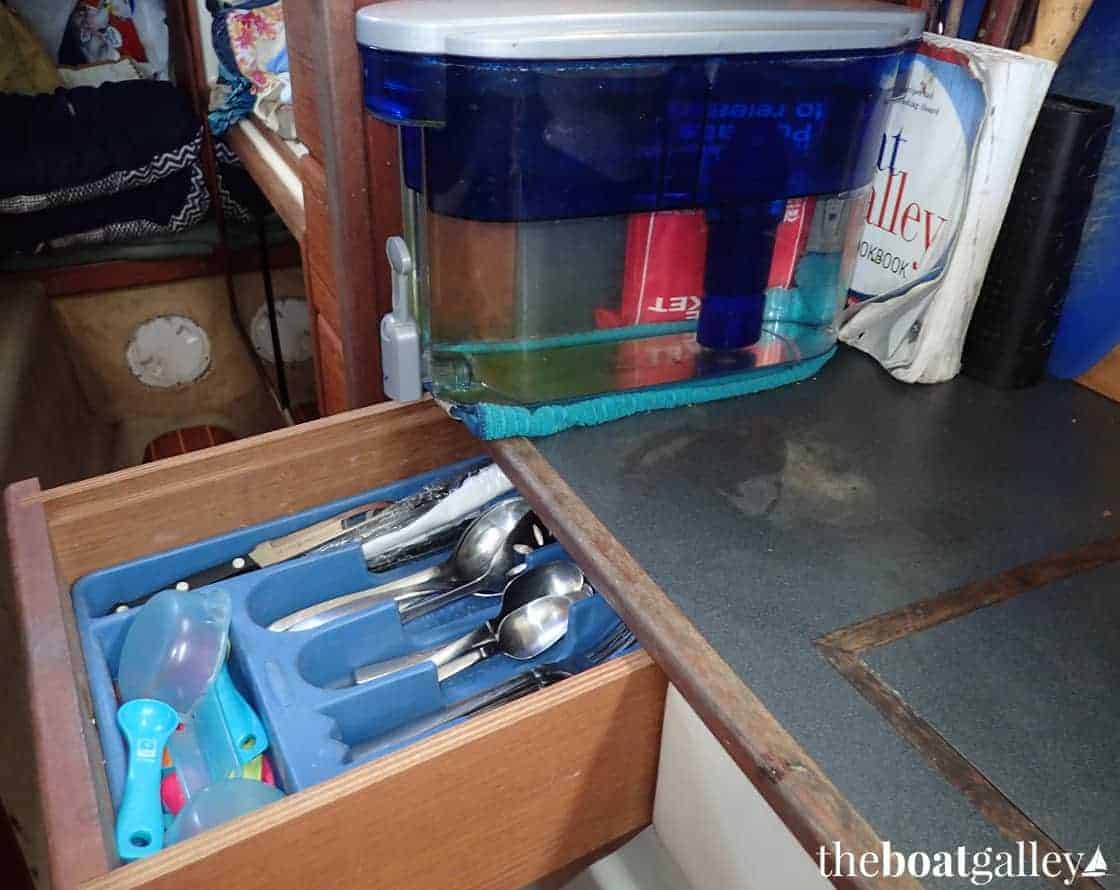
All the way forward is a silverware drawer, followed by a long counter. A knife block sits on the counter — something I’d never do on a monohull, even at anchor, but it works on our catamaran. Underway, the knife block gets laid on our bed with a blanket wrapped around it so nothing falls. For more on safe knife storage options, see Knives and Knife Storage on a Boat.
Our drinking water filter and a second fire blanket are here as well.
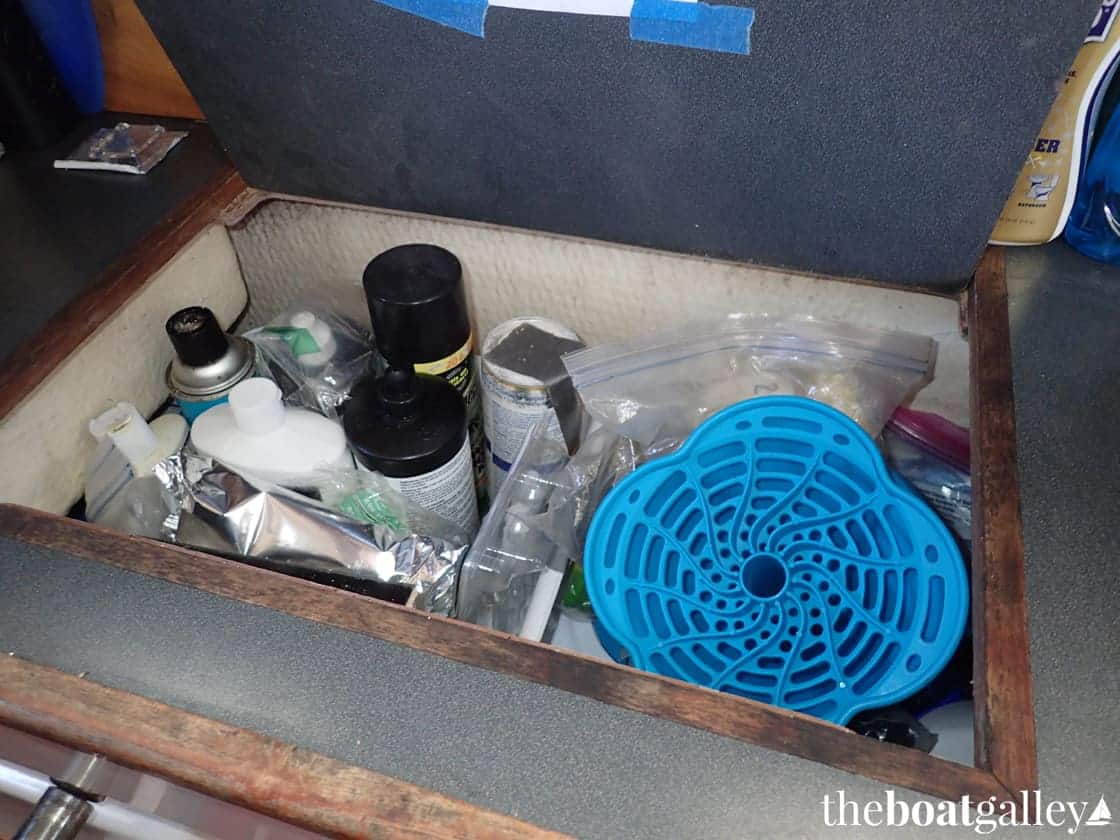
Under the counter is a large top-loading storage area — but since this is my main work surface and dish-drying area, I use it for cleaning supplies rather than food. There is one exception: a lidded bin with passage snacks tucked under the cleaning supplies. It’s fun to have some extra treats to discover once you’re offshore.
Along the back of this counter is a very narrow shelf where I keep spices. Occasionally one falls into the sink underway — not a problem. Everything on the counter goes into the sink when we’re underway anyway.
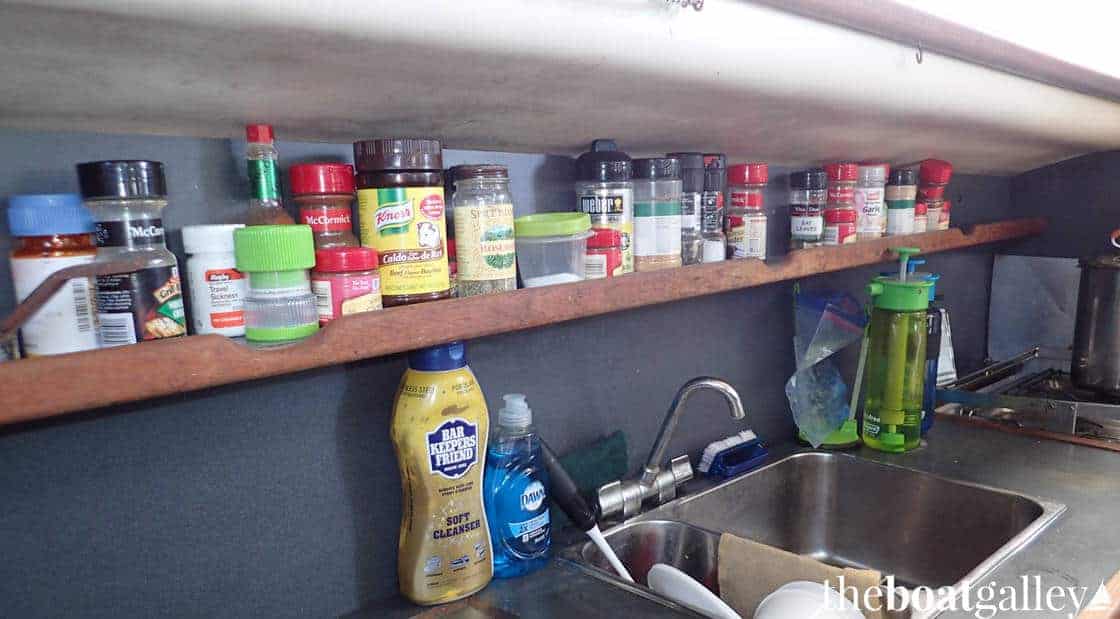
Area 7: Stove Drawer and Cupboard
A small drawer next to the stove holds cooking utensils. Under the stove is a small cupboard where I keep my nesting pans — the configuration makes it impossible to photograph well, but it works.
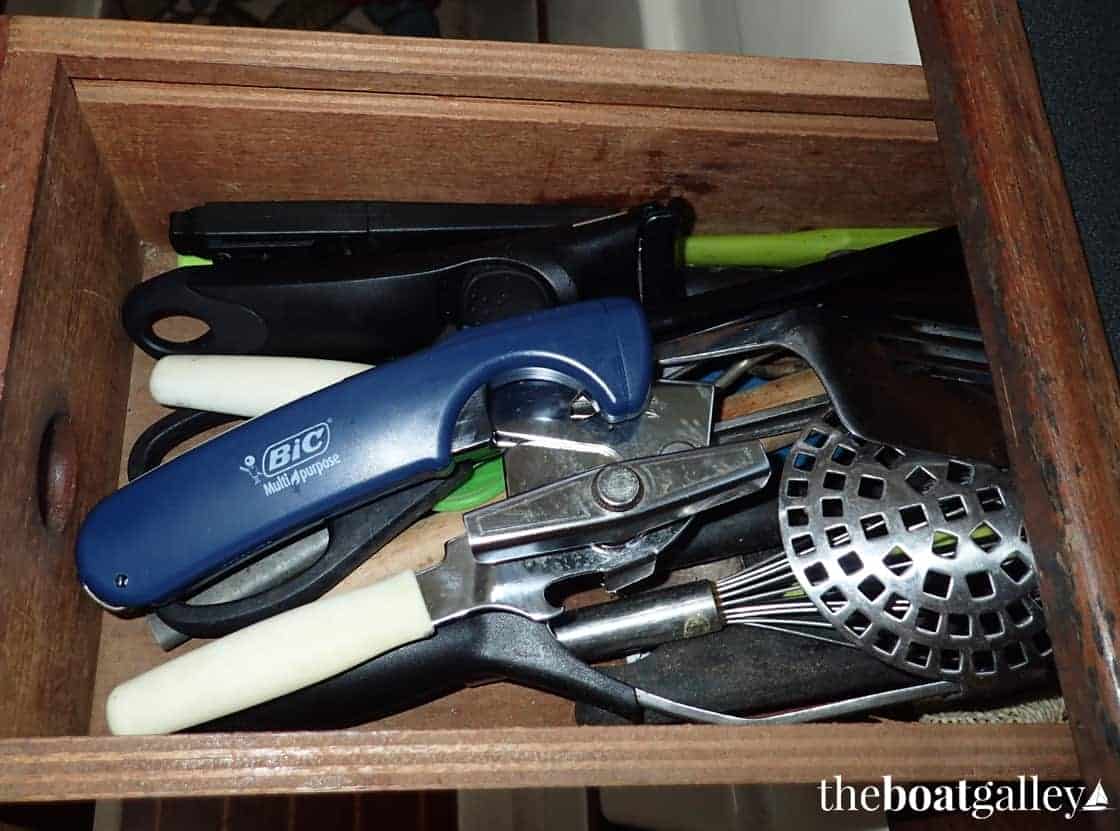
What I’ve Learned About Galley Storage
After years of living aboard two different boats, a few things hold true no matter the layout:
- In top-loading lockers, label the tops of containers. You can’t see inside, so label what’s facing up.
- In deep compartments, put long-term stocks in back. Keep frequently used items in front and within easy reach.
- Use shock cords and Velcro to secure things underway. What’s fine at anchor can become a mess at sea.
- Weight matters on a catamaran. Spread heavy items around and don’t overload one area.
- The “perfect” arrangement doesn’t exist. I rearrange regularly as we change locations, get different foods, or just get fed up with something being hard to reach.
On our previous boat, a Tayana 37 monohull, most of the food storage was under and behind the settees — a very different setup. If you’re on a monohull, Real-Life Monohull Galley Storage shows what that looks like.
Want to Take the Guesswork Out of Boat Storage?
If you’re still figuring out how to organize everything aboard, my course Storage Solutions for Life Aboard covers exactly this — how to choose the right containers, organize food and gear, use bins and dividers effectively, and set up a system that holds up underway. It includes DIY storage projects and a departure prep checklist.

Carolyn Shearlock has lived aboard full-time for 17 years, splitting her time between a Tayana 37 monohull and a Gemini 105 catamaran. She’s cruised over 14,000 miles, from Pacific Mexico and Central America to Florida and the Bahamas, gaining firsthand experience with the joys and challenges of life on the water.
Through The Boat Galley, Carolyn has helped thousands of people explore, prepare for, and enjoy life afloat. She shares her expertise as an instructor at Cruisers University, in leading boating publications, and through her bestselling book, The Boat Galley Cookbook. She is passionate about helping others embark on their liveaboard journey—making life on the water simpler, safer, and more enjoyable.
Pamela Douglas Webster says
Thanks. That was interesting.
Do you know a monohull owner who might be willing to share pics for a future post? I’d volunteer but I haven’t yet made the most of my galley storage since I’m in the ICW and can shop every week or two. 🙂
Jo-Anne Mason says
I would be happy to do that but first I want to fit plastic bins in our closet. We have an old boat not tons of storage but I am making the best of it.
The Boat Galley says
Let me see if I can find one . . . anyone here willing to share pics? If so, I’ll make them into a similar post. Need them to be about 1000 to 1200 pixels wide (if larger, not a problem).
Rosalind Franks says
I don’t mind sharing some pics. I’ll send them to you tomorrow
The Boat Galley says
Many thanks — email to carolyn (at) the boat galley (dot) com (take the spaces out)
Rosalind Franks says
The Boat Galley – will do
Brenda Tough Grimes says
Hello there, I agree with a lot of the other comments I have read on this post as well as a few others I have checked out so far. A lot of great information and helpful tips Carolyn and followers. My husband Peter and I have a 34 ft RL monohull. Still sorting out our galley and storage compartments but this post and comments has confirmed that it is trial and error and later, try again.
Has Rosalind or Jo-Anne shared photos of their monohull? If so, where will I find them?
I love the shelf for cans in post below – I will be on the look out for that or something similar.
We also have an older style fridge/freezer which you store from top/down, so it is a learning process and looking for some plastic shelving or something to assist accessing bottom items without having to completely unload.
We also have a very peculiar shaped cupboard in the galley – like half a triangle, which I am trying to work out best way to utilise its space.
I will keep going through your posts Carolyn as I have already learned a few tips and look forward to learning lots more.
My husband Peter is a sailer and I am learning – I love the water and boating, but sheets and halyards and winches and tacking into the wind or going windward are terms that I am still learning.
Thanks again,
Brenda, Lilac Wine
Carolyn Shearlock says
Yes, the pictures of monohull storage are here: Real-Life Monohull Galley Storage
Jo-Anne Mason says
Wow you have tons of storage I love it. I finally figured out the best way to store food in fridge, got some of those tall plastic food storage containers and put the same types of food in each. We have an old fashion in the hull fridge that is difficult to reach. Ice in a bin in the bottom so no leaks if we have a melt down. Working great so far.
The Boat Galley says
My biggest problem now is not to use all that space in the aft cabin! It’s easy to stuff it full and weigh the boat down.
Ann-Marie says
I really appreciate alll of your resources! We just moved onto our new-to-us Leopard 45. What is the best way to determine if you’ve put too much weight in a berth used for storage?
Carolyn Shearlock says
Great question! The only way I know of is to look at your boat from the outside — at anchor and from a dinghy is best, but you can do it from a dock if you have an unobstructed view of the waterline. See if one side (port/starboard, bow/stern) is lower than the other. Make sure that you’re not below the manufacturer’s waterline anywhere. If so, you need to start rearranging so that the boat is floating evenly and at her intended waterline.
Terri Zorn says
Thank you,thank you. You have no idea how helpful this will be,esp the photos. I just haven’t been able to get things “right”. You’ve shown some wonderful ideas.. #442
The Boat Galley says
Glad it helped!
Michelle Rene says
Love this post!
Joysealife.com says
I think we get used to everything looking like Better Homes & Gardens. Nice to see you keeping it real!
The Boat Galley says
Thanks. I notice so many pics that cannot possibly be of a boat that’s actually being used. But it was a reader who asked for it, so I can’t take credit for the idea.
Betina Lange says
I know this has little to do with storage, but how come your water maker isn’t plummed into your tank?
Carolyn Shearlock says
Previous owner did it that way, and it’s Katadyn’s recommendation so that you don’t accidentally get bad water into the tank. We’ve talked about plumbing it in, but it just hasn’t come to the top of the priority list!
Kristine says
Fire blankets? Does everyone carry them except us? Are they for the obvious or some other use?
Carolyn Shearlock says
Fire blankets often extinguish kitchen fires faster than a fire extinguisher and with a lot less mess. See my post: https://theboatgalley.com/fire-blanket/
cyndy carter says
You can also use a fire blanket to lay across a blazing hot engine to close a through hull or tape up a leaky exhaust elbow or other emergency repair (quick and dirty until that engine cools down!)
You can also wrap a person who’s clothing has caught fire and put it out FAST. It’s very difficult to “stop, drop, and roll” in a 2 1/2 by 3 galley.
As a redhead with very tender skin…. lots of uses! I only have one but 2 might be a good idea!
You may have covered all these things in your article but since I just 2 minutes ago made an amazon order that I linked thru the boat galley… including a new heat blanket…. LOL
Lori Steinbrunner says
Great post. Especially being a fellow Gem owner, it’s always nice to see how others use the same (or similar) space.
The Boat Galley says
There’s no one way, is there? And even my arrangement has changed over time . . .
Dona Cantwell says
We find rearranging the galley is a constant shuffle. What seemed to work, eventually we find isn’t quite right. Still working and not cruising yet, we’re hoping to add storage in our galley steps. Has anyone done this yet?
Carolyn Shearlock says
I’ve met several people who have done this (it wouldn’t have worked on our previous boat as the steps exactly covered the engine). Basically, they’ve made the step so it’s on a hinge and opens upward.
Tory Fine says
Wow it’s good to see this just to confirm we can’t possibly complete the typical provisioning lists with the room our boat provides, lol. It’s always boggled my mind when people come back with 3 carts of food as to where it would go! We have a 37 foot monohull and two cubbies behind our settee and a top loading fridge to store food. Maybe an eighth of the storage you have here. That’s it. But we’ve still done almost 2000 miles of cruising so it’s so true that you can cruise with any size boat if you plan accordingly!
The Boat Galley says
I actually was able to put MORE food on our 37-foot monohull — or at least more heavy cans. A previous owner had done some carpentry to make the under-settee areas into large lockers instead of small drawers (they glued the drawer fronts and cut access panels in the top under the cushions). And we used about half the quarterberth for bins with drink cans.
Tory Fine says
The Boat Galley wow, crazy! It’s amazing what space efficiency some boats have!
The Boat Galley says
Actually, I think it’s a case of knowing how far it is to the next provisioning stop. I suddenly found more places to store stuff on this boat when we went to the Bahamas, and on the previous boat when we went to the Sea of Cortez . . . in both , we wanted to be able to go at least 3 weeks before restocking.
Julia Weeks says
Thank you so much for sharing this info – especially the photos. We have an older cat also – Richard Woods, and have been trying to figure out the best way to store provisions for longer hauls. I really like the way you turned the aft bunk into a pantry. I’m thinking of doing this as well and adding some plastic storage bins with drawers like you have done. I think that would make great use of a space that we rarely use, other than a catchall.
Carolyn Shearlock says
Glad it helps!
Julie OFlaherty says
Hi Carolyn,
I have learned a lot from your website and emails. I am not a boater, but an Airstream camper owner.
I can recommend another great and inexpensive container for storage when ventilation of the contents is not a concern.
It is the bins designed to hold ice cubes in the door of a refrigerator. The cheaper ones from Big Lots are better than the more expensive ones, because they are a bit more flexible, and I have even trimmed the ends at the top to get them to fit just right in smaller areas.
I use them in several areas of our camper. They are good because they are narrow to fit in a lot of areas, but have fairly high sides to keep things from falling over. Great to hold spice bottles, coffee filters and a collapsible cone filter holder, CDs and DVDs in jewel cases, shampoo bottles in the bathroom, The solid bottoms contain any spills, and they hold a lot without taking a lot of room.
Just wanted to pass this along, as I appreciate all of the tips I have gotten from you.
Carolyn Shearlock says
Thanks so much! There are a lot of similarities between boats and RVs — my parents had an Airstream Argosy back in the late 70’s and early 80’s.
Amy says
I’m very jealous. We are moving on board our Gemini in July with 2 of our teenage sons. No port berth to use as a pantry and more stuff to store!
LeslieByrne says
We live on a 48 Selene trawler. Sailboats have way more storage.
Carolyn Shearlock says
And I’ve always been jealous of the space when I step on a friend’s trawler . . .
Coleen says
I found an inexpensive wire 3-shelf horizontal rack at Walmart. The wire shelves slope toward the front. Load a shelf with cans of same size (I typically buy canned tomatoes, broth, etc. in 14.5 oz size), Cans roll down–easy to remove the one in front. New provisions load from the back. No more “losing” older stock with earlier sell-by dates underneath or behind newer stock. Depending on your boat’s configuration, you may need to set it sideways.

Christina Wagner says
OMG your website is a big help!!! I love the website layout and how you explain stuff. Very easy to follow and you keep it interesting!! Not like the old men pages on boating. Pretty dry and dull.
Thank you thank you!!
Carolyn Shearlock says
That may just be my favorite comment yet! Thanks so much for brightening my day!
Anonymous says
Carolyn, I really like the one sink on this pic. Is this your boat?
The Boat Galley says
Yes it is. A Gemini 105M. It’s a double bowl, but with one side much larger than the other. For me, dirty dishes (snacks between meals, etc) go in the small side and leave the “big sink” open for prepping the next meal.
Anonymous says
Yea I want all one sink but can’t find one like that.
The Boat Galley says
Amy Roberts It came with our boat, and I haven’t seen one like it for sale for boats. However, I did have a house sink that was very similar so it the dimensions could work for you, that might be an alternative.