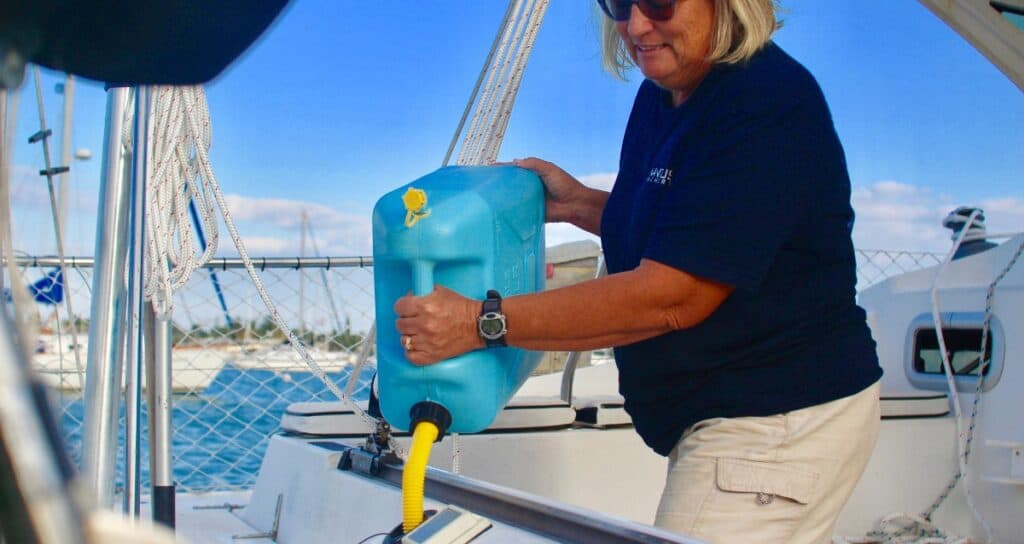
The first time you plan a weekend anchored out or the first time you charter, you’ll wonder: “How much water will we use?” It was one of the first things we asked when we began cruising. Several factors will determine your water usage:
- the climate of your cruising grounds
- your showering habits
- food prep choices
- maintenance habits, and
- the number of crew (including pets) aboard.
The Average Cruiser’s Water Usage
The most extreme cruisers mostly use fresh water only for drinking. They use about 1 gallon (4 liters) per person per day. But if you want to cruise in basic comfort while still being conservative with your water use, plan on using about 4-6 gallons per day (around 25 liters). Twenty gallons (around 75 liters) will allow comfortable cruising. And, if you wish to reproduce your land-based life, you’ll require 40 gallons (about 150 liters) per person per day.
Note that single-handers may use a bit more and families a bit less as “boat use” is divided amongst fewer or more people.
Let’s break it down to some specific water use on a boat.
Drinking Water
Hydration is crucial when cruising. Becoming dehydrated contributes to bad moods as well as illness. Plan on each person on board drinking about 1/2 gallon to nearly a gallon per day (2 – 3.5 liters).
Showers
When we’ve known boats that use 20 to 30 gallons of water per person per day, it’s generally because of long, hot showers. We’ve met cruisers with separate shower stalls and even a washing machine on board.
Now, that’s a pretty nice lifestyle. But it takes either a large water tank and a short trip, frequent stops at marinas or fuel docks where you can get water, or a very large capacity watermaker and the power to support it.
Okay, those are the extremes for water usage on a boat. US dirt-dwellers use about 100 gallons per person per day, in contrast. And luxury yachts probably use almost as much.
What water needs will pets on board have?
Pets
If you have a pet, be sure to allow a bit for them. You’ll need to plan for drinking water and occasional spray-downs if they wade or swim in salt water. Swimming in salt water can make pets itchy if you don’t rinse. In addition, they’ll track it through the boat, onto the carpet, upholstery, and bedding. Obviously, big dogs will take more than small dogs. And if your pup likes to roll in the sand or mud, plan for even more.
For the three of us, Dave and I and very small dog Paz, we were on the low end of the spectrum at about 7 gallons a day (total for the three, not per person), plus a can of soda and a beer or two (or maybe some wine). But we didn’t have cases of bottled water or juice.
Meeting Your Boat’s Water Needs
What are your options for stocking your boat with water? They vary, depending on your budget, cruising grounds, and personal tastes. Of course, the first option is to make your own, from seawater.
Watermaker
Watermakers have become cheaper and easier to maintain since we began cruising. That said, many cruisers travel without one, even today. And, if water is available inexpensively in your cruising grounds, a watermaker won’t pay for itself. It’s simply a matter of convenience.
Check out Do You Need a Watermaker for a discussion of the tradeoffs of installing one on your boat.
Harvesting Rainwater
If you’re cruising in remote settings, harvesting rainwater will fill your tanks during a heavy storm. It takes some effort to collect, but once you have a good system in place, it’s easy to set up.
Learn more from Nica Waters, who described her rainwater harvesting system on The Boat Galley Podcast.
Using Saltwater
The most frugal cruisers use salt water for everything, including most of the cooking. Keep in mind that seawater isn’t always clean. In addition, if you wash and rinse your laundry in salt water, it feels perpetually damp.
I can’t imagine relying on salt water for any length of time, and certainly not if you want cruising to be a “lifestyle” and not an ordeal. Yeah, in an emergency, I could do it. But there are so many better options.
Getting Water From a Marina
Boat Galley team member Nica Waters noted that they found water taps at every dock in the Marquesas. However, not all of them were potable. Water may be expensive, and even if considered potable, it may have contaminants. Again, this is a great method to rely on if it works for your cruising grounds, for example, the Great Loop.
Conservation is Key
Whether you make your water, collect it from the sky, or get it from a marina, you’ll benefit from using basic conservation methods. After all, I’m betting you didn’t decide to go cruising so you could spend most of your time refilling your water tanks.
Water and Lifestyle – An Example
As you have read, average water usage on a boat varies widely. Dave and I were careful about conserving water. Here’s a window into our usage to help you understand how it works for an actual cruiser.
Our Cruising Boat Water Usage
- We were in a hot climate — temperatures generally 90° to 100° F. We drank a lot of water and water-based drinks such as iced tea using “tank” water.
- We swam most days and rinsed off with a half- or one-gallon tank sprayer (Amazon) of fresh water. We also used it to rinse off our snorkel gear and swimsuits. Occasionally, I’d shampoo my hair with biodegradable shampoo, dive in to do the “big rinse,” and then use the sprayer to get the salt out.
- Most days, Paz also got a spray-down after a romp on the beach. She loved to wade to cool down and, yes, she loved to roll in the sand and mud. We usually first poured a bucket of salt water over her to get most of it off, then used fresh water to rinse.
- Most of the time, we’d shower every other day with a 5-gallon solar shower (Amazon). Dave and I each got half. We used it for washing our hair, shaving, etc. We hoisted it with a halyard clipped to a side stay and showered on the side deck. For modesty, we wore old swimsuits. After being surprised a couple of times by fishermen coming into “secluded” anchorages, we decided it was best to stay dressed.
- We never (literally) showered with the pressure water in the head. For one thing, we didn’t want the dampness down below. For another, we didn’t have a hot water heater. And finally, we used a lot less water with the solar shower.
- We both were careful never to let water just run when brushing teeth, rinsing dishes, and so on.
- I never used salt water to cook. It just wasn’t clean enough anywhere that we were.
- We washed and rinsed dishes in fresh water, but were careful how we did it. We used leftover coffee to rinse or soak dishes. I’d put just an inch of water in the gunkiest pan and let it soak while I washed the other dishes. From that, I used a little indoor watering can to rinse the dishes. In all honesty, washing dishes was the one area where I wished I had a little more abundant water supply. I know that I got the dishes clean, but I would have liked to rinse more. See more tips on doing dishes here. I eventually began to use a Lunatec spray bottle (Amazon), which uses less water and does a better job on the dishes — read about my Lunatec spray bottle.)
- We didn’t rinse the boat with fresh water, except that the solar panels would get a quick wipe-down most mornings to keep them producing their max.
- We never did laundry on the boat. My one luxury was to take it to a local lady, drop it off, and come back after doing all the provisioning to a bag of clean and wonderful-smelling clothes. In Mexico, the cost wasn’t too bad, and DIY laundromats were almost unheard of except in some marinas.
Water Use Changes at a Marina
Note that this describes our time while we were away from a marina. When we were simply living aboard in a marina and had access to plenty of water, we definitely used more for dishes and to wash the boat. We’d usually use the marina bath house for showers (luxury!) and I’d usually still send the laundry out, depending on the facilities at the marina (some had none and some would have 2 washers for 200 boats . . . others had great facilities).
Practical Help for Cruisers
Life on a boat has a steep learning curve. We make it a bit easier through a variety of courses, created by and for cruisers. The Basics of Living on a Boat is a good start, available as a standalone course or as part of the All-Access Pass.
The more you learn in advance, the more time you have for fun.


Carolyn Shearlock has lived aboard full-time for 17 years, splitting her time between a Tayana 37 monohull and a Gemini 105 catamaran. She’s cruised over 14,000 miles, from Pacific Mexico and Central America to Florida and the Bahamas, gaining firsthand experience with the joys and challenges of life on the water.
Through The Boat Galley, Carolyn has helped thousands of people explore, prepare for, and enjoy life afloat. She shares her expertise as an instructor at Cruisers University, in leading boating publications, and through her bestselling book, The Boat Galley Cookbook. She is passionate about helping others embark on their liveaboard journey—making life on the water simpler, safer, and more enjoyable.
The Boat Galley says
That’s very impressive!