
A boat garden isn’t about growing all your own vegetables. It’s about solving a specific problem: having fresh leaves on board when you’re anchored out, provisioning stops are days away, and the greens you bought a week ago are looking sad.
Even a few pots of herbs or salad greens can transform meals and take some pressure off a small fridge. The four setups below come from real cruisers who’ve made this work on their own boats. Some are dead simple. One is impressively engineered. All of them are practical.
What Works on a Boat
Before getting into specific setups, a few principles that apply to all of them.
Think small and light. Full-size garden pots become obstacles on a working boat deck. Planters should be easy to pick up and move, whether you’re tidying the deck or heading offshore.
Grow cut-and-come-again crops. These are ideal because you harvest a few leaves at a time, and the plant keeps producing. A pot of mixed greens can give you a salad in two weeks. Good options:
- Leaf lettuce and mesclun mixes
- Arugula
- Pea shoots
- Basil, parsley, chives
- Green onions
- Microgreens
Keep plants short. Tall plants like chilies or full-size tomatoes get unwieldy on a boat, especially when you’re moving planters around. Shorter plants are easier to manage and more wind-tolerant.
Harvest the outer leaves, not the whole plant. Pick the larger outer leaves and leave the center growing. You get salad today, and again tomorrow, and again next week.
Option 1: The Box Garden

Reader Carol Watson and her husband spend summers aboard their converted workboat in Northern Europe, often without refrigeration. She wanted fresh salad, consistently, without a complicated system.
Her solution: small plastic storage boxes used as planters. She drilled drainage holes in the bottom, covered them with a piece of disposable fiber cloth (not paper, which disintegrates), and filled them with potting soil.
The key detail she emphasized is weight. If you can’t easily pick up and move a planter, it becomes a nuisance on a working boat deck. Keep them light enough to shift around without thinking about it.
For seed starting, she uses the plastic trays that grocery store meat comes in. They’re the perfect size, already shaped to hold a bit of moisture, and completely free. Keep the lid, and you can use it to help seeds germinate faster, then flip it to catch drips later.
Her preferred crops are leaf lettuces sold as cut-and-come-again mixes or mesclun. She harvests outer leaves regularly and the plants keep producing for weeks.
No room for a salad spinner? Carol solved this by sewing a small drawstring bag from cheesecloth. Wash the lettuce, put it in the bag, give it a good swing. Compact, simple, and it works. (If you’d rather have a proper spinner, here’s a look at salad spinners and their other uses in a boat kitchen.)
Option 2: Hanging Planters

If your boat is already packed and flat deck space is hard to find, vertical space is often easier to come by.
One idea that’s been circulating among cruisers for years: an over-the-door shoe organizer hung under a bimini or in a sheltered spot, with small plastic containers in each pocket. Instant salad wall.
This works best for small greens and herbs. It keeps everything off the deck, stays reasonably secure at anchor, and it’s lightweight. The main limitation is that each pocket holds a small amount of soil, so stick with shallow-rooted plants rather than anything that needs depth.
Option 3: Pots That Move Below Underway

Reader Nichola Wright has a system that suits a boat that actually sails places. Her husband surprised her with long rectangular planters with drainage holes and trays. They found a dead space on deck behind the mast, an area that wasn’t useful for anything else, and that became the garden’s home in port.
When they went to sea, the planters moved below and got strapped down in place. Salt water and rough conditions aren’t plant-friendly, so keeping them inside underway protects the garden and keeps the deck clear when you need it.

The reassuring part: even if you day sail regularly, plants don’t seem to mind being out of the sun for a few hours.
Nichola reseeds every few weeks to keep a steady supply coming and harvests as baby leaves. She’s grown successfully:
- Arugula
- Mixed salad greens
- Basil, spinach, chard
- Parsley, chives
- Pea shoots
- Spring onions
And she’s learned what not to bother with. Tall plants like chilies get unwieldy fast.
Option 4: A Stern-Rail Garden Built for Cruising
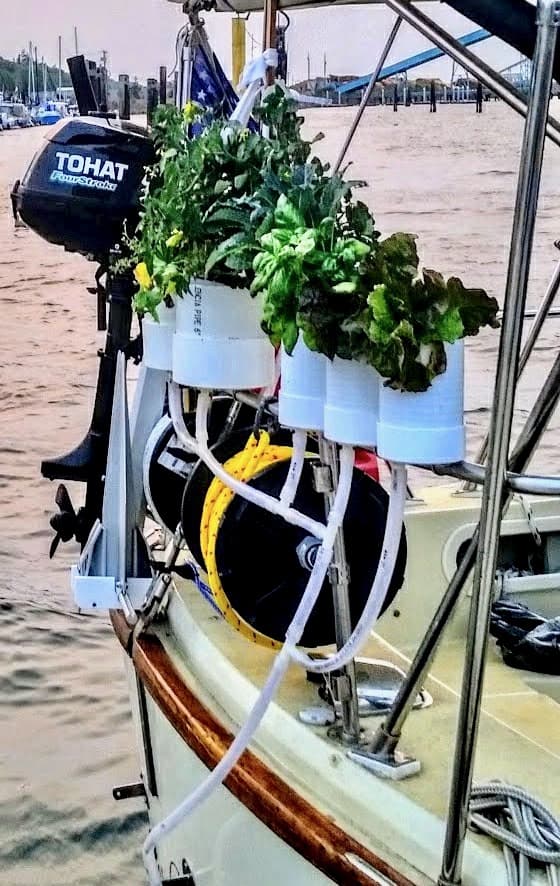
The most impressive DIY setup here comes from Liz and Risto Lappala, who cruised their Pearson 367 from Washington to Cabo San Lucas. Risto made planters from 4-inch and 6-inch PVC pipe with end caps, then U-bolted them directly to the stern rail. He added drain holes, fitted plumbing fittings and tubing, and routed the drainage down toward the water.
The planters stay put, drain properly, and don’t slide around the deck.
Liz researched food-safe materials and found that #2 plastic (HDPE) is one of the better options for growing food. They used upside-down quart bottles as liners in the 4-inch planters and one-gallon jugs in the 6-inch planters. UV eventually makes plastic brittle, so they replace the smaller liners yearly. It’s an easy and cheap fix.
They grew a real variety:
- Lettuce, kale, collards
- Cherry tomatoes and dwarf peppers
- Basil, rosemary, tarragon
And here’s the detail that made me smile: Liz says that on watch offshore, it’s pretty great to grab a fresh tomato right off the plant.
On salt spray: their garden survived the full trip with daily rinsing from a spray bottle. When they hit heavy conditions in the Sea of Cortez and took real spray, some plants didn’t recover. Others came back with a thorough fresh-water rinse. Sometimes you just replant and start again. That’s boat gardening.
What to Grow for the Most Payoff
If the goal is fresh food that’s hard to keep any other way, think high value per square inch. The best crops are the ones that are hardest to store once you leave the dock:
- Leaf lettuce and cut-and-come-again mixes
- Mesclun and microgreens
- Basil, parsley, chives, and green onions
- Pea shoots
- Arugula
Start small. A single box of mixed greens is enough to make a real difference. Once you know the system works for you, you can always expand.
Want to Go Further?
A garden helps, but it’s one piece of the provisioning puzzle. Knowing what else can live outside the fridge matters just as much. Our guide to storing vegetables without refrigeration covers the most common produce and how long each lasts without a fridge. And our real 4-day no-refrigeration meal plan shows how a full stretch without a grocery store actually comes together.
For the complete system — what needs to stay cold, what doesn’t, and how to plan meals when the next store is days away — my course Eating Well With a Tiny Fridge has you covered. It includes a copy of Storing Food Without Refrigeration, the detailed guide to keeping hundreds of foods fresh without a fridge.
- Eating Well With a Tiny Fridge — our store (includes a copy of Storing Food Without Refrigeration)
Storing Food Without Refrigeration:
- Paperback from Amazon
- Paperback or PDF from our store — PDF means no shipping, start reading immediately

Brenda says
Fantastic method! Just don’t try to sail to New Zealand or Australia with it!
Heather Kolankowski says
I too, love to garden. We have a Bayliner 4550 with a large cockpit and bright windows. However, heavy seas make for a bouncy garden. We’ve grown tomatoes, peppers, cucumber, chives, a full compliment of herbs, lettuces, spinach, carrot, beans and this year I’m trying eggplant as well. Plus, when we’re moored at home in Haida Gwaii I have potted and hanging flowers on Cove Quest. Our boat has become quite the conversation piece………everyone visiting knows the “Flower Boat” and does that woman have tomatoes?????? On a boat?????
However, plants can be large and “in the way”. This year we abandoned the “Roof Garden” planter (too much dirt and too rainy here) and my husband built me a “Tomatoe Trolley” for the cockpit. It holds 4-6 10″ pots, has a sturdy trellis for securing them, and bungees in anywhere. It also has room under it for our large crab pot and milk crate for recycling. It can be moved easily (on wheels) inside the salon or around the cockpit when he needs access to the lazarettes.
I’ve also chosen determinate tomatoes for the Boat Garden (5 species) and ones that mature at different times for a longer fresh supply.
Choose small pots, maximum 10″. I LOVE your PVC idea, keeps the drainage off the boat! I bring a bit of potting soil, and reuse the old, provided it hasn’t any diseases. Fertilize with organic products regularly (GAIA and Shake and Feed for Citrus or Flowering plants) and you needn’t bother carrying lots of soil. I also bring 12 little starter trays and seeds of my favorites.
You may want to build a sturdy little “greenhouse” for over your plants that bolts to the rail easily and can be removed when at anchor. Then you won’t have soggy salads!
Love to see others trying this! It is very possible!
Enjoy!
-Heather from Haida Gwaii, BC, Canada
stewart d karakuc says
can you send pics?
Eric says
Has anyone tried hydroponics on a boat?
Carolyn Shearlock says
I know a few people who do, but don’t know the details of their setup. But yes, it’s do-able!