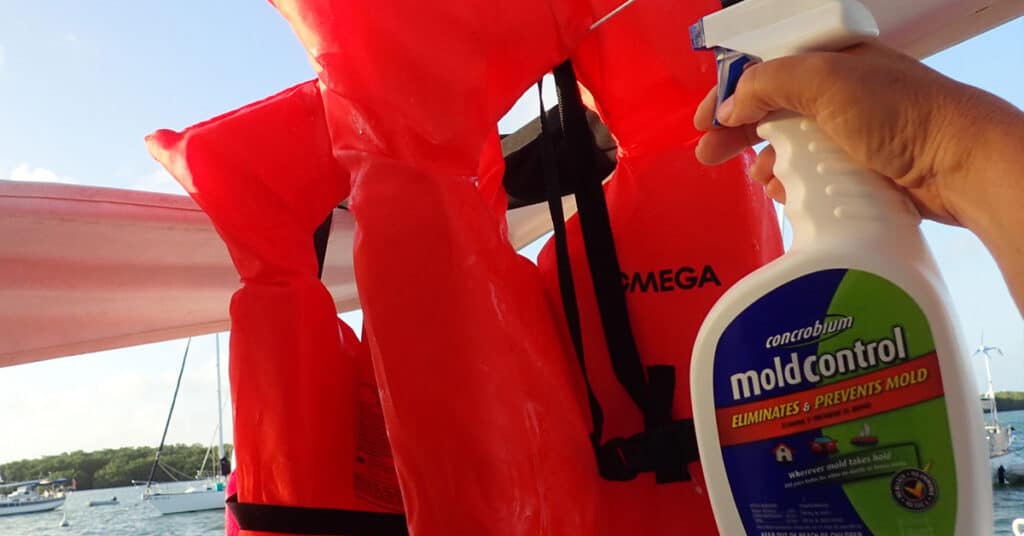
Controlling mold and mildew on a boat comes down to two things working together: airflow to reduce moisture, and treating surfaces with the right products to kill spores, clean up the staining, and discourage new growth.
Mold peaks in winter on boats, not summer. In summer the hatches are open, heat dries surfaces quickly, and air moves constantly. In winter you close everything up, condensation builds on cool surfaces, and mold thrives.
Unfortunately, no matter the season, you will probably need to clean mold every two to four weeks on a boat. Products that claim to prevent it entirely are designed for house conditions. Prevention helps. It doesn’t eliminate it.
The good news: with the right products and a simple routine, you can keep it from taking over.
The Biggest Myth: Bleach Kills Mold
When confronted with mold, most people reach for bleach. I did too, for years. And wondered why the mold kept coming back with absolutely no reduction.
Then I learned: bleach removes the stain. It does not kill the spores. The mold looks gone, and then it comes right back.
The same goes for most wipes and most things marketed as a “mildew stain remover.” They clean up the visual evidence. The underlying problem remains.
What Actually Kills Mold
To kill mold spores, you need one of four things:
- White vinegar, straight and undiluted
- Borax, mixed into hot water as a strong solution
- The Practical Sailor formula (recipe below)
- Concrobium (generally found in the paint department in hardware and big box stores, not with cleaning supplies; also available on Amazon)
Concrobium works well but is much more expensive than the other options, so I use it only where it is particularly better. In most cases, the cheaper alternatives work just as well.
Don’t mix vinegar and borax together in the same solution. Vinegar is an acid and borax is a base. They neutralize each other and you end up with something far less effective than either one alone.
The Practical Sailor Formula
Practical Sailor magazine tested homemade mold treatment formulas and found them to perform as well as commercial products. Our team member Pam has been using this one with good results:
- 1 quart hot water
- 2 tablespoons baking soda
- 2 tablespoons borax
- 1 tablespoon trisodium phosphate (TSP)
This costs about a penny per ounce. Apply with a cloth or sponge, not a spray bottle — the mixture settles and clogs the nozzle.
TSP is caustic. Wear rubber gloves and avoid splashing near your face. TSP is also high in phosphates, which drive algae blooms in harbors and anchorages. Don’t let rinse water drain overboard. Wipe surfaces down and dispose of the used solution on land — modern wastewater treatment plants are designed to remove phosphates, so a shoreside drain is fine.
Two-Part Prevention
Controlling mold on a boat comes down to two things working together:
- Airflow reduces moisture so mold has less to feed on.
- Treating surfaces with one of the mold-killers kills existing spores, cleans up the black staining, and leaves a residue that discourages new growth for two to three weeks.
These aren’t alternatives. You need both.
Airflow
Open hatches whenever conditions allow, and run fans to keep air circulating throughout the boat.
A wind scoop pulls fresh air down below so your fans are moving clean outdoor air, not just recirculating what’s already there. Our favorite is the Breeze Bandit 4-Way Wind Scoop, which catches wind from any direction automatically, even as the boat swings at anchor. For more on fans and other ventilation options, see Boat Ventilation.
In particular, there needs to be airflow around fabric items. Don’t store them right against the hull. Condensation forms on the hull, fabric soaks it up, stays wet, and mold grows right in it.
Many cruisers raise their mattress off the hull using interlocking rubber grids (Amazon) or the Froli System for exactly this reason.
PortVisors let you keep ports open even when it’s raining, which makes a real difference for maintaining airflow in wet weather.
If you have shore power, a dehumidifier can help, but only if you keep the boat sealed up so you’re not constantly pulling in more humid air. Friends who’ve tried it found it wasn’t much more effective than good ventilation, except when the boat was in storage with nobody going in and out.
Treating Each Surface
Treating surfaces does three things at once: kills existing mold spores, cleans up the black staining, and leaves a residue that discourages new growth for two to three weeks.
Hard Surfaces
Ceilings, floors, counters. Use a rag wrung out in white vinegar, the borax solution, or the Practical Sailor formula. Go over the area two or three times until your cloth stops picking up color. Don’t rinse it off but instead let it dry on the surface.
Fabric and Upholstery
Anything that cannot be put in a washing machine. Use a rag wrung out in white vinegar or a borax solution in the hottest water you can stand. Rub it in, blot it out, let it air dry. This usually pulls most of the black staining out as well.
You can also use the Practical Sailor formula on fabric, but test for colorfastness on a hidden area first.
Washable Fabrics
Sheets, towels, clothing. Wash in the hottest water possible with borax added as a detergent boost. At a laundromat, add borax to a hot wash cycle. On the hook with no machine available, boiling items in a strong borax solution on the stove works well. If you can’t find borax, substitute white vinegar.
Even items that don’t look visibly affected can be harboring mold. Washing every 7 to 10 days in hot water with borax makes a real difference.
The Bilge
Start by keeping it as dry as possible. If you can’t keep it dry, add about half a gallon of white vinegar every week or so. That’s enough to kill whatever is growing down there.
One exception: skip the vinegar if you have an aluminum boat, as the acid will corrode the metal over time.
Paper and Books
There’s no good answer here. Store them away from the hull and away from any area where drips can reach them.
Tight Spots
Locker corners, headliner gaps, behind equipment. These are the areas with the least airflow, which is exactly where mold gets its worst grip.
Concrobium spray is worth the extra cost here because you can reach places a cloth or sponge simply can’t get to, and it tends to outperform white vinegar where there is no airflow.
Whatever you are using, wear rubber gloves. You’re protecting your hands both from the mold itself and from the cleaning solutions.
The Locker Problem
Lockers are one of the most overlooked parts of mold control. On Barefoot Gal I once counted 41 lockers and drawers. That number stopped me cold.
I started emptying and wiping out two per day — at that pace I got through all of them in three weeks. That made a huge difference in the number of mold spores “hidden” on the boat. Be sure that whatever solution you are using dries completely before returning items to the locker.
Mold and mildew control isn’t especially complicated. More than anything, it requires diligence. Stay on top of it and mold stays a nuisance, not a crisis.
Want Help Dealing with More Aspects of Living on a Boat?
Mold is just one of dozens of things that catch new liveaboards off guard. My course The Basics of Living on a Boat covers the practical reality of day-to-day life aboard, so you spend less time surprised and more time enjoying it.

Carolyn Shearlock has lived aboard full-time for 17 years, splitting her time between a Tayana 37 monohull and a Gemini 105 catamaran. She’s cruised over 14,000 miles, from Pacific Mexico and Central America to Florida and the Bahamas, gaining firsthand experience with the joys and challenges of life on the water.
Through The Boat Galley, Carolyn has helped thousands of people explore, prepare for, and enjoy life afloat. She shares her expertise as an instructor at Cruisers University, in leading boating publications, and through her bestselling book, The Boat Galley Cookbook. She is passionate about helping others embark on their liveaboard journey—making life on the water simpler, safer, and more enjoyable.
Van Den Broeck Rita says
special underlayer from “akwamat” there are 2 versions in it,rotfree,and not expensive
The Boat Galley says
More about our mattress topper: https://theboatgalley.com/sleeping-well-means-better-cruising/
Gina Soucheray says
We do, especially in cold water (Lake Superior) when body heat and cold boards meet theough the mattress. It can happen in warmer climes, too. We have done two things over time to create an air “gap” under the mattress. One is a layer of dri-lock tiles under the mattress. The other is a layer plasticized “horse hair” that one would get at an upholstery/fabric store. This is more flexible if you need to get to storage under the bunk. However, it can “shed” a little, somif you’re under that a lot, you’ll vacuum a bit! Either one works great for keeping the mattress dry.
Kelley Gudahl says
We use hypervent on Sailing Chance. It’s worked in both northern and warmer climates. And to be clear, we did get condensation this winter still but the hypervent kept it from touching the mattes which avoided ant mildew on the mattress.
Gloria Rooney says
We use hypervent and it solved our problem.
Joe Sprouse says
Defender has hyper vent also.
Tammi Abbey says
We have royal blue dodger, looks to be getting mold on the inside. Would concrobium work?
Carolyn Shearlock says
I don’t see why not — we use it on our hard dodger and it makes a big difference!
The Boat Galley says
Here’s Hypervent at Defender: http://www.defender.com/product3.jsp?path=-1%7C2276179%7C2276186&id=1818021
The Boat Galley says
We don’t really have a problem with it, I think that our mattress topper adds enough insulation that we don’t have the “warm body” problem causing condensation there. For those who do, Dri Dek can be used under a mattress to provide some air flow. You can get Dri Dek at West Marine, or a very similar product from Amazon: https://amzn.to/3ju6JTf
The Boat Galley says
Another good solution is the Froli Sleep System, which also allows air to circulate under the mattress: https://www.froli.com/shop/
Claire McCloskey Ford says
The Boat Galley, we used these on our 36, and they worked great!
tami says
an alternative to Hypervent, and what it actually is, is:
ENKAMAT is one name, there may be others. Search term “roofing underlayment ventilation”
I have used this as well. It’s super cheap, but it does eventually crush down although it still ventilated. Did shed some, but not too badly:
http://www.flandersfilters.com/wp-content/themes/flandersfilters.com/graphics/product_images/sm1006.jpg
Bazza says
Absolutely right Ann, it seems to be the only thing that works for us in tropical Australia. And your recipe is our recipe.
Bazza says
I forgot to add, we also use this at home. The timber walls in the house used to go black with mould in the wet season. We now spray the walls with the mixture at the beginning of the wet season i.e early November, let them soak it up for 5 – 10 minutes, then wipe with a damp cloth. Good bye mould.
Lynn says
We use a product called Homezone which we order online at http://www.homezone.com to prevent/kill mold while the boat is stored in Florida for the summer. It lasts for 6 months, we use the whole container placing paper plates all over the boat including the lazzerettes and engine room. When we return in the fall most of the odor is gone but we leave everything open for a couple of hours to be sure. The boat is as clean as we left it in the spring. This was recommended to us by another cruiser who has used it for several years…this will be our 3rd season. This is the last thing we do before locking the boat. Within a few hours the fumes are pretty toxic…its a form of formaldehyde. Use mask and gloves when handling.
Carolyn Shearlock says
I’ve heard good things about it, but if you use it while the boat is stored, you can’t have a boat watcher check the inside of the boat because of the fumes AND should not be used by anyone with breathing/lung problems.
Florian Wolf says
As we don’t like to use too many chemicals in our house and on our boat we solely use clove oil, even to ‘clean’ (aka ‘de-mould’) our leather upholsteries after the wet season – works like a treat, is absolutely non-toxic, smells nice and has been used by generations of Australians in hot, tropical conditions. Usage instructions are above, and see you later, mould.
Judy Cook says
I just found this product and used it on very dark black mold stains on the ‘monkey fur’ fabric under our windows. After a good dose, the stain practically disappeared!!! The powder was not particularly easy to use… even in hot water the crystals didn’t dissolve and clogged my sprayer. I soaked a sponge and used it to apply to the stains wetting thoroughly. The darkest stains required more than one application.
Carolyn Shearlock says
I’ve had other readers recommend using OxyClean (one said a tablespoon in a couple gallons of the hottest water you can still put your hands in) and a small scrub brush but I have NOT tried it. I’d suggest trying on a hidden place first to make sure it doesn’t change the color!!!
Carolyn Chancellor says
Thanks. I’ll try this and report back.
Michael says
We bought noodles to slide u see mattresses that allow air to circulate better. Yes, those pool toys!
Oliver Jane says
I was also impressed by how this product infiltrates into the source of the fungus to completely remove and prevent it from multiplying further. The only minor issue I found is the smell it produces when being used.